Dune

Paul Atreides, heir to the powerful House Atreides, is to inherit the sand planet of Arrakis, but soon a galactic war begins between Houses and Imperial forces, leading Paul to have to discover his legacy and what kind of leader he wants to be.

One of the most ambitious cinematic projects of the year, Dune merges the styles of mainstream blockbuster and artistic epic, with majestic direction from one of the best filmmakers of our time, Denis Villeneuve. He creates an incredible scope, resonant of the world-building of Star Wars and Lord of the Rings and the grand desert shots of Laurence of Arabia. The visual effects seamlessly combine practical and CGI effects to create an immersive new galaxy, but the action and scenery is defined by the meticulous and grand cinematography, which adds to the gripping, breathtaking nature of the film. The production design and visuals create the ultimate spectacle of the year visually, and the world-building exposition may be slow-moving and slightly hard to follow for some, but mostly done well. The score by Hans Zimmer is destined to be a highlight of his career. The booming sound design combined with Zimmer’s loud, often godly music creates unforgettable moments throughout the movie. The cast is stacked with famous faces so I don’t even know where to start. Chalamet in the lead wonderfully balances Paul’s sense of youth, discovery and uncertainty, though he is good at adapting and looks to embrace his destiny and survive. The heart of the film may rest in the hands of Rebecca Ferguson, who delivers not only the best performance in Dune but the best of her career, as Paul’s mother Lady Jessica. Contrasted to Paul’s father Leto (Oscar Isaac), a noble leader who loves his son but the film mostly focuses on their relationship from the diplomatic lens and the responsibilities Leto will pass down to Paul, we see how Jessica who comes from a lower-ranking society gives Paul new, unique survival instincts and his heart. Other standouts include Josh Brolin and Jason Momoa as warriors from House Atreides who serves as mentors to Paul as well. Sharon Duncan-Brewster is also really great in the film, not to mention other familiar faces show up that will excite audiences — Stellan Skarsgard, Dave Bautista, Zendaya, and Javier Bardem all have small but key roles as well.

Those who have never read the source material will find themselves drawn into these vast new worlds thanks to the beautiful execution, and fans of Frank Herbert’s novel will not be disappointed by the invigoration of the story to the big screen. To add to the intensity and large action, Villeneuve not only likes to immerse the audience in the consequences of violence but often just observe the chaos. Though everything is otherworldly, there’s plenty of moments of stillness felt like the omniscient shots of Sicario, Blade Runner 2049 and Arrival. The film focuses on themes such as legacy, parentage, colonialism and our relationship with the natural world, as well as mentorship, and fate. Though the story is mostly engaging, the third act does fizzle out a little bit in an attempt to set up the sequel. Dune very much feels like the first half of a mega-movie that will be completed and certainly defined by the second part. Unlike other “two-parters” like Avengers: Infinity War which ended on a bang, this feels more like the end of The Fellowship of the Ring or The Hobbit: An Unexpected Journey which ends less on a cliffhanger or large set piece but more on a feeling that the journey has just begun. Many plot points are left deliberately unresolved for that next film to adapt the second half of the book, and the movie has already much story and development to include in its 155-minute runtime. This can be frustrating for some, but for those like me who enjoyed this movie, you’ll be left wanting Part Two ASAP. Dune is a rich experience and a must-see in theaters for sci-fi lovers and fans of Villeneuve’s past efforts as well as the star-studded cast. Supporting this one on the big screen will not only get Warner Bros. to get to work on the next chapter soon, but will have its audience take away some beautiful visuals, scope and action, the kind we only get once in a while, even in the world of fast-paced blockbusters.

Dune (2021 film).jpg

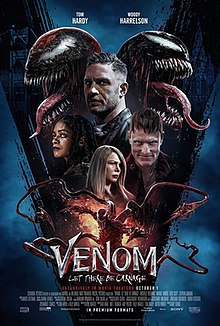
Venom: Let There Be Carnage

Eddie Brock (Tom Hardy) is still learning how to live as a host to alien symbiote Venom, but a visit to an obsessed imprisoned serial killer leads to another symbiote on the loose that the duo must face.

The first Venom movie has a mixed reputation — it’s hated by critics thought it was a box office success and fans enjoyed the relationship between Eddie and Venom. The sequel understands what some fans enjoyed about the first film and leans even more into the silliness of that dynamic. Unfortunately, it carries with it everything that made the first film one of the worst superhero movies in recent years. The dialogue is horrendous — there are a few good jokes here and there but every time every time a plot point needs explaining or the villains open their mouth, you can’t take it seriously at all. And every time the symbiote Venom opens his mouth, his lines are incredibly bland and annoying. For a cast led by four Oscar nominees, nobody does a remotely memorable job, though Hardy looks like he’s enjoying himself more this time. Woody Harrelson as Cletus Kasady could’ve been a darkly hysterical psychopath of a killer, but instead he feels like his character’s twin brother in Now You See Me 2, meaning his performance is truly unbearable. Naomie Harris is also at her worst as Shriek, Kasady’s girlfriend from his teen years who he hasn’t seen in decades but they’re still madly in love. Even the humor often dives from funny into purely cringeworthy territory as the jokes don’t feel more thought out, just Tom Hardy goofing around with 2 different voices.

The action and editing are a mess, with nonstop cuts and dark lighting that prevents you from truly grasping onto the set pieces without laughing at everything that’s going on. The CGI also doesn’t feel so smooth though the design of Carnage is great — the character itself, though, is poorly utilized and we barely get to see him fight Venom or understand what makes him a unique symbiote and fan favorite comic-book villain. There’s no reason viewers would remember him or why he’d strike fear into the audience’s heads like he does with the characters in the film — he’s just a bad symbiote like Riot in the first movie. Considering director Andy Serkis has created some of the most interesting CGI characters of all time, it makes no sense for him to create something as haphazard and painful as this. In terms of conflict, there’s no interesting build of stakes or threat, and in terms of internal conflict for our hero, it’s literally just “Eddie and Venom have to fight less and get along more and Venom needs to eat bad guys but not good guys”.

Visually, script-wise, and tonally, Venom: Let There Be Carnage doesn’t have itself figured out, just like the bro-mance at the center of the film. Though the post-credits scene is worth staying for, the movie as a whole proves why these films can’t latch onto viewers as well as a symbiote like Venom latches onto its host Eddie.

Venom Let There Be Carnage poster.jpg

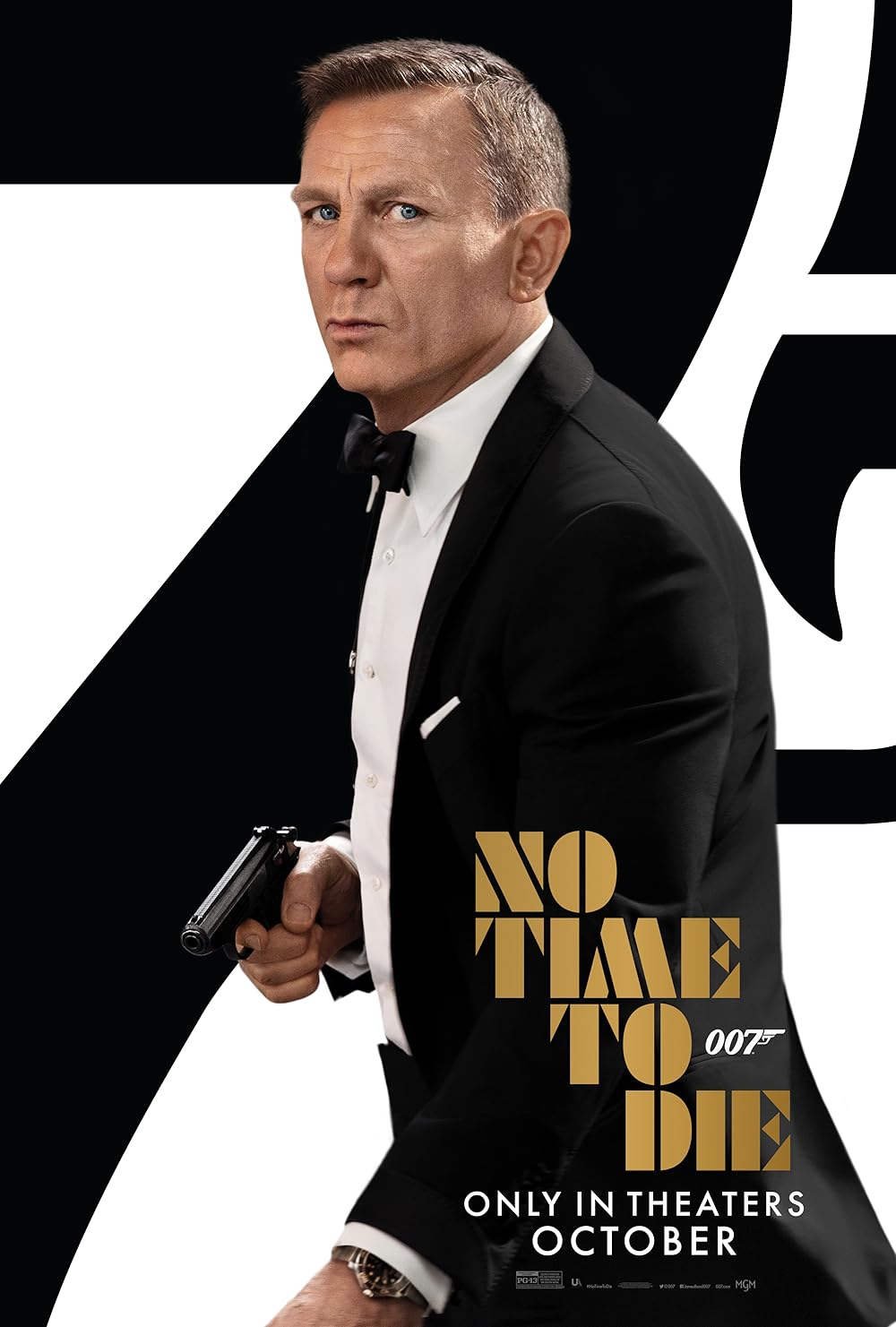
No Time to Die

No Time to Die is the final film starring Daniel Craig as James Bond, a 5-film arc that has elevated the hero in popularity and audience reception and resonance. The movie is a solid theater experience and a strong conclusion to the character’s arc, though it doesn’t live up to Casino Royale and Skyfall, two perfect action movies in my books. The action is large, loud, and often exciting, though there isn’t a single set piece as memorable as the ones from the aforementioned films. Craig delivers his deepest performance in the series though, showing a Bond with a damaged past and an uncertain vulnerability in his character’s future. Another standout is Lashana Lynch as Nomi, the new 007 since Bond’s retirement who accompanies Bond on his missions in the film. She stands up to him in terms of competitiveness and heroism and their dynamic as well as her presence makes the film great. However, I wish she had been given more to do emotionally which could have elevated the film. Most of the emotional core comes from Craig’s romance with Lea Seydoux but it felt like they spent slightly too much time on it, though once you see the entire picture with what they were trying to convey, it makes sense. Ana de Armas, another badass who shares action scenes with Craig, is criminally underused which is surprising for an A-list, Golden Globe nominee who’s proven her talent in films like Blade Runner 2049 and Knives Out — I only wish the script utilized her enjoyable, vivacious character more. Rami Malek does a strong job acting evil and menacing but his motive feels incredibly insufficient, and he’s absent for long periods of the film which doesn’t help build up the stakes strongly. The movie uses some cliches like a deadly biological weapon and a genocidal villain, but the best villain of these films remains Silva from Skyfall, as he wasn’t only evil but had a serious vendetta and felt like a cautionary tale about what our hero could become. It’s problematic that although Malek’s character’s past is shown to be damaged, his motives to do harm on millions is basically unexplained and that he isn’t in the movie as much as one would do. Supporting players such as Ben Whishaw, Naomie Harris, and Jeffrey Wright do very well though, as well as Christoph Waltz reprising his role as Blofeld, the villain from the last movie Spectre. There’s also a lot of downtime in the second act without action that could’ve been shortened No Time to Die makes for a huge, theaters-worthy conclusion for Bond fans, action fans and Craig fans alike, it’s just that some of the character motives and plot points fall short and the story doesn’t overall constitute the best of the saga.

No Time to Die (2021) - IMDb

Shang-Chi and the Legend of the Ten Rings

Shang-Chi is forced to confront his past after being drawn into the Ten Rings organization, led by his father who trained him to become a deadly Kung Fu master from the day he was born.

Shang-Chi and the Legend of the Ten Rings achieves the difficult task a new hero to an already enormous cinematic universe while still feeling as exciting and unpredictable as some of the past outings. The settings, characters and conflict are inviting, especially the vigorous execution from director Destin Daniel Cretton (whose previous movies Short Term 12 and Just Mercy I highly recommend). The action is dynamic with scale that ranges from martial arts on a bus to fantastical battles with ancient superpowers, and sets that range from San Francisco to China. The film clearly took inspiration from the practical martial arts days of Jackie Chan, and the passionate fights of Crouching Tiger, Hidden Dragon. The music, including the excellent score and solid hip-hop soundtrack choices, also adds a lot to the film’s pace and globe-trotting adventure, reminiscent of the modern, colorful nature of Black Panther that also brought elements of ancient culture to its production design. And similar to that film’s effect on black representation and culture, Shang-Chi marks the first time an Asian main character gets their due in an action movie of this proportion, but there are badasses alongside the hero as well, including strong women in power whose place in the fight is never questioned. Simu Liu immediately fits perfectly into the roster of MCU heroes, delivering a well-rounded hero who’s journey you love to follow along. Liu excellently balances charisma and heart that makes you embrace Shang-Chi in a humanly way, with the pain and difficult decisions that comes with the character’s traumatic past. The family dynamic elevates the conflict and Tony Leung’s portrayal of his power-hungry father is ruthless, a character who’s mere presence makes you feel fear and distrust, yet you see his perspective that sends him on this destructive path that sees many hurt. Awkwafina, who’s worked magic almost every time she’s in front of the screen, is not just wonderful comic relief but a loving best friend whose chemistry with Liu makes the runtime interesting. Michelle Yeoh also adds plenty to the film in a key role in the film.

With every Marvel movie, the studio proves that they can reach wide audiences with their large budgets and marketing, but more than that, their heart and entertainment, and this movie has plenty. It’s also helpful that unlike Black Widow, this movie is set in the present day chronologically — so stay free of spoilers because Marvel loves throwing in some surprises, and boy do they pay off! Though a few moments of green screen are noticable and some of the exposition has tedious moments, Shang-Chi’s fast paced adventure of self-discovery, with emotional stakes and action that mixes modern and mythical feelings, presents a fun mix of action, comedy and emotion with great sound editing, fantasy and sets in addition to likable protagonists and formidable foes. By the end I felt on the edge of my seat, unsure of what will happen to the characters because of the stakes and surprises that are presented. Marvel once again brings theater-worthy fun to the screen that all ages can love and eventually rewatch along with the rest of their library.

Shang-Chi and the Legend of the Ten Rings poster.jpeg

Free Guy

Guy, a background character in a videogame called Free City, learns the truth about his existence and must race against time to save his world and reclaim his free will.

It seems that with Free Guy, Ryan Reynolds has finally found a movie that lives up to his comedic skills outside of the Deadpool franchise. Reynolds makes the movie infinitely better with his exaggerated reactions, unpredictable and irreverent self-awareness and pop culture analogies, as well as a sense of purity to his character that isn’t seen in his raunchier, more morally ambiguous portrayal of Deadpool. Meanwhile, this movie has a PG-13 rating yet this movie finds its audience and the humor lands most of the time. He has plenty of charisma and humor that carries the story and action but also not overkill where it compromises his character development. Jodie Comer is also wonderful as a female badass who isn’t a traditional “female sidekick and love interest to the male lead”, yet she’s actually the protagonist of the story as much as Reynolds in the best way. Joe Keery also has much time to shine, he’s very famous as Steve in Stranger Things, and just as lovable here. Lil Rel Howery is excellent comedic relief and best friend material everywhere he appears, and Taika Waititi takes a role that in the script would’ve looked incredibly cheesy and hard to stand, and with his delivery, makes the part an irresistible, hilarious part that was perfect for him. I had the same feeling with Reynolds, the role would’ve been much worse with another A-list funny action star.

Reynolds producing and starring gives the movie the perfect opportunity to be meta and let loose on pop culture references and self-aware jokes. Unlike Space Jam: A New Legacy, however, it never descends into immaturity and nonsense, instead embracing its stars talents instead of overly relying on effects. It also takes time to comment on the violent nature of Grand Theft Auto and similar videogames, as well as our obsession with hyperreality and simulated reality like Ready Player One did. The movie’s heartfelt side also asks us to use our humanity for empathy and connecting with other humans more. Believe me, it sounds cheesy but it’s delivered with plenty of heart, as well as themes about free will, the potential of AI, and being more than what people expect of you. The depiction of the world inside the videogame is colorful and lively and feels like a great live-action companion to Wreck-It Ralph, making you think about what such a world would be like in live-action, striking the perfect balance between letting the audience indulge in the silliness but always retaining heart and fun. The movie sometimes hits similar beats to other mainstream other action comedies, and you may be reminded of elements of similar films but it never lets the familiarity get the best of it. Free Guy flourishes when utilizing the loose, free-spirited edge to the humor, story, and characters, including hilarious editing and some unforgettable cameos that had my audience hysterical in the theater and are too brilliant to spoil. While it’s not a must-watch, it’s a great theater experience that makes the best of its potential and talents. It’s especially great to watch Ryan Reynolds and crew have a clearly awesome time starring in and making this entertaining movie that put a smile on my face and never sacrifices the insane visuals for a good story and time that like Deadpool, knows it’s very out there but is always on the audience’s side and never gets too cheesy for its own good.

Free Guy 2021 Poster.jpg

The Suicide Squad

Supervillains Harley Quinn, Bloodsport, Peacemaker and many other of the most notorious villains from the DC Universe are recruited by Amanda Waller to join a mission to liberate the South American island of Corto Maltese from a murderous regime that’s conducting shady experiments. In, exchange the villains get 10 years off their prison sentences if they successfully complete the mission, but if they fail, they’re dead.

DC’s ambitious 2016 endeavor Suicide Squad was a massive failure and disappointment that’s easily at the bottom of the DC Extended Universe ranking when discussing quality. This new sequel, written and directed by James Gunn, the man behind the Guardians of the Galaxy films, is without a doubt at the top of that ranking. The Suicide Squad does its brilliant concept justice this time, throwing away everything that didn’t work about the original and acting as a hilarious, goofy, energetic action-packed wonder that stands beautifully on its own. While the first film aimed to be goofy and comedic, it still had this dark, gritty edge to it which it struggled to balance with a PG-13 rating and fantastical, world-ending conflicts. This movie is colorful and indulges in the goofiness without ever taking itself seriously, yet the characters and story hit home further. The action set pieces are memorable and the R rating helps this movie fully realize its potential with balls-to-the-wall, cartoonish violence that fits with the twisted nature of the characters while still injecting humor and fun through the R rated violence and jokes. The movie also diverges from many superhero movie tropes by focusing less on the huge fantastical concepts and letting you know that nobody is safe.

The characters in this film are even sillier than in the first movie, and some even viler, but the movie makes them incredibly fun and lively to watch, even when there’s carnage to behold. There’s no way you can get enough of Margot Robbie as Harley Quinn — she adds so much to the movie and both this and Birds of Prey have made the style as insane as her, to make her this psychotic yet somehow lovable and exciting protagonist in the most awesome way. However, the other cast members’ work rival hers here. Idris Elba can do no wrong as Bloodsport and he has some great banter with John Cena’s Peacemaker — they’re both very foul people but have some of the best moments of the movie. Joel Kinnaman also has some memorable moments this time as Rick Flag, and Viola Davis plays the menacing Amanda Waller who is trying to make the Suicide Squad do some good but may be more hatable than all the actual criminals in the film — which is a testament to Davis’ terrific casting and presence. A standout has to be Ratcatcher 2, played by Daniela Melchior who gives the movie lots of heart and empathy. Like I said before, the movie continuously embraces the ridiculousness it presents without trying to put a “sane” lens onto it, as shown with wild concepts like characters named Polka-Dot Man and King Shark (a talking shark voiced by Sylvester Stallone). James Gunn’s direction adds a twisted comedy yet so much care for the story and the people in it while not trying to contribute to the bigger DC universe with forced sequel setups which we’ve seen plenty of lately. From the eye-popping action set pieces to the daring style to the standalone nature of the story, it stands out not just as a great comic book movie but as a great movie, period.

The Suicide Squad shows what the DC universe can do when it gives filmmakers full creative freedom and don’t take themselves too seriously. Even with other R-rated superhero comedies like Deadpool around, The Suicide Squad feels really fresh and with the success of Joker and the entertaining Birds of Prey, DC has been figuring out how to make some gems that stand well on their own while differentiating themselves from Marvel and other superhero iterations.

The Suicide Squad official poster.jpeg

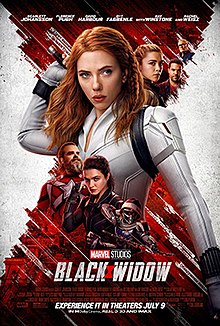
Black Widow

Set in between the events of Captain America: Civil War and Avengers: Infinity War, Natasha Romanoff, on the run from the law, encounters friends and enemies from her past as she confronts her dark origins.

With the return of theaters, it’s so exciting to see a Marvel movie again on the big screen, a whole two years after the last one, Spider-Man: Far From Home. The action, set around the globe from Cuba to Budapest, is exciting and more grounded than other MCU films. It focuses less on superhuman or fantastical abilities and more on the grit and hand-to-hand combat, along the lines of spy films like Jason Bourne and Atomic Blonde. The fights have lots of impact and feel nail-biting — there’s only a few weird moments of slo-mo that weren’t needed. Scarlett Johansson never lets us forget why she’s such a beloved actress and Avenger, and Natasha’s spirit is ever present as personal revelations about her surface. It’s really great to see her front and center, headlining her own film, but it feels like it should’ve been released back in 2017, in between the films it was set. In a cinematic universe all about bringing in connections from past films and setting up future ones, it feels weird to ask the audience to dial their brain back only a few years to an era we already passed where films like Spider-Man: Homecoming and Black Panther are set. What requires even more suspension of disbelief is the fact that we know where Natasha’s journey leads afterwards in Infinity War, and ultimately ends in Endgame. However, that doesn’t completely sink the film’s quality and consistent enjoyment factor, from the get-go with an exciting opening action scene. The visuals consistently stand out, which was enhanced for me by the 3D experience, and the pacing is also strong for a film that’s 2 hours and 14 minutes.

Florence Pugh is the highlight of the film, bringing her fantastic acting chops to the emotion and heart of the film, and shares some wonderful scenes with Johansson as well as David Harbour and Rachel Weisz, who form Nat’s makeshift family. Pugh and Harbour bring their already respected reputations with them, but reinvent themselves with memorable, humorous and heartfelt roles, though Weisz is worth mentioning too. My main issues are mostly minor, but the themes aren’t often as emphasized as in other MCU films, which is a shame, and the progression of the plot isn’t as strong either. It isn’t Black Widow’s best appearance, don’t go in expecting The Winter Soldier, Civil War or Endgame, but better late than never to have her as the lead in her own film. The villain are also very uninteresting, and though he does the job to motivate our hero, Ray Winstone’s performance is very one-dimensional. His sidekick, however, Taskmaster, is a very intimidating presence who’s great to watch. It’s overall not top-tier Marvel material, but still a satisfying standalone film that utilizes its tone, action set pieces, and cast well, and worth the theatrical experience, as always, stay seated for the credits and enjoy and intriguing post-credits scene.

Black Widow (2021 film) poster.jpg

Luca

Set in a beautiful seaside town on the Italian Riviera, Luca shares an adventurous summer with his newfound best friend, but all the fun is threatened by a deeply-held secret: he is a sea monster from another world just below the water’s surface.

Luca proves that Pixar’s stories are always rooted in family appeal, charm, and emotional truth. Though it’s not as revelatory as Inside Out, Coco, and Soul, it would be unfair to dismiss it solely for that reason. It provides a sweet story about differences and compassion, though that may be the main aspect that draws similarities to other animated films like Finding Nemo and The Little Mermaid, especially the idea of a young character wanting to leave the nest to the disapproval of an overprotective parent. The strongest aspect of the story is the innocence of the main characters, such as their friendships, heart, and aspirations. The purity of childhood is beautifully depicted and draws parallels to the feels of old Italian cinema. Jacob Tremblay and Jack Dylan Grazer deliver great voice performances and their parts’ friendship beautifully anchors the story. Maya Rudolph, who was also wonderful in the 2021 Netflix animated film The Mitchells vs the Machines, seems to never do wrong and here plays Luca’s sea creature mother. Be on the lookout for a special voice cameo in the first act from a beloved star that you may or may not miss. The characters are ones to root for, and their wonder and awe of the world around them is such a fun part. Whenever Luca must face his fears, he goes “Silenzio, Bruno!” to silence the voice inside of him that tells him he can’t, a relatable message for all of his. The animation of the Italian settings is terrific, although the character designs feel more 2-dimensional than Pixar’s previous films. The musical score by Dan Romer is the highlight of the productional values and even warrants an Oscar nomination if you ask me. The movie keeps bringing new situations, sometimes obstacles they must face and sometimes humor — both situations and details off to the side that will make you laugh. Ultimately at all culminates in another heartwarming story that feels exactly like what we all need right now — no matter your age — presenting many themes to children in a positive light that won’t ever feel exclusively for kids either, as Pixar excels at making stories that fit every audience’s desires without exception.

Luca (2021 film).png

F9

Dominic Toretto is leading a quiet life off the grid with Letty and his son, little Brian, but a new threat will force Dom to confront the sins of his past to save those he loves most. His crew joins together to stop a world-shattering plot led by the most skilled assassin and high-performance driver they’ve ever encountered: a man who also happens to be Dom’s forsaken brother, Jakob.

F9 will fulfill the fans and audience’s expectations of adrenaline-pumping, large-scale action the franchise delivers. But is it enough this time around? The answer is — the movie is best when focused on the action set pieces and excitement, but the theatrical experience is strictly needed. And the Fast & Furious saga was built just for that. Justin Lin, who directs for the franchise for the fifth time, understands the massive grandeur necessary to experience the action. He directs expensive, impressive stunts that will get you excited — when you don’t think about how they obey the laws of physics. He also brings back the comedic, irreverent sense these films need which I don’t think Hobbs & Shaw managed to nail without becoming too parodical. The comic relief in this series has always been Tyrese Gibson and Ludacris as Roman and Tej and they give so much to this movie with their humorous banter. However, it’s the villains that bring the fun to a halt. Charlize Theron, who’s normally one of my favorite actors, is terrible once again as Cipher, but at least in the last one she was imposing and raised the stakes — here she does almost nothing. John Cena’s performance also didn’t work for me — and neither did lots of the supporting cast shoehorned in from previous films. The villains’ plans and objectives are also boring and not treated with enough care for the audience to even feel like there is a real possibility of danger. Tej and Roman even comment on the fact that after all they’ve been through in these films, they feel “invincible”. And whenever the movie tries to connect to predecessors and tie up “loose” ends with exposition, it feels incredibly heavy-handed and unfitting, and often just there as fan service, especially a certain character who is brought back. This excessive use of flashbacks feels like a pause in the story rather than world-building as the movie believes it is.

F9 continues the growing expansion of the series which started as films about street racing into what they are now, enormous, expensive superhero movies. Logic has been thrown out the window for a lot of the action sequences in this movie, but Lin treads the line between practicality and splendor to keep the audience there with the nail-biting and excitement he wants to deliver. And as said before, the comedy is very important here and he handles that well too. Whenever the script inevitably takes itself seriously at times, though, with big twists and tiring cliches, it becomes a checklist of a formula that the series keeps repeating. The franchise’s reputation has given fans room to laugh both with and at the story, but that’s only excusable with a series that has evolved so expeditiously without truly alienating any demographic of moviegoers. The first 30 minutes are genuinely great and the action gets the audience going and laughing, and the loud action throughout will get you excited, it’s just the series’ character development that feels like it’s given up on truly reinventing the wheel. After all, the saga is notorious for Vin Diesel’s “family” mottos. Although its mostly what you’d expect from this franchise, perhaps for the Fast Saga, that may as well be enough — especially when the scale keeps aiming higher and in a consistent direction that graps onto what its audiences want from an enormous, irreverent theatrical experience like this.

F9 film poster.jpg

Cruella

Cruella dives into the origins of the infamous 101 Dalmatians antagonist. Emma Stone is seriously great as the lead and another reason to praise the actress as well as the seemingly impeccable casting directors at Disney. Her performance is charming, unpredictable, and twisted. Though she is notoriously an insane criminal and dog-killer, she is likable in comparison to the other big Emma of the film. Emma Thompson plays a ruthless, egomaniacal fashion designer whose absolutely repulsive without a single redeeming quality. Her repugnance reminded me of Meryl Streep’s Miranda Priestly in The Devil Wears Prada, another evil, sadistic, fashion designer. Thompson portrays this narcissism and wickedness well, and the movie does a mostly good job, aside from a few lines, keeping her out of cartoonish territory. The relationship between the Emmas onscreen is easily a gripping anchor for the film’s story. Two other standouts are Cruella’s loyal surrogate brothers and sidekicks, played by Joel Fry and Paul Walter Hauser. My favorite was especially Hauser, who is much more comedic (and British) than his other popular turns in films like I, Tonya, Richard Jewell and Da 5 Bloods, and nails every moment he’s on screen. As a fan of his, I was especially glad to see him be in a film with a wide audience like a Disney film.

Cruella‘s script manages to, for most of the runtime, distance itself from the famous story it’s inspired by, despite a few nods and a shoehorned post-credits scene thrown in for the Disney hardcore fans. It feels very much like a Craig Gillespie movie — like his previous film I, Tonya, it’s a fast-paced chronicle of a morally ambiguous woman’s journey into such obscurity. However, it’s the hyper-stylistic approach that’s most detrimental to the film. The soundtrack is a nonstop barrage of rock music with no room for silence or drama, with one popular rock song after the other, and the music choices being frankly on the nose and unoriginal (seriously, why do so many films use “Sympathy for the Devil” by The Rolling Stones?). Had the style kept some of this energy but toned it down to make scenes feel less fluffy and more dramatic for its villain, the movie would’ve resonated more. With such gorgeous production design and costumes that made me awe (and trust me, I don’t always notice beauty in costume design like I did in this film), as well as solid acting and writing, why didn’t Disney trust its audiences to stay engaged from these elements instead of throwing in popular music every second? There’s also a little too much narration for my taste, and you can tell this took inspiration from Scorsese’s hyper-style he trademarked with Goodfellas and The Wolf of Wall Street — a style at least one big movie a year feels the urge to adapt. The movie’s script is best when it follows the psychotic nature of Cruella and her descent into darkness, which Stone wonderfully portrays and is the most intriguing part of the film. It’s also enjoyable to point out the similarities between Cruella and other popular solo movie villains like Joker and Harley Quinn (who headlined the considerably entertaining Birds of Prey), I only wish this movie embraced what worked so much about those two aforementioned films’ approach to their villains. And that’s not saying they should have gotten rid of the energy and fast pace — which does work once Estella becomes Cruella — just give the darker, more unpredictable moments of Stone’s performance room to breathe rather than be edited like a fun heist sequence from an Ocean’s Eleven movie. There’s also a few iffy moments of CGI, including the dogs and a scene involving water, that made me cringe. Cruella is entertaining, fashionable, and has fun with its concept, but feels boxed in by a soundtrack poorly edited into the film that weakens the impact of certain scenes and connections to the original IP that feel thrown in just to check boxes on a studio checklist. Those who are interested will enjoy it, as it’s certainly a good time that’s carried well by its cast, especially the insanity conveyed by Stone, but I feel like there was potential for a stronger film in the editing room.

Cruella 2021 film poster.jpg