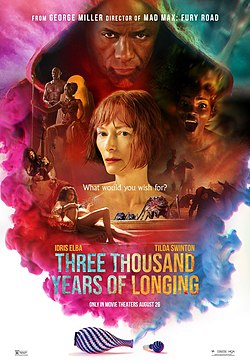
A lonely scholar, on a trip to Istanbul, discovers a Djinn who offers her three wishes in exchange for his freedom.
George Miller’s first film since Mad Max: Fury Road allows him to let loose as expected, but doesn’t feel as rewarding as it could have. Tilda Swinton shines in a more fun, likable role than some of her more “chameleon”-like performances, and Idris Elba is great as a Djinn tasked with most of the film’s dialogue and monologues. The production design is also very noteworthy as is the score by Tom Holkenberg, easily his best music for a film since Fury Road. However, the CGI doesn’t look as grand or convincing as it attempts to be and could’ve used some more work.
Though Swinton and Elba’s conversations about how all the ways wishes could go wrong are interesting, the stories Elba tells about his past don’t feel as powerful or intricate as the film wants you to believe. The third act feels an abrupt turn of events and certainly drags, in a way feeling anticlimactic. Upon digging, Miller has a lot of interesting things to say, whether it be about longing, imagination, or love, but he doesn’t explore them deeply enough to deliver that unexpected blow of catharsis and fulfillment that the ending wants you to experience. Perhaps this is one film that constitutes a rewatch, but only certain parts feel inviting to revisit, while others, I feel I’d simply skip over if I ever saw this film again. It’s certainly bold and like nothing that’s come out this year, and its ambition is worth commending, but for most, this isn’t worth rushing to theaters to watch.
Thor enlists the help of Valkyrie, Korg and ex-girlfriend Jane Foster to fight Gorr the God Butcher, who intends to make the gods extinct.
Taika Waititi brings his signature laugh out loud humor and energetic storytelling style to Love and Thunder, as well as playing the lovable rock giant Korg who’s become Thor’s sidekick of sorts. Chris Hemsworth is as always having lots of fun, and Natalie Portman returns as his old flame Jane, who accompanies him along with Valkyrie (Tessa Thompson kills it as always though her character doesn’t get as personal as Thor and Jane do) on the film’s journey. Russell Crowe is also quite funny as Zeus, and expect some great celebrity cameos as well. The standout though is definitely Christian Bale as the villain. He gets to go all out with his performance as Gorr the God Butcher, and his motivations make sense as well as his weapons and planets seeming cool, though I would’ve added a little more screentime with the character because in a way he’s still underutilized compared to the heroes. But also worth mentioning is the memorable soundtrack that gives the film a lot of life — and Guns N Roses hits.
Though Waititi’s style now feels synonymous with Thor’s solo journey, it also feels like the saving grace of the movie that Taika’s at the director’s chair. Since Thor’s already gone through most of his meaningful development from his first movie unto Endgame, there isn’t much left to develop with him and the movie is best enjoyed as a Waititi adventure comedy as a result. It’s also not as smooth or funny as Ragnarok, and the director’s weakest film yet. The script feels rushed and slowed down in the wrong places and certain nuances feel underdeveloped — a few more minutes of runtime wouldn’t have hurt. The final battle is also visually uninteresting though conceptually fun, the location and lighting of the action feels anything but exciting. Thor and Jane’s romantic chemistry is sweet but also nowhere near as natural of a pairing as Tom Holland and Zendaya in Spider-Man or Robert Downey Jr. and Gwyneth Paltrow in the Iron Man movies. It also feels like Thor’s journey concluded more naturally with Endgame, and as an epilogue to his story it serves the character fine, but I think Marvel should close his arc here because it feels like all of Thor’s most memorable moments and growths are in the past.
Thor: Love and Thunder is a solid 2 hours of fun visuals and laughs, though it feels like the character’s story is being stretched a little past its breaking point, go for the enjoyment and cast, especially Christian Bale’s villanous performance.
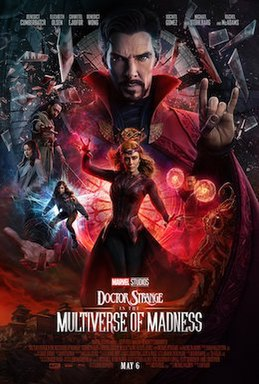
Doctor Strange encounters multiversal threats once again as he goes on a journey across realities with America Chavez, Wong, and Wanda Maximoff.
This sequel certainly lives up to the madness part of its title by providing a journey of visual marvel throughout alternate universes, a concept that’s been set up in other Marvel properties like Loki and Spider-Man: No Way Home but is explored here in full effect. Sam Raimi’s direction provides what feels like a true creative vision, including amazing, adventurous grandeur and use of CGI as well as some horror undertones in certain scenes that is some of the darkest a Marvel Cinematic Universe film has gotten. But to add to that, there’s genuine excitement and thrills to be found in nearly every frame — the pacing is fast and wastes no time doing anything but moving the story forward. Benedict Cumberbatch does a great job as the witty Strange but also some of his more unhinged variants from other universes. Elizabeth Olsen, who was Emmy and Golden Globe nominated for her performance in WandaVision — which I’d call a required watch to understand the events of this film — continues her journey into Wanda’s darker side and wonderfully delivers the pain she experiences and the empathy she conveys with the audience even when her inability to properly grieve from the events of Avengers: Infinity War has gotten people hurt. Together with the preceding show, Olsen creates one of the most tragic and powerful performances in the MCU. Xochitl Gomez is a lovely addition to the franchise as the young America Chavez, who shares a lot of fun scenes with Cumberbatch.
With the vast possibilities of alternate realities comes lots of excitement as to what could happen, as well as genuine thrills and suspense weaved within the many magical rules of the world of the Sorcerer Supreme and the Scarlet Witch. Sam Raimi goes back to his horror roots with some of the dark undertones in certain scenes, that still blend in well with the cheerful and wondrous MCU tone we’re used to. The one thing that gets lost within the gigantic adventure is Strange’s own character arc — Strange’s growth through the film as an actual person has the right setup, but the payoff feels underwhelming and his internal journey needed more of a through line, which was felt more in his first solo movie. Chiwetel Ejiofor is fun to see as Mordo but his inclusion feels haphazard and incomplete. It’s also easy to get lost within all the explanations and world-hopping events that require some attention, with some exposition that ends up being unnecessary. Ultimately though, Doctor Strange in the Multiverse of Madness is one of the most creatively rewarding MCU films in a while, though not the most emotional, funny or heartfelt, it’s filled with moments of edge-of-your-seat action, epic imagination, breathtaking visuals, campy horror, and insanity that have to be experienced in a theater, creating a sensory overload like no other superhero movie or blockbuster.
Newt Scamander and crew join Albus Dumbledore in a quest to stop the evil Gellert Grindelwald from taking control of the entire Wizarding World and starting a war between wizards and Muggles.
Though the Harry Potter films have a fanbase that will stay strong for generations to come, the Fantastic Beasts films yet again fail to capture that same magic, and by now it feels like they’re not even trying to. The strengths still come in its production value and cast — the production design is very impressive and the musical score is top-notch. The cast is sufficient, especially Eddie Redmayne as Newt Scamander who was perfectly cast in the role. His bond with the titular beasts is very touching and gives the films an arc of compassion and heart. Jude Law also gives lots of nuance to the younger Dumbledore as his conflict with Grindelwald is explored deeper. Mads Mikkelsen also gives his fair share of menace and is much better than Johnny Depp, who came off as annoying in the last film. However, this is Jessica Williams’s first time as a lead in this film and she steals her scenes. Her charisma and energy are on another level and she’s going to be recognized by more audiences after this role, hopefully. However, Ezra Miller’s performance is still irritating, and feels rather deadpan and directionless. I don’t appreciate them giving Miller’s character so much screen time when they instead could’ve emphasized Katherine Waterson or Zoe Kravitz as main characters in this series (though Waterson still appears in a minor role).
The first one, though not amazing, still had its fair share of charm and excitement, but the following two installments became needlessly slow and gloomy when the Wizarding World thrives on being touching and cheerful; even in the darker Potter installments, the story is rooted in friendships and themes of goodness and courage. Thematically, these films suffer from a lack of direction in comparison. Though The Secrets of Dumbledore is a big improvement over The Crimes of Grindelwald, it still suffers from the same tonal issues, like feeling too much like a slow-burn drama for its own good and lacking thrills. The movie’s climactic battle is fairly thrilling but the buildup isn’t strong enough to give us much payoff. Where Warner Bros. really messed up here is writing this as a series of five films instead of a trilogy. The last 2 movies in the franchise were very dragged out and unrewarding from a story perspective and this way of pacing the story is costing the films a lot of excitement and coherence. The Harry Potter films were 8 movies and even the less eventful installments are memorable because of the nuances and world-building, but times have changed and having the same story and villain for five movies isn’t something audiences are looking for, as blockbuster films need to feel like a rewarding event when people buy a ticket — and here it’s once again evident that they should’ve stuck to the original plan and kept it at three films.
Though the potential for an exciting story and conflict are there, Fantastic Beasts: The Secrets of Dumbledore suffers from pacing and tonal issues that Wizarding World fans may be able to ignore for fantastical visuals and some strong performances, but it can’t bring the stakes and direction to the level such an epic-scale story needs to hit home.
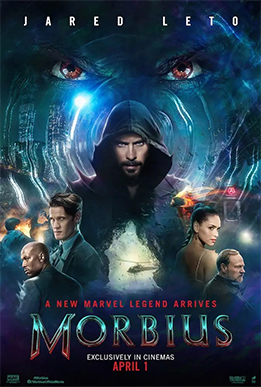
Biochemist Michael Morbius tries to cure himself of a rare blood disease that has rendered him handicapped his entire life, but he inadvertently infects himself with a form of vampirism instead and must fight for control of himself.
After lots of delays and unconvincing trailers, Morbius pulls off the impossible — it’s even worse than expected. It’s one of the worst superhero films to date and one of the worst films I’ve ever seen in a movie theater. Academy Award winner Jared Leto continues a streak of subpar acting choices with a miscast, creepy turn as Michael Morbius, who’s supposed to be a social outcast doctor turned hero the way Benedict Cumberbatch so convincingly was in Doctor Strange, but Leto brings forth no charm or charisma and actually comes off as an unlikable hero who’s distant from the audience for the whole runtime. Matt Smith also delivers a horrible performance with a character you can’t stand and whose every move is predictable. Adria Arjona and Jared Harris try their best but are stuck with poor writing that doesn’t serve their skills or characters any well. Speaking of which, the characters’ morals, decisions, and conflicts feel so hollow they’re almost non-existent and simply there to check off boxes on the list of superhero origin clichés.
The movie attempts to be darker than the Marvel Cinematic Universe films in the main Tom Holland Spider-Man continuity, but unlike The Batman, another dark superhero film this year, Morbius has no energy, tone or clear objective to exist. The CGI makes the fights hard to watch, especially the vampire look and powers which look like images from a video game. The action is done in a way where it’s impossible to tell what’s going on and the lighting and score are dark and gloomy, sucking any life out of this sad movie that feels more like a first-draft concept idea than an actual movie made for an audience’s entertainment. But it’s not only embarrassingly bad to watch — it commits the unforgivable sin of being boring. Although at 1 hour and 44 minutes, it’s one of Marvel’s shortest movies ever, it feels so much slower than any other superhero film and I was begging for it to end. There comes a point where even when you find yourself drifting off and the movie has become beyond saving, it still finds a way to outdo itself and become simply unbearable and laughable in the final act. Even the bland Venom movies (which are set in the same universe as Morbius) have had aspects to offer some fans of the source material, but to any fans of comic-book movies, vampire movies, or just good movies, please spare yourself — the only thing you’ll get out of this movie is the desire to forget it immediately after you watch it.
Mei Lee is a 13-year-old girl who is torn between being her mother’s obedient daughter and the chaos of her youth. As if that were not enough, when she gets too excited, she turns into a big red panda.
Turning Red has some surprisingly mature undertones but manages to be witty and charming in its execution just enough to please youngsters, as all Pixar’s films find the balance to do. Director Domee Shi gives the film imaginative visuals and unique use of culture for an animated film. Rosalie Chiang shies in her first ever voice performance as Mei, and Sandra Oh proves herself a fantastic voice actress as her mother Ming, who embodies the mother who expects big things of her daughter but forgets to let her live a life of her own, which may be exactly what her character did in another Disney movie, Raya and the Last Dragon. The movie portrays youth in a lively way that involves the frights of adolescence, and the journeys of growing up with your friends and being obsessed with boy bands with them, for some. This leads to a lot of charm from the youthful side of the film, as well some some wit in the execution and the way the music ties into the film’s mood. Ludwig Goransson of Black Panther, Creed and Tenet fame again proves himself one of the most exciting film composers, and Billie Eilish and Finneas contribute to the lyrics of the fictional boy band 4*Town’s songs. This coming-of-age fantasy comedy doesn’t rank among Pixar’s stronger works but it proves that they’re still at the top of their game with new ways to bring sweet, relatable themes to the screen, in this case about loving your family while staying true to yourself, and embracing your flaws whether that be anxiety or rebelliousness.
Spider-Man: No Way Home leaves off right after the previous movie, Far From Home, in which Mysterio exposed Spider-Man’s identity as Peter Parker to the world, which has repercussions on Peter’s life as well as his loved ones. He goes to Doctor Strange in an attempt to reverse it, but when a spell goes wrong, villains from other universes — and previous Spider-Man films — emerge and wreak havoc across the multiverse.
After the post-credits scene of the last movie, No Way Home by concept already had immense potential. Marvel Studios decided, however, to up the scale for the Spider-Man series and make it the most exciting film led by the web-slinger yet, by bringing in fantastical aspects and past franchises of the character. Jon Watts takes the style and tone of Homecoming and Far From Home and keeps the heart and lovability of the films but also makes this the darkest and most intense Spider-Man movie yet, with genuinely heart-pounding stakes and characters the audience is invested in. The threats span across multiple realities yet some of the internal conflicts have relatable roots, such as applying to college. Tom Holland’s character’s arc takes mature directions but he’s supported by a great ensemble too. Zendaya and especially Jacob Batalon are hilarious as Peter’s girlfriend and best friend, respectively. The three play off each other wonderfully and are a terrific anchor for the trilogy. Benedict Cumberbatch is great as the no-nonsense Doctor Strange and Marisa Tomei has her most substantial role yet as Aunt May. Actors also return from previous Spidey franchises, including Willem Dafoe and Alfred Molina from the Raimi films starring Tobey Maguire, and Jamie Foxx as Electro from the Amazing Spider-Man films with Andrew Garfield. Dafoe is especially a scene stealer as Green Goblin, reprising the role after nearly 20 years, and the return of Doctor Octopus makes for a great action scene as well. The story, action, and execution up themselves and there are plenty of exciting moments that necessitate a theatrical viewing with an audience. There’s also plenty of surprises, so make sure to be careful with spoilers before seeing this one. There are a few iffy moments in terms of CGI and green screen but they’re redeemed by cool character designs and suits, as well as great fantastical visuals including the Mirror Dimension from Doctor Strange. The movie emotionally builds on its predecessors in a rewarding way while promising great potential for the multiverse in future MCU projects. It’s the most rewarding MCU project of 2021 and arguably the best live-action Spider-Man film to date. It could’ve easily felt like a retread of the conceptually similar animated Spider-Man: Into the Spider-Verse, but it’s the characters that Marvel has worked so hard to build that makes a movie like this work so well that it feels like the event of the year. This will be a delightful time for superhero and Spidey fans, even if it’s not always thematically a home run, by the end there are positive messages and emotional weight that feel earned through the execution and cast. As always, stay for two post-credits scenes that will have you on the edge of your seat.
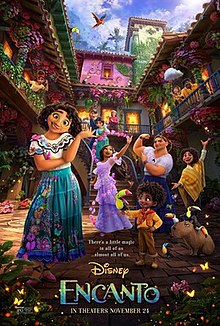
Maribel Madrigal, a member of the magical Madrigal family in Colombia, is the only Madrigal without powers, but soon discovers she’s the family’s only hope of saving their magic.
Encanto once again shows off the unlimited abilities of Disney’s animation team, already having a great year with Raya and the Last Dragon and Luca, as well as Lin-Manuel Miranda who has been everywhere this year, including In the Heights and Tick, Tick… Boom! One of the stars from the former, Stephanie Beatriz, delivers the (voice) performance of a lifetime as Mirabel, a role that feels written for her and she fits it beautifully. Her singing range is also wonderful and Mirabel is incredibly heartfelt as a protagonist. There’s one song in particular called “Waiting on a Miracle” in which her vocals, character arc and the emotion of the entire film especially hit hard. But the catchiness doesn’t stop there — although “The Family Madrigal” and “We Don’t Talk About Bruno” won’t reach the heights of other recent hits like “You’re Welcome” (Moana) or “Remember Me” (Coco), they’re still fun and the musical themes bring so much to the film. With that though, there are a few songs that aren’t as memorable. The animation is Disney’s most colorful yet, and it’s surreal to see them outdo themselves more than once this year but the shots of the Colombian scenery as well as the magic created in their home, an “Encanto”, is so beautiful it’ll invoke emotion just journeying through it. The story revolves around Maribel trying to fit in and find herself when the family’s dynamic is built on each one’s abilities and how they can contribute physically — but each of them is more than that under the surface. With this we also get a number of interesting examinations of Maribel’s connections with her parents, sisters, and Abuela. There are occasions, however, where the pace drags and you wonder where the story is going, but once you get there, it gets fun once again. The movie also continues Disney’s recent trend of ditching traditional villains for complex characters whose decisions conflict but are more complicated than that. While I wouldn’t put this in the same discussion as Coco, Moana or Zootopia, it’s a heartwarming and vibrant family film with strong cultural representation and themes and a lovely protagonist and animation style.
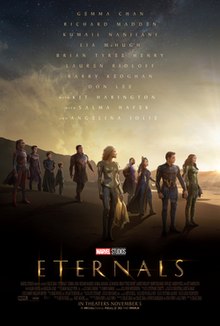
7,000 years ago, the Eternals, a group of immortal beings created by Celestial space giants, arrived on Earth to protect us from the Deviants. In the present day, the Eternals reemerge after living among us humans to fight against the Deviants, who have returned, and stop the end of the world.
Eternals has all the right elements there, including a 2-time Oscar winning director in Chloe Zhao, an acclaimed, diverse ensemble cast that includes Oscar nominees and winners like Kumail Nanjiani, Salma Hayek and Angelina Jolie, a compelling concept and premise, and tonal elements of a more intimate yet grand and mystical MCU film. Though all the parts are there, something feels missing that could have made this one of the best films in the franchise but instead falls short. The movie is very bold and feels the least like the rest of the series, mostly because of the slower, more character and emotion-focused story rather than fast-paced fun that dives straight into the conflict. There is big action and humor, but the movie never spends enough time with either tone at once to give us an earned emotional moment or a “classic MCU moment”. Unfortunately the movie doesn’t have neither the humanity nor the fun it wanted to evoke. Though it did keep me engaged throughout its runtime, I never really felt much of a reaction from watching what should’ve been exciting action go down, though the action set pieces do feel like a mess. There’s often too much going on at once during the fights and the finale especially has messy CGI and questionable character placements.
The cast is great, especially Gemma Chan, Kumail Nanjiani and Brian Tyree Henry. Chan plays an empathetic and strong protagonist and Nanjiani gives the movie its funniest and most entertaining moments, including a Bollywood dance being filmed for a movie his character Kingo directs and stars in. Henry gives the movie lots of charisma as well and an interesting edge due to his character having the most to lose on Earth, having settled down with a husband and son. Richard Madden, Barry Keoghan and Lia McHugh also come to mind with interesting performances of their own, and Lauren Ridloff also gives the movie a lot of heart, even though there’s an extended period of time where she’s not in the movie, which does happen with a few of the film’s best players. The problem is that with there being 10 main Eternals, the movie keeps trying to push them all to center stage and have all of them be the emotional core, which makes the character development very messy, and some of the best characters’ arcs have disappointing or unrewarding resolutions. Avengers: Infinity War managed to balance having over 20 main Avengers by having some beloved characters have more of a supporting presence while a few take the lead in terms of emotional importance, unfortunately the writers here try to shove everyone front and center which hurts the dynamic between the characters and the audience. Hayek’s performance feels especially weird and unnatural at times, and Jolie’s character keeps trying to feel important but the script has no idea what to do with her for the entire second half. Kit Harington needed to be a much bigger part of the film but unfortunately is sidelined in the movie, as he gives the film a lot of charm and humanity.
The movie runs at 2 hours and 37 minutes (even longer than Infinity War!) and though there’s a lot of grand world building including ties to ancient history which makes for interesting sets, the movie definitely slows down with the messy explaining and reexplaining of exposition and dragged out drama between acts 2 and 3 that could’ve been shortened by at least 10 or 15 minutes. If you’ve seen Zhao’s previous film Nomadland, which won Best Picture at the most recent Oscars, you know her style is very intimate and naturalistic, and the movie doesn’t spend enough time with the intimacy and beauty of the scenery to give you much to care about and feel with its characters, as too much is thrown in to really stop and care, despite some great moments between Chan and Madden. On the other hand, though there’s some good humor and lots of big action, the movie never gives you enough epic-ness or fun to feel the stakes and unfortunately, the action and endearing characters going hand-in-hand is always what make these Marvel films resonate. It doesn’t commit to being small-scale or exciting, and this as well as the unrealized pace holds itself back from really gripping you the way Shang-Chi hit the mark earlier this year. It’s a good watch once for MCU fans or those who are interested in the premise and cast, but won’t leave you with that same elation and wonder, and urge to rewatch and treasure the film later, if only the film had been shorter and more focused.
Paul Atreides, heir to the powerful House Atreides, is to inherit the sand planet of Arrakis, but soon a galactic war begins between Houses and Imperial forces, leading Paul to have to discover his legacy and what kind of leader he wants to be.
One of the most ambitious cinematic projects of the year, Dune merges the styles of mainstream blockbuster and artistic epic, with majestic direction from one of the best filmmakers of our time, Denis Villeneuve. He creates an incredible scope, resonant of the world-building of Star Wars and Lord of the Rings and the grand desert shots of Laurence of Arabia. The visual effects seamlessly combine practical and CGI effects to create an immersive new galaxy, but the action and scenery is defined by the meticulous and grand cinematography, which adds to the gripping, breathtaking nature of the film. The production design and visuals create the ultimate spectacle of the year visually, and the world-building exposition may be slow-moving and slightly hard to follow for some, but mostly done well. The score by Hans Zimmer is destined to be a highlight of his career. The booming sound design combined with Zimmer’s loud, often godly music creates unforgettable moments throughout the movie. The cast is stacked with famous faces so I don’t even know where to start. Chalamet in the lead wonderfully balances Paul’s sense of youth, discovery and uncertainty, though he is good at adapting and looks to embrace his destiny and survive. The heart of the film may rest in the hands of Rebecca Ferguson, who delivers not only the best performance in Dune but the best of her career, as Paul’s mother Lady Jessica. Contrasted to Paul’s father Leto (Oscar Isaac), a noble leader who loves his son but the film mostly focuses on their relationship from the diplomatic lens and the responsibilities Leto will pass down to Paul, we see how Jessica who comes from a lower-ranking society gives Paul new, unique survival instincts and his heart. Other standouts include Josh Brolin and Jason Momoa as warriors from House Atreides who serves as mentors to Paul as well. Sharon Duncan-Brewster is also really great in the film, not to mention other familiar faces show up that will excite audiences — Stellan Skarsgard, Dave Bautista, Zendaya, and Javier Bardem all have small but key roles as well.
Those who have never read the source material will find themselves drawn into these vast new worlds thanks to the beautiful execution, and fans of Frank Herbert’s novel will not be disappointed by the invigoration of the story to the big screen. To add to the intensity and large action, Villeneuve not only likes to immerse the audience in the consequences of violence but often just observe the chaos. Though everything is otherworldly, there’s plenty of moments of stillness felt like the omniscient shots of Sicario, Blade Runner 2049 and Arrival. The film focuses on themes such as legacy, parentage, colonialism and our relationship with the natural world, as well as mentorship, and fate. Though the story is mostly engaging, the third act does fizzle out a little bit in an attempt to set up the sequel. Dune very much feels like the first half of a mega-movie that will be completed and certainly defined by the second part. Unlike other “two-parters” like Avengers: Infinity War which ended on a bang, this feels more like the end of The Fellowship of the Ring or The Hobbit: An Unexpected Journey which ends less on a cliffhanger or large set piece but more on a feeling that the journey has just begun. Many plot points are left deliberately unresolved for that next film to adapt the second half of the book, and the movie has already much story and development to include in its 155-minute runtime. This can be frustrating for some, but for those like me who enjoyed this movie, you’ll be left wanting Part Two ASAP. Dune is a rich experience and a must-see in theaters for sci-fi lovers and fans of Villeneuve’s past efforts as well as the star-studded cast. Supporting this one on the big screen will not only get Warner Bros. to get to work on the next chapter soon, but will have its audience take away some beautiful visuals, scope and action, the kind we only get once in a while, even in the world of fast-paced blockbusters.









 filmtoppings.com