Knives Out

When wealthy crime novelist Harlan Thrombey (Christopher Plummer) is found dead on his 85th birthday, his eccentric family is gathered by an equally bizarre detective named Benoit Blanc (Daniel Craig) to solve the case of Harlan’s murder.

When an original project from a respected filmmaker and an incredibly talented cast is released — that’s when I know I’m in for something good. Knives Out has mystery, laughs, and plenty of popular actors quarreling. The cast, including Craig, Chris Evans, Jamie Lee Curtis, Toni Collette, and Michael Shannon, all get a shot to shine, but the film belongs to Ana de Armas. She steals the screen in every one of her moments and is the character you really want to root for. There’s plenty of witty, hilarious, and memorable dialogue from the remarkable Rian Johnson, who also uses some brilliant visual cues for glamour, as well as “a-ha!” moments and even some humor. From the first act, the movie takes a turn away from what you’d normally expect in a “Whodunnit” murder mystery, yet it all makes for an equally creative and thrilling experience. However, I do feel like some revelations were placed too early along the film’s runtime and could have been saved for a few sequences later. Also, while Johnson does present some truly golden moments throughout the film, like the savage, vulgar moments or the more showy, stylish moments, I think the film could’ve overall used a more distinct style, as I know Johnson is of much skill yet a few scenes felt like they could’ve been directed by anyone. Also, perhaps the film could’ve benefited from an R-rating as a few scenes do slightly hold back in terms of language, yet fortunately this is nothing that harms the film. Johnson also goes for some social themes — some so direct and on-the-nose that they feel too obvious and surface-level, and others so subtle and hidden that they require more digging and thought before the true meaning of some of the themes really come to me, but he certainly addresses ideas such as class, race, politics, and the Internet’s influence on Americans.

Ultimately, though, Rian Johnson is able to once again challenge genres and craft unique dialogue while still being able to appeal to mainstream audiences with the incredible cast that help make Knives Out quite the pleasing and interesting experience, appealing to all generations with its call-backs to Agatha Christie’s genres, and cast involving all generations, like Christopher Plummer and Chris Evans, as well as the fast-paced and humorous script that make for a “Whodunnit” like no film has ever “dunnit” before.

Knives Out poster.jpeg

Joker

Imagine a film based on a popular comic book property that’s been adapted before into billion-dollar successes, but this time has no action, no CGI, and focuses solely on character development and delivering dark themes about our society. That’s exactly what Joker is. It’s no Dark Knight — the Joker never robs banks or blows up buildings, and it’s certainly no Suicide Squad — no gang wars, alien armies, or apocalypse-level stakes. Joker aligns more with the likes of Scorsese — certain scenes reminded me very much of The King of Comedy, as well as the filmmaker’s darkest classic Taxi Driver. It always sticks to a very old-fashioned, noir-like style, gracefully shot with every prop feeling like it belongs in a frame of a painting. The roaring music feels perfectly done for a haunting and tense crime thriller that focuses deeply on the protagonist’s descent into darkness. Joaquin Phoenix has always had a spot on my favorite actors list, but he manages to own the show in a completely new way here — different than Ledger’s spectacular take on the character in 2008’s The Dark Knight, but equally worthy of praise. He disappears into Arthur Fleck, a man living in poverty with mental illness who feels like an outcast in society and is soon pushed over the edge. Phoenix’s speech, menacing laugh, and weight loss all contribute to how impressive his performance is, and I seriously think he deserves an Oscar nomination. Also outstanding is Robert De Niro as a talk show host whom Arthur idolizes, resembling Jerry Lewis’ character in The King of Comedy whom Robert De Niro’s character in that film develops an obsession over. Joker does occasionally tie-in to characters or events from the Batman universe which may feel slightly forced, but for the most part it stands on its own as a deep and unpredictable story. For such a large studio to adapt such a large property but then include such little action in the film is a huge risk which completely pays off. It’s a character study and a drama with meaningful social commentary, such as the marginalization of those with mental illnesses by the rest of society, or how the less privileged or fortunate are looked down on and ridiculed by the elites. Even though it takes place in the early ’80s, it asks difficult questions like how our modern society could be taking part in creating criminals like the Joker. It’s more unsettling, resonant, and inventive than any comic book film I’ve seen in recent years, to the point where it could also speak to non-superhero-fan audiences like those who are only expecting a dark crime film. In terms of the concerns about the film’s violence, there isn’t much graphic content (definitely not as much as other R-rated superhero films like Deadpool and Logan) but the implications the violence has are more disturbing, serious, and grounded, but hence the R-rating.

Joker is a finely acted, thought-provoking chcracter piece that takes place in a world of gloomy uncertainty and takes more risks than almost any other franchise film recently. It’s not focused on the big fights, or post-credits scenes teasing another film, instead being a brilliant stand-alone piece that leaves you thinking for a long time, and hopefully paves the way for more variety in blockbuster filmmaking, as well as likely remaining one of the films that will be discussed until the end of the year for its strong filmmaking and top-notch writing and themes.

Joker (2019 film) poster.jpg

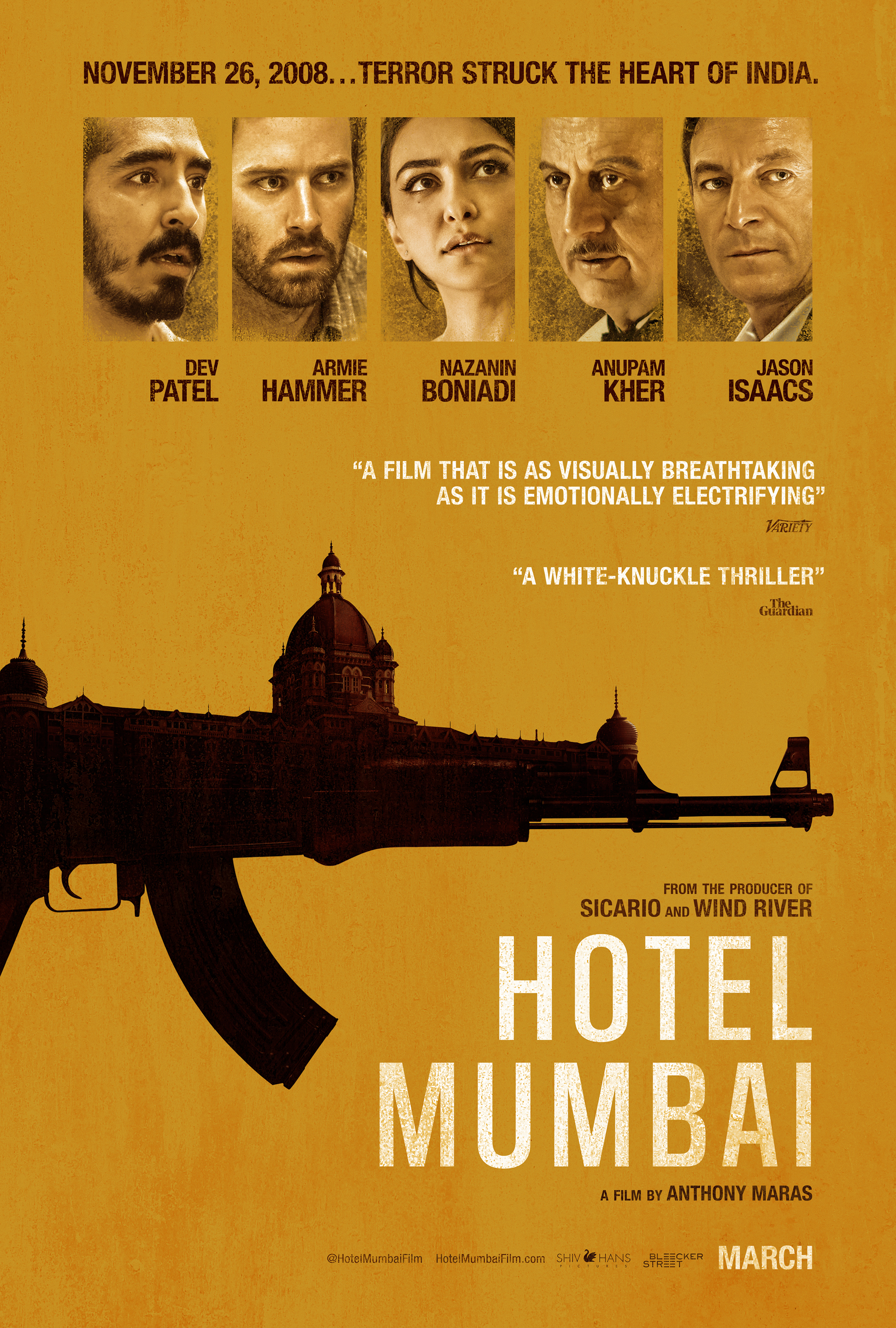
Hotel Mumbai

ratings4

The true story of the Taj Hotel terrorist attack in Mumbai in 2008. Hotel staff risk their lives to keep everyone safe as people make unthinkable sacrifices to protect themselves and their families.

Hotel Mumbai is a terrifyingly realistic and relevant look at the awfulness of the world and a terrible act of hate. However, it also puts the spotlight on the courage of the protagonists, the workers and guests at the hotel being held hostage. We see in numerous scenes where several characters make the difficult choice to put their guests’ lives ahead of theirs, as they claim “Guest is god”, and that the hotel is their home and they would not leave without first ensuring the safety of others. The guests also are seen never giving up to be with their loved ones and protect them, even if it costs them their own lives. Even though we’re also reminded of the horrible, blind beliefs that radical terrorists follow, even they are given brief moments to remind the audience that they’re also human beings, like a terrorist who is critically injured and calls his father tearfully when he realizes it’s unlikely he’ll make it home. Dev Patel and Armie Hammer deliver solid performances, but a surprising standout is Anupam Kher as the head chef at the hotel who constantly displays leadership, courage, and selflessness during the attack. The dirtector also does a great job building sitatuions of tension and showing certain characters in the same shot to make us uncertain who will make it out alive. Despite being an effective thriller, Hotel Mumbai does unfortanely fall into some “true terrorist attack film” cliches, like the main character who’s new at his job, the white guy who’s mostly there to make more money, the couple who gets seperated, the rich guy who’s kind of an asshole, the brave but foolish cops who are the first to arrive at the scene and the seasoned worker who always maintains his dignity. Though it’s easy to tell where it’s going and who’s likely to die or make it out alive, Hotel Mumbai still remains an intense dramatization that does its job of reminding us of the terror that’s happened in this world and continues to happen today.

Hotel Mumbai is strongly acted, well-directed, and feels very realistically and executed. However, it sometimes falls into cliches of films in the similar genre, while thankfully still remaining intense and timely for audiences.


Image result for hotel mumbai


Us

ratings5

This horror film follows a family whose summer trip to a beach house is interrupted when a family that looks exactly like them shows up at their door.

Jordan Peele follows up a victory with another one that should be praised for its own reasons. Though it’s a very different film than Peele’s Oscar-wining horror film, Us is an all-out nightmare that will get under your skin like no other mainstream film ever has. Not only is it more frightening than most horror films, but it’s so meticulously crafted and strongly directed by Peele, who make his care for characters and root for them to survive within an instant. From the very first shot of a girl watching television, Peele already plants clues for what’s to come, followed by an opening credits shot that’s simple but will give you chills. He wonderfully builds every shot to contain mystery and intrigue, that will make you never stop guessing what will happen next. He builds shots hide and show certain things and wonderfully makes the doppelganger characters frightening antagonists for the viewer. Lupita Nyong’o delivers two main performances that feel very different but both are spectacular in their own route. She convincingly acts terrified in many instances, but also changes her voice and achieves many feats in numerous scenes tin which she will blow you away. The violence is uncompromising but a blast to watch if you can watch graphic imagery without flinching, as the fight for survival is always thrilling and unpredictable. However, there’s also great moments of comic relief thrown in there, which delivers while still feeling like a full-on horror film. But above all the fright and entertainment, there’s some true shock thrown in, especially towards the end. Peele leaves the message and themes of the film open for discussion, as opposed to more obvious racial commentary in Get Out , while the meaning of Us will be debated for years. Not to mention a plot twist that will go down as an ending for the ages.

Jordan Peele has not let down expectations and is an established horror genius here in Hollywood, promoting true originality and terror in his films. With strong writing and acting, as well as plot devices and themes that can be analyzed for years to come, there’s so much to say about this new horror masterwork that I’d rather not ruin and let you discover for yourself.

Us (2019) theatrical poster.png

Glass

ratings4

Glass was a bigger risk than any Hollywood blockbuster lately — its target audience is to only those who have seen both Unbreakable and Split, but not all average moviegoers will be able to tell you who David Dunn and Elijah Price are. And for a big studio movie marketed as a superhero film, it doesn’t have a lot of action either. However, Glass presents us with deep story development and world-building unlike other superhero franchises, as a truly great sequel to two outstanding films. The movie holds on to the strengths of the previous two films, which on their own feel very different but are combined seamlessly. M. Night Shyamalan’s style is always there, and his lovely direction is impressive once again, including great cinematography and music. This movie could not have worked without Shyamalan, whose vision for this film has been out there since he made Unbreakable nineteen years ago, and then he brilliantly connected it with Split in the latter’s final scene, a shocking revelation that nobody knew about until the ending of the film. Shyamalan is a one of a kind filmmaker and his passion really shows here with how well he was able to follow up two films of his own and still bring the great style and unpredictability we love from him, even if his cameos are still silly and some lines of dialogue could have been removed. James McAvoy doesn’t show any less commitment or steal the screen any less effectively than he did in Split, and even when he’s placed with Hollywood legends such as Bruce Willis and Samuel L. Jackson, he still makes Kevin Wendell Crumb the most memorable part of the film, making the audience let go of his real-life appearance and disappearing into a frightening role we’ve loved to follow over these last two films. He is able to bring a unique feeling to each personality and really captures this character with a performance like no other.

Shyamalan adds a lot more of the commentary on superhero stories that we got to love in Unbreakable, and the other characters doubting the super-humanity of these characters and how their peers are involved or affected, like David’s son’s strong belief in his father as a superhero and helping him track down criminals, is very interesting. Also a welcome return is Anya Taylor-Joy as Casey, who was abducted by Kevin in Split but the direction their chemistry takes here is always intriguing. Though some critics were not big on this conclusion to Shyamalan’s one-of-a-kind trilogy, I think he did a great job following up on two of his films and bringing the themes of Glass to the screen more effectively than most modern sequels. The climax will split many but I think it had some jaw-dropping revelations and moments that feel very earned and a shocking and risky twist that no other mainstream filmmaker would have gone for. However, the ending does find a brilliant idea but then goes on 5 minutes too long which were not needed and nearly ruined the effect Shyamalan was originally going for. Also, there are a few fight scenes where the violence could have been more utilized, but ultimately this is an expectation-defying and unique film that’s the final part of an expectation-defying and unique trilogy, and you should see this strongly done thriller on the big screen despite what the critics are saying — but make sure you see Unbreakable and Split first.

Glass official theatrical poster.jpg

Widows

ratings4

After four thieves are killed during a heist gone wrong, their widows step up to finish the job.

Widows is a heist film that chooses to focus more on the serious aspect of the genre, similar to films like Michael Mann’s Heat. Instead of quick montages of prepping for the heist or focusing solely on the main heist, Widows is a film about grief, corruption, and injustices that relate to country-wide issues. Steve McQueen creates a frightening look at the corrupt and dangerous crime in modern Chicago, led by a stellar cast. It’s no surprise Viola Davis can bring an audience to feel invested in the film with her strong emotion and passion in every one of her characters. Veronica Rawlins, a woman willing to go far lengths to protect herself after suffering from a loss, is no exception. Also great are Elizabeth Debicki and Michelle Rodriguez as two other widows who join Davis to pull off the heist their husbands failed to. Another standout is Daniel Kaluuya as a menacing henchman for a gangster who will not think twice to use brutality in order to get what he wants. Other popular names headlining the film include Colin Farrell, Liam Neeson, and Robert Duvall, who are pleasing to watch even though some of the British actors’ American accents are questionable. Widows does not hold back on strong violence that not only feels brutal but scarily real, and excellent direction and cinematography that shines in many scenes. The script also has a strong focus on many different issues that could make you fear the world today even more — though it’s a heist film, there isn’t much action, rather violence because the intention of it isn’t to entertain but to provoke themes and often suspense. Even though it sometimes won’t subvert any expectations until the second half, some scenes will have your heart racing and the final act feels very unsafe for every character. I was never sure who would survive and who would die because Steve McQueen crafts a space where anything can happen. Unfortunately, there should have been more closure in the final few minutes for some important characters, but in the end, Widows is a mature crime drama that does not disappoint.

Widows (2018 movie poster).png

Halloween (2018)

ratings3

Forty years after she was attacked by a masked killer, Laurie Strode prepares for the return of Michael Myers so she can end his murderous carnage once and for all.

After several sequels that were poorly received by critics and audiences alike, the most recent film in this slasher franchise retcons all the sequels’s continuities, disregarding them and acting as a direct sequel to the 1978 classic. The movie delivers on the promise of intense sequences elevated by the frightening presence of Myers, and effective tension throughout these horror scenes. The blood and gore is also fittingly strong to amplify the fright of a masked murderer coming after these characters, with some nice cinematography and tracking shots as well. However, even though it’s quite entertaining to watch, most of the jump scares are pretty predictable and a lot of these scenes fall into familiar tropes. Jamie Lee Curtis reprises her role and does a terrific job as Laurie, bringing a layered character to the screen in every scene she’s in. The aspect that hasn’t been seen before is the PTSD Laurie faces and how she’s willing to go to far lengths to prepare herself and her family for the inevitable return of her greatest fear. The way Curtis portrays a woman affected by an incident even decades later and how she’s always looking over her shoulder, ready to bravely face the villain of the story is done very strongly. If only the movie focused more on her, as lots of the film cuts to uninteresting side characters that don’t serve a purpose to the main story and aren’t portrayed very well. Sometimes the movie doesn’t stick true to the promise of being the story of Laurie facing Michael one last time and instead focuses more on developing character who do nothing other than fall victim to Michael’s killing spree.  The plot also basically follows the structure of the original and we can tell what the final showdown will be like even before the movie begins. Halloween has plenty of fun scares and effective violence that will entertain horror fans but it borrows too much from the structure of the first film and doesn’t try much that’s new from the overall horror movie formula, and could’ve used more focus on its compelling protagonist.

Halloween (2018) poster.jpg

Searching

ratings4

This movie follows David Kim as he desperately searches for his missing daughter Margot. From that description it may sound like an ordinary mystery film, but there’s a catch: it’s told entirely through the perspective of a computer screen. This isn’t used simply as a gimmick but rather as a filmmaking tool to amplify the emotion and suspense. It’ll shatter your heart within the first five minutes of staring at a large computer screen projected in front of you, and FaceTime and text conversations are made interesting and thrilling. Though the concept is familiar, the plot is absolutely unpredictable and you can never tell what’s going to happen next. The way it builds up its conflict strongly pulls your interest and from there will find ways to always keep you guessing, as more shocking details are revealed that surprise the audience and put them on the edge of their seat. John Cho plays a loving father whose every action or reaction throughout his search for his daughter feels believable for what a father would do, and Cho displays range, emotion, and humanity in his leading performance. It’s amazing how much you can learn about someone from their computer — even when we’re not directly looking at him, we always feel for David and understand how he’s feeling through the whole film. The format doesn’t limit the film’s opportunities and works perfectly throughout the entire runtime. There is never a dull moment that allows you to take a breath from this gripping mystery until the very end. As an audience member you always feel forced to look for clues and details and invited to embark on this father’s journey through his device. The writer has so much to say in this film and the script works on many thematic levels — It’s about a father’s love for his daughter, about how secretive kids choose to be from their parents, how different generations use technology, and how much a computer can tell you about a person and their life. There’s so much to be analyzed and so much the director wonderfully conveys in 100 minutes.

Searching is the original, creative, and enthralling thriller we need right now — it’s a shocking and unique thriller that will grip onto you and not let go until the very end.

Searching.png

Sicario: Day of the Soldado

ratings3

FBI agent Matt Graver teams up with operative Alejandro Gillick to prevent Mexican drug cartels from smuggling terrorists across the U.S. border.

Sicario director Denis Villeneuve and cinematographer Roger Deakins, who helped make the first one feel so special, are absent this time, but Stefano Sollima and DP Dariusz Wolski still hold their ground to create beautiful production and violent sequences that nearly hold up to the first one’s glamour. The sound editing is harrowing and elevates the terror of sequences that could feel like real-life combat, and the gunfight choreography and use of blood to elevate terror are fitting. Like the first film, even with a slight amount of violence the stakes can be gripping, which is strong for a world with movies filled with loud sound effects and explosions. Even without Emily Blunt, the cast is great, particularly Benicio del Toro once again as a complex lead who isn’t all heroic and also dark at times. Josh Brolin also has a great return as a man trying to get the job done, and this actor never seems to disappoint or perform under your expectations, as he’s able to embrace every one of his performances to the fullest. Some of the powerful writing from the first film is present — like exploring the children of drug lords and their experience in the crosshairs.

Like its predecessor, Day of the Soldado is very well-shot, with night vision scenes to intense shootout sequences in the desert, and the music is as awe-inspiring as in the first. However, there are some scenes that feel unnecessary to the plot or don’t lead to many places, and the movie introduces some great ideas in the first two acts that are ignored towards the end. The ending feels like its teasing what could be next in Sicario 3 which is fine but it ends a little too abruptly to be taken in. I’m glad it’s unpredictable and well made like the first movie but it doesn’t feel as motivated and suspenseful, and it hardly felt like a complete story because a little too much was left open for the next movie and there wasn’t edge of your seat tension and shock in the climax or most importantly emotion like the first film’s insane final minutes. It’s still got a dark story and themes like the first one that work very well, and holds its ground in terms of style, but in the end never justifies its existence other than promising a hopefully better Sicario threequel.

Sicario: Day of the Soldado feels as well-done and harrowingly violent as its predecessor, with great performances as well, but doesn’t completely embrace its themes and saitsfy in terms of substance by the end. Recommended for action fans who will likely enjoy the  thrilling and violent fight sequences like I did.

Sicario - Day of the Soldado.png

Jurassic World: Fallen Kingdom

ratings2

Three years after the fall of Jurassic World, Owen and Claire return to the island to rescue the dinosaurs from a volcano that will cause the extinction of all the dinosaurs on the island.

There’s no surprise that audiences, including me, will continue to go pay watching dinosaurs wreak havoc on the big screen, not just because I enjoy it, but also because Jurassic Park is still on my top 10 favorite movies and I continue to have high hopes for the franchise. Unfortunately, Fallen Kingdom ditches a lot of the heart this series used to have for new high-paid cast members and plenty of scenes dedicated to rich corporate officials talking about dinosaur genetics. Jurassic World was far from perfect but still really enjoyable and had tons of edge-of-your-seat suspense, and one of the best parts of that movie was Chris Pratt’s protagonist, Owen Grady. Last time we met him, he was a unique dino trainer who knew the creatures better than anyone and took on threats in style. Here, there’s nothing heartfelt or fun to his role that all of Chris Pratt’s other performances seem to possess. His character is hardly developed this time around and his connection to Bryce Dallas Howard’s character is done the exact same way as in the last movie. The new characters played by Rafe Spall, Justice Smith, and Toby Jones are anything but engaging and a large subplot involving a young girl made zero impact on the film’s plot. The child protagonist subplot didn’t work well last time, so why try it again with a new child character? Also, if the movie can afford Jeff Goldblum in its budget, why only have him in two scenes instead of having him be a main character again like the old times? The movie’s character roster could have really used a lot more of him as none of the characters outside of Pratt and Howard are interesting at all.

If you’re looking for some monster fun, don’t worry, this will probably please you as plenty of scenes are entertaining for a wide audience. The CGI is great, and even better than the last time around. Every dinosaur has a fun look and characteristic to it and the dinosaur action is quite pleasing most of the time, especially a scene on the island which has been highly teased in the marketing. Viewers new to the franchise and those who love the fright the previous films offer won’t be let down on an action standpoint, and director J.A. Bayona quite delivers with some great shots and visuals. The story does start off with a nice concept that raises the question of whether these creatures that us humans created deserve to live — but it rushes to the action without much meaning or strong buildup. Soon the plot becomes too uneven and it focuses not enough on its main characters and too much on useless or boring parts without moving forward into new ideas the franchise hasn’t explored before. The trailer makes this seem like the Empire Strikes Back of the Jurassic Park movies but there isn’t much tension or suspense besides the constant dinosaur noise after dinosaur noise, and even the action scenes have the familiar “characters making dumb mistakes near monsters” tropes. At the end, it didn’t feel like I had watched a complete movie because though the story could’ve been something very thrilling, there isn’t much depth to it. This could’ve worked really well and even been one of the best Jurassic movies, if only there was a reason to care and get invested into the plot aside from great CGI and chases. The ending is an interesting choice that teases a (hopefully) better final installment, but there wasn’t much of a reason to get excited when it ends. I remember at the end of Jurassic Park, I felt like I had seen something magical like never before, and at the end of Jurassic World, I felt like I had to catch my breath after all the intense and awesome action, but here, there’s no reaction or takeaway that I felt like I did with previous installments of the saga.

Jurassic World: Fallen Kingdom works on the surface as a good looking dinosaur extravaganza with action that will please many wide audiences, but the story has nothing fresh to the franchise and the character focus is out of place. I would recommend it for its action but as a film with real quality, not much is offered that will resonate. It doesn’t reach the heights of what’s been done before and I feel that this saga has much more to it than what’s offered here. It ends up being a mediocre monster movie that many can still have fun with, but won’t be remembered as one of the greats.

Jurassic World Fallen Kingdom.png