Wicked

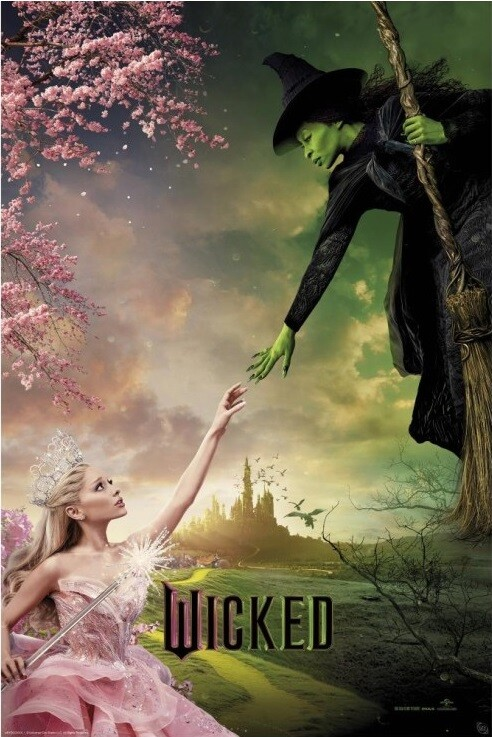
Wicked tells the story of Oz in a new light, as we meet Elphaba and Glinda in their early years of sorcery, who eventually become the Wicked Witch and the Good Witch, respectively.

Few stage-to-musical adaptations in recent memory capture the excitement of being there with the actors on a production filled with song and dance like this one. Despite its title, Wicked is one big burst of joy, led by the spectacular Cynthia Erivo, who makes the material, and the mere art of musical theater itself, feel like they were made for her. Erivo’s enchanting voice is moving and never quite lets go of the audience, rather you’ll be begging for more of her songs. Ariana Grande plays into type well as Galdina, who starts of as quite the narcissist, but the characterizations of both her and Elphaba soon become more complicated in a way that feels genuine and touching. Michelle Yeoh is also wonderful, and Jonathan Bailey and Jeff Goldblum are delightful. But it’s not one element that makes the movie works: it’s the beautiful costumes and sets, put together with the music and story, brought to life by these talents. The songs might have not worked without the incredible musical numbers and dance sequences, but Jon M. Chu steps up to the responsibility of bringing out the best of this bombastic fantasy tale. It also deeply humanizes an infamous movie villain in a way that feels natural and oddly grounded, with themes that may connect with audiences.

As this is only the first part of the two-film adaptation of the musical, the pace dives deep into unexpected subplots, and though this approach threatens to deem the split unnecessary, it ends up fleshing out its world in a rewarding way, making the runtime worth it, and leaving audiences with much anticipation for the next film. Wicked is a cinematic experience with exciting musical numbers, an incredible leading performance from Erivo, and mesmerizing execution that’s a must for both fans and non-fans. It’s hard to believe there’s so much more to come, though where you’re left here in Elphaba and Glinda’s journey is still an astounding and gratifying moment.
Gladiator II

Decades after the events of Gladiator, the Roman Empire has fallen into the tyrannical hands of Emperors Geta and Caracalla. Hanno, a young man taken to Rome as a slave, learns of his connection to the Empire and trains to be a Gladiator to fight against the corrupt emperors.

This long-awaited sequel doesn’t have the same visual beauty and flare as its predecessor, but is still a solid action film that embraces the best aspects of the first film’s story. It’s quite an uphill battle to create a hero as strong as Maximus Meridius now that he and Russell Crowe are out of the picture… unless, of course, you cast Paul Mescal. Mescal brings a tenderness to his performance that shows through even when he ought to show strength and ferocity in the arena. Pedro Pascal is also fantastic and completely chews up the scenery, as do Joseph Quinn and Fred Hechinger as the spoiled and maniacal emperors. Denzel Washington gives so much life to the film, seemingly just by being his soulful, fun self. He brings a lot of humanity as he and Mescal enter a mentor-student dynamic. The film doesn’t work as well without Washington’s presence, whose character takes unexpected turns throughout the film.

Gladiator II‘s script works when focusing on its protagonist’s journey, as well as his fight against tyrrany. The power dynamics and engaging action scenes carry the story forward, though visually, it feels held back from what could’ve been compared to the first film. Ridley Scott’s style here doesn’t feel as patient and refined as in his recent The Last Duel, and the CGI could’ve used a lot more improvement. However, the action choreography is as bloody and grand as fans of the original could hope for, and the ending is beautifully done as a realization of promises we didn’t even realize the first film had. It’s a noble continuation that honors the first film, and its cast led by Mescal and Washington, while never quite reaching that original movie’s breathtaking heights, but still better than some of Scott’s other recent outings, and worth a watch in theaters.

Heretic

When two Mormon missionaries arrive at Mr. Reed’s house attempting to convert them, they find themselves stuck there in a game of wits, fighting for their lives.

When two Mormon missionaries arrive at Mr. Reed’s house attempting to convert them, they find themselves stuck there, fighting for their lives.

Heretic doesn’t play out with the typical levels of jump scares and macabre we’re used to from horror films these days — rather it’s a battle of wits in which the characters contemplate belief, religion, and faith… oh, and an adult man is terrorizing two young women as they’re held captive in his house, which becomes a maze of puzzles related to his disdain for their faith. Hugh Grant is rather terrifying as Mr. Reed here, but he’s clearly having such a delightful time in the character’s skin. He’s as threatening as you can imagine a mysterious man in his 60s alone in a large house but also has plenty of outlandish and hilarious dialogue. Some viewers simply looking for an intellectual dark comedy could most definitely find satisfaction in watching Heretic. You also genuinely care about our two protagonists. Sophie Thatcher and Chloe East both bring cleverness to the film, a willingness to challenge their captor, and not break down and quit. Thatcher brings a rebellious sense of mystery to Sister Barnes, while Chloe East is heartfelt and capable as Sister Paxton.

Though Heretic takes some time for the uniqueness and thrills to set in, it stands out from other recent horror films thanks to its restraint on its scares, as well as its smart screenplay and chilling villain. The three performances are integral and lift up the film’s shocking fun, and may even make you think about some big ideas all while you’re enjoying this dark ride.