The Alto Knights

Two of New York City’s most notorious organized crime bosses vie for control of the city’s streets. Once best friends, petty jealousies and a series of betrayals set them on a deadly collision course.

Robert De Niro playing an infamous mobster is nothing new. But De Niro playing TWO mobsters? Throw in legendary director Barry Levinson of Bugsy, Rain Man, and Good Morning, Vietnam, now that’s something worth writing home about, right? Unfortunately, The Alto Knights is anything but; a film with maybe some potential on set that was completely butchered in the editing room. De Niro’s dual performance is supposed to fascinate the audience but instead distracts. Frank Costello and Vito Genovese are not presented in the film as being two sides of the same coin, as were the mobster twin brothers Kray, played by Tom Hardy in Legend. In this film, the two mobsters are depicted as not just of different families and mannerisms but of different ages, experiences, and motivations. When De Niro finally shares the screen with himself, it’s impossible to buy these disparities as the script depicts them, rather we buy them more like equals under different heaps of makeup, which was not the intention. As Costello, De Niro is giving something between a less soulful version of his turn in The Irishman, a less extravagant version of his turn in The Untouchables, and a less funny version of his turn in Analyze This. He’s interesting as Genovese, but casting another actor to oppose him would’ve worked better to show that one of these gangsters is actually much more frightening than the other.

The film recycles tired tropes of past popular mob films, and as I’ve alluded to here, many of them already star the great De Niro. Though some scenes are at least mediocre in their execution, the editing is horrendous and makes some scenes unwatchable. The film insists on blasting through most scenes like a documentary montage rather than letting scenes breathe and feel like a thrilling drama. The constant narration and barrages of exposition are condescending to its audience of a normally intelligent genre, but insists on feeding us information we could’ve learned through context clues within scenes. The poor dialogue can’t be salvaged by lacking performances from Debra Messing and Cosmo Jarvis, the latter of whose promising transformation never quite gets to shine. Moreover, there never feels like an escalation of tension or events when there feels like we should be building towards something, rather a lack of setup that also leads to a lack of reward. The Alto Knights starts on a bad foot, and never even hints at a chance to redeem itself. Even De Niro and crime film fans need not waste their time, in theaters or at home.

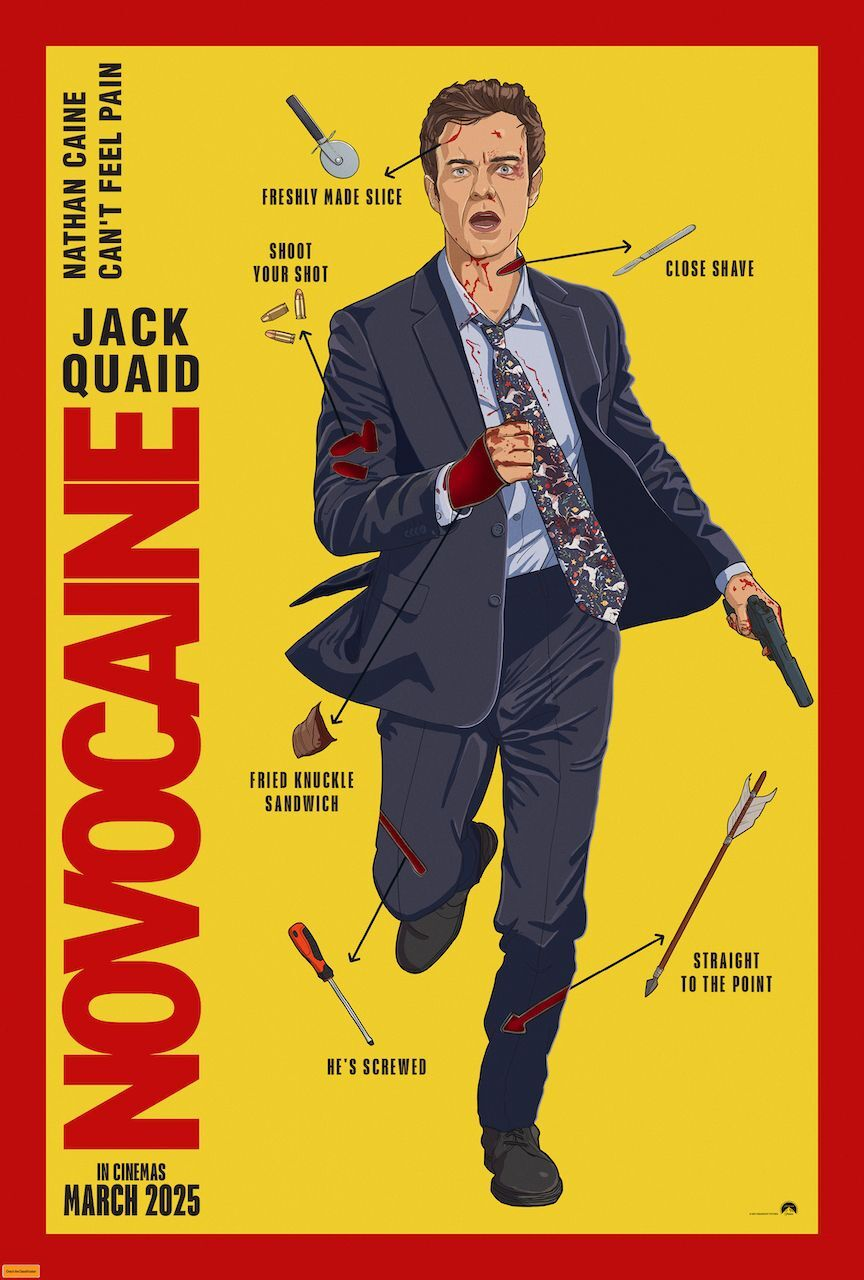
Novocaine

In this increasingly over-the-top action comedy, Nathan Caine is an assistant bank manager who takes manners into his own hands when the girl of his dreams is kidnapped by armed criminals. To make matters both more and less helpful, Nathan has a rare condition where he can’t feel pain at all.

Novocaine takes full advantage of its smart concept, upping the ante in humor, gore, and excitement throughout its runtime. However, it stars off genuinely charming and emotionally effective in its beginning, making Nathan’s arc, and the audience’s investment, pay off. Jack Quaid gives the film its heart, and though the trope of an unskilled, unqualified everyman suddenly thrusted into a deadly action-packed situation has been done to death, the journey feels completely fleshed out and earned here. Quaid has tons of fun leading into the ridiculous and often accidental badassery of his protagonist. Amber Midthunder also gives the film plenty of heart and proves her versatility, and Jacob Batalon is hilarious. Betty Gabriel is also strong as a cop on Nathan’s tail, and even the villains, in all their cheesiness, gives some fun to be appreciated in their performances.

As Novocaine continues to push the limits of the term “over-the-top”, it occasionally stumbles in its story’s believability, but the suspense of disbelief when it comes to the gory action scenes never detracts, just further entertains and may even have your jaw on the floor. The more audacious it becomes, the more pleasing the journey with Novocaine gets. But balancing out the gore and nonsense is a sense of heart with its romance and friendship at its core, with Quaid’s charisma at its center that we can never quite get enough of.

Black Bag

Intelligence agent George Woodhouse is enlisted in investigating his wife, agent Kathryn Woodhouse, for treason, uncovering a web of secrets and deception.

Steven Soderbergh’s cleverest film in years, Black Bag boasts an entertaining cast, an exciting aesthetic, and a story that’s inviting though occasionally overwhelmingly complicated. Michael Fassbender and Cate Blanchett have great chemistry together as a couple with a complex love. Fassbender’s character in particular has an interesting manner to him, and every decision reveals more about the lengths he’s willing to go to. Marisa Abela, Tom Burke, Naomie Harris, and Rege-Jean Page all round out a great ensemble cast, each of whom has unique and intriguing characteristics and flaws.

Soderbergh has tested the limits of filmmaking with a number of his films recently. Though he takes a more traditional approach here, the writing and aesthetic still feel large and thoughtful, with the pace flying by and the turns the story takes becoming more and more exciting. With perfectly cast characters and a smart story, Black Bag definitely ranks high for the director’s more recent efforts.

Mickey 17

Mickey is an Expendable on a expedition to the space colony Niflheim — meaning a new copy of him is printed out every time he dies, which is more often than others. Soon, trouble ensues as Mickey finds himself in a dangerous situation and a fight to survive.

Bong Joon-ho’s likely largest production in sheer scale isn’t subtle in its themes, whether of human nature, fascism, or the arrogant abuse of technology, but it’s still clever, vibrant, and so full of heart, more than enough so to serve as an absolute blast of a film. The look and feel of the sci-fi settings feels original and Pattinson’s delivery of the titular character is likable. Mickey 17 is an insecure man/clone who’s somewhat at peace with the bleakness of his situation, but is fun to follow along and has the sudden urge to stay alive and fight for what’s right. He also has great chemistry with himself as Mickey 18, who’s only a few hours older than 17 but almost the polar opposite — hardened and occasionally ruthless. Naomi Ackie gives the film its soul; she’s so lively and wonderful as Nasha, who elevates Mickey as much as she’s on her own meaningful journey. Steven Yeun also shines as a sleazy and unrealiable but multi-dimensional frenemy of Mickey’s. The parallels between Mark Ruffalo’s character and certain powerful men in our reality aren’t hard to decipher, but he and Toni Collette entertain, even when their performances occasionally threaten to fall into caricature.

Mickey 17‘s magic is finding the humor and gentleness within the darkness. Mickey always sees his situation with a sense of irony, but Bong also finds care and soul within side characters who usually would feel disposable in other films. He never loses sight of the absurdity at hand but keeps elevating the stakes and with it, his signature expert eye. The film packs charm, exceptional world-building, irreverence, and characters we love, not despite but especially for their messiest parts.