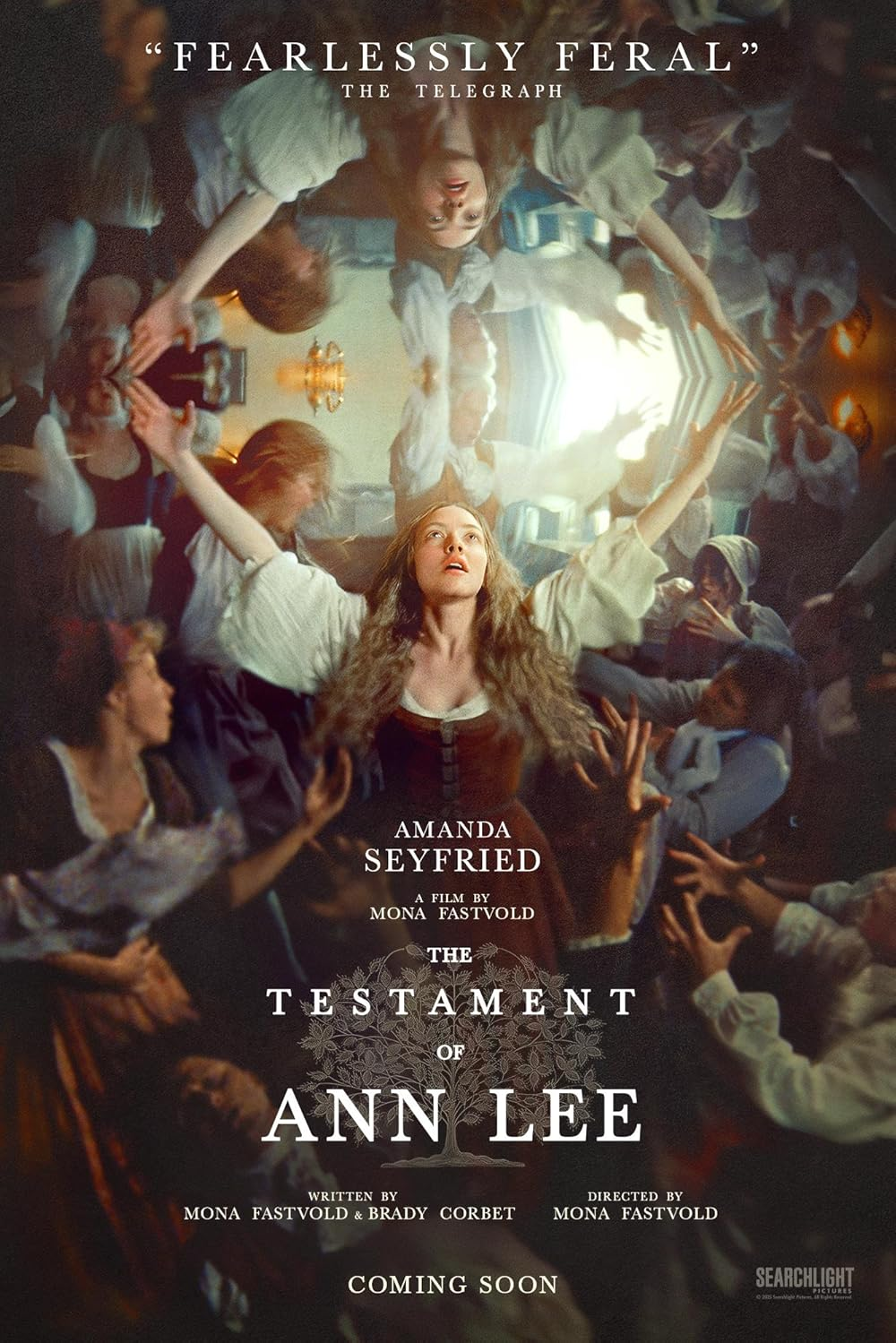
The Testament of Ann Lee

Mona Fastvold’s latest endeavor is almost impossible to describe, but will certainly cast its bizarre spell on many viewers. Amanda Seyfried gives her most potent performance yet, portraying a woman whose faith and guidance becomes relentless in the face of tragedy and hardship. The film brings to light the story of the Shakers, a religious group whose form of worship and communion were rather unique, and compliments the musical element of the film, as their worship is practically in very visceral song and dance. Lewis Pullman and Thomasin McKenzie also greatly stand out here.

The cinematography and the editing make the film almost dream-like, to evoke the state of divinity the worshippers must’ve felt, but also touches on intense and difficult imagery that tests the characters and their surroundings to the brink. Though it’s a slow burn that may lose some for various reasons, it’s also captivating and singular. It works not just as a biopic but as a fascinating experiment that boasts a tremendous leading performance from Seyfried. The film is darkly beautiful and visionary, and it’s impossible to resist its hallucinatory trance.

Is This Thing On?

There’s something pure in seeing the healing nature of art and how it helps people through tough times — but watching a character embrace stand-up comedy means both the audience within the movie and the audience of the film, as in us, gets to laugh, if the movie’s well-written enough. Is This Thing On? hits all the right notes thanks to its funny and vulnerable script and pitch-perfect casting of its two leads.

Will Arnett gives far and away the most wonderful performance of his career, never letting his signature goofiness get in the way of something raw and delicate. The way he finds joy through a new hobby, and many who find that comedy puts just a little beneath his wings, feels so cinematic. Laura Dern is terrific and gives so much to the character’s complexity, and at times the story is very much her own.

Cooper’s direction knows when to be showy and when to close in very intimately, while the script does a great job portraying the complexities of love, even as its practicality and patience fades, and sometimes even reignites. What thankfully subverts expectations is that neither character going through this divorce is “unlikable” or acting in a way that feels to irrational or hard to sympathize with. They can be flawed and distant, but very much easy to care for and understand. Arnett and Dern are splendid together and feel so perfectly matched every second we see them both on the screen. The film has just the right amount of silly yet smart laughs, which never compromise the film’s truthful humanity and intelligence.

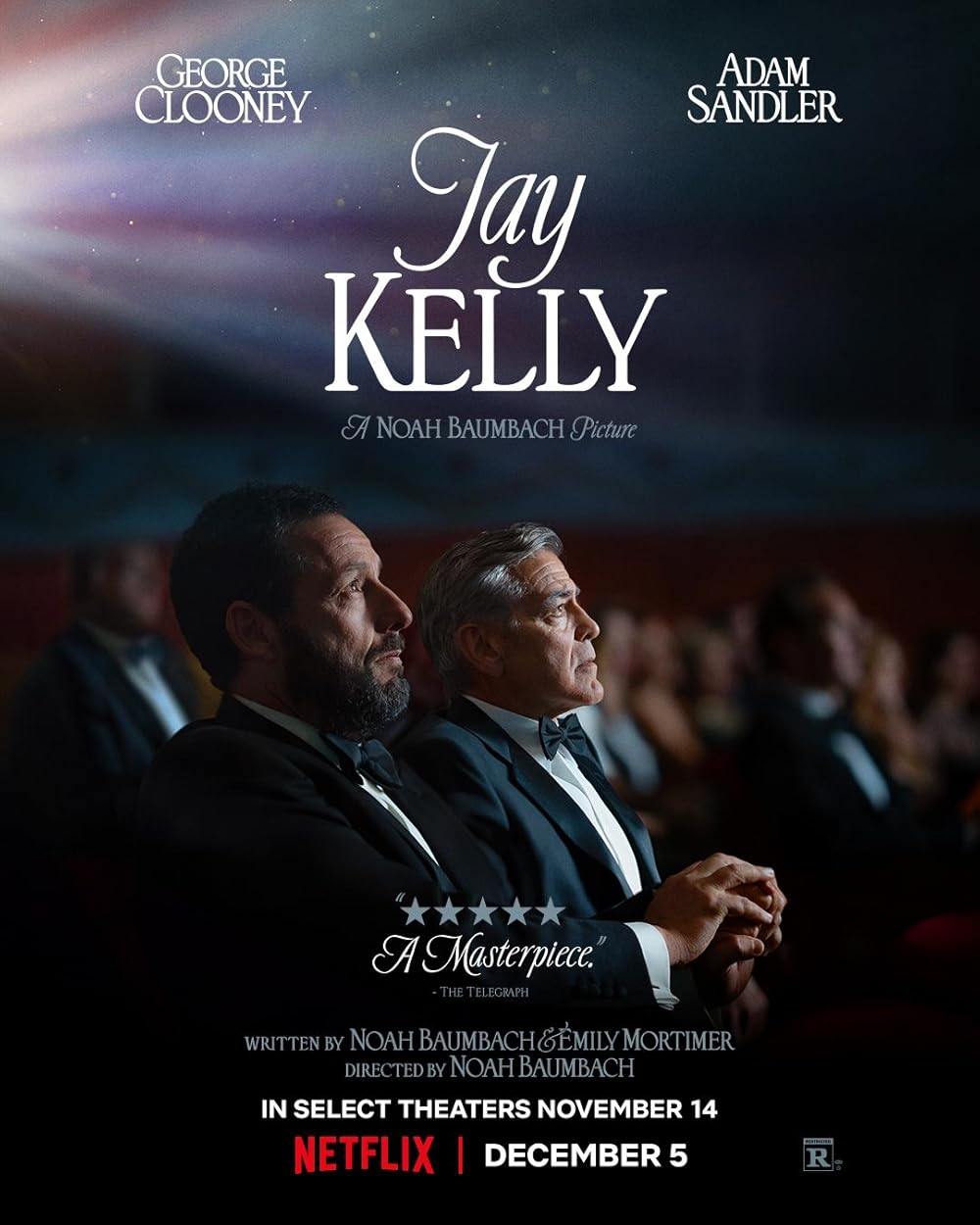
Jay Kelly

Noah Baumbach’s largest film in cast and scale isn’t his best work or even close, but certainly one of his most ambitious. George Clooney stars as the titular Hollywood actor seeking to reconcile with his daughters as he is about to be given a lifetime achievement honor in Europe. Jay’s relationship with his manager Ron is the film’s real heart here, with Adam Sandler not only stealing the entire film but giving one of the best performances of his entire career. Ron is torn between his devotion to his client and dear friend, and the heartache of missing out on time with his wife and kids. Sandler gives the character a dimensional charm, conflict, and vulnerability. Laura Dern is also outstanding as Jay’s publicist, also frustrated as she’s desperately trying to fulfill the impossible role of chasing Jay around and covering for him.

Many other familiar faces give very strong performances here, although Baumbach’s directing here stands out even more than his writing this time around. The film’s approach to memory and distance is very interesting, as is the idea of this “king” finally spending time with ordinary people who perceive him as a legend of sorts. However, the main storyline between Jay and his daughters doesn’t quite have the emotional weight that’s needed, with the themes being a bit too obvious and the film just lacking enough screen time with his youngest daughter to feel the way the movie wants us to about the main father-daughter relationship here. A performance moment and line delivery from Clooney in the film’s final moments, however, elevates the entire film and brings the themes full circle, even if it takes that long for them to really hit hard. Jay Kelly doesn’t live up to the excellence of Baumbach’s best storytelling like Marriage Story, but is still big yet introspective, with Clooney and Sandler standing out together, and the latter’s performance resonating in particular.

Hamnet

In Hamnet, Chloe Zhao seeks the beauty in stillness, and in our flow through the world around us. The film serves as an almost anti-biopic, focusing on the most legendary poet’s inception of one of the most legendary plays ever, though the film isn’t told through William Shakespeare’s eyes — he’s only over mentioned by name once. The center of the film is his wife Agnes, as their love begins a family and interacts with art and time. Jessie Buckley gives a performance that packs such a punch to the gut and demands such dedication in every scene. The relentless devotion of a mother to fight for her kids is on full display in Buckley’s Oscar-worthy turn, as is the anguish of distance and loss. Paul Mescal also digs into a deep devastation as Shakespeare; for him, unlike Agnes, mere love is not enough to satisfy him as he pursues his artistic endeavors in addition to his familial duties. Noah Jupe and his brother Jacobi Jupe, who makes his acting debut, are both incredible in different roles that will stick with you long after the film ends.

Zhao’s filmmaking brings you into an environment that’s calm and safe yet devastating and Earth-shaking, like a lullaby that opens you up into vulnerability, and perhaps even tears. The cinematography by Lukasz Zal is daring and continues to surprise and stun, while Zhao’s deep connection to nature is ever present. The score by Max Richter is captivating and no small part in this masterful experience. Ultimately, the film is about the relationship between love and patience. When people love in such sweeping, and even different ways, love takes its time through hardship, space, creation, and death. Love is tender yet ferocious and enduring in Zhao’s eyes, and her transcendent and meditative film takes us on a profound journey that we may not emotionally disembark for long after it ends.

Rental Family

Brendan Fraser gives an empathy, softness, and delicacy to the lead character, an actor who joins a Japanese “rental family” agency, playing stand-in roles for strangers. He’s the beating heart of the film and allows the audience to connect with every one of his decisions. The movie’s Lost in Translation-like cultural differences raise interesting questions about the titular company and the effect they have on clients, whether positive, negative, or both. The concept is not only unique, but fascinating from a deeper level, and allows for an emotional patience.

However, the film’s editing lacks the same patience as Hikari’s direction, rushing from and to plot points instead of letting the story’s pace and certain scenes breathe and feel more meditative. The supporting cast is really great here, particularly the outstanding Takehiro Hira, Mari Yamamoto, and Akira Emoto. Every part, no matter how small, possesses a special key to the film’s heart. The film embraces its themes about the beautiful risk that comes with living life to the fullest by being there for and with others. However, the final act finds a messy resolution that’s slightly confusing from a thematic perspective. The film works best when it’s subtle, and least when it’s in your face, but thankfully it’s charming, gentle, and will likely work well for everyone who chooses to watch it.

Sentimental Value

Joachim Trier once again is drawn by the quirks, faults, and excellences that drive people towards and away from each other. Sentimental Value is very much about the need to express oneself and tell one’s story, often through art, or discover oneself through it. 

Renate Reinsve shines in a role both subtle yet demanding though never reminds you it’s such. Meanwhile, Stellan Skarsgard finds himself in one of the most powerful roles of his career. He gives a richness to his role, the distant father who in most films would be painted as a humiliation, but rather Trier and co-writer Eskil Vogt make Skarsgard’s character’s journey just as valid as that of his daughters, never trying to make the audience judge whether any of these characters are “better” or “worse” than one another.

Elle Fanning’s character enters this world with fascination, and her character is filled with empathy while avoiding predictable tropes the role could’ve easily fallen into. The film often lets us inhabit a space with these characters in long scenes of reflective — and introspective — dialogue, though sometimes the story takes time to pick up between acts. Once the final act comes, though, it pieces together everything the film had to say about individuals’ need to be spoken and heard through emotional intimacy — with art often being the only way — in a big and resonant manner.

Nuremberg

This accessible and matter-of-fact historical drama is engaging and makes good use of its runtime and central cast. Rami Malek inhabits the role of Douglas Kelley quite well, a psychiatrist brought to assess the mental state of Nazi prisoners convicted of war crimes leading up to the Nuremberg trial. Russell Crowe gives one of his strongest performances in recent years as Hermann Goring, one of the most evil and infamous figures of the Nazi party responsible for carrying out many of the Reich’s atrocities, including Hitler’s plan to conquer Europe and murder millions of innocent Jews and others the party deemed inferior. Crowe’s performance emulates a manipulative coldness that’s hard to read, as the film examines how such ego would respond to losing such immense power, and Malek’s character attempts to find the man’s weaknesses. Michael Shannon gives an excellent performance as Justice Robert H. Jackson, who leads the charge in the trial and remains the film’s most passionate and likable character, though Richard E. Grant does effortlessly steal the screen later on, too. Leo Woodall is solid, but his and Colin Hanks’ characters are slightly underwritten.

The film’s main distracting element is the color-grading that’s oddly dull and dry, even for a film of such hefty subject material. The movie does do a great job, however, of showing the importance of the Nuremberg trials in a broader historical context, and ensuring that such evil would never be enabled again. It also powerfully connects the rise of Nazi ideology to history that followed, including McCarthyism and other far-right movements in America. It’s an interesting watch, if not one of the most resonant recent films about WWII or the Holocaust and their aftermath, led by an all-star cast.

If I Had Legs I’d Kick You

If I Had Legs I’d Kick You digs deep into the darkest corners of the human souls, of the ugliest thoughts that plague our minds, and the crippling anxiety and depression that traps us in the most banal of existences. Rose Byrne gives one of the most demanding, devastating, and furious performances of the last decade, as a woman suffocated by the horror and weakness of her being, confined by the truths of her situation and lacking the strength to find meaning or love in any of it. The remarkable filmmaking and camerawork allows us to pinpoint exactly how Linda interacts with her surroundings, without having to imagine any of what she’s feeling. The dread that anything is about to go wrong, that it’s all your fault, and that this excruciating guilt is forever. The feelings are so tangible to the audience, yet their roots of why she feels responsible for the life she hates are intangible and ambiguous for much of the film. 

Byrne’s character channels universal struggles, including with motherhood, while taking them to the most extreme depths and circumstances. However, we’re never brought to think that she’s a bad person, simply someone who’s isolated and unable to cry for help or carry herself along with those around her. As Linda is inconvenienced with a gaping hole in the roof of her house, the hole metaphorically grows and becomes one with her. 

The final few minutes are haunting and left me dumbfounded. The nightmarish imagery and dark humor play off each other to create a final product that’s arguably more stressful than any horror movie could be. This movie left me dumbfounded and at a loss for words, one of the most anxiety-inducing, uncomfortable, and emotionally raw films I’ve seen in a while. It’s a one-of-a-kind film, with an astounding and unforgettable lead performance, that shook me to my core.

Springsteen: Deliver Me From Nowhere

Music biopics have found themselves a tried and true formula, and though Springsteen deviates from it, it also falls into a few of the same familiarities. Instead of focusing on the Boss’s entire life and on the creation of each and every one of his hits, it’s a quieter film about the recording of his more stripped-down, intimate album Nebraska, that lets us get up close with the man behind the legend. Jeremy Allen White is excellent as one of America’s most iconic and beloved rock stars, capturing the singer’s desire for versatility and personality in his art while struggling with depression. Jeremy Strong, however, ends up stealing the screen in almost all of his scenes. Refreshingly for the genre and the actor, music producer Jon Landau isn’t portrayed as a greedy, conniving villain, but as Bruce’s most reliable and caring friend who’s willing to stand up for his art and vision, even against his own corporate interests. Strong wonderfully captures the delicacy behind the businessman and the relationship between the two is the film’s strongest part. It’s also fascinating to see the old-fashioned ways of recording the songs, some of which have gone down in history, including “Born in the U.S.A.”.

The film does have its weak points, including a romantic subplot that touches on too many cliches, and the traumatic childhood flashbacks, which are rather tiring, though they boast a great performance from Stephen Graham as Bruce’s father. That said, it’s still a refreshingly smaller and far more personal biopic than most, focusing more on emotional journey than big musical numbers, and works thanks to White’s great turn as an American legend.

Kiss of the Spider Woman (2025)

Many films have seen musical adaptations, and then had those musicals adapted into their own films. Some of these musical remake movies have worked as an update to the story, like The Producers and The Color Purple, while others such as Mean Girls and Matilda have failed to justify their existence in the theatrical medium and not offered much new to the material. Kiss of the Spider Woman may have the same main characters and overall premise, but feels completely fresh, exciting, thematically powerful all over again, and even surpasses the original in many respects. The film’s unique approach sees two political prisoners in 1983 Argentina connecting over the memory of an old Hollywood movie, which they recount as a musical, providing them escape from and drawing parallels with their harsh reality. 

Tonatiuh gives a simply incredible performance as Molina, offering a completely new approach from William Hurt’s turn as the role in the 1985 film. Molina desperately wants to be a part of a world that’s rejected him, while believing in the best in others. Tonatiuh commands every single moment of his screen time, as a character telling a story, and coming to terms with his own inner weakness. Diego Luna also gives a career-best performance as revolutionary thinker Valentin, unlocking deep empathy and passion within his impatience and defensiveness. Jennifer Lopez, meanwhile, is playing a character with multiple levels of performance, in a role that may end up becoming a standout in her filmography.

As much as it is a condemnation of the dictatorship that ate away at the soul of Argentina until a few decades ago, it’s also a layered look into the development of a bond between two men who could not be more different, but learn to care about each other profoundly. The songs aren’t all memorable, but the effect the musical numbers create in contrasting between the fantasy and reality of the prison scenes elevates the film, not to mention an unforgettable ending that enriches the entire film, especially with the hindsight since the original film was released.