Celine Song enlists big names and a larger budget for her second feature after the Earth-shattering Past Lives, but this feels like a Celine Song movie first and never compromises for a more mainstream rom-com approach. In fact, despite some great humorous moments and consistent wit from its characters, the movie hardly feels like a comedy, rather a deep and patient romantic drama. Dakota Johnson finds herself in another hard-hitting role among some of her best like Cha Cha Real Smooth and The Peanut Butter Falcon. Her journey is flawed yet always sympathetic. Chris Evans also gives one of his most heartfelt turns in a long time, with the part of John here fitting him like a glove. Pedro Pascal also has some irresistible scenes with Johnson and the dialogue Song gives him to work with really stands out.
The film dissects how modern superficial worldviews complicate the once-simple idea of love and relationships, while romance and love can sometimes not be more different. Song is an expert at rhythmic and sophisticated dialogue, and builds a quiet and meditative atmosphere with a lovely 35mm film look and Daniel Pemberton’s strong score. There may be more than a few films that tackle similar ideas of love and, well, materialism, but it’s only through Song’s words and style that Materialists works so intimately and profoundly.
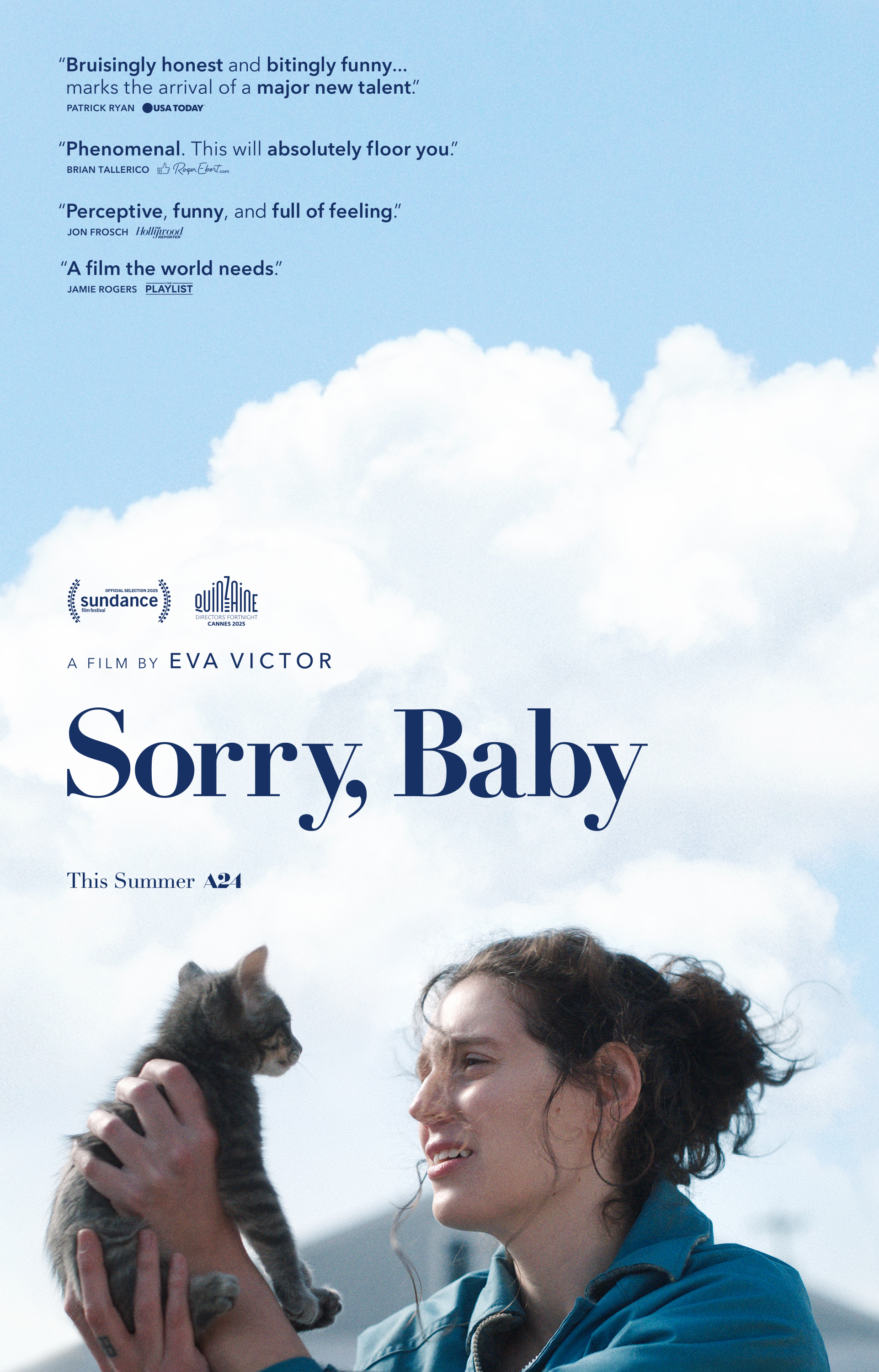
Eva Victor’s revelatory debut film is raw, uncomfortable, and belly-laughing levels of funny. It provides a deeply personal look into a topic that’s far too real, and not only demands but earns the full attention and empathy of all watching.
Victor’s leading performance as Agnes feels real and pierces into your heart, while their charm and comedic timing are always outstanding. Naomi Ackie gives a sweet turn as Agnes’ best friend Lydie, while Lucas Hedges also shines here, as well as John Carroll Lynch in an unforgettable minor role. Victor’s direction and storytelling brilliantly unveil the truth about this film in the first act, while the script continues to surprise you. The humor is sometimes informed by the serious or the awkward. The laughs hit so hard you’ll feel like you’re on your toes — the moment you feel a line will probably be the funniest and most memorable in the movie, its topped moments later.
The film’s unflinching look at sexual violence and the culture around it also ties in to broad themes about time shaping one’s life and soul. The film isn’t optimistic and loving despite the heavy subject matter, but because of its aftermath and the character’s journey to finding purpose again after experiencing something unspeakable. Perhaps by speaking about such things, as the film hints, hope can come through support and redemption. Sorry, Baby is one of the year’s essential watches with a magnificent story and perspective that resonate long after the credits roll.
Imagine peeling back the complex layers of Mike Flanagan’s thematic tissue for a uniquely human tale, devoid of all of his beloved horror and thriller conventions. That seems to be The Life of Chuck’s concern; it’s a cleverly structured film that has the soul of his past works intact, while working more as a psychological drama that has a beautiful wave of positivity rising above some of its bleakness and tragedy. It’s by far his most hopeful work, balancing a great ensemble cast that includes Tom Hiddleston, Chiwetel Ejiofor, Karen Gillan, Mark Hamill, and nearly all of Flanagan’s other regular actors.
The film is divided into three acts, each of which creates an intriguing vignette on its own while brilliantly complimenting the full story as a whole. It finds ways to surprise you with its reflections on human connection — to others and the world — and creating one’s own joy. Each of the three acts recontextualize one another, and it leaves you with poignance while presenting lots of heart. Moments that Flanagan usually plants as a setup for horror can often become bittersweet here but also rather empower and charm. There’s hope, melancholy, sweetness, humor, and dread, yet it stays distinct from the director’s other works in its emotional effectiveness while still remaining something that can please lots of fans of his and Stephen King’s works and adaptations.
Two of New York City’s most notorious organized crime bosses vie for control of the city’s streets. Once best friends, petty jealousies and a series of betrayals set them on a deadly collision course.
Robert De Niro playing an infamous mobster is nothing new. But De Niro playing TWO mobsters? Throw in legendary director Barry Levinson of Bugsy, Rain Man, and Good Morning, Vietnam, now that’s something worth writing home about, right? Unfortunately, The Alto Knights is anything but; a film with maybe some potential on set that was completely butchered in the editing room. De Niro’s dual performance is supposed to fascinate the audience but instead distracts. Frank Costello and Vito Genovese are not presented in the film as being two sides of the same coin, as were the mobster twin brothers Kray, played by Tom Hardy in Legend. In this film, the two mobsters are depicted as not just of different families and mannerisms but of different ages, experiences, and motivations. When De Niro finally shares the screen with himself, it’s impossible to buy these disparities as the script depicts them, rather we buy them more like equals under different heaps of makeup, which was not the intention. As Costello, De Niro is giving something between a less soulful version of his turn in The Irishman, a less extravagant version of his turn in The Untouchables, and a less funny version of his turn in Analyze This. He’s interesting as Genovese, but casting another actor to oppose him would’ve worked better to show that one of these gangsters is actually much more frightening than the other.
The film recycles tired tropes of past popular mob films, and as I’ve alluded to here, many of them already star the great De Niro. Though some scenes are at least mediocre in their execution, the editing is horrendous and makes some scenes unwatchable. The film insists on blasting through most scenes like a documentary montage rather than letting scenes breathe and feel like a thrilling drama. The constant narration and barrages of exposition are condescending to its audience of a normally intelligent genre, but insists on feeding us information we could’ve learned through context clues within scenes. The poor dialogue can’t be salvaged by lacking performances from Debra Messing and Cosmo Jarvis, the latter of whose promising transformation never quite gets to shine. Moreover, there never feels like an escalation of tension or events when there feels like we should be building towards something, rather a lack of setup that also leads to a lack of reward. The Alto Knights starts on a bad foot, and never even hints at a chance to redeem itself. Even De Niro and crime film fans need not waste their time, in theaters or at home.
Bob Dylan as a person has always seemed to be an enigma, as this film’s title hints. But his art has captured, moved, and inspired generations. A Complete Unknown isn’t as interested in cracking Bob’s code, rather portraying him as a complicated man searching to evolve through his music and art, while Timothee Chalamet, over the course of the film, becomes Dylan through his musical commitment and showing both his more grand and uglier sides. He channels Dylan’s layered voice beautifully, while also portraying him as a wild card, who was occasionally destructive towards others on his journey towards fully realizing himself.
Though the film will absolutely make you want to learn more about Dylan’s impact and accomplishments, it’ll definitely have you as eager to discover more about another folk singer as well: Joan Baez. Every time Monica Barbaro graces the screen in A Complete Unknown, she brings an enchantment and captivation in the role, with a singing voice so transfixing you wouldn’t believe she only first learned to sing to play Baez here. Edward Norton shines as the optimistic if fixated and unapologetic Pete Seeger, as does Elle Fanning as Dylan’s love interest Sylvie. James Mangold’s direction, including the shot-on-film look, the production value, and the musical scenes all demand a theatrical watch to experience the folk music being performed with such powerful sound design and aesthetic. Even as someone who was never quite pulled to the genre before, the film makes you feel the power of music in inspiring, changing, and moving others.
Though the first half is rather fantastic, the second half gets so caught up in the stunning musical sequences that the story does unnecessarily slow down, and though the ending is satisfying, there is a little more impact to be wished for. But it still succeeds due to its incredible look and the commitment of its actors, with Mangold yet again proving himself an expert storyteller and filmmaker. The film takes you throughout a moment in time, history, and culture, and makes a strong case for its resonance, and for the awards buzz for Chalamet’s remarkable work as the renowned musician.
I’m Still Here takes place during the tightening grip of a military dictatorship in Brazil, 1971, focusing on a real family that suffered a horrific injustice at the hands of their corrupt government. However, Eunice Paiva emerged stronger than ever from the most unimaginable of tragedies and suffering — as a woman and a mother. Fernanda Torres gives a subtle ferocity to Paiva and the film: a ferocity to both her love and her agony. The film does too good of a job making you connect with the beautiful family of Eunice, Rubens and their children, before their reality is shaken forever. When the film takes this dark turn, you feel the anguish and horror with Eunice, and the impact of this part in the film never quite leaves you, even as the film continues throughout time in her life. Throughout this time afterwards, Eunice’s love preservers throughout grief, and she makes unthinkable choices, that make you think about their unexpected nature.
The film is a reflection of fascism throughout history and its deep-seated ripples on an individual, a family, and a society. The aesthetic evolves throughout the different tones of the film, and though it goes on for five minutes too long at the end, it hits hard with its devastating themes and moving story. It’s a deeply powerful and heart-wrenching film about loss, grief, and the barbarity of fascism made unforgettable by Torres’ leading performance and the difficult yet remarkable subject material.
During the 1972 Summer Olympics in Munich, Germany, an American sports broadcasting team must adapt to live coverage the Israeli athletes being held hostage by a terrorist group.
September 5 is an expertly crafted, tense docudrama set only in the ABC control room, and it’s this restraint, or visual distance from the actual violence, that makes the unfolding of events and revealing of information so much more impactful. Peter Sarsgaard gets to let out an unfiltered side to his character which is fun to watch, while John Magaro gives a wonderful performance in the lead, as the character who serves as the audience’s gateway into this situation and makes us ask what we would do when presented with such dilemmas. The film is so gripping not just because it focuses on a real-life historical tragedy, but because it’s rooted in the human soul of its characters. September 5 is about when humanity and journalism cross, and asks questions about journalistic ethics, and why people are so attracted to such spectacle and horror on the news. Each character’s decisions comes from a place of humanity and conflict, and we understand every perspective, even when they differ.
Most importantly, September 5 feels like it’s not only bringing you into a horrific event from 50 years ago, but heavily mirroring the present, especially viewing the film as a Jew and Israeli. It’s a riveting and urgent film about the role of broadcasting and storytelling in our lives, well making its audience reflect on the ripples of such violent and provocative images captured and shown to the world. It’s a tightly paced, gripping, and emotional film about the dangerous responsibility for the truth that’s a thoughtful and powerful experience, whether or not you’re already familiar with the tragic events of that day.
Better Man chronicles the rise, fall, and resurgence of popstar Robbie Williams, with a twist: Williams himself as depicted as a CGI monkey. This odd approach threatens to distract at times, and works better conceptually than in execution. However, this musical biopic rises among the crowd of forgettable tellings of famous musician’s lives through its vivacious musical sequences and booming soul. Williams, who narrates the film himself, doesn’t let himself off the hook, inviting us into genuine introspection of his ugliest parts: his insecurities, self-destructiveness, addiction, and depression. Michael Gracey’s direction puts everything in his last grand musical film The Greatest Showman to shame within minutes — the lively numbers, dynamic camerawork and choreography make the visual style bombastic while remaining intimate with Williams’ core as a man, not just his journey as a famous singer.
The effect the main character being a CGI chimpanzee has is occasionally jarring and even laughable at worst, but at best, creates an interesting visual experience compared to films with similar plots, and brings you into Williams’ imposter syndrome and self-perception. However, one can’t help but think the gimmick would’ve worked stronger if it had only lasted for one scene. Still, the film is such a breath of fresh air in that it tackles familiar points and themes from the genre on a far more up-close manner, such as feeling trapped by fame, or being numbed by addiction. Non-fans will want to learn much more about Robbie Williams’s story and learn more about his story. Fans will greatly enjoy Williams’s songs being elevated by such beautiful sequences and appreciate a bold and eccentric yet humble, emotional, and entertaining biopic.
A Real Pain beautifully balances the heartbreaking and hysterical through the dynamic of Jesse Eisenberg and Kieran Culkin as cousins David and Benji, who travel from New York to Poland together on a tour in memory of their deceased grandmother, a Polish Holocaust survivor. It’s about so many things, whether big or small. From a Jewish perspective, the film powerfully touches on complicated feelings of nationality towards countries in which one’s family lived but suffered horrific atrocities, as well as generational trauma. As someone who has embarked on this tour myself, the film captures not only the visceral nature of walking into places where such evil was committed eight decades ago (which both I and the characters here came to feel, wasn’t even that long ago), but the deep emotional connection towards one’s ancestors, community, and people it invokes.
From a personal perspective, the film is also very much about empathy — the idea of feeling others’ pain, and sadness, to better understand and connect with oneself. Kieran Culkin in particular brings such harsh complexity to his character. Benji is fascinated with human connection and constantly in pursuit of embracing living life with all his senses, but doesn’t always know how to feel, or express himself to others. Even when he pushes others away and embarrasses himself, the audiences can’t help but hold him close to their heart and feel deeply for him in every moment, because of his desire to grieve for his grandmother, and true yet misguided desire for the best. Eisenberg, in one of his most substantial and beautiful performances, wonderfully conveys David’s pull to and from Benji — his responsibility yet resentment towards the way Benji feels, which comes from a distance and envy from him, yet a dear love for him. Their bond is as moving as it is poignant, and even irreverent, and best of all, it’s easy to connect with them both as an audience member, despite how wildly different they are. Eisenberg’s script is devoted to his love for his Jewish heritage and culture, and exploration of the human condition that may even make you reflect on how you live your life. He and Culkin together make for a wonderful pair in a film that’ll take you on an emotional journey filled with weight and resonance.
Rachel Morrison impresses in her touching and exciting directorial debut. The film focuses on Claressa Shields, the only American boxer to win a gold medal at the Olympics — let alone at age 16!
Morrison’s energetic style and the vibrant soundtrack give a Creed-like energy to The Fire Inside, a film that portrays the city of Flint as the ultimate underdog and gives the audience characters we can really interact with and understand, even if we don’t always agree with them, such as Claressa’s parents. Ryan Destiny shines in her first major role, giving Claressa Shields a titular fire and rageful drive to win that makes her fascinating and lovable.
What makes the film worth the price of admission is watching Brian Tyree Henry work his magic in an awards-worthy powerhouse of a performance. As Claressa’s coach Jason, Henry not only extends an enduring tough love that anchors the film, but makes the audience fall in love with the character and wish for him to be our coach and grounding force. Henry’s one-of-a-kind humanity and charm makes Jason lovable and riveting, and we as an audience deeply care for him and understand his decisions even when Claressa might not.
As for the film as a whole, there are many familiar beats to other sports and boxing films that it touches on, but it never loses its heart and engagement and even subverts the typical uplifting sports film structure to show that its true soul was in this coach-student relationship that feels like so much more to us. It’s not going to rank among the greatest boxing pictures, but surely is worth a watch for a feel-good story.









 filmtoppings.com