The Deetz family returns after a family tragedy to the old home they left behind in Winter River. But Betelgeuse returns into their lives — just as Lydia Deetz feared — when her daughter Astrid accidentally lets the dead loose.
The long-awaited sequel to one of Tim Burton’s films that’s best stood the test of time — and one of his most purely fun — comes over 35 years after its predecessor. It offers the same classic Halloween feeling audiences enjoyed about the first film, and more of pretty much everything else that movie had as well, for better or worse. The music, comedy, and practical effects all work just as well so many years later, and there’s even another phenomenal musical number. It’s delightful to see Michael Keaton, Winona Ryder, and Catherine O’Hara back in their roles, and just as great at them. The heart of the film comes from O’Hara and Jenna Ortega; O’Hara’s goofy yet conscious grandmother provides so many laughs and her energy as an actress stands out, while Ortega perfectly brings a deadpan charm that’s visibly intrigued but not too shocked at all the insanity she’s yanked into.
The humor often hits the mark, including the titular character’s outlandish remarks and plenty of physical and cynical comedy in typical Burton fashion, but the movie does make a few missteps as the runtime goes along. Its most glaring one is introducing an antagonist played by Monica Bellucci in an incredibly strong first scene for the character, and then hardly utilizing her until much, much later. Though the mother-daughter dynamic between Ryder and Ortega is sweet, the overall objective of the story becomes muddled in the later act. It won’t pack any surprises for fans of the first film, but is entertaining and good-hearted enough to offer some creepily comic fun.
While scavenging the deep ends of a derelict space station, a group of young space colonists come face to face with the most terrifying life form in the universe.
Alien: Romulus distances itself from much of the story of the other films, to create a contained haunted house/spaceship thriller. The film manages to give us enough interesting characters to attach us to the action and root for certain ones to make it out, though a few others are simply irritating. Making the premise about a “heist gone wrong” makes it feel unique and gives the film a more fun hook than expected. Cailee Spaeny, who needs no introduction at this point, is not only a terrific lead but perhaps the best person who could’ve played this role, flawlessly balancing the terrified and badass sides to Rain without feeling like Ripley, Shaw, or Daniels 2.0, giving a protective and resourceful edge to her strength. David Jonsson gets a lot to work with as Rain’s surrogate brother Andy, and Isabela Merced absolutely owns her screen time with the terror her character goes through. I mean, who can blame anyone for reacting in such horror after looking at a Xenomorph for the first time?
The effects of the creatures are seamless and innovative, and the gore that unfolds throughout the runtime does not relent or let you feel safe. Though it takes a bit to get going, the thrills get more and more innovative as we explore deeper and deeper through the titular space station. Though it’s often visually stunning, including shots of asteroid belts, planets, and spaceships, the darker lighting makes the shots not quite as gorgeous to look at as Prometheus and Covenant. It embraces enough of the formula that’s made past films work while finding enough in this story to induce curiosity and excitement. It thankfully stands on its own but the action scenes may end up ranking high for fans of the franchise, and ultimately deliver the sophisticated mix of science fiction, action, and horror that have made these films, 45 years later, still feel gripping and cool.
Though A Quiet Place worked best due to its minimal cast and remote settings, this prequel works strongly by embracing the chaos of a Manhattan monster invasion, and the desolation left behind, with that large scale terror that made Cloverfield such a cultural stamp. Michael Sarnoski, who directed the excellent Nicolas Cage drama Pig, effortlessly manages to replicate the beautiful tension and almost melodic sound design that John Krasinski distinguished this franchise with in the first two films. Though this film isn’t as heart-racing and emotionally fine-tuned, it’s still got a fantastic protagonist and captivating thrills. Though it’s very well-filmed when focusing tightly on its lead characters, there are a few unnecessary cuts to wide shots that do harm that tension, even if just for a moment. If any actress can command an audience and emote in a way as brilliantly as Emily Blunt — well, that would clearly be Lupita Nyong’o. It’s impossible to look away when she’s on the screen, as her character expresses instability yet empathy that carries the viewer with her from the film’s very first shot to its last. Joseph Quinn also shines, delivering an inconsolable fear to his character that’s also aligned with his courage and generosity.
The film’s real experience comes from use of sound — the amplification and implications of certain sounds compared to others in the mix takes you on a ride of sorts and keeps you on the very edge of your seat. It cleverly paces itself and uses its wider settings, but never sacrifices the mystery that made this franchise great: that all of civilization and hope might just be lost to these deadly creatures beyond what we see. It’s different enough from its predecessors to justify its existence as a spin-off prequel, and conceptually similar enough to continue playing with the idea of sound-hunting monsters and near-silent human leads in exciting and satisfying ways.
A couple (Anya Taylor-Joy and Nicholas Hoult) travels to a coastal island to eat at an exclusive restaurant where the chef (Ralph Fiennes) has prepared a lavish menu for the affluent guests, with some shocking surprises.
The Menu is an original, tense, and hilarious time at the movies with Ralph Fiennes’ best work in years. Fiennes absolutely kills it as a man who’s controlling and intimidating yet vulnerable and easily provoked. Anya Taylor-Joy is commanding as possibly the only character you may find likable, but that’s completely intentional from the end of the script. All the other actors, like Nicholas Hoult, Hong Chau, Janet McTeer and John Leguizamo are all integral and sneak up on you with moments that are key to the film’s themes and attitudes. Mark Mylod’s stellar direction alludes to his time on Succession with the themes about the snobby and incredibly rich, caught in their pretentious attitudes that they shove onto everyone. Combined with the suspense and occasional bursts of violence, as well as the lavish production design and structure of the high-end kitchen that parodies itself more and more, this movie has one of the most hysterical screenplays of the year. The style feels modern yet sophisticated, irreverent yet deep, and has something for those looking for an eerie and fresh thriller or a sophisticated dark comedy-drama with something to say about the world of art, as well as artists and critics who take themselves way too damn seriously — which gives it a meta angle that boosts the fun even more, and ultimately makes this one of the year’s best moviegoing experiences.
OJ and Emerald Haywood are siblings who own a ranch in a lonely gulch of inland California, where they train and handle horses for movie and TV productions. Soon, they bear witness to an uncanny and chilling discovery.
To call Jordan Peele a unique filmmaker of our time would be an understatement — he’s blended genres and used them to incorporate thoughtful social commentary into the most mainstream popcorn entertainment, all while giving audiences films that can satisfy, challenge, and entertain. Nope is no different. It’s a science fiction-horror-thriller-comedy with a modern infusion of likable characters and borderline surrealist world-building, and Peele’s filmmaking is at the level of the most respected auteurs like Stanley Kubrick. It’s got moments of shock, laughter, brutality, and terrifying humanity that adds so much astonishment to a film that starts with what could’ve been an overused premise in anyone’s else hands. Daniel Kaluuya has evolved into a modern film star of his generation — though he’s starred in Black Panther and won an Oscar for Judas and the Black Messiah, it was Peele’s debut Get Out that guaranteed his stardom. He’s a master at being funny but showing a character confront with real and inner “demons” in a silent way but always being a fun character too. Keke Palmer has a contagious, bubbly energy and I’m sure the entire cast and crew had plenty of laughs due to her fantastic delivery of her lines that often sneaks up on you in hysterical ways. But she’s also a genuine hero, not to mention Steven Yeun and Brandon Perea who are scene stealers.
Peele’s style always challenges genre, structure, and how the audience expects to react to things. His stylistic energy in Nope invokes eyes staring in awe, jaws dropping, and mouths smiling all at once. Due to this, Nope transcends accessibility for fans of horror, and is a top-notch film for all fans of big-screen spectacle, because it never settles for just being a horror movie. In it’s own way, Nope is a piece of art, that’s not meant to give you easy answers or leave you comfortable. Like Peele’s last movie Us, there’s so much to debunk as the thematic elements often drive the filmmaking in his movies. This one addresses many things, but among it, humanity’s flocking to images chaos and danger, and our obsession with getting as close to death and trauma as we can while wanting to arrogantly cheat the effects they may have on us, should our endeavors to harness danger go wrong. The movie is also a tribute to filmmakers and crew members in positions we don’t often acknowledge, and the achievements of black contributions to cinema that aren’t always celebrated. In a way, Peele uses this movie to celebrate the invention of cinema but also warn about our roles as audience members and monetizers of content that’s both real and adapted from truth. With it, he creates the most daring and awe-inspiring summer blockbuster possible that I’m sure will inspire many to create and challenge the world of films the way he has.
Following the events of the predecessor, the Abbott family now face the terrors of the outside world. With both A Quiet Place and its sequel that’s now playing in theaters everywhere, John Krasinski has proven himself to be not only an awesome actor but a master filmmaker. It worries me whenever a studio greenlights a sequel to a great film that stands alone perfectly, but A Quiet Place Part II is one of the rare occasions where the sequel lives up the original, and not only that, but along with that 2018 film, is one of the best horror/thrillers of recent years. A lot of it is thanks to Krasinski’s direction and the style which made the concept and storytelling of the first film so memorable. The opening sequence is nail-biting and even though the violence is kept at a PG-13 level, the film knows where and how to scare most effectively with showing and not showing certain things. For example, we see scenes from characters’ perspectives so the aliens and action aren’t always in the frame but sometimes in the background. The cinematography and editing are great as well, but it’s the sound editing that makes the movie. It’s the small noises that make you terrified for the characters as they try to survive among creatures who can track them based on any small noise from a distance, and the sound creates its own tension without a single jump scare. The loud sound effects of the monsters contrast this excellently and make this a terrific theater experience.
Emily Blunt may be at her best in this series as a mother trying to protect her kids, including a newborn, from otherworldly threats that are a family’s worst nightmare. Cillian Murphy is also excellent as a new addition to the cast, a cynical, hopeless survivor who is changed by his time with the Abbott family. Millicent Simmonds, the deaf actress who plays the deaf daughter in the film, may be the film’s heroine as she takes on challenges courageously and delivers a stellar performance, with not only some of the most positive deaf representation I’ve ever seen in film but all around a brilliant actor and lead role. Noah Jupe, who plays the son/brother, is again excellent, and he’s proven himself with these films as well as his magnificent roles in 2019’s Ford v Ferrari and Honey Boy. And even with just a cameo, Krasinski himself makes his presence felt throughout the film, passing the courage and good-ness of his character from the last film into his children and the world of the movie. Beyond the brilliant scares, which are only strengthened by techniques such as cross-cutting that Krasinski marvelously uses to make scenes more powerful and symbolic, the film retains the heart that made its predecessor so emotional — in every frame and line, this is a movie about a monster apocalypse, but also about parenthood, family, human survival, and hope. And one can’t help but think that with a family taking back their world by venturing back into the unknown and fighting back against the apocalypse, it’s a perfect film to represent our return to theaters. I, for one, had not been to the theaters since Tenet last August, when some screens briefly reopened, and this is an impeccable choice to return to the big screen with for the thrills, sound, and amazing effects and story that will more than satisfy those who know what they’re in for, and for the shared experience we’ve been longing to have back and can finally experience for a new blockbuster once again.
Twenty-seven years after their first encounter with the terrifying Pennywise, the Losers Club have grown up and moved away, until they must return to Derry and band together once again when their worst fear returns.
The massively hyped duology adapting one of Stephen King’s most beloved and terrifying novels comes to a close with It Chapter Two, following the mighty success of the first It. In the first film, a group of kids banded together and formed the Losers Club, using their camaraderie and their heart to defeat the being that feeds off their fears, but now that same being has returned and summons them back together as adults. The leading cast is great, including James McAvoy who shines as Bill, a fearless kid from the first film who led the group, though his on-and-off stutter make his performance slightly confusing. The standout was certainly Jessica Chastain who blesses the screen with her marvelous presence yet again, with her range, from joy to remorse to terror, all make Bev a standout character once again. But also worth noting is SNL alum Bill Hader in what’s definitely his best film role ever, playing the hilarious Ritchie who also gets more layers as the film progresses. Also impressive is Bill Skarsgard as Pennywise, although this time around, he has less moments to strike fear into audiences again.
It Chapter Two‘s main strength definitely lies in its cast, as well as the theme of how being together is what helped these people become their best selves and overcome their fears. However, where Chapter Two stumbles is finding merit outside of what viewers already learned in the first film. There’s a lot of flashbacks to the Losers Club when they were kids, but above that, it seems like Warner Bros. felt like they kept having to remind us what the first movie was about, resulting with the pacing being dragged down with repetitive scenes of Pennywise taking advantage of each individual member through their fears — both through flashbacks and present day scenes. Of course every character needs layer, but extending the runtime so long to the point where they had to bring back nearly every plot point from the predecessor feels unreasonable and tiring. The movie keeps treading this same ground for a while, reminding us for too long about the character relations, arcs and events from the first film, until it ultimately becomes a rehash of that movie. It brings back every character including an irritating side character who we thought was gone for good but wastes screentime here with an awful performance. Above all that, there are less horror scenes that will catch the viewer’s attention, although a very note-worthy scene is a terrifying moment in a mirror maze that I cannot spoil.
When the climax finally arrives, it takes place in the exact same location as the first movie’s final standoff, has the exact same “villain tactics” or obstacles as last time, and ends with the same theme yet an even tackier resolution. There’s also an awful subplot thrown in about a ritual that must be performed, and it goes too deeply into the origins of “It” instead of subtly dropping hints that would leave us guessing. There’s a moment in the film where an old woman tells Bev that her “father joined the circus” — the camera then pans up to a picture of a man in the early 1900s near a sign that says “Pennywise” — this is a perfect example of planting small clues about It’s origin, but it didn’t need to actually reveal the whole deal to us, which slightly undermines the mysteriousness and threat of the entity. What director Andy Muschietti unfortunately did not understand is that less is more, when it comes to storytelling. On the contrary, this film becomes unreasonably long and repetitive without finding as much of a purpose or effect as the first did two years ago. If this one didn’t feel the need to be as long as The Hobbit or Interstellar I could definitely see a slightly more effective story coming out without forcing the audiences through too much of the same thing over and over again.
It Chapter Two feels more like an epilogue to the last movie than a sequel or its own film. There are certainly some touching themes and great cast members — especially the wonderful Jessica Chastain and the hysterical Bill Hader. However, there are definitely less memorable horror moments for the general audiences, but worst of all, Chapter Two fails to justify itself as its own film, rather borrowing all the ideas from the first film and saying, “this is how they deal with this stuff, but this time they’re older!” I was definitely looking forward to this but looking back now, the first It certainly holds up just as well as its own story, and this may just be another case of Hollywood stretching out existing franchises beyond a breaking point. Perhaps this follow-up would have worked better if it was actually released 27 years from now, where relying on nostalgia from the first film to craft another crowd-pleasing success may had actually worked instead of just remaining a myth inside of the Warner Bros executive’s heads that makes a for an often tedious and familiar three hours.
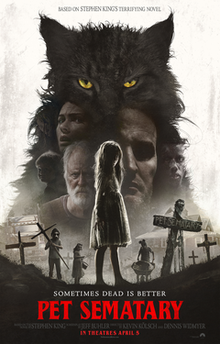
Dr. Louis Creed and his wife, Rachel, relocate from Boston to rural Maine with their two young children. The couple soon discover a mysterious burial ground hidden deep in the woods near their new home.
This latest adaptation from a work of genius author Stephen King proves to be a missed opportunity. The trailers teased something dark, unpredictable, and memorable, but what we got instead was a terribly written film with poor direction and no attempt to fulfill any promises it sets up. The film has some nice atmosphere building in the start, but ultimately falls into too many horror cliches, like the family moving to a new place for a “fresh start”, and the older, wiser, “exposition dump” character who conveniently knows everything. The marketing not only gave away every surprise there as about the movie, but made me believe this would be a brutal and unsettling horror film. Unfortunately, there are few truly scary moments and every important death happens either off screen or too dramatically to be taken seriously and emotionally. Jason Clarke’s acting never stands out, and he’s an actor who’s unfortunately found himself stuck in the limbo of playing the boring characters in reboots, and like I said, John Lithgow is just there for exposition purposes. There’s also an arc for the female lead which becomes super repetitive and involves unnecessary flashbacks that provide the only possible scares this movie had. There’s also some aspects, like a frightening opening hinting at a cult of some sort or more resurrected animals or people, but this buildup ends up leading nowhere. Pet Sematary ultimately becomes frustrating in its climax and I was happy when it was over. It unfortunately fails to dodge any cliches of the genre and misses out on any emotional response it could have gotten out of its audience, which is disappointing because I had hopes for this one. You’re best off watching the trailer and leaving it there, because the 2-minute teaser was far more entertaining than the actual film was. Let’s hope the King adaptations improve when It: Chapter Two and Doctor Sleep are released in the fall.
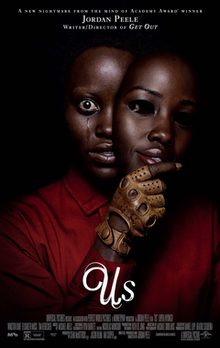
This horror film follows a family whose summer trip to a beach house is interrupted when a family that looks exactly like them shows up at their door.
Jordan Peele follows up a victory with another one that should be praised for its own reasons. Though it’s a very different film than Peele’s Oscar-wining horror film, Us is an all-out nightmare that will get under your skin like no other mainstream film ever has. Not only is it more frightening than most horror films, but it’s so meticulously crafted and strongly directed by Peele, who make his care for characters and root for them to survive within an instant. From the very first shot of a girl watching television, Peele already plants clues for what’s to come, followed by an opening credits shot that’s simple but will give you chills. He wonderfully builds every shot to contain mystery and intrigue, that will make you never stop guessing what will happen next. He builds shots hide and show certain things and wonderfully makes the doppelganger characters frightening antagonists for the viewer. Lupita Nyong’o delivers two main performances that feel very different but both are spectacular in their own route. She convincingly acts terrified in many instances, but also changes her voice and achieves many feats in numerous scenes tin which she will blow you away. The violence is uncompromising but a blast to watch if you can watch graphic imagery without flinching, as the fight for survival is always thrilling and unpredictable. However, there’s also great moments of comic relief thrown in there, which delivers while still feeling like a full-on horror film. But above all the fright and entertainment, there’s some true shock thrown in, especially towards the end. Peele leaves the message and themes of the film open for discussion, as opposed to more obvious racial commentary in Get Out , while the meaning of Us will be debated for years. Not to mention a plot twist that will go down as an ending for the ages.
Jordan Peele has not let down expectations and is an established horror genius here in Hollywood, promoting true originality and terror in his films. With strong writing and acting, as well as plot devices and themes that can be analyzed for years to come, there’s so much to say about this new horror masterwork that I’d rather not ruin and let you discover for yourself.
Forty years after she was attacked by a masked killer, Laurie Strode prepares for the return of Michael Myers so she can end his murderous carnage once and for all.
After several sequels that were poorly received by critics and audiences alike, the most recent film in this slasher franchise retcons all the sequels’s continuities, disregarding them and acting as a direct sequel to the 1978 classic. The movie delivers on the promise of intense sequences elevated by the frightening presence of Myers, and effective tension throughout these horror scenes. The blood and gore is also fittingly strong to amplify the fright of a masked murderer coming after these characters, with some nice cinematography and tracking shots as well. However, even though it’s quite entertaining to watch, most of the jump scares are pretty predictable and a lot of these scenes fall into familiar tropes. Jamie Lee Curtis reprises her role and does a terrific job as Laurie, bringing a layered character to the screen in every scene she’s in. The aspect that hasn’t been seen before is the PTSD Laurie faces and how she’s willing to go to far lengths to prepare herself and her family for the inevitable return of her greatest fear. The way Curtis portrays a woman affected by an incident even decades later and how she’s always looking over her shoulder, ready to bravely face the villain of the story is done very strongly. If only the movie focused more on her, as lots of the film cuts to uninteresting side characters that don’t serve a purpose to the main story and aren’t portrayed very well. Sometimes the movie doesn’t stick true to the promise of being the story of Laurie facing Michael one last time and instead focuses more on developing character who do nothing other than fall victim to Michael’s killing spree. The plot also basically follows the structure of the original and we can tell what the final showdown will be like even before the movie begins. Halloween has plenty of fun scares and effective violence that will entertain horror fans but it borrows too much from the structure of the first film and doesn’t try much that’s new from the overall horror movie formula, and could’ve used more focus on its compelling protagonist.





 filmtoppings.com