Intelligence agent George Woodhouse is enlisted in investigating his wife, agent Kathryn Woodhouse, for treason, uncovering a web of secrets and deception.
Steven Soderbergh’s cleverest film in years, Black Bag boasts an entertaining cast, an exciting aesthetic, and a story that’s inviting though occasionally overwhelmingly complicated. Michael Fassbender and Cate Blanchett have great chemistry together as a couple with a complex love. Fassbender’s character in particular has an interesting manner to him, and every decision reveals more about the lengths he’s willing to go to. Marisa Abela, Tom Burke, Naomie Harris, and Rege-Jean Page all round out a great ensemble cast, each of whom has unique and intriguing characteristics and flaws.
Soderbergh has tested the limits of filmmaking with a number of his films recently. Though he takes a more traditional approach here, the writing and aesthetic still feel large and thoughtful, with the pace flying by and the turns the story takes becoming more and more exciting. With perfectly cast characters and a smart story, Black Bag definitely ranks high for the director’s more recent efforts.
Companion might fall apart if you think too much about plausibility, but that’s not the whole point. It starts out as a “getaway” thriller like any other, but soon things go, well, incredibly south. There isn’t much I can say beyond that because the story and its unfolding take so many unexpected directions that elevate the enjoyment of watching the film. Not to mention, it’s incredibly funny. Sophie Thatcher continues breaking into the thriller genre amazingly, giving her all to what the character needs. Jack Quaid is also fittingly cast as a seemingly “nice guy” with more insecurity under the surface. Rounding out the great supporting cast are Harvey Guillen and Lukas Cage, who nail the comedic timing and pitiful complexities of their characters.
The editing, comedic timing, music choices, and thrills elevate Companion above a few minor writing missteps towards the end. It’s entertaining while smart, with some outrageous dialogue and very well-filmed sequences and production value. It’s not the first modern film to try the satirical horror-thriller approach to issues of masculinity and toxic relationships, even in the last few months, but does it cleverly and with so much fun, including the humor and twisted violence, that it wins you over from start to finish.
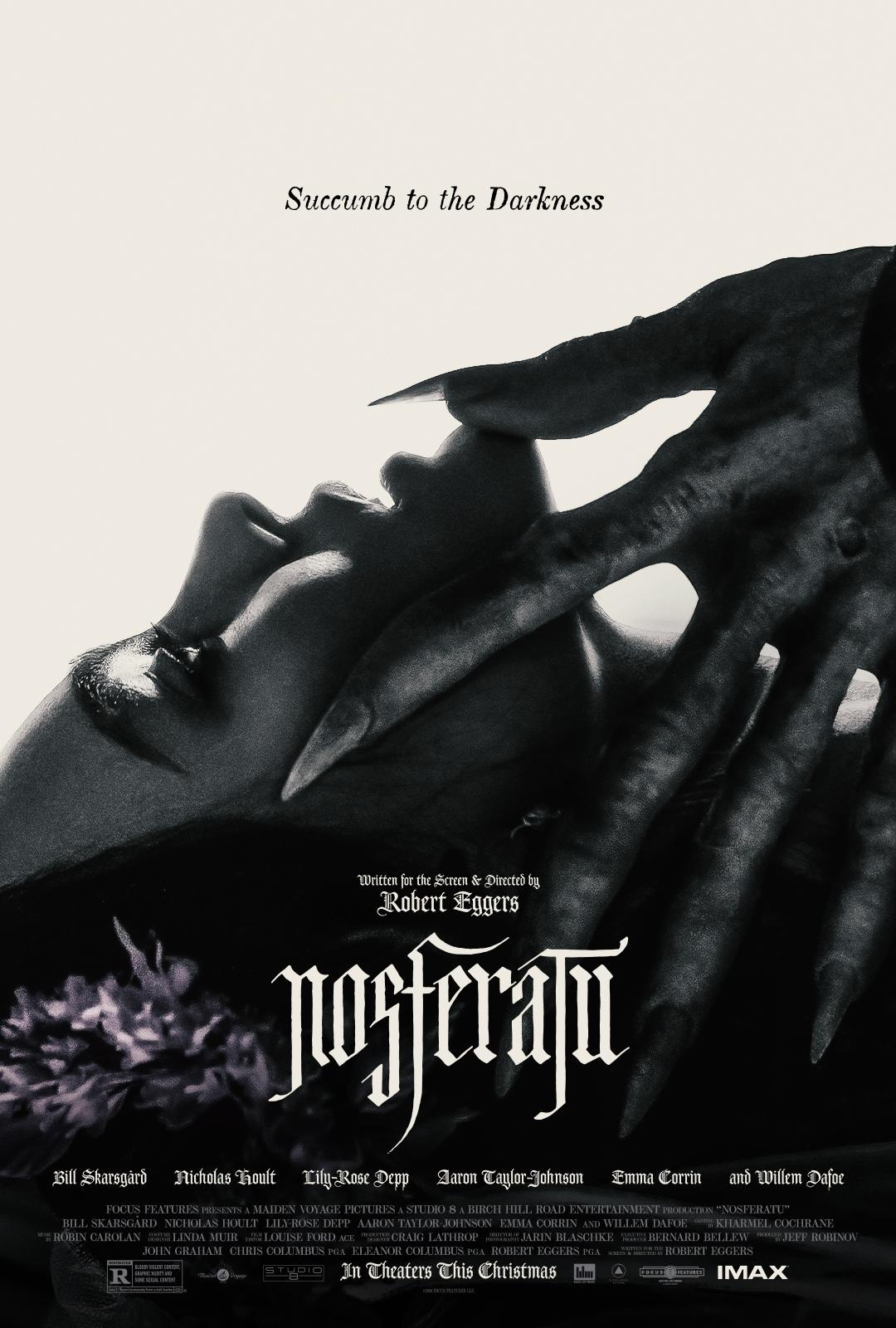
Out of all the reimaginings of the tale as old as time that is Dracula, none have been quite as chilling and outright transfixing as Robert Eggers’ Nosferatu. Eggers captures beautiful simplicity yet utter darkness in the film’s breathtaking imagery, as well as deeply terrifying sequences of gothic horror. From the jaw-dropping opening scene, the film captures its audience in a sense of heart-stopping fear that never ends until long after the credits roll. Jarin Blaschke’s cinematography wonderfully uses imbalanced lighting, gloomy color schemes, and silhouettes to create something that looks timeless. Every shot evokes a feeling of an ancient evil’s presence that’s about to be awoken and get ahold of what we’re looking at, which is exactly what happens with Count Orlok. Bill Skarsgard is unrecognizable under stunning makeup and changes his voice to create a towering and skin-crawling vampire, who’s face we wisely don’t see in close-ups until much later on. Lily-Rose Depp is a scene-stealer whose performance is so astounding that if you stop to realize it’s acting, it becomes hard to comprehend the sheer levels of physical and emotional commitment required — Depp never makes you question it once. Though the film cleverly shifts main characters between her and Nicholas Hoult, she’s the film’s beating heart and muscle.
Eggers expands on all his trademark oddities as a filmmaker, making us feel helplessly entranced. It’s nail-biting, gory, and does not hold back on scares and twisted, graphic content. The director feels in complete command of the style, whether the score, production design, or material, that digs into ideas of masculinity, obsession, and self-deception, without needing to overexplain what it’s truly about. Though I was dreading what was about to happen between the main characters and the titular vampire, I could never look away; I was deeply unsettled yet never wanted the experience to end, knowing I was in such good hands. No matter whether you know the story beats or not, there’s genuine shock and brilliance in every scene’s execution, breathing new life into a story that felt like it was always meant to fall into Eggers’ hands. It’s masterful and haunting, like watching a gorgeous fever dream that keeps building and building until an unforgettable final act. You may be going for the cast, the monstrous scares, or even just the cinematography — individually, they’re remarkable, yet together, the parts create a spellbinding whole.
When two Mormon missionaries arrive at Mr. Reed’s house attempting to convert them, they find themselves stuck there in a game of wits, fighting for their lives.
When two Mormon missionaries arrive at Mr. Reed’s house attempting to convert them, they find themselves stuck there, fighting for their lives.
Heretic doesn’t play out with the typical levels of jump scares and macabre we’re used to from horror films these days — rather it’s a battle of wits in which the characters contemplate belief, religion, and faith… oh, and an adult man is terrorizing two young women as they’re held captive in his house, which becomes a maze of puzzles related to his disdain for their faith. Hugh Grant is rather terrifying as Mr. Reed here, but he’s clearly having such a delightful time in the character’s skin. He’s as threatening as you can imagine a mysterious man in his 60s alone in a large house but also has plenty of outlandish and hilarious dialogue. Some viewers simply looking for an intellectual dark comedy could most definitely find satisfaction in watching Heretic. You also genuinely care about our two protagonists. Sophie Thatcher and Chloe East both bring cleverness to the film, a willingness to challenge their captor, and not break down and quit. Thatcher brings a rebellious sense of mystery to Sister Barnes, while Chloe East is heartfelt and capable as Sister Paxton.
Though Heretic takes some time for the uniqueness and thrills to set in, it stands out from other recent horror films thanks to its restraint on its scares, as well as its smart screenplay and chilling villain. The three performances are integral and lift up the film’s shocking fun, and may even make you think about some big ideas all while you’re enjoying this dark ride.
After inciting violence, murder, and chaos in Gotham City, Arthur Fleck is institutionalized at Arkham, where he faces trial for his crimes — and perhaps the love of his life.
It might still be that there’s no reality in which a sequel to Joker makes sense. Joker felt so fresh compared to other IP-driven blockbusters when it was released, but also provided a sense of shock when it ended. Folie à Deux is a confused sequel that left me feeling nothing. Perhaps a radical decision like making this follow-up a jukebox musical is exactly what it needed to justify its existence, but a movie this ambitious is also too cowardly to take large enough swings or hit hard as a musical. The two main ingredients that work here are Joaquin Phoenix’s performance, which is still incredibly committed and breathtaking at times, and the gorgeous cinematography by Lawrence Sher, which embraces different colors and a grand sort of look to its prison scenes. However, it’s a bad sign when you wish such a legend like Phoenix was spending his time and talents elsewhere rather than helping Warner Bros. milk this character, which won him an Oscar the first time around.
One of the things that inherently doesn’t work about the concept of a Joker sequel is that we don’t have that gateway of sympathy into Arthur’s world when we meet him; he’s been dejected and abused by the world around him, but by the time this movie starts, he’s already done his awful deeds, and it’s hard to feel anything for him in this one’s opening act. Without that fascinating entrance into this world of sorrow and sadism, it’s hard to really feel anything watching the movie. Lady Gaga’s casting is inspired, but the film itself doesn’t do her and the character justice. Why make the singer of a generation whisper lots of her singing or not give her something more substantial than to pine over Arthur? In a psychological thriller about two insane criminals that turns into a musical, the numbers couldn’t afford to be this safe and scared. They feel like they’re holding back and are too concerned with convincing us they are set in the characters’ heads rather than leaning into surrealism and ambiguity. The music scenes don’t feel like a trip, or like they’re unlocking something about the characters and the film that can’t be backtracked on, they’re just breaks with song, and that’s what makes this risk feel so frustrating and timid. Not to mention, we don’t feel like we learn anything new about Arthur that wasn’t already established in the first film, nor anything original about the justice system, the mass hysteria around violence, or society’s outlook on poverty and the mentally ill.
Joker: Folie à Deux is a film that, unlike the masterful and already iconic first movie, has no identity of its own, because it’s too scared to commit to its giant leaps. As a courtroom drama, it’s derivative. As a romance, it’s painfully undercooked. As a social commentary, it’s tiring. And as a musical, it’s just too dim. By the end, nothing really transports, terrifies, or resonates, and worst of all, it fails to answer the most important question of why another chapter to this story.
Waitress Frida meets cocktail billionaire Slater King at his fundraising gala, and the next thing she knows, she and her friend Jess are invited to join him and his friends on a dream vacation on his private island. But reality starts to close in on itself when strange occurrences start to happen to Frida.
Blink Twice is as colorful as it is relentlessly violent, reality-bending, and darkly humorous in the most horrific of situations. Naomi Ackie is amazing in what starts as her loosest and most charismatic performance to date, but soon she grips us when she has to act shocked, horrified, and straight-up puzzled for most of the movie. Channing Tatum was perhaps perfect for the character of Slater King, whose mask of cluelessness and charm makes him appear apologetic and soft with the right edge of craziness. Adria Arjona also particularly shines, throwing subtle comedy into pressing fear and paranoia. The film not only has a vivid look and energy, it’s also got genuine intrigue to its mystery, even if you might know where it’s going. It’s a film in the vein of Get Out, The Menu, Fresh, and even Last Night in Soho, and I’m not here to say it’s incredibly different or original compared to other modern dark satirical comedy thrillers like those. Its social and feminist undertones wouldn’t have left as much food for thought if not for the memorable mood and tone debut director Zoe Kravitz brings. Every single cast member is memorable, even if their characters don’t have much under the surface, and motifs like nail polish, a jazz song, or other seemingly harmless objects stick out to the mind. The way the editing reveals things as a sudden retrieval of memory by the mind is also masterfully done. The violence is a lot to watch but culminates in some macabre pleasure that allows for that release of audience excitement, and the movie doesn’t overstay its welcome at all either. Blink Twice is a dark and relentless thriller that takes its time to set the groundwork for the insanity that’s to come in the final act, and once you reach the end, you’ll feel that the buildup was completely worth it.
While scavenging the deep ends of a derelict space station, a group of young space colonists come face to face with the most terrifying life form in the universe.
Alien: Romulus distances itself from much of the story of the other films, to create a contained haunted house/spaceship thriller. The film manages to give us enough interesting characters to attach us to the action and root for certain ones to make it out, though a few others are simply irritating. Making the premise about a “heist gone wrong” makes it feel unique and gives the film a more fun hook than expected. Cailee Spaeny, who needs no introduction at this point, is not only a terrific lead but perhaps the best person who could’ve played this role, flawlessly balancing the terrified and badass sides to Rain without feeling like Ripley, Shaw, or Daniels 2.0, giving a protective and resourceful edge to her strength. David Jonsson gets a lot to work with as Rain’s surrogate brother Andy, and Isabela Merced absolutely owns her screen time with the terror her character goes through. I mean, who can blame anyone for reacting in such horror after looking at a Xenomorph for the first time?
The effects of the creatures are seamless and innovative, and the gore that unfolds throughout the runtime does not relent or let you feel safe. Though it takes a bit to get going, the thrills get more and more innovative as we explore deeper and deeper through the titular space station. Though it’s often visually stunning, including shots of asteroid belts, planets, and spaceships, the darker lighting makes the shots not quite as gorgeous to look at as Prometheus and Covenant. It embraces enough of the formula that’s made past films work while finding enough in this story to induce curiosity and excitement. It thankfully stands on its own but the action scenes may end up ranking high for fans of the franchise, and ultimately deliver the sophisticated mix of science fiction, action, and horror that have made these films, 45 years later, still feel gripping and cool.
Though A Quiet Place worked best due to its minimal cast and remote settings, this prequel works strongly by embracing the chaos of a Manhattan monster invasion, and the desolation left behind, with that large scale terror that made Cloverfield such a cultural stamp. Michael Sarnoski, who directed the excellent Nicolas Cage drama Pig, effortlessly manages to replicate the beautiful tension and almost melodic sound design that John Krasinski distinguished this franchise with in the first two films. Though this film isn’t as heart-racing and emotionally fine-tuned, it’s still got a fantastic protagonist and captivating thrills. Though it’s very well-filmed when focusing tightly on its lead characters, there are a few unnecessary cuts to wide shots that do harm that tension, even if just for a moment. If any actress can command an audience and emote in a way as brilliantly as Emily Blunt — well, that would clearly be Lupita Nyong’o. It’s impossible to look away when she’s on the screen, as her character expresses instability yet empathy that carries the viewer with her from the film’s very first shot to its last. Joseph Quinn also shines, delivering an inconsolable fear to his character that’s also aligned with his courage and generosity.
The film’s real experience comes from use of sound — the amplification and implications of certain sounds compared to others in the mix takes you on a ride of sorts and keeps you on the very edge of your seat. It cleverly paces itself and uses its wider settings, but never sacrifices the mystery that made this franchise great: that all of civilization and hope might just be lost to these deadly creatures beyond what we see. It’s different enough from its predecessors to justify its existence as a spin-off prequel, and conceptually similar enough to continue playing with the idea of sound-hunting monsters and near-silent human leads in exciting and satisfying ways.
A journey across a dystopian future America, following a team of military-embedded journalists as they race against time to reach DC before rebel factions descend upon the White House.
Alex Garland is often not one to shy away from dark images as they unfold, but there’s something particular about the violence in Civil War, as if you’re peeking at something you’re not supposed to, only it’s happening in your own yard. Garland seems to have something to say with the “action” here that’s proven itself in reality too much not to struck a chord when it’s depicted way — Americans being just a few disagreements (and arms) away from completely tearing each other apart. What began this second civil war in America is none of our concern, rather the ease at which we’ve turned on the very fabric of democracy. Bloodthirsty militias and anarchists seem too familiar a sight, though we’re following this dystopian war through a group of journalists. Kirsten Dunst gives a powerful performance, as she reveals the most about her character in the quietest of moments. Wagner Moura also gives the film a lot with his charismatic, knowledgeable, and authoritative presence among the protagonists. Cailee Spaeny is notably wonderful as the ambitious younger photographer on the journey who’s horrified responses to what unfolds in front of her are probably how we’d react to, let’s face it. Stephen McKinley Henderson is a fantastic presence as well who adds a lot with his wisdom and charm to each of Garland’s projects that he’s in.
Though Civil War is minimal on exposition as to the larger politics of this war — rather we get an idea of the state of the nation through smaller moments and remarks — the action is incredibly harrowing and graphic. The sounds of gunfire and combat roar through the speakers, and blood is a “loud” reality and consequence. It all plays out without the “cool” sort of filter many Hollywood action movies have, rather it’s an unfolding of sheer chaos and carnage through intentionally amassed manpower, in the way that Children of Men and Sicario throw you into uncontained, senseless warfare. Best of all, the climactic battle at the center of the third act is exhilarating and ends in the most Alex Garland rug-pulling way possible for a film with this subject matter. Fans of Garland’s daring and mature work be interested in the punch he packs here, but for anyone who’s simply looking for an action film — this one’s singular and profound but does not hold back, and when it’s untamed, it’s at its most engrossing.
Oliver, a student at Oxford University, finds himself drawn into the world of charming and aristocratic classmate Felix, who invites him to his eccentric family’s sprawling estate for the summer, where lust, infatuation, and envy ensue.
Emerald Fennell’s new film may not be as socially relevant as Promising Young Woman, but it’s even more daring as it presents a world in which everything is just a little crazier than our own. The world of Saltburn is drenched in beautiful colors thanks to the remarkable cinematography, and Barry Keoghan gives a psychopathic performance — not his first of the sort, but it feels like everything his acting career has built up to. The production design subtly symbolizes Oliver’s journey in the film into becoming something he’s not, but soon you may believe he’s really shedding his skin and showing his true self. Jacob Elordi gives a charismatic performance that dominates the screen just as his character Felix is made to feel like he owns every room he enters. The chemistry between the two men treads the line between friendship, adoration, and unhealthy obsession. Rosamund Pike also gives a highlight performance as Felix’s mother, who’s caring yet eccentric and even stuck-up, and Archie Madekwe and Richard E. Grant round out the rest of this great cast.
Fennell has created a truly unique experience here that never quite tells you if it’s a college party film, a social satire, a psychosexual thriller, or something completely new. The depths Keoghan’s character goes to and the twists and turns you’ll embark on in this fever dream won’t be for everyone, but those who will welcome a film that surprises you, gets under your skin, and makes you not want to look away, Saltburn delivers on the unexpected fronts in a darkly flashy, twisted, and expertly directed and filmed movie.