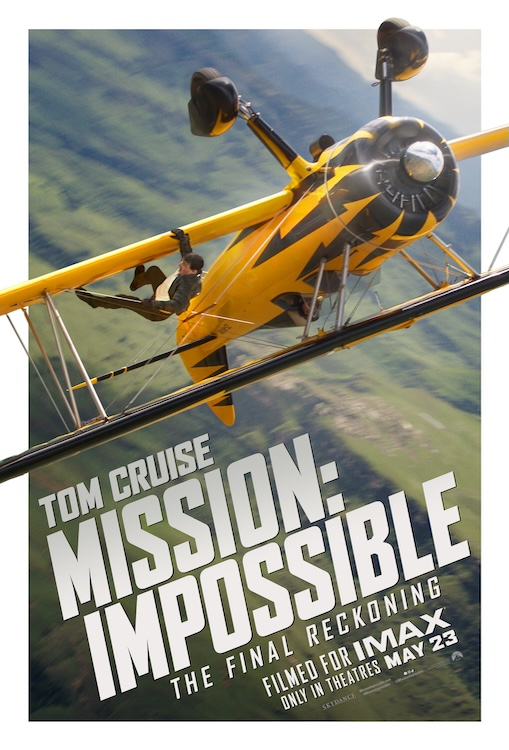
Mission: Impossible – The Final Reckoning

One of the most notoriously enormous franchises ever in scale comes to a close with its most ambitious installment yet. Tom Cruise’s practical commitment to the action is again breathtaking, especially the set pieces including planes and submarines. Christopher McQuarrie and Cruise are again dedicating everything to creating something gigantic that warrants the moviegoing experience, with nail-biting stakes, jaw-dropping sets, and stunning direction. It’s got a genuine feeling of danger, that the team’s loss could result in truly destructive consequences. It also pushes Ethan to the brink of his values and abilities, as each last film before it has challenged how impossible of a mission he can actually go up against, as well as personal decisions he is faced with. The ensemble cast surrounding him is great, particularly Simon Pegg, while Hayley Atwell sometimes feel pushed too far into the mix to stand out as much as she did in Dead Reckoning and Esai Morales’ villain this time lacks the presence that was felt from him in that film. The standout from the supporting players is definitely Angela Bassett as President Erika Sloane, whose relationship with Ethan Hunt becomes deeper and more complex with their new dynamic of power and the situation at hand.

In an attempt to tie past installments into this finale, the editing does become bloated, with excessive flashbacks to clips from those past films to clarify details most viewers either already know or didn’t need to be shown. Sometimes a quick dialogue exchange or even context clues can give viewers who don’t remember 7 films worth of lore the background they need, but though at times this method is excessive, it becomes rather disorienting. Not to mention, the script is also at times hard to follow, with the logic that needs to be pieced together to follow the story sometimes happening at light speed and may only be completely taken in on rewatches,. Some plot threads feel under-explained when others are given too much explanation. Despite these story and editing issues that are especially prominent in the first hour, the second half is so incredible to watch and some of the stunts feel like a once-in-a-lifetime moment in their realism and scope, and the story arcs continue to escalate until they finally come to a hard-hitting close. It’s ultimately an exhilarating and satisfying conclusion that may not be the best Mission ever, but it’s certainly the biggest and a must-watch on the most massive screen you can find.
The Fall Guy

Colt Seavers, a down-and-out stuntman, must find the missing star of a new blockbuster film he’s doubling on, while (hopefully) winning the director (and his ex-girlfriend)’s affection back.

David Leitch continues to be a leading voice in action movies with his creative and passionate voice for action and comedy that often turns out star-studded and visually appealing. Much of the film’s charm comes from Ryan Gosling’s brilliant turn as Colt. Like his Oscar-nominated Ken in Barbie, Colt is a sad shell of a “cool guy” who’s too evidently madly in love. Gosling’s comedic timing is at the lightning speed of his Ken, or Holland March from The Nice Guys, and his big personality infuses Colt with a foolishly endearing heart. Emily Blunt also gives one of her most entertaining performances of late as the romantic lead, and Winston Duke is also loads of fun as Colt’s best friend and the film-within-a-film’s stunt coordinator, while Aaron Taylor-Johnson, Hannah Waddingham, and Stephanie Hsu also round out the stellar cast. Waddingham in particular is very extravagant but delightful as Gail, the producer of the film Colt’s working on.

The most clever and thrilling part of The Fall Guy is that Leitch makes the movie stunt-filming scenes as high-stakes and exciting as the actual action scenes of the film. The great scale, dedication, and sound effects make shooting an action movie stunt feel like the incredible, hard-achieved feat that it really is. Additionally, the lightspeed humor feels effortless thanks to the writing, editing, and the cast’s delivery. The lively soundtrack does have a few generic and overused selections, but it’s not enough to sink this smooth romantic action comedy where all the different genre pieces play off each other pitch-perfectly. The director’s career as a stunt coordinator is made evident by the love and tribute to the stunts community here, in this blockbuster that’s hilariously pleasing and greatly worth the big screen price of admission.

The Ministry of Ungentlemanly Warfare

Guy Ritchie’s latest action film is loosely based on true, mostly encrypted stories, in which the British military recruits a small group of highly skilled soldiers to strike against German forces behind enemy lines during World War II.

Guy Ritchie seems to be racking out more movies than some of his fans will be able to keep track of, but among a slew with varying qualities, this one may end up being looked back at as one of his most entertaining films ever. Ritchie imbues the screen with an Inglorious Basterds-like irreverence to its Nazi-killing action. The WWII battles are swiftly edited and have action sequences that’ll make you cheer with glee at the bad guy body count and the different ways they get killed by the titular heroes. Henry Cavill leads the pack with a similar irreverence he gave Ritchie’s The Man From U.N.C.L.E., but with an even rougher edge to his badassery. The ensemble of Eiza Gonzalez, Alan Ritchson, Henry Golding, and Cary Elwes all give the film a liveliness that makes up for a lack of uniqueness to them, as well as a menacing Til Schweiger who maintains a strong presence. Unlike last year’s Operation Fortune, the film’s witty humor matches the extra wicked energy the director is known for, but it may lack character depth for some viewers. Most of the characters have little substance besides “recently incarcerated” or “they’re crazy”, but their outlandish personalities make up for that in the case of this film. The soundtrack choices aren’t always on-point, but the Western-inspired music usually adds to the film’s sharp direction. The film also doesn’t manage to always balance the different moving plots seamlessly, as Ritchie sometimes can’t help but indulge too much in his trademark banters which can sidetrack, but ultimately culminates in some strong tension in the third act. The Ministry of Ungentlemanly Warfare perhaps achieves what Matthew Vaughn’s The King’s Man failed to do — turn covert misfit spies into World War heroes and make the journey feel exciting and earned on the way. Ritchie is no stranger to the approach he set out to achieve here, but he manages to balance out his quirks with an excellent style, an interesting mission and cast of characters, and a rewarding catharsis when the action and comedy hit their peaks, as you might not want the fighting to stop out of sheer Ritchie delight.

Ghostbusters: Frozen Empire

The Ghostbusters have reestablished themselves as the heroes of New York City, but the city soon faces its greatest threat yet when an ancient artifact unlocks a destructive force.

Ghostbusters: Afterlife was a solid tribute to the heart of the original film. This sequel has all the ingredients with none of the direction. The cast still has that charming energy, particularly the Spenglers played by Carrie Coon, Finn Wolfhard, and McKenna Grace (with Paul Rudd stepping into the new stepdad role). Grace is the most interesting part of the film, but her role as the protagonist is watered down by an overabundance of characters. Dan Aykroyd, however, is very enjoyable in his role, as is Ernie Hudson, but the film tries to balance too many of these people, and the original cast ultimately was only there for fan service in a lesser way than the last film. Not to mention, Kumail Nanjiani is usually a standout in any film, but his character here is uninteresting, save for a few laughs. The action has some fun a bit of a retro vibe, with solid SFX editing as well, but the film’s runtime wanders through C-level subplots and the pacing lacks a consistent excitement. When we finally get to the villain, its yet another faceless ancient giant with apocalyptic intent, and the visual effects of the ghosts are also quite lacking. Ultimately, the film settles for a lot of the same, but its the sluggish pace that makes it a lot hollower and not as lively or meaningful as before. This may just be another instance of a beloved franchise going on for one too many films.

Monkey Man

An anonymous young man unleashes a campaign of vengeance against the corrupt leaders who murdered his mother and in turn, soon finds himself empowering the poor and victimized of Mumbai.

Monkey Man is proof that no matter how overdone a simple revenge story is, it can always feel fun if the right filmmaker elevates it through energy and style. And Dev Patel’s directorial debut proves that he’s capable of making not just a fun action film, but one with lively world-building and interesting characters. The action is bloody and jaw-dropping, with rewarding long takes and soundtrack choices that elevate the fights. But most importantly, when the action isn’t there for a long time, I always found myself engaged in the story. Similar to John Wick, it also doesn’t romanticize its hero, rather just empowers him to do the wrong things for the right reasons, justifying his ends rather than his means, which gives the film even more of a ruthless edge. The long takes may feel dizzying for a moment, but soon work in the film’s favor to create some exhilarating carnage. The incorporation of Indian culture and mythology, as well as MMA in the film also give the film plenty of life. Patel’s performance is committed and shows once again how much he can command an audience when he’s front and center, and his direction gives the film a vibrant yet patient style. Unlike the majority of the year’s action films so far, it treats its audience like intelligent adults. Monkey Man‘s greatness isn’t just through the expert fight choreography, but also through strong character and mythos development. Other action films this year so far like Road House and Argylle were simply missing that nuance and restraint with its heroes and villains that makes this film one in which we don’t feel talked down on, no “fake-out deaths” or “exposition dumps”, but rather a stylish build to the excitement that lets you breathe, yet still takes action movie fans on a thrilling ride that ends on a satisfying high note.

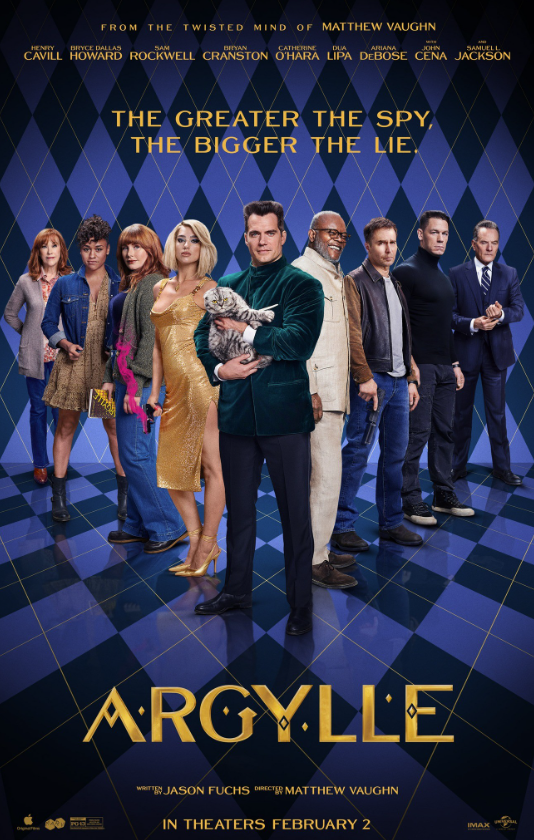
Argylle

Elly Conway is the reclusive author of the Argylle spy novels . Soon, she realizes the plot of the new book she’s writing starts to mirror real-world events, as a global spy syndicate starts to come after her.

It’s always a blessing when Matthew Vaughn gives us a glimpse into his twisted mind with his witty and bombastic action scenes, and Argylle has a few of those, but it’s everything else that disappoints. Vaughn directs with a love for spy material and cartoonish entertainment mixed with modern, meta flare. The script, however, completely misses the mark and looks the commanding energy that his Kingsman had. Even Sam Rockwell, whose charm and goofiness often comes effortlessly, has to work with dialogue that falls flat and the attempts at humor don’t manage to illicit a response. Though Henry Cavill has some fun and Bryce Dallas Howard tries her best in the leading role, there’s more left to be desired in Ariana DeBose, John Cena, and Samuel L. Jackson’s screentime. Bryan Cranston’s villain may be the weakest link of the cast, as everything he’s given to do is annoyingly generic.

The movie’s downfall is also its ambition, which is often what lifts Vaughn up above the rest. The ludicrous twists are executed in a head-scratching way, and all the film’s rules or explorations of fiction vs reality are thrown to the side for more frustrating decisions that make its lead character less interesting. The pacing also suffers greatly in the film’s second half, the end of which sees us getting a few of those glorious scenes of carnage Vaughn’s known for, which still feel softened compared to what they could’ve been due to the PG-13 rating, but are delightfully exaggerated and have great soundtrack choices. By then, however, the journey to get there is simply exhausting and it may be too little, too late for many viewers.

Argylle is a massive disappointment in which a singular director brings his trademarks to the screen yet again, only this time without the laugh-out-loud glee or the clever script that usually support his vision. Its ambition unfortunately exceeds its grasp, and its inconsistent and convoluted execution make this invitation to take the world a little less seriously with Matthew Vaughn a sadly unrewarding one.

Napoleon

Two decades after receiving his first Oscar nomination for Ridley Scott’s Gladiator, Joaquin Phoenix reteams with the legendary director for another epic action film about one of history’s most famous (and infamous) generals. Scott delivers on the promise of a Napoleon epic filled with spectacle. The action sequences are clearly committed and the best of Scott’s approach. The grandiose definitely comes through particularly in two famous battles; the violence does get a laughably gratuitous in certain occasions, though. Phoenix’s central performance captures Napoleon’s larger-than-life presence without romanticizing his historical grandeur, showing his ruthlessness and narcissism having led to countless deaths through his wars and invasions. His performance makes his screentime interesting, but sometimes the political dynamics drag and other scenes fall into unintentional camp or lifelessness when the battlefield isn’t the centerpiece. His relationship with Empress Josephine (Vanessa Kirby) is an interesting but also generic storytelling catalyst as well. The music and editing feel particularly poor in the film’s execution and rather unfitting. Though it’s cool to see the 158-minute film cover Napoleon’s entire life and rise to power, it also robs the film of any intimate tension that a film like The Last Duel benefitted from. Sometimes it feels like empty spectacle, and the muted color palette may distract in the wider shots, too.

Still, Napoleon benefits from its production value and immense storytelling among a historical icon’s rise and fall, and seeing a 2.5-hour Ridley Scott Napoleon epic may be all we really needed and were asking for. With the engaging action and lead performance that carry some of the film, it delivers on those fronts. However, it isn’t a must on the big screen and may still deliver the same entertainment when you watch it at home, as the grandiose on its own may be the saving grace for those who end up liking it.

The Creator

In a future where humans have gone to war with artificial intelligence, Joshua, an ex-special forces agent, is recruited to hunt down and kill the “Creator”, who has developed a mysterious weapon with the power to end the war.

Seven years after the release of his last film Rogue One: A Star Wars Story, Gareth Edwards arrives with what feels like a visionary action film that feels parts Blade Runner and Avatar. The visual effects come together seamlessly to create a world that’s set in the distant future but might not be so far-fetched considering attitudes on AI in these times. The humans, robots, and hybrids all blend together in the frame and the robots’ movements look so smooth you’d believe they look exactly like that as they interact with other items in the screen. Not to mention the pitch-perfect cinematography from Greig Fraser and Oren Soffer that creates a mood that’s stunning yet violent, in-camera yet out of this world. John David Washington makes becoming one of the generation’s coolest action stars look effortless, and Allison Janney is surprisingly great, as well as the always delightful and nuanced work of Ken Watanabe. Madeline Yuna Voyles delivers a great breakout as a powerful AI child, though her relationship with Washington’s character doesn’t really click until later on, and even then feels a little derivative.

Though structurally you will occasionally encounter familiarity, the film takes a unique approach to the conflict between humans and artificial life, and visually it’s like nothing out there right now. Though the plot turns may be predictable for many viewers, it has a flare and liveliness to the action that not many other action movies this year had. More importantly, it feels even more special today as it’s one of the only theatrical action/sci-fi blockbusters of this scale without any source material/IP that’s been released in the last few years, and that’s worth commending and supporting. But whenever this had been released or viewed, Gareth Edwards’ inspired direction solidifies him as someone who’s in love with the worlds his movies imagine as much as the stories they tell on the page, and The Creator would make you want to invest in anything he puts his stamp on next.

A Haunting in Venice

Hercule Poirot attends a seance at the suggestion of his friend, mystery novelist Ariadne Oliver, who wants to expose a medium as a fraud, but a murder occurs and Poirot must get to the bottom of what seems to be an impossible deadly truth.

Though Kenneth Branagh has seemed to find a formula that works in his slew of Agatha Christie-based films in which he directs himself as the iconic detective, he also wisely ditches the CGI-heavy look of the last two films for a more intimate setting within a darkly lit Venice palazzo one stormy Halloween night in 1947. Though the cast has more weak links this time, Jamie Dornan, Kyle Allen, Jude Hill, Michelle Yeoh and others deliver interesting performances, with Tina Fey being as cocky and entertaining as you’d expect her to be as a writer in the 1940s who’s friends with the Hercule Poirot. It embraces some of the visual and tonal aspects of gothic horror but cleverly doesn’t fully indulge in the genre and remains a solid Whodunit murder mystery, although the pacing still has its slow moments. As I said before, the less “obnoxious” or massively cinematic style helps it better establish a darker mood and a murder mystery that feels contained and believable, and delving just enough into the concept of spirits to feel unique compared to the last two, without throwing too many supernatural elements at you. In other words, it’s another delightful Poirot mystery that never quite surpasses the description of satisfactory, but still fun enough for a watch.

Mission: Impossible – Dead Reckoning Part One

Ethan Hunt and his IMF (Impossible Missions Force) team must track down a dangerous weapon before it falls into the wrong hands.

Mission: Impossible is a franchise that has my utmost respect for how much it aspires to keep daring and topping what came before. Each of the last four installments have delivered unforgettable action scenes and helped redefine the franchise, so Dead Reckoning does… just that. And seven movies in, it’s still got a phenomenal amount of excitement to go along with the loud, immersive action. Tom Cruise commits to the massive action set pieces in a way that’s audacious, commendable, and likable. With the various locations, vehicles, weapons, and lighting styles, Christopher McQuarrie has proven himself to be a top-tier action director of the 21st century with this and the last two installments. Not to mention it doesn’t just look cool, but also nail-biting as I felt my body in suspense throughout a lot of the film.

Cruise also isn’t the only winning part of the cast — Simon Pegg and Ving Rhames’ lovable IMF members continue to be expanded on and serve the movie’s mood, Rebecca Ferguson proves again that she’s the best of the franchise’s female badasses (though I’d have liked to see her given more to do than she had here), and Hayley Atwell is a charming and fun addition to the cast. Vanessa Kirby, Shea Whigham, and Pom Klementieff are also giving it their all in memorable roles, and Esai Morales is a simply fantastic villain. His layered voice compliments his chilling appearance and dialogue — I only wish his motivations were expanded on a little more.

Similar to Fallout, the visual style feels gritty, like almost anything could happen, though it also effectively embraces the fun and humor even more. But like its predecessor, the writing is so complex it may take rewatches to understand every objective, alliance, motivation, and MacGuffin the script presents. However, it’s rewarding to see this franchise keep aiming for higher while never losing what’s made the last few installments into epic must-watches. I also loved the way the film modernizes the saga in that it explores technology and its dangers in a way that hopefully enough people out there take note of. There’s only a few minor narrative points I would’ve polished, like an emotional moment for Ethan that should have embraced the darkness of what Ethan was feeling more, but it’s not like the movie isn’t already 163 minutes long — but don’t worry, it flies by. Mission: Impossible – Dead Reckoning Part One isn’t just a must-watch in theaters, it made me feel lucky to have caught such a marvelous action movie on the big screen. Tom Cruise continues to show us, well, the impossible, in countless ways, but that and the stunning thrills, fun, scale, cast and directions the story and filmmaking take make it worth every second of its length, and shows the action spy genre at some of its finest ever.