Captain America: Brave New World

Sam Wilson has fully accepted and embodied the role of Captain America in a post-Blip world, but comes into conflict with President Thaddeus “Thunderbolt” Ross after an international incident that unveils a deadly conspiracy.

The latest Marvel Studios film, which tries its very best to pay tribute to political conspiracy thrillers such as In the Line of Fire and The Pelican Brief, occasionally entertains but ends up retreading too much familiar ground and feeling too flat. Though it’s great to see Mackie donning the titular suit and in the leading role on the big screen, his character isn’t given real meaningful impact besides what he already went through before and represents for others. Harrison Ford brings a deeper gravitas to Ross than we did in William Hurt’s portrayal of the character, but other characters leave much to be desired, particularly those played by Shira Haas, Giancarlo Esposito, and Tim Blake Nelson. The antagonist has an intriguing backstory but hardly feels plausible in his strategies and dialogue. Though Danny Ramirez gives a fun performance, Carl Lumbly is the only one giving real soul to the film as the fascinating Isaiah Bradley.

The film stumbles in its attempts to show the political consequences of some of the past MCU films, which is interesting but doesn’t deliver anything powerful besides a cool action backdrop. The script as a whole starts off much better as it ends, but even then is mostly rehashing ideas from The Falcon and the Winter Soldier, such as dangerous super soldier villains and the political and national representations of Captain America. Even compared to that miniseries, this film has far less soul, wit, or intrigue, with a half-baked villain plot that doesn’t lead to much. It also feels somewhat implausible compared to the rules that past MCU projects have set, but sadly, the film ultimately feels empty because it’s devoid of real thematic weight. Any attempt at such felt lousy and recycled, particularly the third act, in which the CGI is distracting and the resolution is rather underwhelming. Attempts to set up what’s to come in the MCU feel forced, and though this may feel serviceable enough as a big action film, it’s underwhelming as a Captain America film (considering how stellar the action and themes were in the first three) and ultimately forgettable, which is not what a film with Sam Wilson as its protagonist should be.

Gladiator II

Decades after the events of Gladiator, the Roman Empire has fallen into the tyrannical hands of Emperors Geta and Caracalla. Hanno, a young man taken to Rome as a slave, learns of his connection to the Empire and trains to be a Gladiator to fight against the corrupt emperors.

This long-awaited sequel doesn’t have the same visual beauty and flare as its predecessor, but is still a solid action film that embraces the best aspects of the first film’s story. It’s quite an uphill battle to create a hero as strong as Maximus Meridius now that he and Russell Crowe are out of the picture… unless, of course, you cast Paul Mescal. Mescal brings a tenderness to his performance that shows through even when he ought to show strength and ferocity in the arena. Pedro Pascal is also fantastic and completely chews up the scenery, as do Joseph Quinn and Fred Hechinger as the spoiled and maniacal emperors. Denzel Washington gives so much life to the film, seemingly just by being his soulful, fun self. He brings a lot of humanity as he and Mescal enter a mentor-student dynamic. The film doesn’t work as well without Washington’s presence, whose character takes unexpected turns throughout the film.

Gladiator II‘s script works when focusing on its protagonist’s journey, as well as his fight against tyrrany. The power dynamics and engaging action scenes carry the story forward, though visually, it feels held back from what could’ve been compared to the first film. Ridley Scott’s style here doesn’t feel as patient and refined as in his recent The Last Duel, and the CGI could’ve used a lot more improvement. However, the action choreography is as bloody and grand as fans of the original could hope for, and the ending is beautifully done as a realization of promises we didn’t even realize the first film had. It’s a noble continuation that honors the first film, and its cast led by Mescal and Washington, while never quite reaching that original movie’s breathtaking heights, but still better than some of Scott’s other recent outings, and worth a watch in theaters.

The Fall Guy

Colt Seavers, a down-and-out stuntman, must find the missing star of a new blockbuster film he’s doubling on, while (hopefully) winning the director (and his ex-girlfriend)’s affection back.

David Leitch continues to be a leading voice in action movies with his creative and passionate voice for action and comedy that often turns out star-studded and visually appealing. Much of the film’s charm comes from Ryan Gosling’s brilliant turn as Colt. Like his Oscar-nominated Ken in Barbie, Colt is a sad shell of a “cool guy” who’s too evidently madly in love. Gosling’s comedic timing is at the lightning speed of his Ken, or Holland March from The Nice Guys, and his big personality infuses Colt with a foolishly endearing heart. Emily Blunt also gives one of her most entertaining performances of late as the romantic lead, and Winston Duke is also loads of fun as Colt’s best friend and the film-within-a-film’s stunt coordinator, while Aaron Taylor-Johnson, Hannah Waddingham, and Stephanie Hsu also round out the stellar cast. Waddingham in particular is very extravagant but delightful as Gail, the producer of the film Colt’s working on.

The most clever and thrilling part of The Fall Guy is that Leitch makes the movie stunt-filming scenes as high-stakes and exciting as the actual action scenes of the film. The great scale, dedication, and sound effects make shooting an action movie stunt feel like the incredible, hard-achieved feat that it really is. Additionally, the lightspeed humor feels effortless thanks to the writing, editing, and the cast’s delivery. The lively soundtrack does have a few generic and overused selections, but it’s not enough to sink this smooth romantic action comedy where all the different genre pieces play off each other pitch-perfectly. The director’s career as a stunt coordinator is made evident by the love and tribute to the stunts community here, in this blockbuster that’s hilariously pleasing and greatly worth the big screen price of admission.

Civil War

A journey across a dystopian future America, following a team of military-embedded journalists as they race against time to reach DC before rebel factions descend upon the White House.

Alex Garland is often not one to shy away from dark images as they unfold, but there’s something particular about the violence in Civil War, as if you’re peeking at something you’re not supposed to, only it’s happening in your own yard. Garland seems to have something to say with the “action” here that’s proven itself in reality too much not to struck a chord when it’s depicted way — Americans being just a few disagreements (and arms) away from completely tearing each other apart. What began this second civil war in America is none of our concern, rather the ease at which we’ve turned on the very fabric of democracy. Bloodthirsty militias and anarchists seem too familiar a sight, though we’re following this dystopian war through a group of journalists. Kirsten Dunst gives a powerful performance, as she reveals the most about her character in the quietest of moments. Wagner Moura also gives the film a lot with his charismatic, knowledgeable, and authoritative presence among the protagonists. Cailee Spaeny is notably wonderful as the ambitious younger photographer on the journey who’s horrified responses to what unfolds in front of her are probably how we’d react to, let’s face it. Stephen McKinley Henderson is a fantastic presence as well who adds a lot with his wisdom and charm to each of Garland’s projects that he’s in.

Though Civil War is minimal on exposition as to the larger politics of this war — rather we get an idea of the state of the nation through smaller moments and remarks — the action is incredibly harrowing and graphic. The sounds of gunfire and combat roar through the speakers, and blood is a “loud” reality and consequence. It all plays out without the “cool” sort of filter many Hollywood action movies have, rather it’s an unfolding of sheer chaos and carnage through intentionally amassed manpower, in the way that Children of Men and Sicario throw you into uncontained, senseless warfare. Best of all, the climactic battle at the center of the third act is exhilarating and ends in the most Alex Garland rug-pulling way possible for a film with this subject matter. Fans of Garland’s daring and mature work be interested in the punch he packs here, but for anyone who’s simply looking for an action film — this one’s singular and profound but does not hold back, and when it’s untamed, it’s at its most engrossing.

The Ministry of Ungentlemanly Warfare

Guy Ritchie’s latest action film is loosely based on true, mostly encrypted stories, in which the British military recruits a small group of highly skilled soldiers to strike against German forces behind enemy lines during World War II.

Guy Ritchie seems to be racking out more movies than some of his fans will be able to keep track of, but among a slew with varying qualities, this one may end up being looked back at as one of his most entertaining films ever. Ritchie imbues the screen with an Inglorious Basterds-like irreverence to its Nazi-killing action. The WWII battles are swiftly edited and have action sequences that’ll make you cheer with glee at the bad guy body count and the different ways they get killed by the titular heroes. Henry Cavill leads the pack with a similar irreverence he gave Ritchie’s The Man From U.N.C.L.E., but with an even rougher edge to his badassery. The ensemble of Eiza Gonzalez, Alan Ritchson, Henry Golding, and Cary Elwes all give the film a liveliness that makes up for a lack of uniqueness to them, as well as a menacing Til Schweiger who maintains a strong presence. Unlike last year’s Operation Fortune, the film’s witty humor matches the extra wicked energy the director is known for, but it may lack character depth for some viewers. Most of the characters have little substance besides “recently incarcerated” or “they’re crazy”, but their outlandish personalities make up for that in the case of this film. The soundtrack choices aren’t always on-point, but the Western-inspired music usually adds to the film’s sharp direction. The film also doesn’t manage to always balance the different moving plots seamlessly, as Ritchie sometimes can’t help but indulge too much in his trademark banters which can sidetrack, but ultimately culminates in some strong tension in the third act. The Ministry of Ungentlemanly Warfare perhaps achieves what Matthew Vaughn’s The King’s Man failed to do — turn covert misfit spies into World War heroes and make the journey feel exciting and earned on the way. Ritchie is no stranger to the approach he set out to achieve here, but he manages to balance out his quirks with an excellent style, an interesting mission and cast of characters, and a rewarding catharsis when the action and comedy hit their peaks, as you might not want the fighting to stop out of sheer Ritchie delight.

Ghostbusters: Frozen Empire

The Ghostbusters have reestablished themselves as the heroes of New York City, but the city soon faces its greatest threat yet when an ancient artifact unlocks a destructive force.

Ghostbusters: Afterlife was a solid tribute to the heart of the original film. This sequel has all the ingredients with none of the direction. The cast still has that charming energy, particularly the Spenglers played by Carrie Coon, Finn Wolfhard, and McKenna Grace (with Paul Rudd stepping into the new stepdad role). Grace is the most interesting part of the film, but her role as the protagonist is watered down by an overabundance of characters. Dan Aykroyd, however, is very enjoyable in his role, as is Ernie Hudson, but the film tries to balance too many of these people, and the original cast ultimately was only there for fan service in a lesser way than the last film. Not to mention, Kumail Nanjiani is usually a standout in any film, but his character here is uninteresting, save for a few laughs. The action has some fun a bit of a retro vibe, with solid SFX editing as well, but the film’s runtime wanders through C-level subplots and the pacing lacks a consistent excitement. When we finally get to the villain, its yet another faceless ancient giant with apocalyptic intent, and the visual effects of the ghosts are also quite lacking. Ultimately, the film settles for a lot of the same, but its the sluggish pace that makes it a lot hollower and not as lively or meaningful as before. This may just be another instance of a beloved franchise going on for one too many films.

Dune: Part Two

In the second part of Denis Villeneuve’s adaptation of the classic sci-fi novel, Paul Atreides seeks revenge against the Harkonnens, who slaughtered most of his House Atreides, and liberate the native Fremen of the planet Arrakis while joining them and learning their ways, all while the fate of the Imperium lays in the balance.

The first Dune from 2021 may have been one of the most stunning blockbusters in recent memory, but this extraordinary sequel puts everything in its predecessor — and almost any action movie I’ve ever seen — to shame. Picking up shortly after the first film, the drama is heightened, the world-building is bombastic, and the sound and visual experience is a one-of-a-kind theater trip. Visceral is such an overused term these days that it wouldn’t do Dune: Part Two justice; you feel how wide this universe spreads and the history of the different conflicts and races that inhabit it. And once you’re brought into this fictional world, you’ll never want to leave, as the nearly 3-hour runtime flies by and every plot development is fascinating. Beyond Villeneuve’s imagination, Greig Fraser’s cinematography is the real MVP here. The beauty within the uncertainty of the desert planet is captured in such a scope that it demands in IMAX viewing, and the different planets all contribute a symbolic and gorgeous aesthetic. Timothee Chalamet takes us on the next step of Paul’s journey: his desire to adapt and fight and his fear of allowing power and faith to corrupt him. He proves that he’s always been a movie star that’s here to stay, and Rebecca Ferguson’s Lady Jessica also takes really interesting directions that make you see her role in the story, and of her son’s, in a murkier way. Zendaya also becomes a lot of the heart here as Chani, one of the franchise’s most noble characters, and Josh Brolin is always terrific as Gurney, while Javier Bardem puts his soul into the role of Stilgar, whose faith drives him towards Paul and Jessica. Austin Butler may be the standout, however, as Feyd-Rautha, whose deranged and sadistic presence create a nail-biting character and a powerful young man who has fully embraced his disturbed nature.

Though Dune: Part Two ups the ante with its visuals and performances, its the powerful script and heightened emotional stakes that make this experience what it is. The film explores questions as to how faith and hope can be exploited, and if the urge for power truly corrupts whoever gets a taste of it. Though you may find yourself trying to guess which paths these characters will take, there’s also lots of unexpectedness and the film’s most intense moments took my breath away. You understand so deeply the dynamics of this galaxy and its cultures, and how much lays in the balance. The exhilarating scale and exciting, constantly developing pace only works because of the passion behind each character and story thread: passion to lead, rule, fight, love, honor, avenge, or secure a future. These moral greys form the dark and poetic drama that’s impeccably guided by frame-worthy shots and booming sound. Never have I felt so deeply that I didn’t want a film to end, as once you’re sucked into this marvelous world by Villeneuve, you’ll never want to go home. We’ve rarely seen emotion and grandiose like this in action movies so flawlessly convert to a magnetic cinematic experience. The Empire Strikes Back comparisons are worthy but also a little humbling; this reaches the bar that The Lord of the Rings: The Return of the King set for sci-fi/fantasy epics. It’s a show-stopping galactic saga that unleashes its ambition and magnitude onto you in a way that will entrance and thrill whoever buys a ticket. It’s a spectacle that sets the bar so high for whatever else is to come in blockbuster filmmaking, and like the unreal visuals and scale of Avatar: The Way of Water, needs to be seen on a massive screen, to be transported with other people, and watch a story unfold that you’ll never forget.

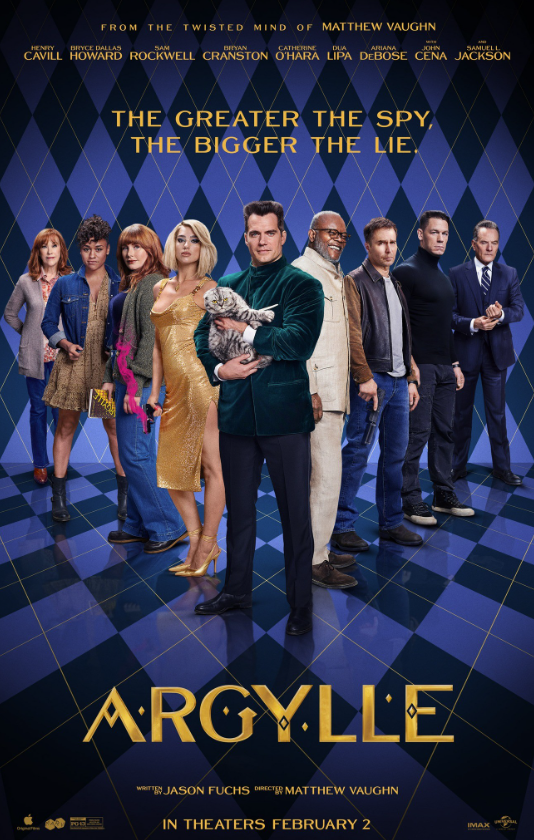
Argylle

Elly Conway is the reclusive author of the Argylle spy novels . Soon, she realizes the plot of the new book she’s writing starts to mirror real-world events, as a global spy syndicate starts to come after her.

It’s always a blessing when Matthew Vaughn gives us a glimpse into his twisted mind with his witty and bombastic action scenes, and Argylle has a few of those, but it’s everything else that disappoints. Vaughn directs with a love for spy material and cartoonish entertainment mixed with modern, meta flare. The script, however, completely misses the mark and looks the commanding energy that his Kingsman had. Even Sam Rockwell, whose charm and goofiness often comes effortlessly, has to work with dialogue that falls flat and the attempts at humor don’t manage to illicit a response. Though Henry Cavill has some fun and Bryce Dallas Howard tries her best in the leading role, there’s more left to be desired in Ariana DeBose, John Cena, and Samuel L. Jackson’s screentime. Bryan Cranston’s villain may be the weakest link of the cast, as everything he’s given to do is annoyingly generic.

The movie’s downfall is also its ambition, which is often what lifts Vaughn up above the rest. The ludicrous twists are executed in a head-scratching way, and all the film’s rules or explorations of fiction vs reality are thrown to the side for more frustrating decisions that make its lead character less interesting. The pacing also suffers greatly in the film’s second half, the end of which sees us getting a few of those glorious scenes of carnage Vaughn’s known for, which still feel softened compared to what they could’ve been due to the PG-13 rating, but are delightfully exaggerated and have great soundtrack choices. By then, however, the journey to get there is simply exhausting and it may be too little, too late for many viewers.

Argylle is a massive disappointment in which a singular director brings his trademarks to the screen yet again, only this time without the laugh-out-loud glee or the clever script that usually support his vision. Its ambition unfortunately exceeds its grasp, and its inconsistent and convoluted execution make this invitation to take the world a little less seriously with Matthew Vaughn a sadly unrewarding one.

Napoleon

Two decades after receiving his first Oscar nomination for Ridley Scott’s Gladiator, Joaquin Phoenix reteams with the legendary director for another epic action film about one of history’s most famous (and infamous) generals. Scott delivers on the promise of a Napoleon epic filled with spectacle. The action sequences are clearly committed and the best of Scott’s approach. The grandiose definitely comes through particularly in two famous battles; the violence does get a laughably gratuitous in certain occasions, though. Phoenix’s central performance captures Napoleon’s larger-than-life presence without romanticizing his historical grandeur, showing his ruthlessness and narcissism having led to countless deaths through his wars and invasions. His performance makes his screentime interesting, but sometimes the political dynamics drag and other scenes fall into unintentional camp or lifelessness when the battlefield isn’t the centerpiece. His relationship with Empress Josephine (Vanessa Kirby) is an interesting but also generic storytelling catalyst as well. The music and editing feel particularly poor in the film’s execution and rather unfitting. Though it’s cool to see the 158-minute film cover Napoleon’s entire life and rise to power, it also robs the film of any intimate tension that a film like The Last Duel benefitted from. Sometimes it feels like empty spectacle, and the muted color palette may distract in the wider shots, too.

Still, Napoleon benefits from its production value and immense storytelling among a historical icon’s rise and fall, and seeing a 2.5-hour Ridley Scott Napoleon epic may be all we really needed and were asking for. With the engaging action and lead performance that carry some of the film, it delivers on those fronts. However, it isn’t a must on the big screen and may still deliver the same entertainment when you watch it at home, as the grandiose on its own may be the saving grace for those who end up liking it.

The Hunger Games: The Ballad of Songbirds and Snakes

The Hunger Games: The Ballad of Songbirds and Snakes is set 64 years before the first Hunger Games movie, around the time of the 10th Hunger Games where a young Coriolanus Snow is living in the Capitol, facing choices that will define his future and that of Panem as he mentors District 12 tribute Lucy Gray Baird to victory in the arena.

This adaptation of Suzanne Collins’ excellent prequel to her acclaimed series of novels has the best cinematography of the franchise, and stunning production design. The Hunger Games films have always boasted incredible world-building, making the intricate politics and history of Panem spread far beyond the screen, and introducing the audience to a wide world of characters within it. However, the film sometimes lacks soul when it needs it most, especially in its first act. Tom Blyth gives an interesting performance of a young man as his narcissism and consumption for power begins to consume him whole. Though Rachel Zegler’s singing voice and presence gives Lucy Gray heart, her character lacks the consistency and potency she’s meant to have, not to mention an off-putting Southern accent. The chemistry between Zegler and Blyth feels weak, though it should’ve been a key component in the film. Jason Schwartzman gives a great comedic performance as Lucky Flickerman, the announcer of the Games, and Josh Andres Rivera gives the most empathetic performance as Sejanus. Hunter Schafer also steals the screen as Snow’s cousin Tigris, but doesn’t have nearly as many scenes as she deserved. Although Viola Davis’ character is supposed to be repulsive, her voice and lines are weirdly over-the-top.

The sequences we see inside of the Hunger Games are absolutely amazing, and more visually exciting than anything we saw in the arena of the original 2012 film. The dynamic shots and lighting create a scenery that’s both grand and sadistic. The post-war dynamics between the Capitol and Districts hits hard with the viewing of the Games, the dialogue itself is lacking and character decisions seem sometimes unearned. What is well-earned is this idea of a Hunger Games prequel set at this era so soon after a civil war and its sickening aftermath, and hitting home themes about human nature, but it should likely be viewed in the context of the films that were released before it — films that may have had better characterization despite this one’s admirable ambitions and aesthetic.