The Brutalist

There’s no shortage of incredible films covering the dark chapter of humanity that is the Holocaust, not to mention one starring The Brutalist’s Adrien Brody. That said, no film has asked in this fashion what comes after a film like The Pianist, or even The Zone of Interest — life after the war ended for survivors of one of humanity’s great atrocities, including mass immigration to America, was no “fairy tale” happy ending. Instead, The Brutalist portrays mere life for a Holocaust survivor as what it really must have been: an endless waking nightmare. An early shot sets the tone perfectly: our main character Lazlo Toth, is on a boat arriving in New York, only the camera frames the Statue of Liberty sideways and shakily — a look into Lazlo’s hidden perspective of the world ahead of him.

Brody’s performance is integral to our journey with the film. The unlocking of Lazlo’s ambitions is gripping for the audiences, but even more so is his struggles with his surroundings and his outlook on his sense of self, which has been fractured after the war, as for every survivor. Brody’s chronicling of a fictional man’s journey, who is brought to life with such pain and understanding that some viewers may be surprised this isn’t a biopic, is a tremendous performance and some of the decade’s most remarkable acting. When Lazlo is cold, angry, or hard to read, we still understand and care about him because he’s incredibly delicate and empathetic. Felicity Jones is heartbreaking and vulnerable as Lazlo’s wife, whose tenderness anchors him, while she goes against odds to stand up for him when even he can’t. Guy Pearce is riveting and unforgettable as a larger-than-life man who starts an almost angel in Lazlo’s life, sweeping him from the poverty of immigrant life and giving him a canvas for glory and success. What’s key to the intrigue is that Pearce’s character isn’t so easy to read. He’s elegant, but also temperamental and has a sick idea of power and control.

The film captures a chapter in history in its grandeur, powerfully covering Jewish assimilation in America, and how willing America is to truly let others. There’s a sense of hopelessness to the struggles they endure, as the promises of immigration prove more difficult than meets the eye, but not just that. There’s a feeling of horror underneath, even when there isn’t a moment of violence, and you’re simply witnessing the towering cinematography and hearing the booming score. Brady Corbet brilliantly hides discomfort and terror that’s itching to break out of this historical drama about architecture, and it seeps deep into its audience while never quite making it to the surface in a literal sense. Still, the gorgeous shots, magnificent production design, and undertones of every scene grip us throughout the long time it depicts.


The ending is delivered in a way that’s tonally unexpected and polarizing compared to the rest of the film and hits you like an emotional sledgehammer. It makes the entire experience more heart-shattering and important and is impossible to forget. The Brutalist is a devastating and sweeping epic like we’ve rarely gotten in recent decades, with a look and feel that stuns as much as it quietly terrifies, capturing an entire era with a long but mostly earned runtime. Like the big epic films like Lawrence of Arabia and Schindler’s List, The Brutalist is massive and transformative and is one of those films that’ll stay with you forever.

Gladiator II

Decades after the events of Gladiator, the Roman Empire has fallen into the tyrannical hands of Emperors Geta and Caracalla. Hanno, a young man taken to Rome as a slave, learns of his connection to the Empire and trains to be a Gladiator to fight against the corrupt emperors.

This long-awaited sequel doesn’t have the same visual beauty and flare as its predecessor, but is still a solid action film that embraces the best aspects of the first film’s story. It’s quite an uphill battle to create a hero as strong as Maximus Meridius now that he and Russell Crowe are out of the picture… unless, of course, you cast Paul Mescal. Mescal brings a tenderness to his performance that shows through even when he ought to show strength and ferocity in the arena. Pedro Pascal is also fantastic and completely chews up the scenery, as do Joseph Quinn and Fred Hechinger as the spoiled and maniacal emperors. Denzel Washington gives so much life to the film, seemingly just by being his soulful, fun self. He brings a lot of humanity as he and Mescal enter a mentor-student dynamic. The film doesn’t work as well without Washington’s presence, whose character takes unexpected turns throughout the film.

Gladiator II‘s script works when focusing on its protagonist’s journey, as well as his fight against tyrrany. The power dynamics and engaging action scenes carry the story forward, though visually, it feels held back from what could’ve been compared to the first film. Ridley Scott’s style here doesn’t feel as patient and refined as in his recent The Last Duel, and the CGI could’ve used a lot more improvement. However, the action choreography is as bloody and grand as fans of the original could hope for, and the ending is beautifully done as a realization of promises we didn’t even realize the first film had. It’s a noble continuation that honors the first film, and its cast led by Mescal and Washington, while never quite reaching that original movie’s breathtaking heights, but still better than some of Scott’s other recent outings, and worth a watch in theaters.

Heretic

When two Mormon missionaries arrive at Mr. Reed’s house attempting to convert them, they find themselves stuck there in a game of wits, fighting for their lives.

When two Mormon missionaries arrive at Mr. Reed’s house attempting to convert them, they find themselves stuck there, fighting for their lives.

Heretic doesn’t play out with the typical levels of jump scares and macabre we’re used to from horror films these days — rather it’s a battle of wits in which the characters contemplate belief, religion, and faith… oh, and an adult man is terrorizing two young women as they’re held captive in his house, which becomes a maze of puzzles related to his disdain for their faith. Hugh Grant is rather terrifying as Mr. Reed here, but he’s clearly having such a delightful time in the character’s skin. He’s as threatening as you can imagine a mysterious man in his 60s alone in a large house but also has plenty of outlandish and hilarious dialogue. Some viewers simply looking for an intellectual dark comedy could most definitely find satisfaction in watching Heretic. You also genuinely care about our two protagonists. Sophie Thatcher and Chloe East both bring cleverness to the film, a willingness to challenge their captor, and not break down and quit. Thatcher brings a rebellious sense of mystery to Sister Barnes, while Chloe East is heartfelt and capable as Sister Paxton.

Though Heretic takes some time for the uniqueness and thrills to set in, it stands out from other recent horror films thanks to its restraint on its scares, as well as its smart screenplay and chilling villain. The three performances are integral and lift up the film’s shocking fun, and may even make you think about some big ideas all while you’re enjoying this dark ride.

Challengers

Tashi, a former tennis prodigy turned coach, turned her husband Art into a champion. But to overcome a losing streak, he needs to face his ex-best friend, Patrick, who’s also Tashi’s ex-boyfriend.

One thing that’s thrilling about Challengers is that it never gives you easy answers. Is it about devotion? Manipulation? Triumph? Doom? All of them? One thing’s for sure: it’s a film about passion. Raw physical and emotional passion between humans for one another, and for the kick they get doing the one thing they can’t live without — in this case, playing tennis. And for all the right reasons, Luca Guadagnino is at his most maximalist stylistically to convey this raw passion these characters feel and bring us into the world, from exciting editing and some experimental cinematography to the synth, almost Run Lola Run-esque score from Trent Reznor and Atticus Ross. It’s the polar opposite to his more naturalistic, minimalist approach to the intimacy of Call Me By Your Name, and an upping of the ante of the wilder style of Bones and All. Zendaya gives one of her heaviest performance, portraying Tashi perfectly over a long span of time, through fascination, ambition, longing, control, and deceit. Josh O’Connor and Mike Faist are also great, particularly Faist, whose charm entrances the screen. The West Side Story star announces himself as a powerhouse whose apparent harmlessness you can’t help but feel for. Their friendship established in the opening minutes of the film sets the stage for everything to come, and makes you care for how the rest may unfold or fall apart.

Challengers is the rare film that transports you into its world in a case where there are only 3 characters who really bear any significance. There’s a scene between the three main characters that happens early on chronologically that enchants you and sucks you into the close, complicated intimacy they inhabit in this space, and the film never lets you go once this scene happens until the credits roll. It’s an experience that’s dynamic, unpredictable, and darkly human, with three riveting leading performances at its center, and sets the bar the rest of what’s to come in Guadagnino’s directorial career.

The Fall Guy

Colt Seavers, a down-and-out stuntman, must find the missing star of a new blockbuster film he’s doubling on, while (hopefully) winning the director (and his ex-girlfriend)’s affection back.

David Leitch continues to be a leading voice in action movies with his creative and passionate voice for action and comedy that often turns out star-studded and visually appealing. Much of the film’s charm comes from Ryan Gosling’s brilliant turn as Colt. Like his Oscar-nominated Ken in Barbie, Colt is a sad shell of a “cool guy” who’s too evidently madly in love. Gosling’s comedic timing is at the lightning speed of his Ken, or Holland March from The Nice Guys, and his big personality infuses Colt with a foolishly endearing heart. Emily Blunt also gives one of her most entertaining performances of late as the romantic lead, and Winston Duke is also loads of fun as Colt’s best friend and the film-within-a-film’s stunt coordinator, while Aaron Taylor-Johnson, Hannah Waddingham, and Stephanie Hsu also round out the stellar cast. Waddingham in particular is very extravagant but delightful as Gail, the producer of the film Colt’s working on.

The most clever and thrilling part of The Fall Guy is that Leitch makes the movie stunt-filming scenes as high-stakes and exciting as the actual action scenes of the film. The great scale, dedication, and sound effects make shooting an action movie stunt feel like the incredible, hard-achieved feat that it really is. Additionally, the lightspeed humor feels effortless thanks to the writing, editing, and the cast’s delivery. The lively soundtrack does have a few generic and overused selections, but it’s not enough to sink this smooth romantic action comedy where all the different genre pieces play off each other pitch-perfectly. The director’s career as a stunt coordinator is made evident by the love and tribute to the stunts community here, in this blockbuster that’s hilariously pleasing and greatly worth the big screen price of admission.

The Ministry of Ungentlemanly Warfare

Guy Ritchie’s latest action film is loosely based on true, mostly encrypted stories, in which the British military recruits a small group of highly skilled soldiers to strike against German forces behind enemy lines during World War II.

Guy Ritchie seems to be racking out more movies than some of his fans will be able to keep track of, but among a slew with varying qualities, this one may end up being looked back at as one of his most entertaining films ever. Ritchie imbues the screen with an Inglorious Basterds-like irreverence to its Nazi-killing action. The WWII battles are swiftly edited and have action sequences that’ll make you cheer with glee at the bad guy body count and the different ways they get killed by the titular heroes. Henry Cavill leads the pack with a similar irreverence he gave Ritchie’s The Man From U.N.C.L.E., but with an even rougher edge to his badassery. The ensemble of Eiza Gonzalez, Alan Ritchson, Henry Golding, and Cary Elwes all give the film a liveliness that makes up for a lack of uniqueness to them, as well as a menacing Til Schweiger who maintains a strong presence. Unlike last year’s Operation Fortune, the film’s witty humor matches the extra wicked energy the director is known for, but it may lack character depth for some viewers. Most of the characters have little substance besides “recently incarcerated” or “they’re crazy”, but their outlandish personalities make up for that in the case of this film. The soundtrack choices aren’t always on-point, but the Western-inspired music usually adds to the film’s sharp direction. The film also doesn’t manage to always balance the different moving plots seamlessly, as Ritchie sometimes can’t help but indulge too much in his trademark banters which can sidetrack, but ultimately culminates in some strong tension in the third act. The Ministry of Ungentlemanly Warfare perhaps achieves what Matthew Vaughn’s The King’s Man failed to do — turn covert misfit spies into World War heroes and make the journey feel exciting and earned on the way. Ritchie is no stranger to the approach he set out to achieve here, but he manages to balance out his quirks with an excellent style, an interesting mission and cast of characters, and a rewarding catharsis when the action and comedy hit their peaks, as you might not want the fighting to stop out of sheer Ritchie delight.

Dune: Part Two

In the second part of Denis Villeneuve’s adaptation of the classic sci-fi novel, Paul Atreides seeks revenge against the Harkonnens, who slaughtered most of his House Atreides, and liberate the native Fremen of the planet Arrakis while joining them and learning their ways, all while the fate of the Imperium lays in the balance.

The first Dune from 2021 may have been one of the most stunning blockbusters in recent memory, but this extraordinary sequel puts everything in its predecessor — and almost any action movie I’ve ever seen — to shame. Picking up shortly after the first film, the drama is heightened, the world-building is bombastic, and the sound and visual experience is a one-of-a-kind theater trip. Visceral is such an overused term these days that it wouldn’t do Dune: Part Two justice; you feel how wide this universe spreads and the history of the different conflicts and races that inhabit it. And once you’re brought into this fictional world, you’ll never want to leave, as the nearly 3-hour runtime flies by and every plot development is fascinating. Beyond Villeneuve’s imagination, Greig Fraser’s cinematography is the real MVP here. The beauty within the uncertainty of the desert planet is captured in such a scope that it demands in IMAX viewing, and the different planets all contribute a symbolic and gorgeous aesthetic. Timothee Chalamet takes us on the next step of Paul’s journey: his desire to adapt and fight and his fear of allowing power and faith to corrupt him. He proves that he’s always been a movie star that’s here to stay, and Rebecca Ferguson’s Lady Jessica also takes really interesting directions that make you see her role in the story, and of her son’s, in a murkier way. Zendaya also becomes a lot of the heart here as Chani, one of the franchise’s most noble characters, and Josh Brolin is always terrific as Gurney, while Javier Bardem puts his soul into the role of Stilgar, whose faith drives him towards Paul and Jessica. Austin Butler may be the standout, however, as Feyd-Rautha, whose deranged and sadistic presence create a nail-biting character and a powerful young man who has fully embraced his disturbed nature.

Though Dune: Part Two ups the ante with its visuals and performances, its the powerful script and heightened emotional stakes that make this experience what it is. The film explores questions as to how faith and hope can be exploited, and if the urge for power truly corrupts whoever gets a taste of it. Though you may find yourself trying to guess which paths these characters will take, there’s also lots of unexpectedness and the film’s most intense moments took my breath away. You understand so deeply the dynamics of this galaxy and its cultures, and how much lays in the balance. The exhilarating scale and exciting, constantly developing pace only works because of the passion behind each character and story thread: passion to lead, rule, fight, love, honor, avenge, or secure a future. These moral greys form the dark and poetic drama that’s impeccably guided by frame-worthy shots and booming sound. Never have I felt so deeply that I didn’t want a film to end, as once you’re sucked into this marvelous world by Villeneuve, you’ll never want to go home. We’ve rarely seen emotion and grandiose like this in action movies so flawlessly convert to a magnetic cinematic experience. The Empire Strikes Back comparisons are worthy but also a little humbling; this reaches the bar that The Lord of the Rings: The Return of the King set for sci-fi/fantasy epics. It’s a show-stopping galactic saga that unleashes its ambition and magnitude onto you in a way that will entrance and thrill whoever buys a ticket. It’s a spectacle that sets the bar so high for whatever else is to come in blockbuster filmmaking, and like the unreal visuals and scale of Avatar: The Way of Water, needs to be seen on a massive screen, to be transported with other people, and watch a story unfold that you’ll never forget.

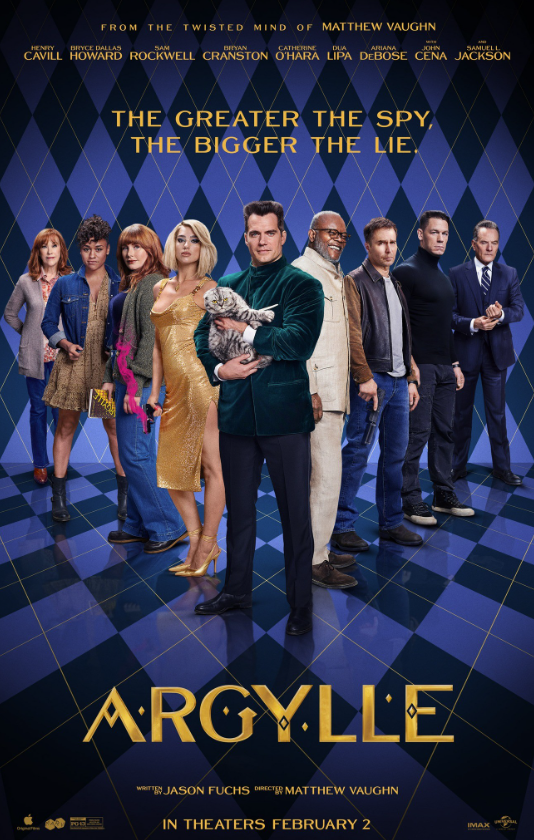
Argylle

Elly Conway is the reclusive author of the Argylle spy novels . Soon, she realizes the plot of the new book she’s writing starts to mirror real-world events, as a global spy syndicate starts to come after her.

It’s always a blessing when Matthew Vaughn gives us a glimpse into his twisted mind with his witty and bombastic action scenes, and Argylle has a few of those, but it’s everything else that disappoints. Vaughn directs with a love for spy material and cartoonish entertainment mixed with modern, meta flare. The script, however, completely misses the mark and looks the commanding energy that his Kingsman had. Even Sam Rockwell, whose charm and goofiness often comes effortlessly, has to work with dialogue that falls flat and the attempts at humor don’t manage to illicit a response. Though Henry Cavill has some fun and Bryce Dallas Howard tries her best in the leading role, there’s more left to be desired in Ariana DeBose, John Cena, and Samuel L. Jackson’s screentime. Bryan Cranston’s villain may be the weakest link of the cast, as everything he’s given to do is annoyingly generic.

The movie’s downfall is also its ambition, which is often what lifts Vaughn up above the rest. The ludicrous twists are executed in a head-scratching way, and all the film’s rules or explorations of fiction vs reality are thrown to the side for more frustrating decisions that make its lead character less interesting. The pacing also suffers greatly in the film’s second half, the end of which sees us getting a few of those glorious scenes of carnage Vaughn’s known for, which still feel softened compared to what they could’ve been due to the PG-13 rating, but are delightfully exaggerated and have great soundtrack choices. By then, however, the journey to get there is simply exhausting and it may be too little, too late for many viewers.

Argylle is a massive disappointment in which a singular director brings his trademarks to the screen yet again, only this time without the laugh-out-loud glee or the clever script that usually support his vision. Its ambition unfortunately exceeds its grasp, and its inconsistent and convoluted execution make this invitation to take the world a little less seriously with Matthew Vaughn a sadly unrewarding one.

Poor Things

Bella Baxter is a young woman brought back from the dead by the brilliant and unorthodox scientist Dr. Godwin Baxter. Under Baxter’s protection, Bella is eager to learn. Hungry for the worldliness she is lacking, Bella runs off with Duncan Wedderburn, a slick and debauched lawyer, on a whirlwind adventure across the continents.

Trigger warnings are a no-brainer with Yorgos Lanthimos, as his films are often filled with sadistic, violent, and hypersexualized power games where nobody is quite a pleasant person. These tropes as well as Lanthimos’ trademark cringe humor are just the baseline to describing Poor Things, a sickening yet grandiose movie that transcends categorization. It’s hysterical but not quite a comedy; it’s poetic but not quite a drama. Emma Stone gives a performance so demanding and so audacious yet it never breaks the illusion of being acting. You completely buy her character in the context of the story and are taken aback by her character’s abnormal physicality and wonder with being alive. Mark Ruffalo is also throwing himself into this role that could’ve easily fallen into unbelievability, but he perfectly balances an exaggerated, almost theatrical edge to his role with a vile, pitiful nature to it. Willem Dafoe plays a scientist under heaps of makeup whose motives may provide an emotional anchor to Stone’s character but also unpeels itself to be uncomfortably pathetic due to his background, and Ramy Youssef also does a great job here.

Poor Things may owe some of its inspiration to classic monster movies, but really isn’t like anything audiences have seen before. The production design creates an eye-popping, fantastical version of the Victorian Era and a world with a completely fresh aesthetic, as well as dynamic cinematography with color, B&W, and even a few fish-eye lens shots to invoke Bella’s warped worldview. Bella’s curiosity is devoid of prejudice and preconceived notions on the world’s structures, and she finds herself appalled by those around her trying to control her, and fascinated by anything she gets to choose to do. The humor is ridiculously honest and ballsy, and therefore, not for everyone — not to mention the exaggeratedly comic sex scenes and the uncompromising and even disgusting violence. Its audacity will certainly find its pleasurers, especially those who already love the director’s filmography. This bold tour de force isn’t for the faint of heart and may leave you at a loss for words. The writing and execution are exhilarating in the best way; the more disturbing and out-of-this world it gets, the less you’ll feel you want to look away. You’ll simply want to witness the bizarre yet fascinating unfold in front of you when it’s through Yorgos’ eye and so irresistibly played by Stone as this woman with the literal brain of an infant in her head, eager to experience being alive for all its peculiarities..

Napoleon

Two decades after receiving his first Oscar nomination for Ridley Scott’s Gladiator, Joaquin Phoenix reteams with the legendary director for another epic action film about one of history’s most famous (and infamous) generals. Scott delivers on the promise of a Napoleon epic filled with spectacle. The action sequences are clearly committed and the best of Scott’s approach. The grandiose definitely comes through particularly in two famous battles; the violence does get a laughably gratuitous in certain occasions, though. Phoenix’s central performance captures Napoleon’s larger-than-life presence without romanticizing his historical grandeur, showing his ruthlessness and narcissism having led to countless deaths through his wars and invasions. His performance makes his screentime interesting, but sometimes the political dynamics drag and other scenes fall into unintentional camp or lifelessness when the battlefield isn’t the centerpiece. His relationship with Empress Josephine (Vanessa Kirby) is an interesting but also generic storytelling catalyst as well. The music and editing feel particularly poor in the film’s execution and rather unfitting. Though it’s cool to see the 158-minute film cover Napoleon’s entire life and rise to power, it also robs the film of any intimate tension that a film like The Last Duel benefitted from. Sometimes it feels like empty spectacle, and the muted color palette may distract in the wider shots, too.

Still, Napoleon benefits from its production value and immense storytelling among a historical icon’s rise and fall, and seeing a 2.5-hour Ridley Scott Napoleon epic may be all we really needed and were asking for. With the engaging action and lead performance that carry some of the film, it delivers on those fronts. However, it isn’t a must on the big screen and may still deliver the same entertainment when you watch it at home, as the grandiose on its own may be the saving grace for those who end up liking it.