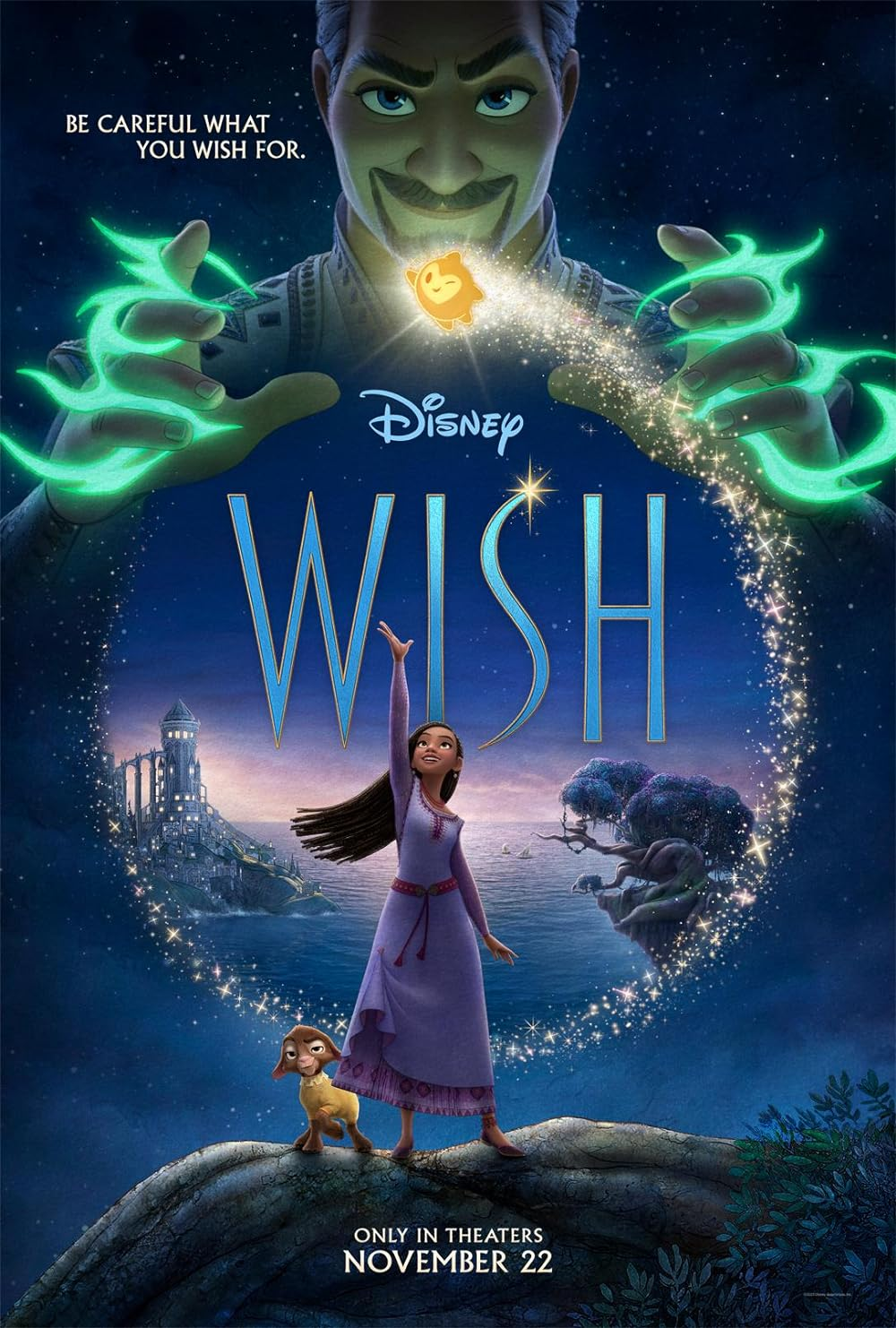
Wish

In the Kingdom of Rosas, King Magnifico safeguards the people’s wishes with the promise to grant them one day. But when young Asha wishes upon a star for her community to have better, what she didn’t expect was for the star to answer back.

Disney experiments with the 2D coloring of 3D characters that films like the Spider-Verse have popularized, which can’t seem to make up for the film’s derivative story. Though the animation is vivid in colorful in the scenes that are night-set or creatively lit, most of the scenes set during the day feel like they lack lighting or any sort of flare besides the gimmick. Ariana DeBose’s performance is full of joy and her singing is spectacular, though that shouldn’t come as a surprise. The character of Asha has nothing to really distinguish herself from other Disney heroines like Rapunzel and Mirabel, and the concept of her wishes and motives feel rather underdeveloped. Chris Pine does great as well, but his villain’s descent from charismatic leader to power-hungry wizard feels unearned. None of the supporting characters are quite memorable, and a few of the songs do stand out, including “This Wish”, “At All Costs”, and “This is the Thanks I Get”. But both the middle and end portions, particularly the talking animals and forgettable action, greatly suffer from this lack of an interesting ensemble and heart that made the characters in Frozen, Moana or Encanto resonate. It’s certainly enough to keep the children entertained and singing along, but is also too generic to earn a place among the ranks of other films from the studio that have solidified themselves in Disney’s legacy.
The Hunger Games: The Ballad of Songbirds and Snakes

The Hunger Games: The Ballad of Songbirds and Snakes is set 64 years before the first Hunger Games movie, around the time of the 10th Hunger Games where a young Coriolanus Snow is living in the Capitol, facing choices that will define his future and that of Panem as he mentors District 12 tribute Lucy Gray Baird to victory in the arena.

This adaptation of Suzanne Collins’ excellent prequel to her acclaimed series of novels has the best cinematography of the franchise, and stunning production design. The Hunger Games films have always boasted incredible world-building, making the intricate politics and history of Panem spread far beyond the screen, and introducing the audience to a wide world of characters within it. However, the film sometimes lacks soul when it needs it most, especially in its first act. Tom Blyth gives an interesting performance of a young man as his narcissism and consumption for power begins to consume him whole. Though Rachel Zegler’s singing voice and presence gives Lucy Gray heart, her character lacks the consistency and potency she’s meant to have, not to mention an off-putting Southern accent. The chemistry between Zegler and Blyth feels weak, though it should’ve been a key component in the film. Jason Schwartzman gives a great comedic performance as Lucky Flickerman, the announcer of the Games, and Josh Andres Rivera gives the most empathetic performance as Sejanus. Hunter Schafer also steals the screen as Snow’s cousin Tigris, but doesn’t have nearly as many scenes as she deserved. Although Viola Davis’ character is supposed to be repulsive, her voice and lines are weirdly over-the-top.

The sequences we see inside of the Hunger Games are absolutely amazing, and more visually exciting than anything we saw in the arena of the original 2012 film. The dynamic shots and lighting create a scenery that’s both grand and sadistic. The post-war dynamics between the Capitol and Districts hits hard with the viewing of the Games, the dialogue itself is lacking and character decisions seem sometimes unearned. What is well-earned is this idea of a Hunger Games prequel set at this era so soon after a civil war and its sickening aftermath, and hitting home themes about human nature, but it should likely be viewed in the context of the films that were released before it — films that may have had better characterization despite this one’s admirable ambitions and aesthetic.

Next Goal Wins

Next Goal Wins is the true story of American soccer coach Thomas Rongen, who travels to the American Samoa to help transform their team from the world’s worst team into stars. Taika Waititi’s irreverent flare not only gives the film plenty of laughs but an endearing underdog spirit that also highlights Samoan culture unlike lots of popular media. The casting of Michael Fassbender, an actor known primarily for dramatic roles, as a comedic lead does the film wonders. The way he portrays frustration and confusion with the incompetence around him is enjoyable, until the character begins to accept his journey into finding community around him, which becomes quite touching. Kaimana is also a standout as the character Jaiyah, an incredibly memorable and impactful character, not to mention fun supporting performances from Will Arnett and Elisabeth Moss.

The film’s comedic style is incredibly laugh-out-loud and makes you laugh in every way from situational humor to extreme physical comedy — the way Waititi does it best. Sure, underdog sports movies aren’t new to us, but the special cultural touch and loving characters make this a film that’s entertaining with every moment it has to offer. It’s short but incredibly sweet and wears its heart on its sleeve from the opening to the end credits that show you the real story the film is based on.

A Haunting in Venice

Hercule Poirot attends a seance at the suggestion of his friend, mystery novelist Ariadne Oliver, who wants to expose a medium as a fraud, but a murder occurs and Poirot must get to the bottom of what seems to be an impossible deadly truth.

Though Kenneth Branagh has seemed to find a formula that works in his slew of Agatha Christie-based films in which he directs himself as the iconic detective, he also wisely ditches the CGI-heavy look of the last two films for a more intimate setting within a darkly lit Venice palazzo one stormy Halloween night in 1947. Though the cast has more weak links this time, Jamie Dornan, Kyle Allen, Jude Hill, Michelle Yeoh and others deliver interesting performances, with Tina Fey being as cocky and entertaining as you’d expect her to be as a writer in the 1940s who’s friends with the Hercule Poirot. It embraces some of the visual and tonal aspects of gothic horror but cleverly doesn’t fully indulge in the genre and remains a solid Whodunit murder mystery, although the pacing still has its slow moments. As I said before, the less “obnoxious” or massively cinematic style helps it better establish a darker mood and a murder mystery that feels contained and believable, and delving just enough into the concept of spirits to feel unique compared to the last two, without throwing too many supernatural elements at you. In other words, it’s another delightful Poirot mystery that never quite surpasses the description of satisfactory, but still fun enough for a watch.

Mission: Impossible – Dead Reckoning Part One

Ethan Hunt and his IMF (Impossible Missions Force) team must track down a dangerous weapon before it falls into the wrong hands.

Mission: Impossible is a franchise that has my utmost respect for how much it aspires to keep daring and topping what came before. Each of the last four installments have delivered unforgettable action scenes and helped redefine the franchise, so Dead Reckoning does… just that. And seven movies in, it’s still got a phenomenal amount of excitement to go along with the loud, immersive action. Tom Cruise commits to the massive action set pieces in a way that’s audacious, commendable, and likable. With the various locations, vehicles, weapons, and lighting styles, Christopher McQuarrie has proven himself to be a top-tier action director of the 21st century with this and the last two installments. Not to mention it doesn’t just look cool, but also nail-biting as I felt my body in suspense throughout a lot of the film.

Cruise also isn’t the only winning part of the cast — Simon Pegg and Ving Rhames’ lovable IMF members continue to be expanded on and serve the movie’s mood, Rebecca Ferguson proves again that she’s the best of the franchise’s female badasses (though I’d have liked to see her given more to do than she had here), and Hayley Atwell is a charming and fun addition to the cast. Vanessa Kirby, Shea Whigham, and Pom Klementieff are also giving it their all in memorable roles, and Esai Morales is a simply fantastic villain. His layered voice compliments his chilling appearance and dialogue — I only wish his motivations were expanded on a little more.

Similar to Fallout, the visual style feels gritty, like almost anything could happen, though it also effectively embraces the fun and humor even more. But like its predecessor, the writing is so complex it may take rewatches to understand every objective, alliance, motivation, and MacGuffin the script presents. However, it’s rewarding to see this franchise keep aiming for higher while never losing what’s made the last few installments into epic must-watches. I also loved the way the film modernizes the saga in that it explores technology and its dangers in a way that hopefully enough people out there take note of. There’s only a few minor narrative points I would’ve polished, like an emotional moment for Ethan that should have embraced the darkness of what Ethan was feeling more, but it’s not like the movie isn’t already 163 minutes long — but don’t worry, it flies by. Mission: Impossible – Dead Reckoning Part One isn’t just a must-watch in theaters, it made me feel lucky to have caught such a marvelous action movie on the big screen. Tom Cruise continues to show us, well, the impossible, in countless ways, but that and the stunning thrills, fun, scale, cast and directions the story and filmmaking take make it worth every second of its length, and shows the action spy genre at some of its finest ever.

Guardians of the Galaxy Vol. 3

Years after defeating Thanos alongside the Avengers, the Guardians embark on an uncertain adventure to save one of their own from a monumental threat, meeting old and new friends and foes along the way.

It’s been almost a decade since James Gunn’s first Guardians changed the game for superhero movies — and so many copycats or inspirations have come to the mainstream since, or attempted to. But the camaraderie of the titular team has not gotten old, even if it’s their sixth overall appearance in the MCU, and likely their last. The goofy quirks of Gunn’s humor, poking fun at the mistfit-like attitudes of the characters, or his way of giving the outcasts a traumatic backstory and a chance to grow, breathe life and soul into nearly every frame of Vol. 3. It’s not necessarily the best of the three, but it is the most visually dynamic, with engaging settings and interesting close-ups or moving shots during the actions. Chris Pratt and Dave Bautista continue to deliver in the roles that have come to define their career and help shape their A-lister status, but it’s Karen Gillan and especially Pom Klementieff who get to really grow and steal the screen from them. Rocket is also given a heavy storyline that is as tear-jerking as it is revelatory for his character. Though Chukwudi Iwuji’s villain is very over-the-top, he’s also entertaining and works for the film’s purpose. However, the inclusion of Gamora’s alternate version from an Endgame timeline feels like the storyline that didn’t add too much to the film, and her original incarnation’s death in Infinity War still feels best left untouched as it hangs weirdly over her appearance here. Here, her character is more to serve Peter Quill’s arc or simply an excuse to have the awesome Zoë Saldaña around. However, Will Poulter’s presence is Adam Warlock suffer here despite the movie’s already long (yet breezy and earned) 150-minute runtime — though he’s built up as a threat to interact with the Guardians and make his own decisions, he’s left as a very basic side character who cracks a few jokes. The character deserved an awful lot better than he got, especially due to the great work Poulter does do with what he’s given, it’s just a shame his and Ayesha’s story set up from the post-credits scene of Vol. 2 gets the bare minimum payoff. In addition, a notable standout is Oscar nominee Maria Bakalova as the voice of Cosmo the Spacedog, a very entertaining critter who gets her deserved limelight.

The soundtrack in the last two films was dominant and diverse, practically its own character within the film and a driving force for Quill’s arc. The soundtrack in this movie definitely hits less hard and may have a few too similar songs, but it’s made up for with a few amazing needle drops that set the tone and immerse you in the moment. Most of all, the character’s dynamics are all so beautiful and the building of the action is the backbone of the film, rooted in the bond of this team that has strengthened and matured over a few films. Even if the first film is a beast that’s only rivaled by a few other Marvel movies for the title of the studio’s best film, Guardians of the Galaxy Vol. 3 has undeniable charm and is also one of the most emotional MCU films across all the phases. It’s one of their better post-Endgame works and a great big-screen watch for the visuals, heart, and cast of characters.

Dungeons & Dragons: Honor Among Thieves

A charming thief and a band of unlikely adventurers embark on an epic quest to retrieve a lost relic, but things go dangerously awry when they run afoul of the wrong people.

With the medieval action/fantasy epic genre being worn out to death in recent years, and a franchise with a less than notable track record, Dungeons & Dragons: Honor Among Thieves is the year’s most pleasant surprise so far. Sure, the conflict and world-building tread the line of “just enough” and the exposition isn’t that engaging, but Jonathan Goldstein and John Francis Daley imbue the film with a well-meaning, heartfelt energy that provides unexpected laughs and charm. Unlike a lot of bland fantasy action films from recent years like King Arthur: Legend of the Sword, Warcraft or the countless Hercules reboots, the characters in this movie feel like they have actual souls and empathetic reasons for the audience to root for them, not just in the quest but in their personal journeys. Chris Pine reminds the audience why his charisma works so naturally for a leading man, even though his character is occasionally greedy and a misfit. Michelle Rodriguez also delivers a more hardcore but lovable character than Letty from the Fast and Furious saga, and Justice Smith also delivers a sorcerer learning to gain his confidence well. Rege-Jean Page and Sophia Lillis both play standouts as very well-realized characters that may one day deserve a cool spinoff. Hugh Grant is also a silly yet fun villain, though his character’s presence and writing do the bare minimum for an antagonist to face off against the main team, and with an actor less capable than Grant, the role would’ve needed much more to sustain the audience’s attention.

Though some of the visual effects and green-screen are obvious, the movie isn’t trying to remind too much of the Lord of the Rings films, but rather create a jolly and comedic journey that perfectly fits the imagination, playfulness and vast possibilities of the Dungeons & Dragons brand. The action and excitement are enough to make up for conflict and rules that seem cliche, not to mention editing, direction and humor that make this not a must-watch, but better than it had any right to be, and will make the audience have a smile on their face and want to spend even more time with these characters than they ever thought they would.

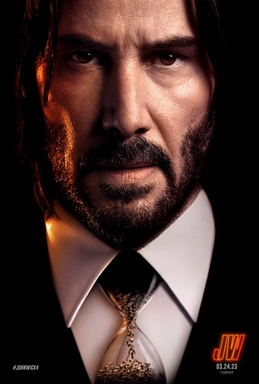
John Wick: Chapter 4

John Wick uncovers a path to defeating The High Table. But before he can earn his freedom, Wick must face off against a new enemy with powerful alliances across the globe and forces that turn old friends into foes.

Ever since John Wick offered a fresh and influential voice to the action movie landscape, the sequels have been attempting to top the scale, world-building, and insanity of the action from before. To say John Wick: Chapter 4 delivers on the promise of being the largest and most outrageous in the franchise would be an understatement. The fights are the longest, most intricately choreographed and most beautifully shot this series has been, and Keanu Reeves and the stunt team give mind-blowing work. Though for some, the movie’s obsession with topping itself may result in caricature, but it’s everything that fans of this franchise have signed up and waited for through 4 films, and then some. In addition to Reeves’ incredible commitment, Donnie Yen is one of the best characters this franchise has seen, bringing his martial-arts reputation to the series, not to mention Shamier Anderson, who’s incredibly an entertaining and likable character, as well as the excellent Hiroyuki Sanada who has great scenes with Keanu. Fans of the franchise already know to expect Ian McShane and Laurence Fishburne, not to mention this is one of the last appearances of the late Lance Reddick who was always a gem as the Continental concierge Charon. Bill Skarsgard’s character is intentionally hatable, but occasionally gets too much on the audience’s nerves to even be a fun villain.

Though these films are known way less for story beats and more for the “gun fu”, Chapter 4 culminates the titular character’s arc from the four films with more going on with him than in the last film, though the second act is 10 or so minutes too long, particularly a scene with Scott Adkins and the buildup to it. Set pieces from a Continental Hotel in Osaka to the Arc de Triomphe in Paris are nail-biting and stunning to watch, though the soundtrack is frustratingly repetitive and maybe too aggressive during the action — perhaps less dubstep would’ve been just fine — which I didn’t find to be an issue in the previous films. However, this is still a big-screen treat and an iconic action franchise coming to a grand, thrilling, and satisfying conclusion, rewarding viewers who have been tuning in through John’s creative kills and all the rules of the hitman underground world.

Creed III

Adonis Creed has been living out his wildest dreams, including being the reigning heavyweight boxing champion of the world, and a loving husband and father. When an old friend Dame returns from a long prison sentence, he brings back his and Adonis’ past with him, which will lead to the next big match of Creed’s career.

Though the Creed films were always follow-ups to the beloved Rocky franchise, they’ve made themselves feel fresh and modern while retaining the themes of hard work, underdogs, healthy masculinity, and family that make Rocky so iconic. Three films in, and what you’re watching still feels exciting and imbued with passion from behind the camera. Not to mention the director behind the camera is also its star, Michael B. Jordan. He delivers a strong debut as a filmmaker and brings out not only a strong visual energy to the boxing and training sequences, but the best out of the performances. Jordan and Thompson again work so well together and are two of the most charismatic, vigorous stars of this generation. The dynamic they have, now that their daughter is in the films too, brings another beautiful layer to their world that we’ve already been invested in thanks to the last two films. Jonathan Majors is a formidable screen partner to Jordan as Dame, a man ready to get back at the world for the unfortunate past he’s suffered and the life he feels he’s been robbed of. But similar to the Dragos in Creed II, Dame is empathetic and his longing for the championship Rocky and Creed have already felt isn’t as selfish as his attitude towards getting there.

Along with the excitement of seeing cool stars spar it out in the boxing ring is the complexity that the Creed films’ characters have and the scripts’ push to always have them growing and learning new things, as for every film to feel significant. Despite this, one story arc does feel slightly incomplete at the end and despite creative editing from Jordan, it does get aggressive in a few instances. Though it isn’t as wondrously directed as when Ryan Coogler was at the helm, it’s a film that gets better and better, with the dialogue just as exciting as the sports, but when the sports is there, it’s a blast thanks to the actors, direction, and always thrilling soundtrack that gives the film so much life.

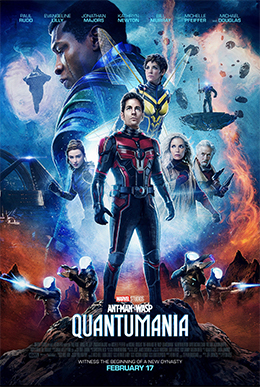
Ant-Man and the Wasp: Quantumania

Scott and Cassie Lang, Hope and Janet van Dyne, and Hank Pym are all accidentally transported to the Quantum Realm and embark on an adventure that goes beyond the limits of what they thought was possible.

Though this threequel expands on the scale of the last two Ant-Man movies to the massive possibilities of the Quantum Realm, the film lacks the charm and wit that a movie with Paul Rudd as a shrinking superhero should have. The green screen and visual effects are hit or miss in terms of blending in with the actors, and the sets feel derivative of Star Wars and Guardians of the Galaxy, almost as if the production asked James Gunn to borrow a Guardians set for a day but without following through with the weird and quirkiness of what we’re seeing. Instead, the adventure just feels like it’s going through the motions until we meet Kang, who’s played strongly by Jonathan Majors. The stakes when it comes to his character are engaging but still too vague to give his character the depth beneath Majors’ stellar presence. Whenever the actors do get the chance to quip off each other or interact with bonkers new characters they meet, it makes for funny moments, especially due to Rudd’s undeniable talent and Kathryn Newton’s performance as Cassie, but any meaningful character development is nonexistent besides the characters revealing secrets or reiterating their love to each other. The movie’s themes about heroism and “looking out for the little guy” are sweet but only take it so far because of the unoriginal execution. The action itself has some fun moments and laughs, but ends up a standard adventure that isn’t inspired or clever enough to do its titular hero justice or advance his arc besides showing him the MCU’s new big bad.

Ant-Man and the Wasp: Quantumania is a watchable movie without enough quirks to make the tone satisfying or enough complexity to make the conflict fascinating. Even for the Ant-Man trilogy, it’s simply fine and only needs to be watched to collect important puzzle pieces for the future of the MCU.