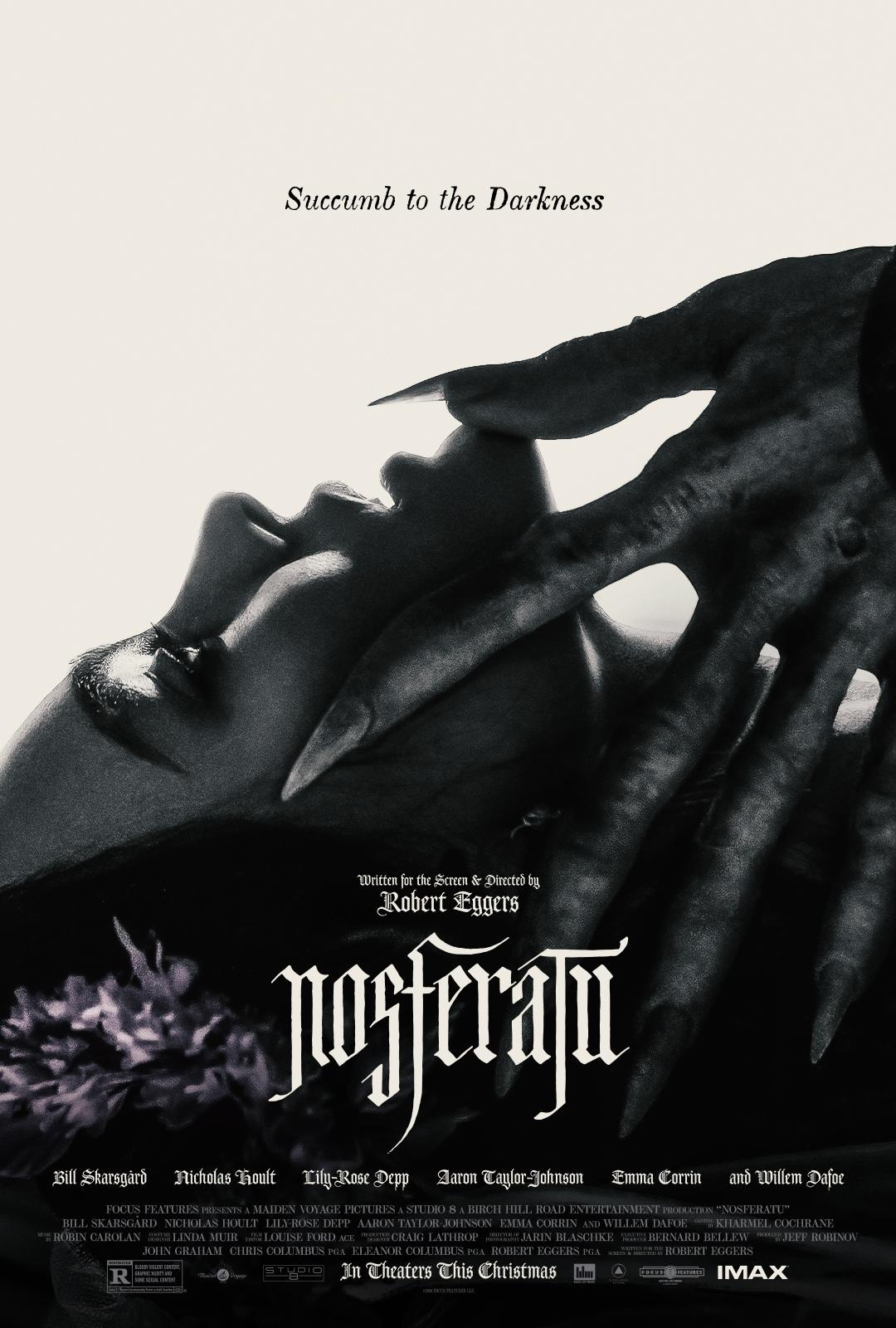
Nosferatu

Out of all the reimaginings of the tale as old as time that is Dracula, none have been quite as chilling and outright transfixing as Robert Eggers’ Nosferatu. Eggers captures beautiful simplicity yet utter darkness in the film’s breathtaking imagery, as well as deeply terrifying sequences of gothic horror. From the jaw-dropping opening scene, the film captures its audience in a sense of heart-stopping fear that never ends until long after the credits roll. Jarin Blaschke’s cinematography wonderfully uses imbalanced lighting, gloomy color schemes, and silhouettes to create something that looks timeless. Every shot evokes a feeling of an ancient evil’s presence that’s about to be awoken and get ahold of what we’re looking at, which is exactly what happens with Count Orlok. Bill Skarsgard is unrecognizable under stunning makeup and changes his voice to create a towering and skin-crawling vampire, who’s face we wisely don’t see in close-ups until much later on. Lily-Rose Depp is a scene-stealer whose performance is so astounding that if you stop to realize it’s acting, it becomes hard to comprehend the sheer levels of physical and emotional commitment required — Depp never makes you question it once. Though the film cleverly shifts main characters between her and Nicholas Hoult, she’s the film’s beating heart and muscle.

Eggers expands on all his trademark oddities as a filmmaker, making us feel helplessly entranced. It’s nail-biting, gory, and does not hold back on scares and twisted, graphic content. The director feels in complete command of the style, whether the score, production design, or material, that digs into ideas of masculinity, obsession, and self-deception, without needing to overexplain what it’s truly about. Though I was dreading what was about to happen between the main characters and the titular vampire, I could never look away; I was deeply unsettled yet never wanted the experience to end, knowing I was in such good hands. No matter whether you know the story beats or not, there’s genuine shock and brilliance in every scene’s execution, breathing new life into a story that felt like it was always meant to fall into Eggers’ hands. It’s masterful and haunting, like watching a gorgeous fever dream that keeps building and building until an unforgettable final act. You may be going for the cast, the monstrous scares, or even just the cinematography — individually, they’re remarkable, yet together, the parts create a spellbinding whole.
Deadpool & Wolverine

Deadpool enters the larger Marvel Cinematic Universe when he’s called upon by the TVA to save his timeline from erasure — or in other words, a Disney acquisition.

Deadpool continuing into the larger MCU, and with a larger sandbox to reference and joke with, only feels right, with the character reminding us that anything and everything in the world of entertainment need not be taken so seriously. Excitingly, it’s not just the convergence of the Fox Marvel heroes and the MCU, but also Hugh Jackman’s return as Wolverine, whom Deadpool has already poked fun of in his films. The film asks, what if two people who can’t die and have no temper but are polar opposites need to get along (but can’t)? That buddy comedy aspect drives the film, as do the multiverse-level visuals. In addition to Reynolds’ increasingly impressive commitment to one of the most foul-mouthed heroes to ever wear spandex, and Jackman’s rage-filled but emotionally charged take on a Wolverine different from the one we parted ways from in Logan, Emma Corrin shines and never feels lesser than the two A-listers when on screen with them. Corrin gives a delightfully cruel and loose performance as Cassandra Nova, and certainly not right-minded, almost like a Mad Max character given Professor X’s powers. Matthew Macfadyen also gives the film some great fun as a TVA agent whose a little murkier than the ones we met in Loki.

The film’s writing for its lead character doesn’t really hit hard on a deep level, and Wade’s relationship with Vanessa feels like a superficial conflict thrown in for the sake of necessity. Their arc worked way better in Deadpool 2, and here, this variant of Logan is by far the more inviting emotional aspect of the film. Despite Deadpool’s growth as a person taking a backseat, this is a film where the experience is reliant on the action, humor, and surprises, and it delivers on all three fronts. The action scenes are creative, eye-popping, and cheerfully graphic, from an opening that’s one of the most brilliant fight scenes in the trilogy to much, much more that comes after. The jokes come at light speed and have something belly laugh-inducing for everyone, including references to the actors’ filmography. The film also embraces the idea of the multiverse with cameos to behold that’s been kept secret from the marketing for our enjoyment in the theater. It’s probably why Deadpool & Wolverine, despite not having a marginally original story, is such a memorable crowd experience and action blockbuster that does not hold back, continuing to push the limits of how much the blood, raunchiness, and self-awareness can surprise and amuse us. But it’s not just irreverent for the sake of it — the humor and energy of the film brilliantly mesh with the CGI-heavy worldbuilding of the MCU, so come the chemistry that’s promised from the title and meta potential of these franchises colliding, and though that’s the mainstay here, it’s more than enough devoted fans of the superhero genre and the collective theater experience.