Renee Zellweger’s iconic British protagonist has become something of a cinematic treasure across four films now. But her films haven’t made us just laugh along at her missteps, but watch her develop, and even come of age, you could say. This final film has a somewhat more bittersweet tone, though, as Bridget’s lover, Mark Darcy, is no longer in the picture. Four years after his loss, she is finally ready to move on and find love again. The film maturely tackles coming to terms with grief, finding joy again while coexisting with the memory of those who have passed on. But it’s also still irreverent, charming, and romantic. It tackles some of the basics that the first film gave a go at, but Zellweger not only shows Bridget’s goofy side, but her struggles with being a single mother of two, and the absence of her husband.
Joining the mix are Chiwetel Ejiofor and Leo Woodall, who both charm in different ways, but Ejiofor in particular has great chemistry with Zellweger. Though it does retread familiar rom-com territory, or that of comedies about parents raising children, and it’s not the sharpest or smartest of the franchise over Bridget Jones’s Baby, it still offers a good time and a heartwarming conclusion to a lovable, messy delight of a character.
Decades after the events of Gladiator, the Roman Empire has fallen into the tyrannical hands of Emperors Geta and Caracalla. Hanno, a young man taken to Rome as a slave, learns of his connection to the Empire and trains to be a Gladiator to fight against the corrupt emperors.
This long-awaited sequel doesn’t have the same visual beauty and flare as its predecessor, but is still a solid action film that embraces the best aspects of the first film’s story. It’s quite an uphill battle to create a hero as strong as Maximus Meridius now that he and Russell Crowe are out of the picture… unless, of course, you cast Paul Mescal. Mescal brings a tenderness to his performance that shows through even when he ought to show strength and ferocity in the arena. Pedro Pascal is also fantastic and completely chews up the scenery, as do Joseph Quinn and Fred Hechinger as the spoiled and maniacal emperors. Denzel Washington gives so much life to the film, seemingly just by being his soulful, fun self. He brings a lot of humanity as he and Mescal enter a mentor-student dynamic. The film doesn’t work as well without Washington’s presence, whose character takes unexpected turns throughout the film.
Gladiator II‘s script works when focusing on its protagonist’s journey, as well as his fight against tyrrany. The power dynamics and engaging action scenes carry the story forward, though visually, it feels held back from what could’ve been compared to the first film. Ridley Scott’s style here doesn’t feel as patient and refined as in his recent The Last Duel, and the CGI could’ve used a lot more improvement. However, the action choreography is as bloody and grand as fans of the original could hope for, and the ending is beautifully done as a realization of promises we didn’t even realize the first film had. It’s a noble continuation that honors the first film, and its cast led by Mescal and Washington, while never quite reaching that original movie’s breathtaking heights, but still better than some of Scott’s other recent outings, and worth a watch in theaters.
When two Mormon missionaries arrive at Mr. Reed’s house attempting to convert them, they find themselves stuck there in a game of wits, fighting for their lives.
When two Mormon missionaries arrive at Mr. Reed’s house attempting to convert them, they find themselves stuck there, fighting for their lives.
Heretic doesn’t play out with the typical levels of jump scares and macabre we’re used to from horror films these days — rather it’s a battle of wits in which the characters contemplate belief, religion, and faith… oh, and an adult man is terrorizing two young women as they’re held captive in his house, which becomes a maze of puzzles related to his disdain for their faith. Hugh Grant is rather terrifying as Mr. Reed here, but he’s clearly having such a delightful time in the character’s skin. He’s as threatening as you can imagine a mysterious man in his 60s alone in a large house but also has plenty of outlandish and hilarious dialogue. Some viewers simply looking for an intellectual dark comedy could most definitely find satisfaction in watching Heretic. You also genuinely care about our two protagonists. Sophie Thatcher and Chloe East both bring cleverness to the film, a willingness to challenge their captor, and not break down and quit. Thatcher brings a rebellious sense of mystery to Sister Barnes, while Chloe East is heartfelt and capable as Sister Paxton.
Though Heretic takes some time for the uniqueness and thrills to set in, it stands out from other recent horror films thanks to its restraint on its scares, as well as its smart screenplay and chilling villain. The three performances are integral and lift up the film’s shocking fun, and may even make you think about some big ideas all while you’re enjoying this dark ride.
Colt Seavers, a down-and-out stuntman, must find the missing star of a new blockbuster film he’s doubling on, while (hopefully) winning the director (and his ex-girlfriend)’s affection back.
David Leitch continues to be a leading voice in action movies with his creative and passionate voice for action and comedy that often turns out star-studded and visually appealing. Much of the film’s charm comes from Ryan Gosling’s brilliant turn as Colt. Like his Oscar-nominated Ken in Barbie, Colt is a sad shell of a “cool guy” who’s too evidently madly in love. Gosling’s comedic timing is at the lightning speed of his Ken, or Holland March from The Nice Guys, and his big personality infuses Colt with a foolishly endearing heart. Emily Blunt also gives one of her most entertaining performances of late as the romantic lead, and Winston Duke is also loads of fun as Colt’s best friend and the film-within-a-film’s stunt coordinator, while Aaron Taylor-Johnson, Hannah Waddingham, and Stephanie Hsu also round out the stellar cast. Waddingham in particular is very extravagant but delightful as Gail, the producer of the film Colt’s working on.
The most clever and thrilling part of The Fall Guy is that Leitch makes the movie stunt-filming scenes as high-stakes and exciting as the actual action scenes of the film. The great scale, dedication, and sound effects make shooting an action movie stunt feel like the incredible, hard-achieved feat that it really is. Additionally, the lightspeed humor feels effortless thanks to the writing, editing, and the cast’s delivery. The lively soundtrack does have a few generic and overused selections, but it’s not enough to sink this smooth romantic action comedy where all the different genre pieces play off each other pitch-perfectly. The director’s career as a stunt coordinator is made evident by the love and tribute to the stunts community here, in this blockbuster that’s hilariously pleasing and greatly worth the big screen price of admission.
In the second part of Denis Villeneuve’s adaptation of the classic sci-fi novel, Paul Atreides seeks revenge against the Harkonnens, who slaughtered most of his House Atreides, and liberate the native Fremen of the planet Arrakis while joining them and learning their ways, all while the fate of the Imperium lays in the balance.
The first Dune from 2021 may have been one of the most stunning blockbusters in recent memory, but this extraordinary sequel puts everything in its predecessor — and almost any action movie I’ve ever seen — to shame. Picking up shortly after the first film, the drama is heightened, the world-building is bombastic, and the sound and visual experience is a one-of-a-kind theater trip. Visceral is such an overused term these days that it wouldn’t do Dune: Part Two justice; you feel how wide this universe spreads and the history of the different conflicts and races that inhabit it. And once you’re brought into this fictional world, you’ll never want to leave, as the nearly 3-hour runtime flies by and every plot development is fascinating. Beyond Villeneuve’s imagination, Greig Fraser’s cinematography is the real MVP here. The beauty within the uncertainty of the desert planet is captured in such a scope that it demands in IMAX viewing, and the different planets all contribute a symbolic and gorgeous aesthetic. Timothee Chalamet takes us on the next step of Paul’s journey: his desire to adapt and fight and his fear of allowing power and faith to corrupt him. He proves that he’s always been a movie star that’s here to stay, and Rebecca Ferguson’s Lady Jessica also takes really interesting directions that make you see her role in the story, and of her son’s, in a murkier way. Zendaya also becomes a lot of the heart here as Chani, one of the franchise’s most noble characters, and Josh Brolin is always terrific as Gurney, while Javier Bardem puts his soul into the role of Stilgar, whose faith drives him towards Paul and Jessica. Austin Butler may be the standout, however, as Feyd-Rautha, whose deranged and sadistic presence create a nail-biting character and a powerful young man who has fully embraced his disturbed nature.
Though Dune: Part Two ups the ante with its visuals and performances, its the powerful script and heightened emotional stakes that make this experience what it is. The film explores questions as to how faith and hope can be exploited, and if the urge for power truly corrupts whoever gets a taste of it. Though you may find yourself trying to guess which paths these characters will take, there’s also lots of unexpectedness and the film’s most intense moments took my breath away. You understand so deeply the dynamics of this galaxy and its cultures, and how much lays in the balance. The exhilarating scale and exciting, constantly developing pace only works because of the passion behind each character and story thread: passion to lead, rule, fight, love, honor, avenge, or secure a future. These moral greys form the dark and poetic drama that’s impeccably guided by frame-worthy shots and booming sound. Never have I felt so deeply that I didn’t want a film to end, as once you’re sucked into this marvelous world by Villeneuve, you’ll never want to go home. We’ve rarely seen emotion and grandiose like this in action movies so flawlessly convert to a magnetic cinematic experience. The Empire Strikes Back comparisons are worthy but also a little humbling; this reaches the bar that The Lord of the Rings: The Return of the King set for sci-fi/fantasy epics. It’s a show-stopping galactic saga that unleashes its ambition and magnitude onto you in a way that will entrance and thrill whoever buys a ticket. It’s a spectacle that sets the bar so high for whatever else is to come in blockbuster filmmaking, and like the unreal visuals and scale of Avatar: The Way of Water, needs to be seen on a massive screen, to be transported with other people, and watch a story unfold that you’ll never forget.
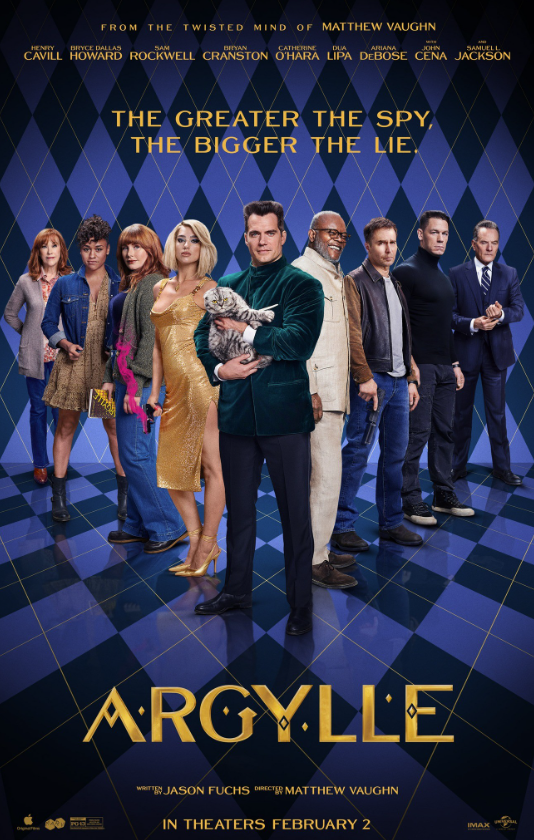
Elly Conway is the reclusive author of the Argylle spy novels . Soon, she realizes the plot of the new book she’s writing starts to mirror real-world events, as a global spy syndicate starts to come after her.
It’s always a blessing when Matthew Vaughn gives us a glimpse into his twisted mind with his witty and bombastic action scenes, and Argylle has a few of those, but it’s everything else that disappoints. Vaughn directs with a love for spy material and cartoonish entertainment mixed with modern, meta flare. The script, however, completely misses the mark and looks the commanding energy that his Kingsman had. Even Sam Rockwell, whose charm and goofiness often comes effortlessly, has to work with dialogue that falls flat and the attempts at humor don’t manage to illicit a response. Though Henry Cavill has some fun and Bryce Dallas Howard tries her best in the leading role, there’s more left to be desired in Ariana DeBose, John Cena, and Samuel L. Jackson’s screentime. Bryan Cranston’s villain may be the weakest link of the cast, as everything he’s given to do is annoyingly generic.
The movie’s downfall is also its ambition, which is often what lifts Vaughn up above the rest. The ludicrous twists are executed in a head-scratching way, and all the film’s rules or explorations of fiction vs reality are thrown to the side for more frustrating decisions that make its lead character less interesting. The pacing also suffers greatly in the film’s second half, the end of which sees us getting a few of those glorious scenes of carnage Vaughn’s known for, which still feel softened compared to what they could’ve been due to the PG-13 rating, but are delightfully exaggerated and have great soundtrack choices. By then, however, the journey to get there is simply exhausting and it may be too little, too late for many viewers.
Argylle is a massive disappointment in which a singular director brings his trademarks to the screen yet again, only this time without the laugh-out-loud glee or the clever script that usually support his vision. Its ambition unfortunately exceeds its grasp, and its inconsistent and convoluted execution make this invitation to take the world a little less seriously with Matthew Vaughn a sadly unrewarding one.
The Color Purple is the second film adaptation of Alice Walker’s beloved novel, this one based on the Broadway musical adaptation as well, about a young woman named Celie who faces many hardships living in the South in the 1900s, but ultimately finds extraordinary strength and hope in the unbreakable bonds of sisterhood.
Though everyone in this new cinematic rendition The Color Purple is one of the best at what they do, the idea of making this a musical doesn’t always fit with the tone of all the rough things going on in the characters’ world, and the very clean cinematography removes the grit that Steven Spielberg’s version had that showed you the weight of the hardships and abuse Celie endured. Here, the most earned moments for Celie’s character aren’t necessarily her musical numbers but rather moments where Fantasia Barrino gets to shine just based on her interactions with other actors or set pieces that inform Celie’s character. Barrino is very strong in the role, but Taraji P. Henson runs away with the movie every time she shares a scene with her, or anyone for that matter. Henson portrays blues singer and “loose woman” Shug Avery with a power to her that commands every other character in both a loving and wise way, not to mention her show-stopping musical number in a tavern. Danielle Brooks is the other highlight as Sofia, whose characters shamelessness and courage shine through in both her songs and her incredible physical acting. Colman Domingo is simply incredible as Mister, inhabiting the character in not an inch less of meanness and disgust as Danny Glover did so brilliantly in the 1985 film, but also giving the abusive man a quietly human edge to him that Domingo finds even when the audience doesn’t want to see it. Corey Hawkins, Halle Bailey, and H.E.R. also give strong turns due to their potent screen presences and musical talents, and even Louis Gossett Jr. shows up for an excellent short appearance.
There’s no denying how amazing their singing and dancing is. However, it’s the songs themselves that don’t blend in with the material this story is telling. Save for a song or two, the lyrics aren’t quite memorable, either. This imagination of the story clearly works much better as a stage musical, where the audience can interact with the actors in real space as they sing and dance. For a film that gets cruelly serious at times, though the more uplifting song breaks don’t compliment the more hard-hitting scenes as much as the film would like to think, even though the actresses are always killing it. And although the costume design is award-worthy, the digital cinematography may have given it more of a music video edge that director Blitz Bazawule is used to, that could’ve benefitted from longer shots and a more period-like look. In short, come for the spectacular cast and a timeless story, but there’s no promising audiences won’t prefer the rougher and more dramatically coherent film that Spielberg led back in 1985 with Whoopi Goldberg and Oprah Winfrey.
Bella Baxter is a young woman brought back from the dead by the brilliant and unorthodox scientist Dr. Godwin Baxter. Under Baxter’s protection, Bella is eager to learn. Hungry for the worldliness she is lacking, Bella runs off with Duncan Wedderburn, a slick and debauched lawyer, on a whirlwind adventure across the continents.
Trigger warnings are a no-brainer with Yorgos Lanthimos, as his films are often filled with sadistic, violent, and hypersexualized power games where nobody is quite a pleasant person. These tropes as well as Lanthimos’ trademark cringe humor are just the baseline to describing Poor Things, a sickening yet grandiose movie that transcends categorization. It’s hysterical but not quite a comedy; it’s poetic but not quite a drama. Emma Stone gives a performance so demanding and so audacious yet it never breaks the illusion of being acting. You completely buy her character in the context of the story and are taken aback by her character’s abnormal physicality and wonder with being alive. Mark Ruffalo is also throwing himself into this role that could’ve easily fallen into unbelievability, but he perfectly balances an exaggerated, almost theatrical edge to his role with a vile, pitiful nature to it. Willem Dafoe plays a scientist under heaps of makeup whose motives may provide an emotional anchor to Stone’s character but also unpeels itself to be uncomfortably pathetic due to his background, and Ramy Youssef also does a great job here.
Poor Things may owe some of its inspiration to classic monster movies, but really isn’t like anything audiences have seen before. The production design creates an eye-popping, fantastical version of the Victorian Era and a world with a completely fresh aesthetic, as well as dynamic cinematography with color, B&W, and even a few fish-eye lens shots to invoke Bella’s warped worldview. Bella’s curiosity is devoid of prejudice and preconceived notions on the world’s structures, and she finds herself appalled by those around her trying to control her, and fascinated by anything she gets to choose to do. The humor is ridiculously honest and ballsy, and therefore, not for everyone — not to mention the exaggeratedly comic sex scenes and the uncompromising and even disgusting violence. Its audacity will certainly find its pleasurers, especially those who already love the director’s filmography. This bold tour de force isn’t for the faint of heart and may leave you at a loss for words. The writing and execution are exhilarating in the best way; the more disturbing and out-of-this world it gets, the less you’ll feel you want to look away. You’ll simply want to witness the bizarre yet fascinating unfold in front of you when it’s through Yorgos’ eye and so irresistibly played by Stone as this woman with the literal brain of an infant in her head, eager to experience being alive for all its peculiarities..
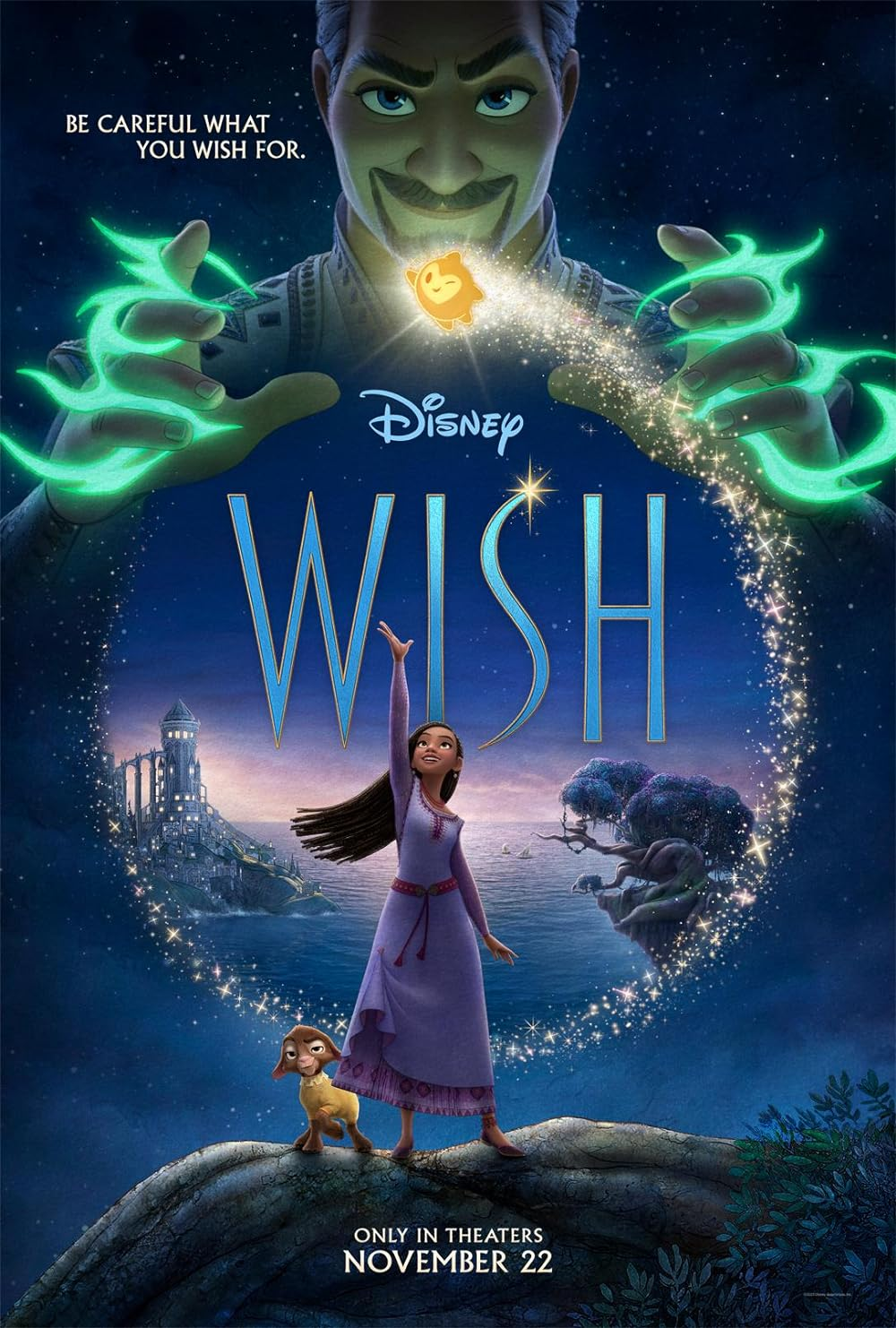
In the Kingdom of Rosas, King Magnifico safeguards the people’s wishes with the promise to grant them one day. But when young Asha wishes upon a star for her community to have better, what she didn’t expect was for the star to answer back.
Disney experiments with the 2D coloring of 3D characters that films like the Spider-Verse have popularized, which can’t seem to make up for the film’s derivative story. Though the animation is vivid in colorful in the scenes that are night-set or creatively lit, most of the scenes set during the day feel like they lack lighting or any sort of flare besides the gimmick. Ariana DeBose’s performance is full of joy and her singing is spectacular, though that shouldn’t come as a surprise. The character of Asha has nothing to really distinguish herself from other Disney heroines like Rapunzel and Mirabel, and the concept of her wishes and motives feel rather underdeveloped. Chris Pine does great as well, but his villain’s descent from charismatic leader to power-hungry wizard feels unearned. None of the supporting characters are quite memorable, and a few of the songs do stand out, including “This Wish”, “At All Costs”, and “This is the Thanks I Get”. But both the middle and end portions, particularly the talking animals and forgettable action, greatly suffer from this lack of an interesting ensemble and heart that made the characters in Frozen, Moana or Encanto resonate. It’s certainly enough to keep the children entertained and singing along, but is also too generic to earn a place among the ranks of other films from the studio that have solidified themselves in Disney’s legacy.
The Hunger Games: The Ballad of Songbirds and Snakes is set 64 years before the first Hunger Games movie, around the time of the 10th Hunger Games where a young Coriolanus Snow is living in the Capitol, facing choices that will define his future and that of Panem as he mentors District 12 tribute Lucy Gray Baird to victory in the arena.
This adaptation of Suzanne Collins’ excellent prequel to her acclaimed series of novels has the best cinematography of the franchise, and stunning production design. The Hunger Games films have always boasted incredible world-building, making the intricate politics and history of Panem spread far beyond the screen, and introducing the audience to a wide world of characters within it. However, the film sometimes lacks soul when it needs it most, especially in its first act. Tom Blyth gives an interesting performance of a young man as his narcissism and consumption for power begins to consume him whole. Though Rachel Zegler’s singing voice and presence gives Lucy Gray heart, her character lacks the consistency and potency she’s meant to have, not to mention an off-putting Southern accent. The chemistry between Zegler and Blyth feels weak, though it should’ve been a key component in the film. Jason Schwartzman gives a great comedic performance as Lucky Flickerman, the announcer of the Games, and Josh Andres Rivera gives the most empathetic performance as Sejanus. Hunter Schafer also steals the screen as Snow’s cousin Tigris, but doesn’t have nearly as many scenes as she deserved. Although Viola Davis’ character is supposed to be repulsive, her voice and lines are weirdly over-the-top.
The sequences we see inside of the Hunger Games are absolutely amazing, and more visually exciting than anything we saw in the arena of the original 2012 film. The dynamic shots and lighting create a scenery that’s both grand and sadistic. The post-war dynamics between the Capitol and Districts hits hard with the viewing of the Games, the dialogue itself is lacking and character decisions seem sometimes unearned. What is well-earned is this idea of a Hunger Games prequel set at this era so soon after a civil war and its sickening aftermath, and hitting home themes about human nature, but it should likely be viewed in the context of the films that were released before it — films that may have had better characterization despite this one’s admirable ambitions and aesthetic.





 filmtoppings.com