When two Mormon missionaries arrive at Mr. Reed’s house attempting to convert them, they find themselves stuck there in a game of wits, fighting for their lives.
When two Mormon missionaries arrive at Mr. Reed’s house attempting to convert them, they find themselves stuck there, fighting for their lives.
Heretic doesn’t play out with the typical levels of jump scares and macabre we’re used to from horror films these days — rather it’s a battle of wits in which the characters contemplate belief, religion, and faith… oh, and an adult man is terrorizing two young women as they’re held captive in his house, which becomes a maze of puzzles related to his disdain for their faith. Hugh Grant is rather terrifying as Mr. Reed here, but he’s clearly having such a delightful time in the character’s skin. He’s as threatening as you can imagine a mysterious man in his 60s alone in a large house but also has plenty of outlandish and hilarious dialogue. Some viewers simply looking for an intellectual dark comedy could most definitely find satisfaction in watching Heretic. You also genuinely care about our two protagonists. Sophie Thatcher and Chloe East both bring cleverness to the film, a willingness to challenge their captor, and not break down and quit. Thatcher brings a rebellious sense of mystery to Sister Barnes, while Chloe East is heartfelt and capable as Sister Paxton.
Though Heretic takes some time for the uniqueness and thrills to set in, it stands out from other recent horror films thanks to its restraint on its scares, as well as its smart screenplay and chilling villain. The three performances are integral and lift up the film’s shocking fun, and may even make you think about some big ideas all while you’re enjoying this dark ride.
The Apprentice envisions the rise of billionaire tycoon and megalomaniac Donald Trump as a teacher-student relationship between Trump and his cutthroat attorney Roy Cohn, the acolyte of many evildoers in American history such as Nixon and McCarthy. It takes a serious approach with only a dash of irreverence in its script and style, showing the true scope of the values America represents and the ones it claims to but fails. Sebastian Stan isn’t doing a comedic impersonation of the man like many we’ve seen on Saturday Night Live, rather he transcends that and embodies Trump’s skin, becoming more and more like the Trump we’re used to seeing and hearing as the runtime progresses. Donald in the film is chronicled in his journey from a spoiled brat living off his dad’s achievements, to the narcissistic bully obsessed with greed and demonizing others. Much of what he seems to learn is attributed to his mentor, attorney Roy Cohn. Jeremy Strong is incredible in the role, giving a massive performance as a man who dominates every room yet evidently has a small sense of self. Cohn is played by Strong with immense physicality and a fragile fearfulness to his appearance. Even when the film’s pacing occasionally slows down or falters, the film is entirely worth it for those two principal performances.
Director Ali Abassi is fascinated with the American ambitions and values that surfaced in the 1980s, including Cohn’s “kill or be killed” mentality that many big American wealth giants lived by, or splitting the world into “winners and losers”. The use of various vintage cameras to immerse the audience in its 80s period can come off as indulgent and even distracting when too rushed, but the production value looks uncanny to how the Trumps at that time and their “achievements” really looked. Most importantly, it shows the normalization of bigotry and corruption in the American system, and how it’s rigged to enable the wealthy to get richer, and continuously toss the needs of the people aside. Trump comes of age in the film, but perhaps for the worst. His wishes are all granted, but at what cost? The spread of his ambitions to conquer the world and rub it in everyone else’s faces seem never-ending, but we see his infamous persona here originating from a desire to always be strong and win no matter the cost. The Apprentice isn’t just an origin story of modern evil, but a tale of the delusional men who roam at the top of society, capturing the essence of how a force of destruction and its hunger for power was activated and enabled by forces not so unlike him.
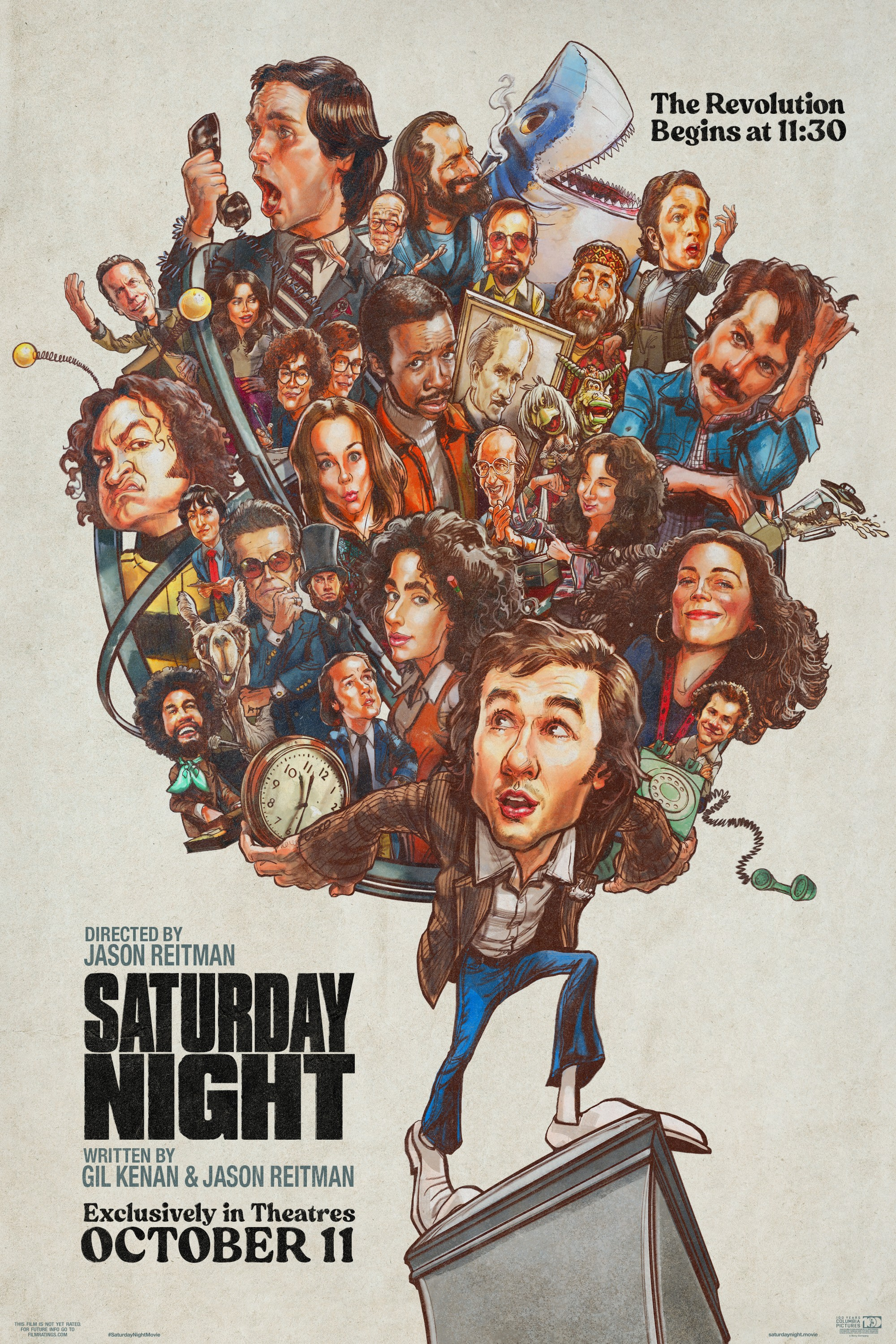
Saturday Night takes us to the fateful night of October 11, 1975 in Manhattan, where Lorne Michaels tried to launch his sketch comedy show for its first-ever episode, which we now know as the iconic and influential Saturday Night Live nearly 50 years later.
A film about SNL should make us laugh, feel revealing, and be packed with celebrity and pop culture history, and that’s exactly what Jason Reitman’s take on the sketch show’s beginning offers plenty of. The lovely 70mm look, long takes throughout the studio, and energetic score from Jon Batiste give the film a strong and dedicated technical edge.
While many films based on true stories have one or two casting choices that feel inspired, Saturday Night has dozens. Gabriel LaBelle, who’s probably a decade younger than Lorne Michaels was when this all went down, plays the creator with a contagious ambition to make magic for audiences on the stage. Rachel Sennott is sometimes the scene-stealer and the heart of it all, while Dylan O’Brien as Dan Aykroyd is one of his most fun performances in years. Cory Michael Smith brilliantly portrays the unstable ego of Chevy Chase, one of the most infamous members of the show’s original cast, while Matt Wood is uncanny in his recreation of the late John Belushi. Nicholas Braun is impeccable and unforgettable as not one but two cultural icons; they’re a pair of performances you have to see to believe. And we haven’t even mentioned Lamorne Morris, Cooper Hoffman, and Matthew Rhys, the latter of whom chews up the scenery as comedian George Carlin. More recognizable names Willem Dafoe and J.K. Simmons are also excellent and hysterical. The best part about this cast is that it reflects how Reitman wants us to feel about the characters and circumstances in the film — a ragtag group of youngsters with the potential to make us laugh, joining forces hoping to change the world.
As we know, the events of this movie, as chaotic as they unfold, did change the world. The most wonderful part about Saturday Night is that it celebrates the convergence of culture for half a decade, which began as NBC’s laughing stock but has since brought together millions with the arts of comedy, music, and performance joining together. The movie itself isn’t as funny as it thinks it is, but when a film celebrates laughter while making you laugh, those ingredients are the perfect groundwork for a purely entertaining wonder, even as you watch everything go wrong (at first). Fans of SNL will have a delightful time with the mythology of 20th-century American comedy, but anyone else will still have a great time with Reitman’s love letter to popular culture, humor, New York City, and the underdog.
Megalopolis is the ambitious new epic fantasy/sci-fi drama from cinema legend Francis Ford Coppola. In the city of New Rome, Julia Cicero (Nathalie Emmanuel) is torn between the ideas and loyalties of architect Cesar Catalina (Adam Driver), who sets out to reinvent the NYC-esque city entirely into a utopia of his imagining, and her father (Giancarlo Esposito), the mayor who wants to keep things as they are.
Megalopolis sets out to be the most ambitious movie meant for a large screen in ages, with outrageous ideas coming at us straight from Coppola’s mind (and pockets, too). Unfortunately, shooting for the moon doesn’t land Megalopolis among the stars, more so the dirt. It’s a canvas of messy ideas that come together without reward, prestige, or even sense. The dialogue is unintelligible, the story is impossible to follow, and the green screen and effects that try to imagine out-of-this-world visuals in line with Doctor Strange look rather hideous and more in line with Spy Kids or Speed Racer. The film poorly utilizes its stacked cast that includes Driver, Emmanuel, Esposito, Aubrey Plaza, Shia LaBeouf, Jon Voight, Laurence Fishburne, Dustin Hoffman, and more. They’re all given surface-level characters with awful dialogue and absolutely no idea what to do with them. An early scene featuring a number of the principal cast debating on the city’s feature feels more like a drunken celebrity costume party than a scripted and rehearsed scene in a film. The characters are inconsistent (and have unexplained superpowers?), and LaBeouf’s antagonist is laughable and serves no threat whatsoever. Fishburne’s narration is indulgent and unnecessary — the movie begins with Coppola conveying to the audience through Fishburne that he sees parallels between our modern metropolises and Ancient Rome, and then proceeds to spoonfeed that same message to us for 138 minutes with no further nuance.
You may be glad you chose to see Megalopolis on a huge screen… for about two minutes, and then everything goes haywire. The mess of tones and logic is the least of the audience’s worries here; it’s a sensory disaster and a meaningless, incomprehensible drag with hollow ideas and distracting visuals. Things don’t explain themselves or mean things in Megalopolis. They just happen. Yet there’s no mystery underneath to unlock and no sense of intrigue, maturity, or intellect whatsoever from the man who directed The Godfather, Apocalypse Now, and The Conversation. If, like me, you don’t manage to hop on board with this puzzling vision from a filmmaking master devoid of wonder or enjoyment, this is one city you’ll be itching to escape from.
Tashi, a former tennis prodigy turned coach, turned her husband Art into a champion. But to overcome a losing streak, he needs to face his ex-best friend, Patrick, who’s also Tashi’s ex-boyfriend.
One thing that’s thrilling about Challengers is that it never gives you easy answers. Is it about devotion? Manipulation? Triumph? Doom? All of them? One thing’s for sure: it’s a film about passion. Raw physical and emotional passion between humans for one another, and for the kick they get doing the one thing they can’t live without — in this case, playing tennis. And for all the right reasons, Luca Guadagnino is at his most maximalist stylistically to convey this raw passion these characters feel and bring us into the world, from exciting editing and some experimental cinematography to the synth, almost Run Lola Run-esque score from Trent Reznor and Atticus Ross. It’s the polar opposite to his more naturalistic, minimalist approach to the intimacy of Call Me By Your Name, and an upping of the ante of the wilder style of Bones and All. Zendaya gives one of her heaviest performance, portraying Tashi perfectly over a long span of time, through fascination, ambition, longing, control, and deceit. Josh O’Connor and Mike Faist are also great, particularly Faist, whose charm entrances the screen. The West Side Story star announces himself as a powerhouse whose apparent harmlessness you can’t help but feel for. Their friendship established in the opening minutes of the film sets the stage for everything to come, and makes you care for how the rest may unfold or fall apart.
Challengers is the rare film that transports you into its world in a case where there are only 3 characters who really bear any significance. There’s a scene between the three main characters that happens early on chronologically that enchants you and sucks you into the close, complicated intimacy they inhabit in this space, and the film never lets you go once this scene happens until the credits roll. It’s an experience that’s dynamic, unpredictable, and darkly human, with three riveting leading performances at its center, and sets the bar the rest of what’s to come in Guadagnino’s directorial career.
Colt Seavers, a down-and-out stuntman, must find the missing star of a new blockbuster film he’s doubling on, while (hopefully) winning the director (and his ex-girlfriend)’s affection back.
David Leitch continues to be a leading voice in action movies with his creative and passionate voice for action and comedy that often turns out star-studded and visually appealing. Much of the film’s charm comes from Ryan Gosling’s brilliant turn as Colt. Like his Oscar-nominated Ken in Barbie, Colt is a sad shell of a “cool guy” who’s too evidently madly in love. Gosling’s comedic timing is at the lightning speed of his Ken, or Holland March from The Nice Guys, and his big personality infuses Colt with a foolishly endearing heart. Emily Blunt also gives one of her most entertaining performances of late as the romantic lead, and Winston Duke is also loads of fun as Colt’s best friend and the film-within-a-film’s stunt coordinator, while Aaron Taylor-Johnson, Hannah Waddingham, and Stephanie Hsu also round out the stellar cast. Waddingham in particular is very extravagant but delightful as Gail, the producer of the film Colt’s working on.
The most clever and thrilling part of The Fall Guy is that Leitch makes the movie stunt-filming scenes as high-stakes and exciting as the actual action scenes of the film. The great scale, dedication, and sound effects make shooting an action movie stunt feel like the incredible, hard-achieved feat that it really is. Additionally, the lightspeed humor feels effortless thanks to the writing, editing, and the cast’s delivery. The lively soundtrack does have a few generic and overused selections, but it’s not enough to sink this smooth romantic action comedy where all the different genre pieces play off each other pitch-perfectly. The director’s career as a stunt coordinator is made evident by the love and tribute to the stunts community here, in this blockbuster that’s hilariously pleasing and greatly worth the big screen price of admission.
A journey across a dystopian future America, following a team of military-embedded journalists as they race against time to reach DC before rebel factions descend upon the White House.
Alex Garland is often not one to shy away from dark images as they unfold, but there’s something particular about the violence in Civil War, as if you’re peeking at something you’re not supposed to, only it’s happening in your own yard. Garland seems to have something to say with the “action” here that’s proven itself in reality too much not to struck a chord when it’s depicted way — Americans being just a few disagreements (and arms) away from completely tearing each other apart. What began this second civil war in America is none of our concern, rather the ease at which we’ve turned on the very fabric of democracy. Bloodthirsty militias and anarchists seem too familiar a sight, though we’re following this dystopian war through a group of journalists. Kirsten Dunst gives a powerful performance, as she reveals the most about her character in the quietest of moments. Wagner Moura also gives the film a lot with his charismatic, knowledgeable, and authoritative presence among the protagonists. Cailee Spaeny is notably wonderful as the ambitious younger photographer on the journey who’s horrified responses to what unfolds in front of her are probably how we’d react to, let’s face it. Stephen McKinley Henderson is a fantastic presence as well who adds a lot with his wisdom and charm to each of Garland’s projects that he’s in.
Though Civil War is minimal on exposition as to the larger politics of this war — rather we get an idea of the state of the nation through smaller moments and remarks — the action is incredibly harrowing and graphic. The sounds of gunfire and combat roar through the speakers, and blood is a “loud” reality and consequence. It all plays out without the “cool” sort of filter many Hollywood action movies have, rather it’s an unfolding of sheer chaos and carnage through intentionally amassed manpower, in the way that Children of Men and Sicario throw you into uncontained, senseless warfare. Best of all, the climactic battle at the center of the third act is exhilarating and ends in the most Alex Garland rug-pulling way possible for a film with this subject matter. Fans of Garland’s daring and mature work be interested in the punch he packs here, but for anyone who’s simply looking for an action film — this one’s singular and profound but does not hold back, and when it’s untamed, it’s at its most engrossing.
Guy Ritchie’s latest action film is loosely based on true, mostly encrypted stories, in which the British military recruits a small group of highly skilled soldiers to strike against German forces behind enemy lines during World War II.
Guy Ritchie seems to be racking out more movies than some of his fans will be able to keep track of, but among a slew with varying qualities, this one may end up being looked back at as one of his most entertaining films ever. Ritchie imbues the screen with an Inglorious Basterds-like irreverence to its Nazi-killing action. The WWII battles are swiftly edited and have action sequences that’ll make you cheer with glee at the bad guy body count and the different ways they get killed by the titular heroes. Henry Cavill leads the pack with a similar irreverence he gave Ritchie’s The Man From U.N.C.L.E., but with an even rougher edge to his badassery. The ensemble of Eiza Gonzalez, Alan Ritchson, Henry Golding, and Cary Elwes all give the film a liveliness that makes up for a lack of uniqueness to them, as well as a menacing Til Schweiger who maintains a strong presence. Unlike last year’s Operation Fortune, the film’s witty humor matches the extra wicked energy the director is known for, but it may lack character depth for some viewers. Most of the characters have little substance besides “recently incarcerated” or “they’re crazy”, but their outlandish personalities make up for that in the case of this film. The soundtrack choices aren’t always on-point, but the Western-inspired music usually adds to the film’s sharp direction. The film also doesn’t manage to always balance the different moving plots seamlessly, as Ritchie sometimes can’t help but indulge too much in his trademark banters which can sidetrack, but ultimately culminates in some strong tension in the third act. The Ministry of Ungentlemanly Warfare perhaps achieves what Matthew Vaughn’s The King’s Man failed to do — turn covert misfit spies into World War heroes and make the journey feel exciting and earned on the way. Ritchie is no stranger to the approach he set out to achieve here, but he manages to balance out his quirks with an excellent style, an interesting mission and cast of characters, and a rewarding catharsis when the action and comedy hit their peaks, as you might not want the fighting to stop out of sheer Ritchie delight.
Back to Black chronicles the life and music of Amy Winehouse, through the journey of adolescence to adulthood and the creation of one of the best-selling albums of our time.
It may feel like a step up from recent music biopics like Elvis and I Wanna Dance with Somebody, and may be on par with something like Respect and not quite at the glory of Rocketman. Marisa Abela is great as Winehouse, bringing the young music-loving girl to the screen in the start and the mess of an unstable addict she becomes later in life. But what’s most unbelievable is Abela’s singing which completely captures the one-of-a-kind grandeur of Amy’s voice. There are times when Abela completely disappears and you simply feel the singer alive in front of you. Eddie Marsan gives one of his most memorable performances to date as Amy’s father, while Lesley Manville also brings a lot to the movie as her grandmother. When Jack O’Connell comes in, however, as Amy’s love interest and eventual husband, the film falls into messy melodrama that sinks the runtime and falls into the same traps that many of these biopics suffer from when channeling the artist’s pain and troubles. Winehouse’s journey through love and addiction is filled with cliches, but is empathetic enough for us to forgive her shortcomings. The film also does a great job of incorporating her songs into the film, and best of all, it manages to have its audience actually interact with the subject as a tangible person, rather than just a larger-than-life legend. The more minimalistic approach to the musical biopic gives Back to Black a strong start, but you’ll also have a few too many instances of deja vu, though we’ve certainly seen it done worse. It’s watchable enough for non-fans of the late singer, but for some, it might not stand out among similar films with similar beats that have come out far too recently.
In the second part of Denis Villeneuve’s adaptation of the classic sci-fi novel, Paul Atreides seeks revenge against the Harkonnens, who slaughtered most of his House Atreides, and liberate the native Fremen of the planet Arrakis while joining them and learning their ways, all while the fate of the Imperium lays in the balance.
The first Dune from 2021 may have been one of the most stunning blockbusters in recent memory, but this extraordinary sequel puts everything in its predecessor — and almost any action movie I’ve ever seen — to shame. Picking up shortly after the first film, the drama is heightened, the world-building is bombastic, and the sound and visual experience is a one-of-a-kind theater trip. Visceral is such an overused term these days that it wouldn’t do Dune: Part Two justice; you feel how wide this universe spreads and the history of the different conflicts and races that inhabit it. And once you’re brought into this fictional world, you’ll never want to leave, as the nearly 3-hour runtime flies by and every plot development is fascinating. Beyond Villeneuve’s imagination, Greig Fraser’s cinematography is the real MVP here. The beauty within the uncertainty of the desert planet is captured in such a scope that it demands in IMAX viewing, and the different planets all contribute a symbolic and gorgeous aesthetic. Timothee Chalamet takes us on the next step of Paul’s journey: his desire to adapt and fight and his fear of allowing power and faith to corrupt him. He proves that he’s always been a movie star that’s here to stay, and Rebecca Ferguson’s Lady Jessica also takes really interesting directions that make you see her role in the story, and of her son’s, in a murkier way. Zendaya also becomes a lot of the heart here as Chani, one of the franchise’s most noble characters, and Josh Brolin is always terrific as Gurney, while Javier Bardem puts his soul into the role of Stilgar, whose faith drives him towards Paul and Jessica. Austin Butler may be the standout, however, as Feyd-Rautha, whose deranged and sadistic presence create a nail-biting character and a powerful young man who has fully embraced his disturbed nature.
Though Dune: Part Two ups the ante with its visuals and performances, its the powerful script and heightened emotional stakes that make this experience what it is. The film explores questions as to how faith and hope can be exploited, and if the urge for power truly corrupts whoever gets a taste of it. Though you may find yourself trying to guess which paths these characters will take, there’s also lots of unexpectedness and the film’s most intense moments took my breath away. You understand so deeply the dynamics of this galaxy and its cultures, and how much lays in the balance. The exhilarating scale and exciting, constantly developing pace only works because of the passion behind each character and story thread: passion to lead, rule, fight, love, honor, avenge, or secure a future. These moral greys form the dark and poetic drama that’s impeccably guided by frame-worthy shots and booming sound. Never have I felt so deeply that I didn’t want a film to end, as once you’re sucked into this marvelous world by Villeneuve, you’ll never want to go home. We’ve rarely seen emotion and grandiose like this in action movies so flawlessly convert to a magnetic cinematic experience. The Empire Strikes Back comparisons are worthy but also a little humbling; this reaches the bar that The Lord of the Rings: The Return of the King set for sci-fi/fantasy epics. It’s a show-stopping galactic saga that unleashes its ambition and magnitude onto you in a way that will entrance and thrill whoever buys a ticket. It’s a spectacle that sets the bar so high for whatever else is to come in blockbuster filmmaking, and like the unreal visuals and scale of Avatar: The Way of Water, needs to be seen on a massive screen, to be transported with other people, and watch a story unfold that you’ll never forget.










 filmtoppings.com