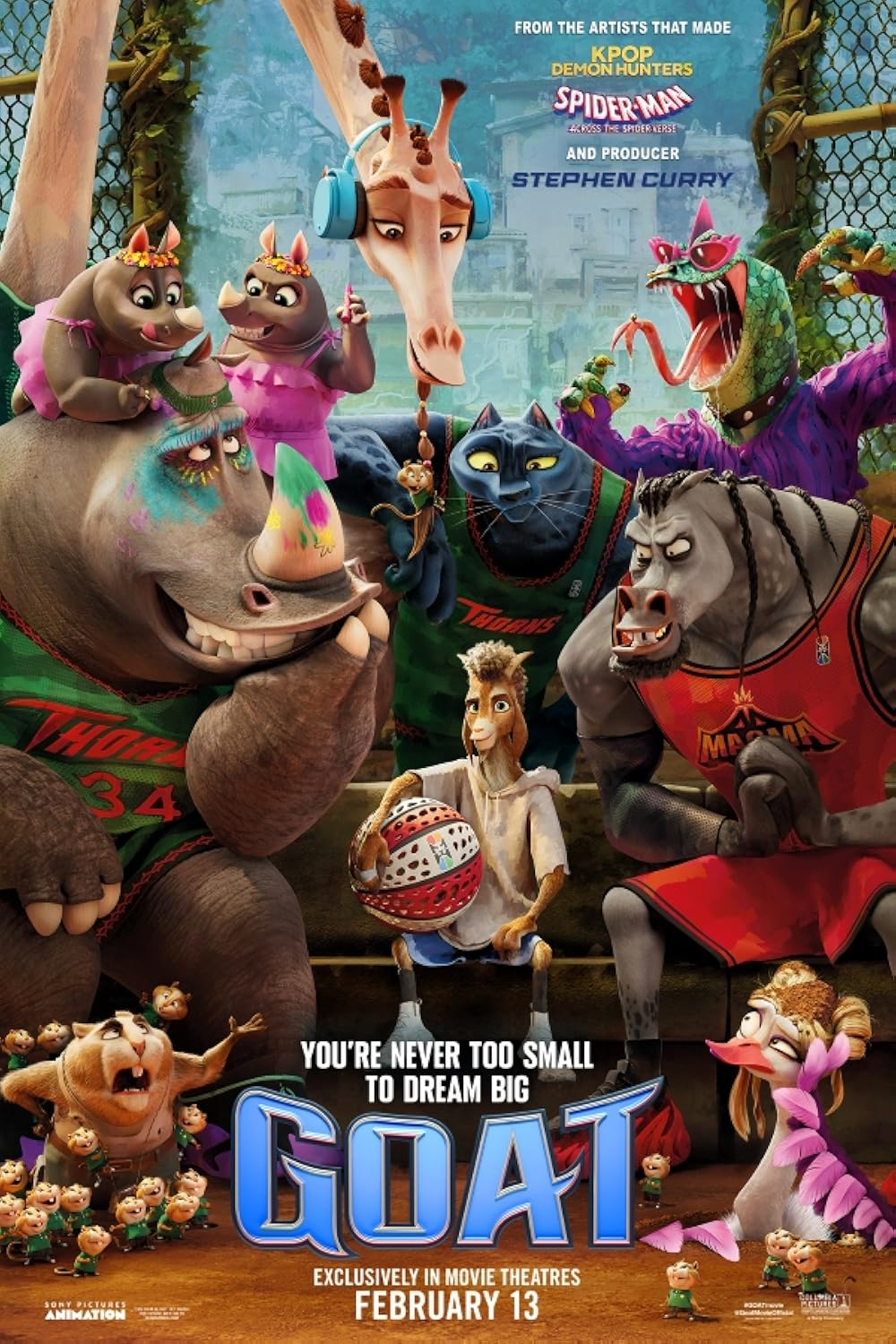
GOAT is about a goat who wants to be, well, the GOAT. Will dreams of changing the game of roarball by becoming the first “small” animal to play on his favorite time, the Vineland Thorns, though he faces adversity from both teammates and rivals.
Continuing Sony Pictures Animation’s winning streak that began with Spider-Man: Into the Spider-Verse, GOAT embraces a similar fusion of animation styles as that aforementioned film and its sequel, as well as the studio’s The Mitchells vs the Machines and KPop Demon Hunters, to create another engaging and exciting adventure that defies tropes and stereotypes and amasses an all-star cast for a delightful time. Caleb McLaughlin is great as the titular leading role, portraying Will as a humble and hard-working young athlete who wants to make it big his own way, while encouraging other to be their best, even those who doubt him.
Gabrielle Union is wonderful voicing Jett Fillmore, a local hero who can’t seem to want to share the spotlight, though this doesn’t quite make her unlikable, rather it comes from Jett’s insecurities about getting older and being pressured to retire. It’s also noteworthy that in a family film like this, the male main character’s basketball idol is a female athlete, something that’s never questioned or called out. Other standouts include Aaron Pierre as an irresistible antagonist, as well as David Harbour, Nicola Coughlan, Jenifer Lewis, Patton Oswalt, Jennifer Hudson, and NBA legend Stephen Curry, who also produced the film, which somewhat mirrors his own NBA journey.
A film that fully embraces what makes the best sports movies great, but takes unique and mature directions, GOAT is a great watch for all ages that’s a love letter to basketball and the dreamers everywhere, that never stops being eye-popping and fun, and puts a big grin on your face.
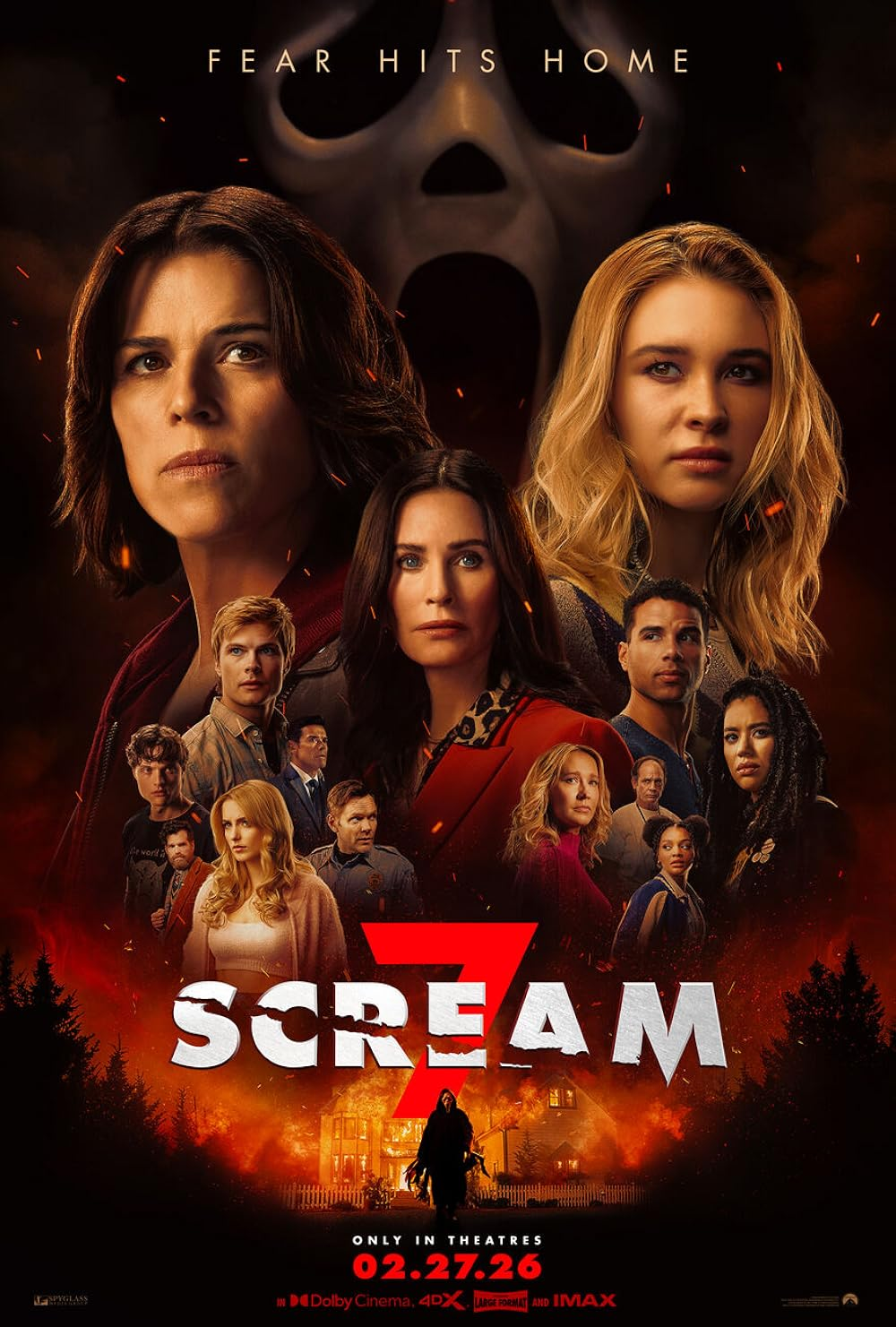
In the words of Christopher Nolan’s great superhero epic The Dark Knight, all great franchises can either go out a hero, or live long enough to see themselves become the villain. Too many great franchises that haven’t concluded on their own terms find themselves in the latter trap, running out of steam because they went on too long for the simple reason of trying to make more money. A project that may have been doomed from the start after the departure of franchise leads Melissa Barrera and Jenna Ortega, Scream 7 feels almost like an apology for the freshness of Scream VI, trading everything that made that film exciting for more of the same that we’ve seen done several times, over and over again.
We’ve seen the series return to Sidney Prescott years later in Scream 4 and the fifth Scream, which also finally allowed the big three of Neve Campbell, Courtney Cox, and David Aqruette to give up center stage to new leads. At this point, not only does Sidney’s return feel stale, but Campbell and Cox’s leading performances feel rather boring and fail to carry the film. Meanwhile, Jasmin Savoy Brown and Mason Gooding’s characters are by far the most fun and not given much to do. The film does up the gore from past installments, but the small town set pieces aren’t that engaging and the ensemble cast doesn’t hook you in much either, providing for a far less exciting guessing game about who might be behind the Ghostface mask than before, and it’s never a good sign when I was able to guess the killer less than halfway into the runtime.
Nostalgia in Scream (2022) and Scream VI was cleverly used as a tool to flip expectations and actually satirize and deconstruct the idea of nostalgia itself. Now, Scream 7 feels too afraid to critique or even surprise its audiences any longer. The commentary on other horror film and franchise tropes that has become a staple of the Scream films feels groan-worthy and half-baked here, especially because the movie is just reusing the same old tropes like a checklist, resulting in an installment that feels like a whole lot of nothing and especially underwhelming compared to the great fifth and sixth films. It’s time Paramount learned that if you don’t have anything new to say, it’s best not to say anything at all.
If I Had Legs I’d Kick You digs deep into the darkest corners of the human souls, of the ugliest thoughts that plague our minds, and the crippling anxiety and depression that traps us in the most banal of existences. Rose Byrne gives one of the most demanding, devastating, and furious performances of the last decade, as a woman suffocated by the horror and weakness of her being, confined by the truths of her situation and lacking the strength to find meaning or love in any of it. The remarkable filmmaking and camerawork allows us to pinpoint exactly how Linda interacts with her surroundings, without having to imagine any of what she’s feeling. The dread that anything is about to go wrong, that it’s all your fault, and that this excruciating guilt is forever. The feelings are so tangible to the audience, yet their roots of why she feels responsible for the life she hates are intangible and ambiguous for much of the film.
Byrne’s character channels universal struggles, including with motherhood, while taking them to the most extreme depths and circumstances. However, we’re never brought to think that she’s a bad person, simply someone who’s isolated and unable to cry for help or carry herself along with those around her. As Linda is inconvenienced with a gaping hole in the roof of her house, the hole metaphorically grows and becomes one with her.
The final few minutes are haunting and left me dumbfounded. The nightmarish imagery and dark humor play off each other to create a final product that’s arguably more stressful than any horror movie could be. This movie left me dumbfounded and at a loss for words, one of the most anxiety-inducing, uncomfortable, and emotionally raw films I’ve seen in a while. It’s a one-of-a-kind film, with an astounding and unforgettable lead performance, that shook me to my core.
When seventeen children from the same class all disappear one night, a community is sent reeling and forced to deal with the terrifying consequences.
Weapons is a film that bids farewell to all the tropes we’re used to in even the best of modern horror movies, throwing us first into how a community is affected by such cruel and unexplainable loss. Julia Garner is at the film’s heart as a gentle teacher who suddenly loses all but one of her students — and is quickly blamed by her peers for it. Garner is immediately bondable with the audience due to her desire for answers and peace amidst her unfair situation. But on the other side of the public tensions is what comes off as rage but reveals itself to be fear and desperation in Josh Brolin’s performance as a father hellbent on finding his missing son. His hardness reveals itself as pain and vulnerability and stands out among many others of the actor’s roles.
Though writer-director Zach Cregger sets out to make Weapons feel far more patient than other horror films, he also goes for broke structurally, stylistically, and graphically. The editing, score, and cinematography are chilling, with moments that may end up in modern horror classic territory. Cregger retains some of his previous film Barbarian‘s DNA, such as jumps in time and perspective — some less interesting than others yet necessary for the film’s slow revelation of its mysteries. Within the film’s title lies many of the answers, including the weapon of the human soul itself: the harm that we can inflict or can be inflicted on us. But it’s because the film does hold back so much, and for so much of its runtime, that everything clicks so beautifully. We see and learn just as much as we need to in order to be asking the right questions, and hopelessly guessing what might really be going on here. Once you reach the end of Weapons, you may find yourself equal parts terrified and delighted, but its unraveling will make your heart sink and your legs shake. Weapons is bold and extraordinary even in today’s ever challenging horror landscape. Cregger’s cynical and at times darkly humorous lens fits perfectly into a modern folk tale of sorts that radiates the kind of singular originality felt in M. Night Shyamalan’s golden days of making thrillers. In this epic yet personal horror film, the scares aren’t nearly the whole point, but the whole point is seriously scary — just not in all the ways you’d expect.
Twin brothers Smoke and Stack return to their hometown to open a blues club for a fresh start, only to discover that an even greater evil is waiting to welcome them back.
Ryan Coogler, one of the most impactful filmmakers to come out of the last decade, creates his most original, commanding, and dazzling film, a kind many have been waiting to see for a long time. Coogler gets free reign to blend genres with unique storytelling on a larger scale than we’ve seen before. The characters leap off the page and screen with their wonderful portrayals from Michael B. Jordan, Hailee Steinfeld, Wunmi Mosaku, and Delroy Lindo, as well as a more menacing turn from Jack O’Connell. As both Smoke and Stack, Jordan plays characters who aren’t free of moral question marks but still worth rooting for, and have excellent romances with Mosaku and Steinfeld, while Lindo has brilliant moments of reflection, strength, and humor.
The film portrays America in the 1930s as a place of difficulty and strive, with a system built to oppress black Americans, but in the main characters’ blues club, a dazzling, one-of-a-kind portrayal of black culture and music in a safe space of untouched, booming joy. The music is a language of its own in the film, not just another magnificent score by Ludwig Goransson, but the way music inspires and drives the characters across generations of their history. Music in the film is its own plane of sacred storytelling and unity, and it’s brought to life with roaring energy that the audience can enjoy yet by moved by. The cinematography by Autumn Durald Arkapaw, who also collaborated with Coogler on Black Panther: Wakanda Forever, also takes the film to another level, with distance between objects, characters, and backgrounds — or mere darkness — creating a weight in its shock. The film develops its characters in a world that’s breathing and moving around them in unexpected and exciting ways, even before the blues kicks in, and far before the horror action elevates the film to yet another level of mastery. The bloody violence is unpredictable and riveting to look at, and balances the line between horrific and irresistibly fun.
Though an ending scene stretches out and explains the themes too excessively, Sinners brings together genres and a remarkable cast full of life and heart that spreads to the audience. The visionary cinematography, music, and costume design compliment a story that’s filled with as much adoration for the immersive settings it creates as it is deeply hinting at themes of the system’s attempts to appropriate and erase black culture and history, and much more beneath the surface. Not only does it work for action, horror, or thriller fans, but it’s a beautiful piece of storytelling that only comes every few years. Not quite like any blockbuster we’ve seen, Sinners is a journey of pride, terror, and legend that needs to be experience on the big screen, solidifying Ryan Coogler as one of our great modern filmmakers who deserves all the more creative freedom and spotlight that’s coming his way.
Two of New York City’s most notorious organized crime bosses vie for control of the city’s streets. Once best friends, petty jealousies and a series of betrayals set them on a deadly collision course.
Robert De Niro playing an infamous mobster is nothing new. But De Niro playing TWO mobsters? Throw in legendary director Barry Levinson of Bugsy, Rain Man, and Good Morning, Vietnam, now that’s something worth writing home about, right? Unfortunately, The Alto Knights is anything but; a film with maybe some potential on set that was completely butchered in the editing room. De Niro’s dual performance is supposed to fascinate the audience but instead distracts. Frank Costello and Vito Genovese are not presented in the film as being two sides of the same coin, as were the mobster twin brothers Kray, played by Tom Hardy in Legend. In this film, the two mobsters are depicted as not just of different families and mannerisms but of different ages, experiences, and motivations. When De Niro finally shares the screen with himself, it’s impossible to buy these disparities as the script depicts them, rather we buy them more like equals under different heaps of makeup, which was not the intention. As Costello, De Niro is giving something between a less soulful version of his turn in The Irishman, a less extravagant version of his turn in The Untouchables, and a less funny version of his turn in Analyze This. He’s interesting as Genovese, but casting another actor to oppose him would’ve worked better to show that one of these gangsters is actually much more frightening than the other.
The film recycles tired tropes of past popular mob films, and as I’ve alluded to here, many of them already star the great De Niro. Though some scenes are at least mediocre in their execution, the editing is horrendous and makes some scenes unwatchable. The film insists on blasting through most scenes like a documentary montage rather than letting scenes breathe and feel like a thrilling drama. The constant narration and barrages of exposition are condescending to its audience of a normally intelligent genre, but insists on feeding us information we could’ve learned through context clues within scenes. The poor dialogue can’t be salvaged by lacking performances from Debra Messing and Cosmo Jarvis, the latter of whose promising transformation never quite gets to shine. Moreover, there never feels like an escalation of tension or events when there feels like we should be building towards something, rather a lack of setup that also leads to a lack of reward. The Alto Knights starts on a bad foot, and never even hints at a chance to redeem itself. Even De Niro and crime film fans need not waste their time, in theaters or at home.
Sing Sing takes place in the titular New York prison and focuses on inmates involved in the Rehabilitation Through the Arts (RTA) program, as they work through their traumas to find redemption through acting.
Colman Domingo beautifully leads this film as one of the only actors not starring as themselves, opening us to a completely different side of him from his turn in Rustin, but equally moving and majestic. His charisma and soul commands the screen like not many actors can, balancing authority in his efforts to strengthen camaraderie throughout the RTA’s production at Sing Sing, and a longing to leave his imprisonment and prove his innocence from a crime he’s doing time for that he didn’t commit. He makes us deeply care for Divine G’s struggle but his “performance within a performance” scenes are also impossible to look away from. Paul Raci is also lovely as the RTA director encouraging the inmates to open up and unlock their deepest feelings through the process of acting and imagination. Besides those two Oscar nominees, almost everyone else is a veteran of the RTA program playing themselves, unlocking a naturalistic sincerity in not just the characters but the experience (similar to watching Frances McDormand interact with real-life nomads in Nomadland).
As these inmates find the hidden parts of themselves and get in touch with their most vulnerable sides, the experience of watching Sing Sing becomes just that for the audience. We’re left reflecting on our own livelihoods we’ve taken for granted, and the times we may have felt trapped and longed to escape from realities of our own. Acting is not just redemption for these characters we grow to feel deeply for — it reinvigorates their love for being alive, and reminds them of something to fight for, including their brothers on the stage with them. The film frames this rehabilitative process as a reclamation of the self, even behind bars where people are often treated as, well, less than people. It’s a rare experience that breaks down barriers and makes us feel close to characters that would often frighten us from the outside in any other film. Beyond those discussions about empathy it may stir within us, the film is kind-hearted and funny even amidst the most difficult of settings. In this mix of Oscar-nominated actors alongside a number of men playing themselves, the real often blends with the scripted, both for the characters and the art, that invites audiences for a complex but loving and extraordinary drama of raw and beautiful storytelling.
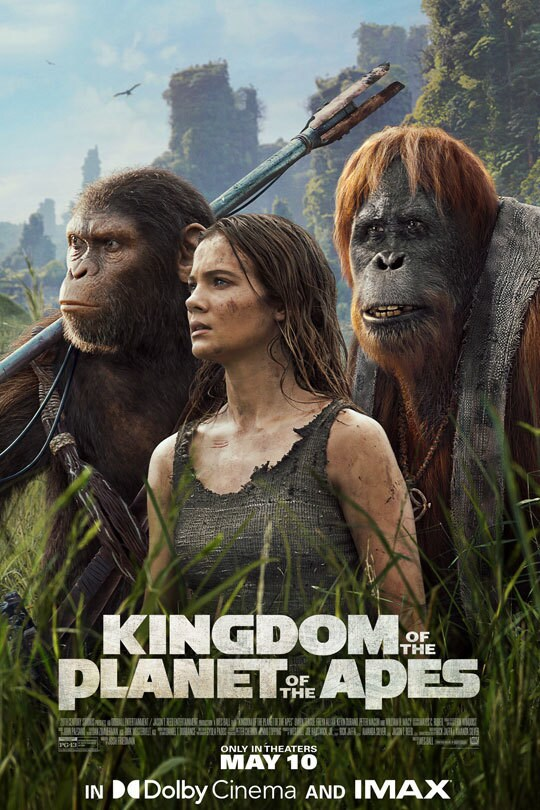
Set several generations in the future following Caesar’s reign, apes are the dominant species living harmoniously and humans have been regressed to a feral state. One young ape undertakes a harrowing journey that will cause him to question all that he has known about the past and to make choices that will define a future for apes and humans alike.
More Apes after the conclusion of the incredible Caesar trilogy with War for the Planet of the Apes sounded too cash-grabby and too soon. What was wise on the filmmakers’ behalf was to treat this installment not as a direct sequel or reboot, but a slight reset of sorts as we pick up 300 years later, focusing on the legacy of the apocalypse and Caesar’s leadership. Apes are no longer living in fear of humans, rather Earth has become their planet, which creates an intriguing new setting that still doesn’t quite undo the finality of the last film. Ever present is the amazing dedication to the visuals and world-building. The motion-capture technology used to transform the actors into chimps, and the performances themselves, are impressive and make you forget for the entire 2 hour and 25 minute runtime that you’re watching performers rather than real apes in this world. Though Andy Serkis as Caesar was an iconic leading character that’s impossible to top, Owen Teague gives a sympathetic performance as Noa who strongly takes us on this adventure in this new era for the planet. Peter Macon also stand out as the wise Raka, and Freya Allan is especially expressive in her deep performance as human character Mae, though the script missteps in where to take her path later on. Kevin Durand gives such a committed presence to the villainous and tyrannical Proximus, a more charismatic version of the manipulative and sadistic Koba from Dawn. Proximus’ dialogue and physicality dominates whatever else is in the screen and truly terrifies, and his objective is quite menacing as well. However, his motivations, compared to Koba (who many ranked as one of the 2010s’ best villains), leave less room for moral grey area and rather feel like “pure evil”; there’s no layer or nuance to the terror Proximus wants to inflict or how he got there, though I can’t complain as to how well Durand brings the character to life.
Kingdom is most interesting when focusing on the apes’ new ways and how Caesar’s legacy impacts the sects of apes in different ways. But gone is the intrigue of the human-ape conflict and its undertones for human nature, though the film doesn’t understand this and often dwells too much in conflicts that War had ended with such finality, instead of embracing its other themes as its strengths. There’s also a character played by a recognizable Oscar nominee who’s entire being there felt unnecessary and simply complicates the logic of the world building further. The film isn’t short on great action and visuals in this imaginative, lively, post-apocalyptic world. It’s just that when you have two practically perfect films in the franchise preceding it, as Matt Reeves helmed them, it’s harder for this film to escape that shadow especially when the last one ended so definitively and didn’t beg for any sort of ambiguity or continuation. Kingdom of the Planet of the Apes is an engaging ride that should probably be seen on a large screen, even when it stumbles in justifying its existence and polishing its character motivations. Not to mention, it may have just been to soon for this inevitable continuation to a perfect ending, and the film’s final minutes raise more unnecessary questions that undo what we just saw than exciting invitations for more.
Following the events of the predecessor, the Abbott family now face the terrors of the outside world. With both A Quiet Place and its sequel that’s now playing in theaters everywhere, John Krasinski has proven himself to be not only an awesome actor but a master filmmaker. It worries me whenever a studio greenlights a sequel to a great film that stands alone perfectly, but A Quiet Place Part II is one of the rare occasions where the sequel lives up the original, and not only that, but along with that 2018 film, is one of the best horror/thrillers of recent years. A lot of it is thanks to Krasinski’s direction and the style which made the concept and storytelling of the first film so memorable. The opening sequence is nail-biting and even though the violence is kept at a PG-13 level, the film knows where and how to scare most effectively with showing and not showing certain things. For example, we see scenes from characters’ perspectives so the aliens and action aren’t always in the frame but sometimes in the background. The cinematography and editing are great as well, but it’s the sound editing that makes the movie. It’s the small noises that make you terrified for the characters as they try to survive among creatures who can track them based on any small noise from a distance, and the sound creates its own tension without a single jump scare. The loud sound effects of the monsters contrast this excellently and make this a terrific theater experience.
Emily Blunt may be at her best in this series as a mother trying to protect her kids, including a newborn, from otherworldly threats that are a family’s worst nightmare. Cillian Murphy is also excellent as a new addition to the cast, a cynical, hopeless survivor who is changed by his time with the Abbott family. Millicent Simmonds, the deaf actress who plays the deaf daughter in the film, may be the film’s heroine as she takes on challenges courageously and delivers a stellar performance, with not only some of the most positive deaf representation I’ve ever seen in film but all around a brilliant actor and lead role. Noah Jupe, who plays the son/brother, is again excellent, and he’s proven himself with these films as well as his magnificent roles in 2019’s Ford v Ferrari and Honey Boy. And even with just a cameo, Krasinski himself makes his presence felt throughout the film, passing the courage and good-ness of his character from the last film into his children and the world of the movie. Beyond the brilliant scares, which are only strengthened by techniques such as cross-cutting that Krasinski marvelously uses to make scenes more powerful and symbolic, the film retains the heart that made its predecessor so emotional — in every frame and line, this is a movie about a monster apocalypse, but also about parenthood, family, human survival, and hope. And one can’t help but think that with a family taking back their world by venturing back into the unknown and fighting back against the apocalypse, it’s a perfect film to represent our return to theaters. I, for one, had not been to the theaters since Tenet last August, when some screens briefly reopened, and this is an impeccable choice to return to the big screen with for the thrills, sound, and amazing effects and story that will more than satisfy those who know what they’re in for, and for the shared experience we’ve been longing to have back and can finally experience for a new blockbuster once again.
The final chapter of the legendary story that’s spanned generations, The Rise of Skywalker follows the Resistance taking a final stand against the First Order, as Rey, the last of the lightsaber-wielding Jedi, prepares to face off against the Supreme Leader Kylo Ren.
Star Wars: The Rise of Skywalker takes the challenge of concluding a culturally treasured story that’s spanned four decades head-on, yet sacrifices something important in the process. Part of Star Wars is taking you away from reality and over to a galaxy far, far away, and this film succeeds at making the eye-popping visuals stand out in every shot, especially if you watch it in 3D, as you should for every Star Wars movie considering the grand scale they have to offer. John Williams, one of the real MVPs of the franchise, has composed every film in this saga and once again stuns with his beautiful musical scores. The cast still has plenty of energy and heart, especially the trio of protagonists — Daisy Ridley’s Rey shows plenty of emotion and energy and it’s hard not to love her character as she embarks on the final chapter of her adventure, and John Boyega’s Finn, as well as Oscar Isaac’s Poe, are very lovable as the daring fighters who are eager to lead and defeat the First Order for the greater good of the galaxy. It’s difficult not to enjoy whenever the lovable Chewbacca, C3P0, or BB-8 are on-screen either. The late Carrie Fisher also appears as General Leia, and although her appearance is very small, it’s a welcome and bittersweet one. Also returning from the original trilogy are Mark Hamill and Billy Dee Williams as galactic legends Luke and Lando — if only they had a bit more to do on screen, though. Unfortunately, nobody really gets a meaningful arc this time except Rey, but even her arc gets muddled and confusing by a decision that harms the emotional weight of the previous two installments. Not even Adam Driver, who plays the main antagonist in Episodes VII and VIII, gets much to do. In the last film, Kylo Ren became the Supreme Leader of the First Order, but instead of utilizing that brilliant and original idea of having a young, conflicted boy become the head of the evil, tyrannical organization, he ends up answering to Palpatine for most of the film, and I’m not sure if Palpatine’s role in the film was even warranted. Finn’s a deserter of the First Order who’s become a sign of heroism and bravery for the Resistance, but that isn’t explored as an important character trait anymore — hell, he’s no longer a multi-dimensional character anymore, barely anyone is in this movie. Naomi Ackie is introduced as a new character named Jannah. Her character seems fantastic, yet they do absolutely nothing with her character other than make her stand next to Finn for the film’s entire second half, so unfortunately we’ll never know anything about her or if she was really as great of a character as she could’ve been.
The runtime is stuffed with so many ideas that either don’t make sense or are rushed past in the blink of an eye; it felt so rushed that it was almost like Disney mandated them to not make it a minute longer. The editing in The Force Awakens was so excellent it even received an Oscar nomination, but here the cuts are so fast and occasionally feel unnatural. In the other films, the action scenes feel nuanced but the ones here are so quick that it’s going to be hard to look at them as “scenes” for their filmmaking and purpose. In a movie with so much fighting, I ironically can’t remember a specific moment where the action is notably impressive, although it’s thankfully loud and colorful enough to be engaging, yet not resonant. In the predecessor The Last Jedi, I was shaking in suspense for a lot of the film, but unfortunately in The Rise of Skywalker, there isn’t really a moment where I had that same feeling. Maybe it’s because although there’s so much plot, the script never gives us a moment to breathe or just develop the characters emotionally. Without any emotional arcs being set up, we can’t be concerned about what’ll happen to them later in the film. There’s also a few iffy lines of dialogue that either felt like placeholders or sub-par ways to convey ideas that could’ve come off as stronger. The movie also has plenty of moments that allude to the previous films, such as A New Hope and The Empire Strikes Back, and these moments will work well because how much of an impact this saga has had throughout the audience’s lifetimes. Some moments will make you applaud and smile, and my theater experience with this film only reminds me how beautiful these Star Wars films bring people together, even after 42 years. However, by the end The Rise of Skywalker doesn’t feel like the natural continuation of the trilogy’s story, but rather like it’s trying to be the antithesis of The Last Jedi. Many of the powerful decisions Rian Johnson made in VIII feel undermined by what J.J. Abrams chooses to do in some scenes, and instead of going with the flow of the story, it feels like he disregarded the tone and value of the previous film, and even his own film The Force Awakens (I’m not even sure what the tone of this movie is, if I’m being honest). Abrams is a filmmaker I regard with lots of talent towards bringing a sense of wonder and imagination towards the screen, and it’s unfortunate because there so many moments of greatness throughout that are harmed by the light-speed runtime (which although, at 142 minutes, is longer than most other SW films, still feels incredibly rushed and overcrowded), and the director’s working against the story that he and Johnson established so well before. Although the actual ending of the film and the Skywalker Saga is nicely done, the final chapter of the journey there should’ve hit home as well. Regrettably though, it’s the least risky and exhilarating film of the bunch (although it’s arguably better than the prequels, which to me don’t capture the true meaning of Star Wars that well).
Star Wars: The Rise of Skywalker is the conclusion to one of the most beloved stories in the history of not only film, but also the art of fiction itself. Unfortunately, as an enormous fan myself, I found myself disappointed. the overabundance of ideas Abrams tries to fit into a crammed runtime (if you ask me, they should’ve taken a page out of Marvel’s book and made the movie 3 hours in order to give this saga the fitting send-off it deserved), and the choice to emphasize too much fan service over a sufficient amount of character/emotional payoff end up harming the story that was so beautifully constructed in the past outings of this trilogy. This feels like a great film that was cut in half and then made some frustrating last-minute decisions that don’t even impact the later events of the film, and the main characters’ arcs would’ve been much stronger without these decisions. While there were definitely some plot points I enjoyed and the vibrant visuals and world-building, as well as the film’s role in concluding the franchise, will excite most audiences and incite instances of applause, the lack of boldness and spirit makes this the least gripping and rewarding film in the sequel trilogy, despite the satisfying nostalgia that makes for an awesome theater experience when you’re watching it with other Star Wars-loving audience members.











 filmtoppings.com