Renee Zellweger’s iconic British protagonist has become something of a cinematic treasure across four films now. But her films haven’t made us just laugh along at her missteps, but watch her develop, and even come of age, you could say. This final film has a somewhat more bittersweet tone, though, as Bridget’s lover, Mark Darcy, is no longer in the picture. Four years after his loss, she is finally ready to move on and find love again. The film maturely tackles coming to terms with grief, finding joy again while coexisting with the memory of those who have passed on. But it’s also still irreverent, charming, and romantic. It tackles some of the basics that the first film gave a go at, but Zellweger not only shows Bridget’s goofy side, but her struggles with being a single mother of two, and the absence of her husband.
Joining the mix are Chiwetel Ejiofor and Leo Woodall, who both charm in different ways, but Ejiofor in particular has great chemistry with Zellweger. Though it does retread familiar rom-com territory, or that of comedies about parents raising children, and it’s not the sharpest or smartest of the franchise over Bridget Jones’s Baby, it still offers a good time and a heartwarming conclusion to a lovable, messy delight of a character.
Sam Wilson has fully accepted and embodied the role of Captain America in a post-Blip world, but comes into conflict with President Thaddeus “Thunderbolt” Ross after an international incident that unveils a deadly conspiracy.
The latest Marvel Studios film, which tries its very best to pay tribute to political conspiracy thrillers such as In the Line of Fire and The Pelican Brief, occasionally entertains but ends up retreading too much familiar ground and feeling too flat. Though it’s great to see Mackie donning the titular suit and in the leading role on the big screen, his character isn’t given real meaningful impact besides what he already went through before and represents for others. Harrison Ford brings a deeper gravitas to Ross than we did in William Hurt’s portrayal of the character, but other characters leave much to be desired, particularly those played by Shira Haas, Giancarlo Esposito, and Tim Blake Nelson. The antagonist has an intriguing backstory but hardly feels plausible in his strategies and dialogue. Though Danny Ramirez gives a fun performance, Carl Lumbly is the only one giving real soul to the film as the fascinating Isaiah Bradley.
The film stumbles in its attempts to show the political consequences of some of the past MCU films, which is interesting but doesn’t deliver anything powerful besides a cool action backdrop. The script as a whole starts off much better as it ends, but even then is mostly rehashing ideas from The Falcon and the Winter Soldier, such as dangerous super soldier villains and the political and national representations of Captain America. Even compared to that miniseries, this film has far less soul, wit, or intrigue, with a half-baked villain plot that doesn’t lead to much. It also feels somewhat implausible compared to the rules that past MCU projects have set, but sadly, the film ultimately feels empty because it’s devoid of real thematic weight. Any attempt at such felt lousy and recycled, particularly the third act, in which the CGI is distracting and the resolution is rather underwhelming. Attempts to set up what’s to come in the MCU feel forced, and though this may feel serviceable enough as a big action film, it’s underwhelming as a Captain America film (considering how stellar the action and themes were in the first three) and ultimately forgettable, which is not what a film with Sam Wilson as its protagonist should be.
Decades after the events of Gladiator, the Roman Empire has fallen into the tyrannical hands of Emperors Geta and Caracalla. Hanno, a young man taken to Rome as a slave, learns of his connection to the Empire and trains to be a Gladiator to fight against the corrupt emperors.
This long-awaited sequel doesn’t have the same visual beauty and flare as its predecessor, but is still a solid action film that embraces the best aspects of the first film’s story. It’s quite an uphill battle to create a hero as strong as Maximus Meridius now that he and Russell Crowe are out of the picture… unless, of course, you cast Paul Mescal. Mescal brings a tenderness to his performance that shows through even when he ought to show strength and ferocity in the arena. Pedro Pascal is also fantastic and completely chews up the scenery, as do Joseph Quinn and Fred Hechinger as the spoiled and maniacal emperors. Denzel Washington gives so much life to the film, seemingly just by being his soulful, fun self. He brings a lot of humanity as he and Mescal enter a mentor-student dynamic. The film doesn’t work as well without Washington’s presence, whose character takes unexpected turns throughout the film.
Gladiator II‘s script works when focusing on its protagonist’s journey, as well as his fight against tyrrany. The power dynamics and engaging action scenes carry the story forward, though visually, it feels held back from what could’ve been compared to the first film. Ridley Scott’s style here doesn’t feel as patient and refined as in his recent The Last Duel, and the CGI could’ve used a lot more improvement. However, the action choreography is as bloody and grand as fans of the original could hope for, and the ending is beautifully done as a realization of promises we didn’t even realize the first film had. It’s a noble continuation that honors the first film, and its cast led by Mescal and Washington, while never quite reaching that original movie’s breathtaking heights, but still better than some of Scott’s other recent outings, and worth a watch in theaters.
When two Mormon missionaries arrive at Mr. Reed’s house attempting to convert them, they find themselves stuck there in a game of wits, fighting for their lives.
When two Mormon missionaries arrive at Mr. Reed’s house attempting to convert them, they find themselves stuck there, fighting for their lives.
Heretic doesn’t play out with the typical levels of jump scares and macabre we’re used to from horror films these days — rather it’s a battle of wits in which the characters contemplate belief, religion, and faith… oh, and an adult man is terrorizing two young women as they’re held captive in his house, which becomes a maze of puzzles related to his disdain for their faith. Hugh Grant is rather terrifying as Mr. Reed here, but he’s clearly having such a delightful time in the character’s skin. He’s as threatening as you can imagine a mysterious man in his 60s alone in a large house but also has plenty of outlandish and hilarious dialogue. Some viewers simply looking for an intellectual dark comedy could most definitely find satisfaction in watching Heretic. You also genuinely care about our two protagonists. Sophie Thatcher and Chloe East both bring cleverness to the film, a willingness to challenge their captor, and not break down and quit. Thatcher brings a rebellious sense of mystery to Sister Barnes, while Chloe East is heartfelt and capable as Sister Paxton.
Though Heretic takes some time for the uniqueness and thrills to set in, it stands out from other recent horror films thanks to its restraint on its scares, as well as its smart screenplay and chilling villain. The three performances are integral and lift up the film’s shocking fun, and may even make you think about some big ideas all while you’re enjoying this dark ride.
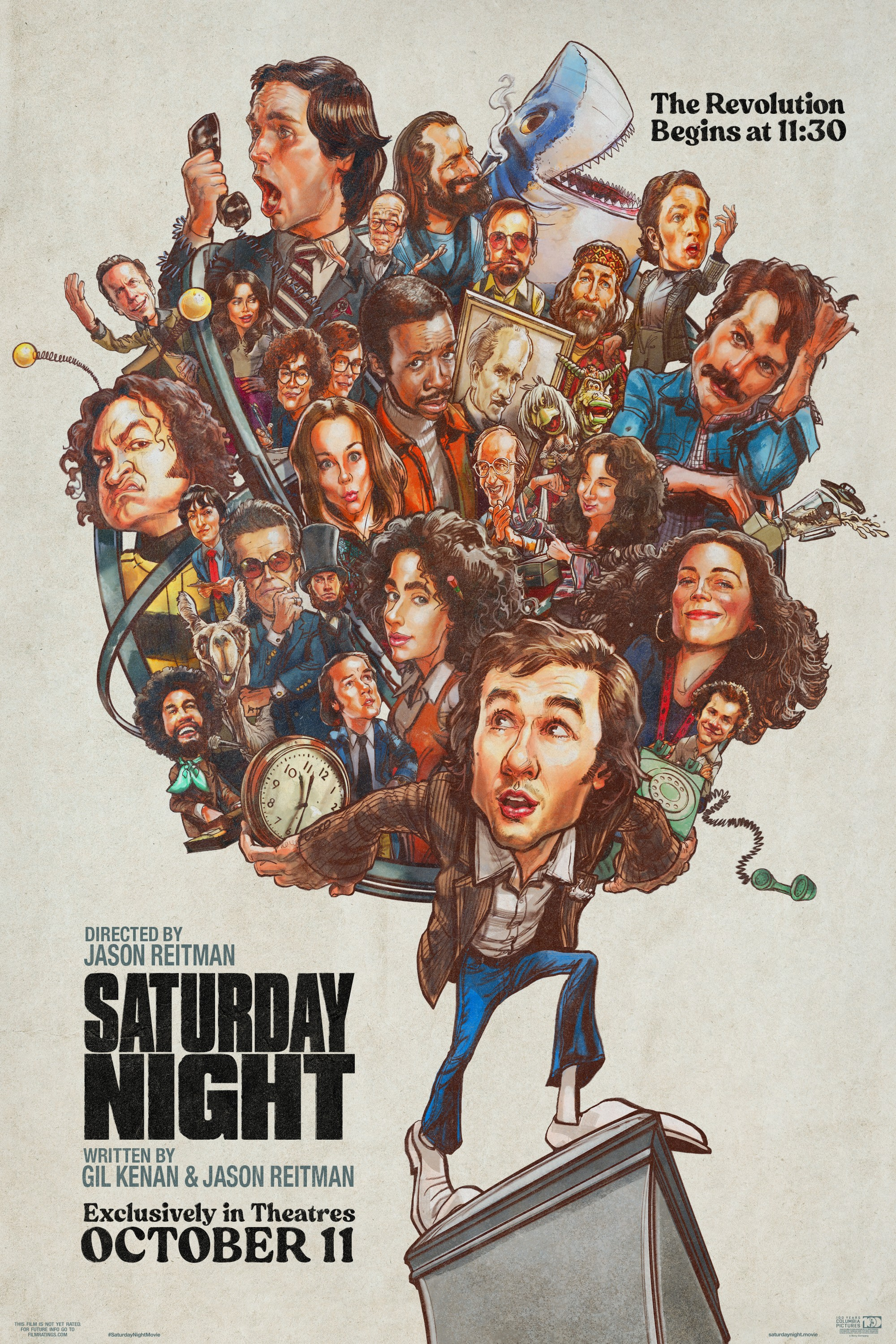
Saturday Night takes us to the fateful night of October 11, 1975 in Manhattan, where Lorne Michaels tried to launch his sketch comedy show for its first-ever episode, which we now know as the iconic and influential Saturday Night Live nearly 50 years later.
A film about SNL should make us laugh, feel revealing, and be packed with celebrity and pop culture history, and that’s exactly what Jason Reitman’s take on the sketch show’s beginning offers plenty of. The lovely 70mm look, long takes throughout the studio, and energetic score from Jon Batiste give the film a strong and dedicated technical edge.
While many films based on true stories have one or two casting choices that feel inspired, Saturday Night has dozens. Gabriel LaBelle, who’s probably a decade younger than Lorne Michaels was when this all went down, plays the creator with a contagious ambition to make magic for audiences on the stage. Rachel Sennott is sometimes the scene-stealer and the heart of it all, while Dylan O’Brien as Dan Aykroyd is one of his most fun performances in years. Cory Michael Smith brilliantly portrays the unstable ego of Chevy Chase, one of the most infamous members of the show’s original cast, while Matt Wood is uncanny in his recreation of the late John Belushi. Nicholas Braun is impeccable and unforgettable as not one but two cultural icons; they’re a pair of performances you have to see to believe. And we haven’t even mentioned Lamorne Morris, Cooper Hoffman, and Matthew Rhys, the latter of whom chews up the scenery as comedian George Carlin. More recognizable names Willem Dafoe and J.K. Simmons are also excellent and hysterical. The best part about this cast is that it reflects how Reitman wants us to feel about the characters and circumstances in the film — a ragtag group of youngsters with the potential to make us laugh, joining forces hoping to change the world.
As we know, the events of this movie, as chaotic as they unfold, did change the world. The most wonderful part about Saturday Night is that it celebrates the convergence of culture for half a decade, which began as NBC’s laughing stock but has since brought together millions with the arts of comedy, music, and performance joining together. The movie itself isn’t as funny as it thinks it is, but when a film celebrates laughter while making you laugh, those ingredients are the perfect groundwork for a purely entertaining wonder, even as you watch everything go wrong (at first). Fans of SNL will have a delightful time with the mythology of 20th-century American comedy, but anyone else will still have a great time with Reitman’s love letter to popular culture, humor, New York City, and the underdog.
Megalopolis is the ambitious new epic fantasy/sci-fi drama from cinema legend Francis Ford Coppola. In the city of New Rome, Julia Cicero (Nathalie Emmanuel) is torn between the ideas and loyalties of architect Cesar Catalina (Adam Driver), who sets out to reinvent the NYC-esque city entirely into a utopia of his imagining, and her father (Giancarlo Esposito), the mayor who wants to keep things as they are.
Megalopolis sets out to be the most ambitious movie meant for a large screen in ages, with outrageous ideas coming at us straight from Coppola’s mind (and pockets, too). Unfortunately, shooting for the moon doesn’t land Megalopolis among the stars, more so the dirt. It’s a canvas of messy ideas that come together without reward, prestige, or even sense. The dialogue is unintelligible, the story is impossible to follow, and the green screen and effects that try to imagine out-of-this-world visuals in line with Doctor Strange look rather hideous and more in line with Spy Kids or Speed Racer. The film poorly utilizes its stacked cast that includes Driver, Emmanuel, Esposito, Aubrey Plaza, Shia LaBeouf, Jon Voight, Laurence Fishburne, Dustin Hoffman, and more. They’re all given surface-level characters with awful dialogue and absolutely no idea what to do with them. An early scene featuring a number of the principal cast debating on the city’s feature feels more like a drunken celebrity costume party than a scripted and rehearsed scene in a film. The characters are inconsistent (and have unexplained superpowers?), and LaBeouf’s antagonist is laughable and serves no threat whatsoever. Fishburne’s narration is indulgent and unnecessary — the movie begins with Coppola conveying to the audience through Fishburne that he sees parallels between our modern metropolises and Ancient Rome, and then proceeds to spoonfeed that same message to us for 138 minutes with no further nuance.
You may be glad you chose to see Megalopolis on a huge screen… for about two minutes, and then everything goes haywire. The mess of tones and logic is the least of the audience’s worries here; it’s a sensory disaster and a meaningless, incomprehensible drag with hollow ideas and distracting visuals. Things don’t explain themselves or mean things in Megalopolis. They just happen. Yet there’s no mystery underneath to unlock and no sense of intrigue, maturity, or intellect whatsoever from the man who directed The Godfather, Apocalypse Now, and The Conversation. If, like me, you don’t manage to hop on board with this puzzling vision from a filmmaking master devoid of wonder or enjoyment, this is one city you’ll be itching to escape from.
Deadpool enters the larger Marvel Cinematic Universe when he’s called upon by the TVA to save his timeline from erasure — or in other words, a Disney acquisition.
Deadpool continuing into the larger MCU, and with a larger sandbox to reference and joke with, only feels right, with the character reminding us that anything and everything in the world of entertainment need not be taken so seriously. Excitingly, it’s not just the convergence of the Fox Marvel heroes and the MCU, but also Hugh Jackman’s return as Wolverine, whom Deadpool has already poked fun of in his films. The film asks, what if two people who can’t die and have no temper but are polar opposites need to get along (but can’t)? That buddy comedy aspect drives the film, as do the multiverse-level visuals. In addition to Reynolds’ increasingly impressive commitment to one of the most foul-mouthed heroes to ever wear spandex, and Jackman’s rage-filled but emotionally charged take on a Wolverine different from the one we parted ways from in Logan, Emma Corrin shines and never feels lesser than the two A-listers when on screen with them. Corrin gives a delightfully cruel and loose performance as Cassandra Nova, and certainly not right-minded, almost like a Mad Max character given Professor X’s powers. Matthew Macfadyen also gives the film some great fun as a TVA agent whose a little murkier than the ones we met in Loki.
The film’s writing for its lead character doesn’t really hit hard on a deep level, and Wade’s relationship with Vanessa feels like a superficial conflict thrown in for the sake of necessity. Their arc worked way better in Deadpool 2, and here, this variant of Logan is by far the more inviting emotional aspect of the film. Despite Deadpool’s growth as a person taking a backseat, this is a film where the experience is reliant on the action, humor, and surprises, and it delivers on all three fronts. The action scenes are creative, eye-popping, and cheerfully graphic, from an opening that’s one of the most brilliant fight scenes in the trilogy to much, much more that comes after. The jokes come at light speed and have something belly laugh-inducing for everyone, including references to the actors’ filmography. The film also embraces the idea of the multiverse with cameos to behold that’s been kept secret from the marketing for our enjoyment in the theater. It’s probably why Deadpool & Wolverine, despite not having a marginally original story, is such a memorable crowd experience and action blockbuster that does not hold back, continuing to push the limits of how much the blood, raunchiness, and self-awareness can surprise and amuse us. But it’s not just irreverent for the sake of it — the humor and energy of the film brilliantly mesh with the CGI-heavy worldbuilding of the MCU, so come the chemistry that’s promised from the title and meta potential of these franchises colliding, and though that’s the mainstay here, it’s more than enough devoted fans of the superhero genre and the collective theater experience.
Though A Quiet Place worked best due to its minimal cast and remote settings, this prequel works strongly by embracing the chaos of a Manhattan monster invasion, and the desolation left behind, with that large scale terror that made Cloverfield such a cultural stamp. Michael Sarnoski, who directed the excellent Nicolas Cage drama Pig, effortlessly manages to replicate the beautiful tension and almost melodic sound design that John Krasinski distinguished this franchise with in the first two films. Though this film isn’t as heart-racing and emotionally fine-tuned, it’s still got a fantastic protagonist and captivating thrills. Though it’s very well-filmed when focusing tightly on its lead characters, there are a few unnecessary cuts to wide shots that do harm that tension, even if just for a moment. If any actress can command an audience and emote in a way as brilliantly as Emily Blunt — well, that would clearly be Lupita Nyong’o. It’s impossible to look away when she’s on the screen, as her character expresses instability yet empathy that carries the viewer with her from the film’s very first shot to its last. Joseph Quinn also shines, delivering an inconsolable fear to his character that’s also aligned with his courage and generosity.
The film’s real experience comes from use of sound — the amplification and implications of certain sounds compared to others in the mix takes you on a ride of sorts and keeps you on the very edge of your seat. It cleverly paces itself and uses its wider settings, but never sacrifices the mystery that made this franchise great: that all of civilization and hope might just be lost to these deadly creatures beyond what we see. It’s different enough from its predecessors to justify its existence as a spin-off prequel, and conceptually similar enough to continue playing with the idea of sound-hunting monsters and near-silent human leads in exciting and satisfying ways.
Tashi, a former tennis prodigy turned coach, turned her husband Art into a champion. But to overcome a losing streak, he needs to face his ex-best friend, Patrick, who’s also Tashi’s ex-boyfriend.
One thing that’s thrilling about Challengers is that it never gives you easy answers. Is it about devotion? Manipulation? Triumph? Doom? All of them? One thing’s for sure: it’s a film about passion. Raw physical and emotional passion between humans for one another, and for the kick they get doing the one thing they can’t live without — in this case, playing tennis. And for all the right reasons, Luca Guadagnino is at his most maximalist stylistically to convey this raw passion these characters feel and bring us into the world, from exciting editing and some experimental cinematography to the synth, almost Run Lola Run-esque score from Trent Reznor and Atticus Ross. It’s the polar opposite to his more naturalistic, minimalist approach to the intimacy of Call Me By Your Name, and an upping of the ante of the wilder style of Bones and All. Zendaya gives one of her heaviest performance, portraying Tashi perfectly over a long span of time, through fascination, ambition, longing, control, and deceit. Josh O’Connor and Mike Faist are also great, particularly Faist, whose charm entrances the screen. The West Side Story star announces himself as a powerhouse whose apparent harmlessness you can’t help but feel for. Their friendship established in the opening minutes of the film sets the stage for everything to come, and makes you care for how the rest may unfold or fall apart.
Challengers is the rare film that transports you into its world in a case where there are only 3 characters who really bear any significance. There’s a scene between the three main characters that happens early on chronologically that enchants you and sucks you into the close, complicated intimacy they inhabit in this space, and the film never lets you go once this scene happens until the credits roll. It’s an experience that’s dynamic, unpredictable, and darkly human, with three riveting leading performances at its center, and sets the bar the rest of what’s to come in Guadagnino’s directorial career.
Colt Seavers, a down-and-out stuntman, must find the missing star of a new blockbuster film he’s doubling on, while (hopefully) winning the director (and his ex-girlfriend)’s affection back.
David Leitch continues to be a leading voice in action movies with his creative and passionate voice for action and comedy that often turns out star-studded and visually appealing. Much of the film’s charm comes from Ryan Gosling’s brilliant turn as Colt. Like his Oscar-nominated Ken in Barbie, Colt is a sad shell of a “cool guy” who’s too evidently madly in love. Gosling’s comedic timing is at the lightning speed of his Ken, or Holland March from The Nice Guys, and his big personality infuses Colt with a foolishly endearing heart. Emily Blunt also gives one of her most entertaining performances of late as the romantic lead, and Winston Duke is also loads of fun as Colt’s best friend and the film-within-a-film’s stunt coordinator, while Aaron Taylor-Johnson, Hannah Waddingham, and Stephanie Hsu also round out the stellar cast. Waddingham in particular is very extravagant but delightful as Gail, the producer of the film Colt’s working on.
The most clever and thrilling part of The Fall Guy is that Leitch makes the movie stunt-filming scenes as high-stakes and exciting as the actual action scenes of the film. The great scale, dedication, and sound effects make shooting an action movie stunt feel like the incredible, hard-achieved feat that it really is. Additionally, the lightspeed humor feels effortless thanks to the writing, editing, and the cast’s delivery. The lively soundtrack does have a few generic and overused selections, but it’s not enough to sink this smooth romantic action comedy where all the different genre pieces play off each other pitch-perfectly. The director’s career as a stunt coordinator is made evident by the love and tribute to the stunts community here, in this blockbuster that’s hilariously pleasing and greatly worth the big screen price of admission.