Renee Zellweger’s iconic British protagonist has become something of a cinematic treasure across four films now. But her films haven’t made us just laugh along at her missteps, but watch her develop, and even come of age, you could say. This final film has a somewhat more bittersweet tone, though, as Bridget’s lover, Mark Darcy, is no longer in the picture. Four years after his loss, she is finally ready to move on and find love again. The film maturely tackles coming to terms with grief, finding joy again while coexisting with the memory of those who have passed on. But it’s also still irreverent, charming, and romantic. It tackles some of the basics that the first film gave a go at, but Zellweger not only shows Bridget’s goofy side, but her struggles with being a single mother of two, and the absence of her husband.
Joining the mix are Chiwetel Ejiofor and Leo Woodall, who both charm in different ways, but Ejiofor in particular has great chemistry with Zellweger. Though it does retread familiar rom-com territory, or that of comedies about parents raising children, and it’s not the sharpest or smartest of the franchise over Bridget Jones’s Baby, it still offers a good time and a heartwarming conclusion to a lovable, messy delight of a character.
Decades after the events of Gladiator, the Roman Empire has fallen into the tyrannical hands of Emperors Geta and Caracalla. Hanno, a young man taken to Rome as a slave, learns of his connection to the Empire and trains to be a Gladiator to fight against the corrupt emperors.
This long-awaited sequel doesn’t have the same visual beauty and flare as its predecessor, but is still a solid action film that embraces the best aspects of the first film’s story. It’s quite an uphill battle to create a hero as strong as Maximus Meridius now that he and Russell Crowe are out of the picture… unless, of course, you cast Paul Mescal. Mescal brings a tenderness to his performance that shows through even when he ought to show strength and ferocity in the arena. Pedro Pascal is also fantastic and completely chews up the scenery, as do Joseph Quinn and Fred Hechinger as the spoiled and maniacal emperors. Denzel Washington gives so much life to the film, seemingly just by being his soulful, fun self. He brings a lot of humanity as he and Mescal enter a mentor-student dynamic. The film doesn’t work as well without Washington’s presence, whose character takes unexpected turns throughout the film.
Gladiator II‘s script works when focusing on its protagonist’s journey, as well as his fight against tyrrany. The power dynamics and engaging action scenes carry the story forward, though visually, it feels held back from what could’ve been compared to the first film. Ridley Scott’s style here doesn’t feel as patient and refined as in his recent The Last Duel, and the CGI could’ve used a lot more improvement. However, the action choreography is as bloody and grand as fans of the original could hope for, and the ending is beautifully done as a realization of promises we didn’t even realize the first film had. It’s a noble continuation that honors the first film, and its cast led by Mescal and Washington, while never quite reaching that original movie’s breathtaking heights, but still better than some of Scott’s other recent outings, and worth a watch in theaters.
The Apprentice envisions the rise of billionaire tycoon and megalomaniac Donald Trump as a teacher-student relationship between Trump and his cutthroat attorney Roy Cohn, the acolyte of many evildoers in American history such as Nixon and McCarthy. It takes a serious approach with only a dash of irreverence in its script and style, showing the true scope of the values America represents and the ones it claims to but fails. Sebastian Stan isn’t doing a comedic impersonation of the man like many we’ve seen on Saturday Night Live, rather he transcends that and embodies Trump’s skin, becoming more and more like the Trump we’re used to seeing and hearing as the runtime progresses. Donald in the film is chronicled in his journey from a spoiled brat living off his dad’s achievements, to the narcissistic bully obsessed with greed and demonizing others. Much of what he seems to learn is attributed to his mentor, attorney Roy Cohn. Jeremy Strong is incredible in the role, giving a massive performance as a man who dominates every room yet evidently has a small sense of self. Cohn is played by Strong with immense physicality and a fragile fearfulness to his appearance. Even when the film’s pacing occasionally slows down or falters, the film is entirely worth it for those two principal performances.
Director Ali Abassi is fascinated with the American ambitions and values that surfaced in the 1980s, including Cohn’s “kill or be killed” mentality that many big American wealth giants lived by, or splitting the world into “winners and losers”. The use of various vintage cameras to immerse the audience in its 80s period can come off as indulgent and even distracting when too rushed, but the production value looks uncanny to how the Trumps at that time and their “achievements” really looked. Most importantly, it shows the normalization of bigotry and corruption in the American system, and how it’s rigged to enable the wealthy to get richer, and continuously toss the needs of the people aside. Trump comes of age in the film, but perhaps for the worst. His wishes are all granted, but at what cost? The spread of his ambitions to conquer the world and rub it in everyone else’s faces seem never-ending, but we see his infamous persona here originating from a desire to always be strong and win no matter the cost. The Apprentice isn’t just an origin story of modern evil, but a tale of the delusional men who roam at the top of society, capturing the essence of how a force of destruction and its hunger for power was activated and enabled by forces not so unlike him.
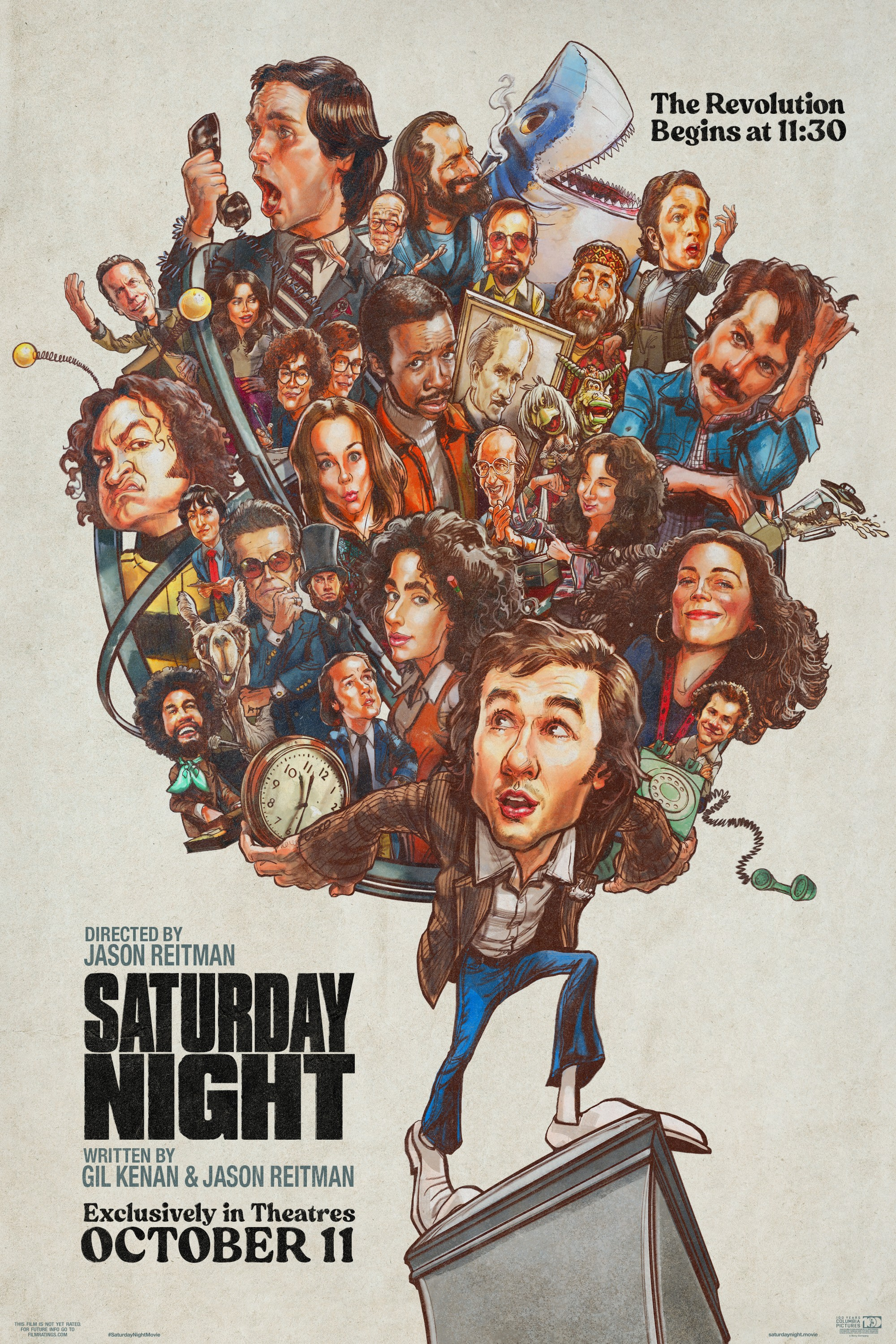
Saturday Night takes us to the fateful night of October 11, 1975 in Manhattan, where Lorne Michaels tried to launch his sketch comedy show for its first-ever episode, which we now know as the iconic and influential Saturday Night Live nearly 50 years later.
A film about SNL should make us laugh, feel revealing, and be packed with celebrity and pop culture history, and that’s exactly what Jason Reitman’s take on the sketch show’s beginning offers plenty of. The lovely 70mm look, long takes throughout the studio, and energetic score from Jon Batiste give the film a strong and dedicated technical edge.
While many films based on true stories have one or two casting choices that feel inspired, Saturday Night has dozens. Gabriel LaBelle, who’s probably a decade younger than Lorne Michaels was when this all went down, plays the creator with a contagious ambition to make magic for audiences on the stage. Rachel Sennott is sometimes the scene-stealer and the heart of it all, while Dylan O’Brien as Dan Aykroyd is one of his most fun performances in years. Cory Michael Smith brilliantly portrays the unstable ego of Chevy Chase, one of the most infamous members of the show’s original cast, while Matt Wood is uncanny in his recreation of the late John Belushi. Nicholas Braun is impeccable and unforgettable as not one but two cultural icons; they’re a pair of performances you have to see to believe. And we haven’t even mentioned Lamorne Morris, Cooper Hoffman, and Matthew Rhys, the latter of whom chews up the scenery as comedian George Carlin. More recognizable names Willem Dafoe and J.K. Simmons are also excellent and hysterical. The best part about this cast is that it reflects how Reitman wants us to feel about the characters and circumstances in the film — a ragtag group of youngsters with the potential to make us laugh, joining forces hoping to change the world.
As we know, the events of this movie, as chaotic as they unfold, did change the world. The most wonderful part about Saturday Night is that it celebrates the convergence of culture for half a decade, which began as NBC’s laughing stock but has since brought together millions with the arts of comedy, music, and performance joining together. The movie itself isn’t as funny as it thinks it is, but when a film celebrates laughter while making you laugh, those ingredients are the perfect groundwork for a purely entertaining wonder, even as you watch everything go wrong (at first). Fans of SNL will have a delightful time with the mythology of 20th-century American comedy, but anyone else will still have a great time with Reitman’s love letter to popular culture, humor, New York City, and the underdog.
Tashi, a former tennis prodigy turned coach, turned her husband Art into a champion. But to overcome a losing streak, he needs to face his ex-best friend, Patrick, who’s also Tashi’s ex-boyfriend.
One thing that’s thrilling about Challengers is that it never gives you easy answers. Is it about devotion? Manipulation? Triumph? Doom? All of them? One thing’s for sure: it’s a film about passion. Raw physical and emotional passion between humans for one another, and for the kick they get doing the one thing they can’t live without — in this case, playing tennis. And for all the right reasons, Luca Guadagnino is at his most maximalist stylistically to convey this raw passion these characters feel and bring us into the world, from exciting editing and some experimental cinematography to the synth, almost Run Lola Run-esque score from Trent Reznor and Atticus Ross. It’s the polar opposite to his more naturalistic, minimalist approach to the intimacy of Call Me By Your Name, and an upping of the ante of the wilder style of Bones and All. Zendaya gives one of her heaviest performance, portraying Tashi perfectly over a long span of time, through fascination, ambition, longing, control, and deceit. Josh O’Connor and Mike Faist are also great, particularly Faist, whose charm entrances the screen. The West Side Story star announces himself as a powerhouse whose apparent harmlessness you can’t help but feel for. Their friendship established in the opening minutes of the film sets the stage for everything to come, and makes you care for how the rest may unfold or fall apart.
Challengers is the rare film that transports you into its world in a case where there are only 3 characters who really bear any significance. There’s a scene between the three main characters that happens early on chronologically that enchants you and sucks you into the close, complicated intimacy they inhabit in this space, and the film never lets you go once this scene happens until the credits roll. It’s an experience that’s dynamic, unpredictable, and darkly human, with three riveting leading performances at its center, and sets the bar the rest of what’s to come in Guadagnino’s directorial career.
Colt Seavers, a down-and-out stuntman, must find the missing star of a new blockbuster film he’s doubling on, while (hopefully) winning the director (and his ex-girlfriend)’s affection back.
David Leitch continues to be a leading voice in action movies with his creative and passionate voice for action and comedy that often turns out star-studded and visually appealing. Much of the film’s charm comes from Ryan Gosling’s brilliant turn as Colt. Like his Oscar-nominated Ken in Barbie, Colt is a sad shell of a “cool guy” who’s too evidently madly in love. Gosling’s comedic timing is at the lightning speed of his Ken, or Holland March from The Nice Guys, and his big personality infuses Colt with a foolishly endearing heart. Emily Blunt also gives one of her most entertaining performances of late as the romantic lead, and Winston Duke is also loads of fun as Colt’s best friend and the film-within-a-film’s stunt coordinator, while Aaron Taylor-Johnson, Hannah Waddingham, and Stephanie Hsu also round out the stellar cast. Waddingham in particular is very extravagant but delightful as Gail, the producer of the film Colt’s working on.
The most clever and thrilling part of The Fall Guy is that Leitch makes the movie stunt-filming scenes as high-stakes and exciting as the actual action scenes of the film. The great scale, dedication, and sound effects make shooting an action movie stunt feel like the incredible, hard-achieved feat that it really is. Additionally, the lightspeed humor feels effortless thanks to the writing, editing, and the cast’s delivery. The lively soundtrack does have a few generic and overused selections, but it’s not enough to sink this smooth romantic action comedy where all the different genre pieces play off each other pitch-perfectly. The director’s career as a stunt coordinator is made evident by the love and tribute to the stunts community here, in this blockbuster that’s hilariously pleasing and greatly worth the big screen price of admission.
In the second part of Denis Villeneuve’s adaptation of the classic sci-fi novel, Paul Atreides seeks revenge against the Harkonnens, who slaughtered most of his House Atreides, and liberate the native Fremen of the planet Arrakis while joining them and learning their ways, all while the fate of the Imperium lays in the balance.
The first Dune from 2021 may have been one of the most stunning blockbusters in recent memory, but this extraordinary sequel puts everything in its predecessor — and almost any action movie I’ve ever seen — to shame. Picking up shortly after the first film, the drama is heightened, the world-building is bombastic, and the sound and visual experience is a one-of-a-kind theater trip. Visceral is such an overused term these days that it wouldn’t do Dune: Part Two justice; you feel how wide this universe spreads and the history of the different conflicts and races that inhabit it. And once you’re brought into this fictional world, you’ll never want to leave, as the nearly 3-hour runtime flies by and every plot development is fascinating. Beyond Villeneuve’s imagination, Greig Fraser’s cinematography is the real MVP here. The beauty within the uncertainty of the desert planet is captured in such a scope that it demands in IMAX viewing, and the different planets all contribute a symbolic and gorgeous aesthetic. Timothee Chalamet takes us on the next step of Paul’s journey: his desire to adapt and fight and his fear of allowing power and faith to corrupt him. He proves that he’s always been a movie star that’s here to stay, and Rebecca Ferguson’s Lady Jessica also takes really interesting directions that make you see her role in the story, and of her son’s, in a murkier way. Zendaya also becomes a lot of the heart here as Chani, one of the franchise’s most noble characters, and Josh Brolin is always terrific as Gurney, while Javier Bardem puts his soul into the role of Stilgar, whose faith drives him towards Paul and Jessica. Austin Butler may be the standout, however, as Feyd-Rautha, whose deranged and sadistic presence create a nail-biting character and a powerful young man who has fully embraced his disturbed nature.
Though Dune: Part Two ups the ante with its visuals and performances, its the powerful script and heightened emotional stakes that make this experience what it is. The film explores questions as to how faith and hope can be exploited, and if the urge for power truly corrupts whoever gets a taste of it. Though you may find yourself trying to guess which paths these characters will take, there’s also lots of unexpectedness and the film’s most intense moments took my breath away. You understand so deeply the dynamics of this galaxy and its cultures, and how much lays in the balance. The exhilarating scale and exciting, constantly developing pace only works because of the passion behind each character and story thread: passion to lead, rule, fight, love, honor, avenge, or secure a future. These moral greys form the dark and poetic drama that’s impeccably guided by frame-worthy shots and booming sound. Never have I felt so deeply that I didn’t want a film to end, as once you’re sucked into this marvelous world by Villeneuve, you’ll never want to go home. We’ve rarely seen emotion and grandiose like this in action movies so flawlessly convert to a magnetic cinematic experience. The Empire Strikes Back comparisons are worthy but also a little humbling; this reaches the bar that The Lord of the Rings: The Return of the King set for sci-fi/fantasy epics. It’s a show-stopping galactic saga that unleashes its ambition and magnitude onto you in a way that will entrance and thrill whoever buys a ticket. It’s a spectacle that sets the bar so high for whatever else is to come in blockbuster filmmaking, and like the unreal visuals and scale of Avatar: The Way of Water, needs to be seen on a massive screen, to be transported with other people, and watch a story unfold that you’ll never forget.
Bella Baxter is a young woman brought back from the dead by the brilliant and unorthodox scientist Dr. Godwin Baxter. Under Baxter’s protection, Bella is eager to learn. Hungry for the worldliness she is lacking, Bella runs off with Duncan Wedderburn, a slick and debauched lawyer, on a whirlwind adventure across the continents.
Trigger warnings are a no-brainer with Yorgos Lanthimos, as his films are often filled with sadistic, violent, and hypersexualized power games where nobody is quite a pleasant person. These tropes as well as Lanthimos’ trademark cringe humor are just the baseline to describing Poor Things, a sickening yet grandiose movie that transcends categorization. It’s hysterical but not quite a comedy; it’s poetic but not quite a drama. Emma Stone gives a performance so demanding and so audacious yet it never breaks the illusion of being acting. You completely buy her character in the context of the story and are taken aback by her character’s abnormal physicality and wonder with being alive. Mark Ruffalo is also throwing himself into this role that could’ve easily fallen into unbelievability, but he perfectly balances an exaggerated, almost theatrical edge to his role with a vile, pitiful nature to it. Willem Dafoe plays a scientist under heaps of makeup whose motives may provide an emotional anchor to Stone’s character but also unpeels itself to be uncomfortably pathetic due to his background, and Ramy Youssef also does a great job here.
Poor Things may owe some of its inspiration to classic monster movies, but really isn’t like anything audiences have seen before. The production design creates an eye-popping, fantastical version of the Victorian Era and a world with a completely fresh aesthetic, as well as dynamic cinematography with color, B&W, and even a few fish-eye lens shots to invoke Bella’s warped worldview. Bella’s curiosity is devoid of prejudice and preconceived notions on the world’s structures, and she finds herself appalled by those around her trying to control her, and fascinated by anything she gets to choose to do. The humor is ridiculously honest and ballsy, and therefore, not for everyone — not to mention the exaggeratedly comic sex scenes and the uncompromising and even disgusting violence. Its audacity will certainly find its pleasurers, especially those who already love the director’s filmography. This bold tour de force isn’t for the faint of heart and may leave you at a loss for words. The writing and execution are exhilarating in the best way; the more disturbing and out-of-this world it gets, the less you’ll feel you want to look away. You’ll simply want to witness the bizarre yet fascinating unfold in front of you when it’s through Yorgos’ eye and so irresistibly played by Stone as this woman with the literal brain of an infant in her head, eager to experience being alive for all its peculiarities..
The Hunger Games: The Ballad of Songbirds and Snakes is set 64 years before the first Hunger Games movie, around the time of the 10th Hunger Games where a young Coriolanus Snow is living in the Capitol, facing choices that will define his future and that of Panem as he mentors District 12 tribute Lucy Gray Baird to victory in the arena.
This adaptation of Suzanne Collins’ excellent prequel to her acclaimed series of novels has the best cinematography of the franchise, and stunning production design. The Hunger Games films have always boasted incredible world-building, making the intricate politics and history of Panem spread far beyond the screen, and introducing the audience to a wide world of characters within it. However, the film sometimes lacks soul when it needs it most, especially in its first act. Tom Blyth gives an interesting performance of a young man as his narcissism and consumption for power begins to consume him whole. Though Rachel Zegler’s singing voice and presence gives Lucy Gray heart, her character lacks the consistency and potency she’s meant to have, not to mention an off-putting Southern accent. The chemistry between Zegler and Blyth feels weak, though it should’ve been a key component in the film. Jason Schwartzman gives a great comedic performance as Lucky Flickerman, the announcer of the Games, and Josh Andres Rivera gives the most empathetic performance as Sejanus. Hunter Schafer also steals the screen as Snow’s cousin Tigris, but doesn’t have nearly as many scenes as she deserved. Although Viola Davis’ character is supposed to be repulsive, her voice and lines are weirdly over-the-top.
The sequences we see inside of the Hunger Games are absolutely amazing, and more visually exciting than anything we saw in the arena of the original 2012 film. The dynamic shots and lighting create a scenery that’s both grand and sadistic. The post-war dynamics between the Capitol and Districts hits hard with the viewing of the Games, the dialogue itself is lacking and character decisions seem sometimes unearned. What is well-earned is this idea of a Hunger Games prequel set at this era so soon after a civil war and its sickening aftermath, and hitting home themes about human nature, but it should likely be viewed in the context of the films that were released before it — films that may have had better characterization despite this one’s admirable ambitions and aesthetic.
Next Goal Wins is the true story of American soccer coach Thomas Rongen, who travels to the American Samoa to help transform their team from the world’s worst team into stars. Taika Waititi’s irreverent flare not only gives the film plenty of laughs but an endearing underdog spirit that also highlights Samoan culture unlike lots of popular media. The casting of Michael Fassbender, an actor known primarily for dramatic roles, as a comedic lead does the film wonders. The way he portrays frustration and confusion with the incompetence around him is enjoyable, until the character begins to accept his journey into finding community around him, which becomes quite touching. Kaimana is also a standout as the character Jaiyah, an incredibly memorable and impactful character, not to mention fun supporting performances from Will Arnett and Elisabeth Moss.
The film’s comedic style is incredibly laugh-out-loud and makes you laugh in every way from situational humor to extreme physical comedy — the way Waititi does it best. Sure, underdog sports movies aren’t new to us, but the special cultural touch and loving characters make this a film that’s entertaining with every moment it has to offer. It’s short but incredibly sweet and wears its heart on its sleeve from the opening to the end credits that show you the real story the film is based on.






 filmtoppings.com