Avatar: Fire and Ash

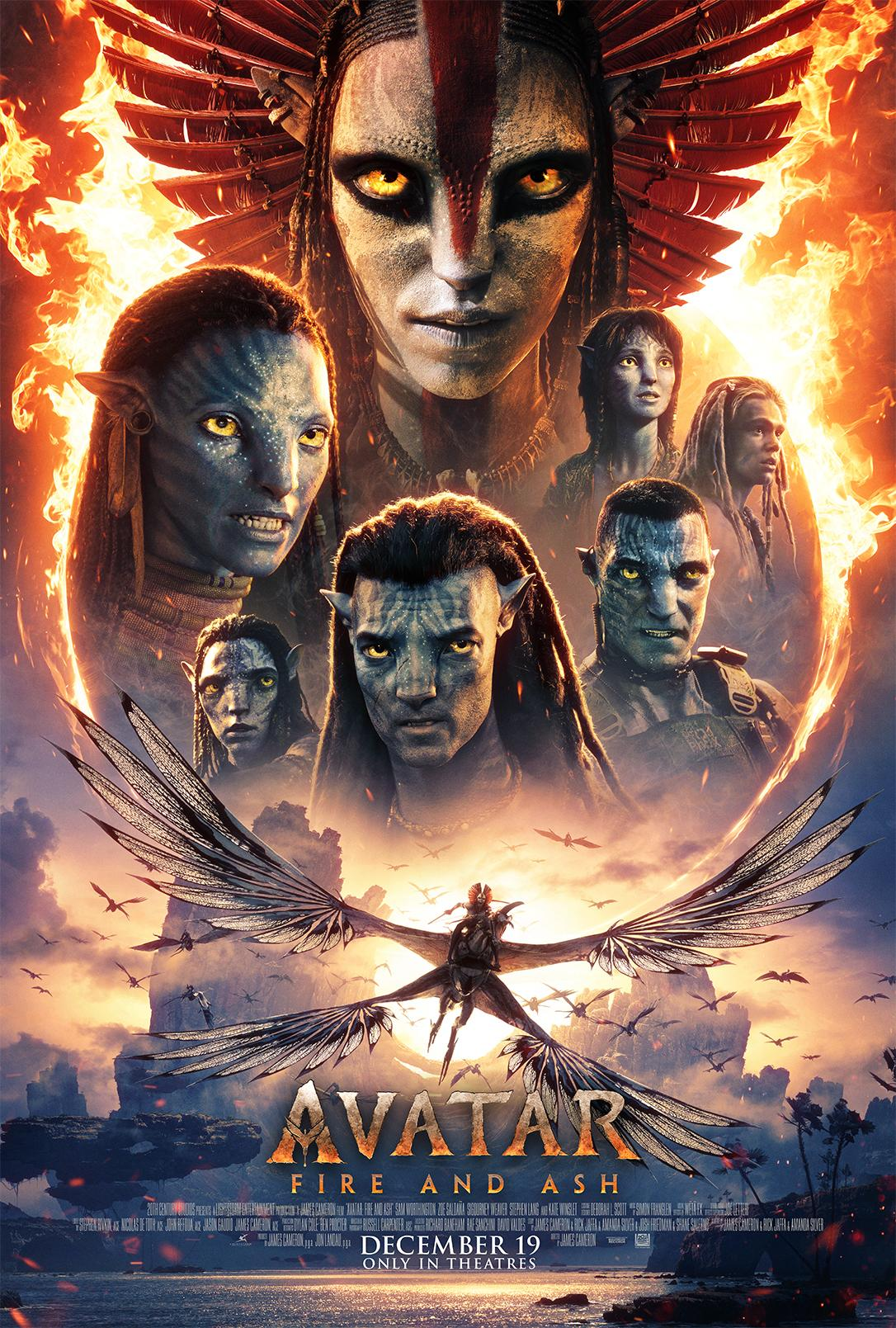
James Cameron succeeds yet again in teleporting the audience from their seats into the lands, airs, and seas of Pandora and anyone who buys a ticket for Avatar: Fire and Ash may experience one of the most visually arresting things they’ve ever seen. The complexity of the water, the Na’vi people themselves, and the incredible settings are so detailed and breathtaking to look at, immersing you into an action sci-fi saga with epic scale that only Star Wars and Dune have reached recently. Every character is challenged to the brink to make the most difficult choices, and the child characters from the last film are even stronger here. Jake and Neytiri’s son Lo’ak earns a lot of spotlight he’s given, and Jack Champion’s performance has definitely improved. Zoe Saldaña is again a highlight as Neytiri and given much more to do, while Sigourney Weaver impresses in her strong performance as Kiri. Stephen Lang eats up the scenery as the ruthless and vengeful Quaritch. It’s interesting to examine his grievance against Jake, as they’re both once-human military men now in Na’vi bodies, but even more interesting is the dichotomy between Neytiri and new antagonist Varang, played fantastically by Oona Chaplin. She’s the leader of the Ash People, who reject the Na’vi belief in the goddess Eywa and is hellbent on spreading chaos.

The action sequences are brought to life with such a might and grandeur that it truly feels like the culmination of decades of blockbuster filmmaking. The journey is so stunning that you may not want it to end, but if anything holds the film back, is action set pieces feeling recycled from the last film. The similarities to The Way of Water, especially in the final act, are glaring, including numerous character dynamics/arcs and action scenes. The human characters get a lot of screen time and are rather annoying, especially Giovanni Ribisi, who is needlessly brought back from the first film. However, it looks so gorgeous, particularly a jaw-dropping final battle, and the emotional stakes are so high that the immersive adventure forgives much of its unoriginality and some narrative shortcomings. Those looking for another thrilling experience will be amazed by the sheer beauty of what may be one of the most intricate and astounding CGI achievements of all time. If you can forgive some familiarity, Fire and Ash will lift you out of your seat and take you to worlds away that feel so tangible that watching it in big formats like IMAX and 3D is a once-in-a-lifetime experience.
Jay Kelly

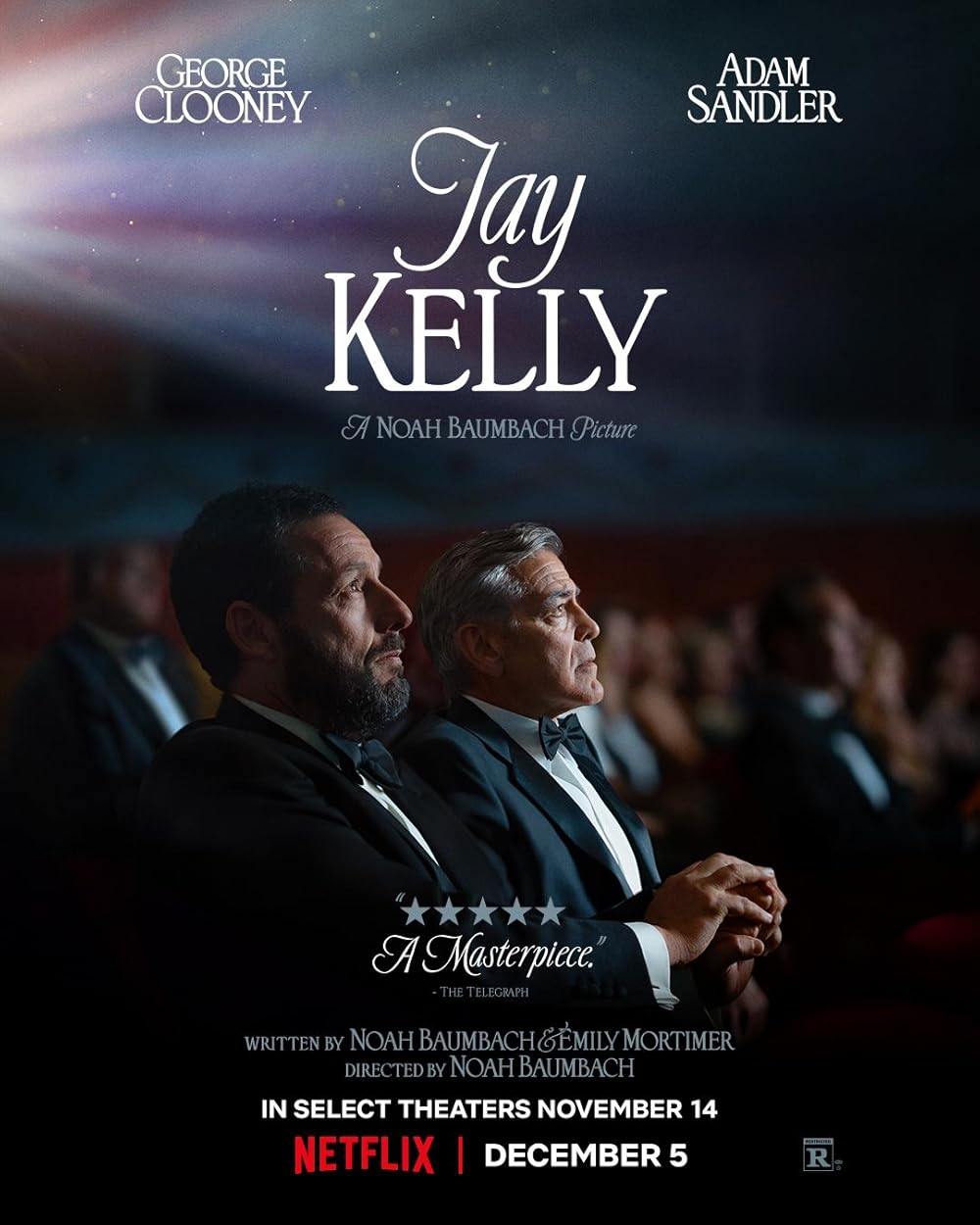
Noah Baumbach’s largest film in cast and scale isn’t his best work or even close, but certainly one of his most ambitious. George Clooney stars as the titular Hollywood actor seeking to reconcile with his daughters as he is about to be given a lifetime achievement honor in Europe. Jay’s relationship with his manager Ron is the film’s real heart here, with Adam Sandler not only stealing the entire film but giving one of the best performances of his entire career. Ron is torn between his devotion to his client and dear friend, and the heartache of missing out on time with his wife and kids. Sandler gives the character a dimensional charm, conflict, and vulnerability. Laura Dern is also outstanding as Jay’s publicist, also frustrated as she’s desperately trying to fulfill the impossible role of chasing Jay around and covering for him.

Many other familiar faces give very strong performances here, although Baumbach’s directing here stands out even more than his writing this time around. The film’s approach to memory and distance is very interesting, as is the idea of this “king” finally spending time with ordinary people who perceive him as a legend of sorts. However, the main storyline between Jay and his daughters doesn’t quite have the emotional weight that’s needed, with the themes being a bit too obvious and the film just lacking enough screen time with his youngest daughter to feel the way the movie wants us to about the main father-daughter relationship here. A performance moment and line delivery from Clooney in the film’s final moments, however, elevates the entire film and brings the themes full circle, even if it takes that long for them to really hit hard. Jay Kelly doesn’t live up to the excellence of Baumbach’s best storytelling like Marriage Story, but is still big yet introspective, with Clooney and Sandler standing out together, and the latter’s performance resonating in particular.

The Running Man

In a future ruled by an authoritarian government, Ben Richards joins a deadly game show to win money to support his family. There’s one catch: to win, he has to survive one month on the run from expert assassins who are trying to kill him.

The Running Man is not the first film adaptation of the Stephen King novel, but it’s also the rare reimagining that not only justifies its existence by taking a completely different and more faithful direction, but also tops the original film by far. Edgar Wright’s love of filmmaking shines through in all of his projects, no matter the scale or setting. This one is a lot more self-serious than his other works, but still enough irreverence and humor shines through to balance that out. Glen Powell’s action star material gives the film much flare and entertainment, making Ben Richards a fun character to root for, even when some of his characteristics don’t always add up (a subplot about his anger issues becomes rather irrelevant after the opening minutes). Colman Domingo is also a riveting standout as the host of the titular game show, giving the dialogue and performance his all. His scenes of commentary and theatrics elevate much of the film.

Though its themes have been explored in other films, including many recent ones, it still very intriguingly explores how capitalism and consumerism enslave the working class through sadistic entertainment. It hits both close to home while evoking something different from our reality. The pace is just fast enough for the audience to root for our hero and be interested in its vibrant world-building and energy. The action is bloody and creative without feeling overly cartoonish and fitting within the world of the film, and the directions it takes are thrilling while the humor and dark satire work perfectly together. This modern adaptation not only works far better than its predecessor, but it’s a winning ride for action fans and for the always charismatic Powell.

If I Had Legs I’d Kick You

If I Had Legs I’d Kick You digs deep into the darkest corners of the human souls, of the ugliest thoughts that plague our minds, and the crippling anxiety and depression that traps us in the most banal of existences. Rose Byrne gives one of the most demanding, devastating, and furious performances of the last decade, as a woman suffocated by the horror and weakness of her being, confined by the truths of her situation and lacking the strength to find meaning or love in any of it. The remarkable filmmaking and camerawork allows us to pinpoint exactly how Linda interacts with her surroundings, without having to imagine any of what she’s feeling. The dread that anything is about to go wrong, that it’s all your fault, and that this excruciating guilt is forever. The feelings are so tangible to the audience, yet their roots of why she feels responsible for the life she hates are intangible and ambiguous for much of the film. 

Byrne’s character channels universal struggles, including with motherhood, while taking them to the most extreme depths and circumstances. However, we’re never brought to think that she’s a bad person, simply someone who’s isolated and unable to cry for help or carry herself along with those around her. As Linda is inconvenienced with a gaping hole in the roof of her house, the hole metaphorically grows and becomes one with her. 

The final few minutes are haunting and left me dumbfounded. The nightmarish imagery and dark humor play off each other to create a final product that’s arguably more stressful than any horror movie could be. This movie left me dumbfounded and at a loss for words, one of the most anxiety-inducing, uncomfortable, and emotionally raw films I’ve seen in a while. It’s a one-of-a-kind film, with an astounding and unforgettable lead performance, that shook me to my core.

Tron: Ares

Ares, the most intelligent artificial being in the world, is sent from the virtual world of Tron into the real world on a dangerous mission that could determine the future of AI and the world.

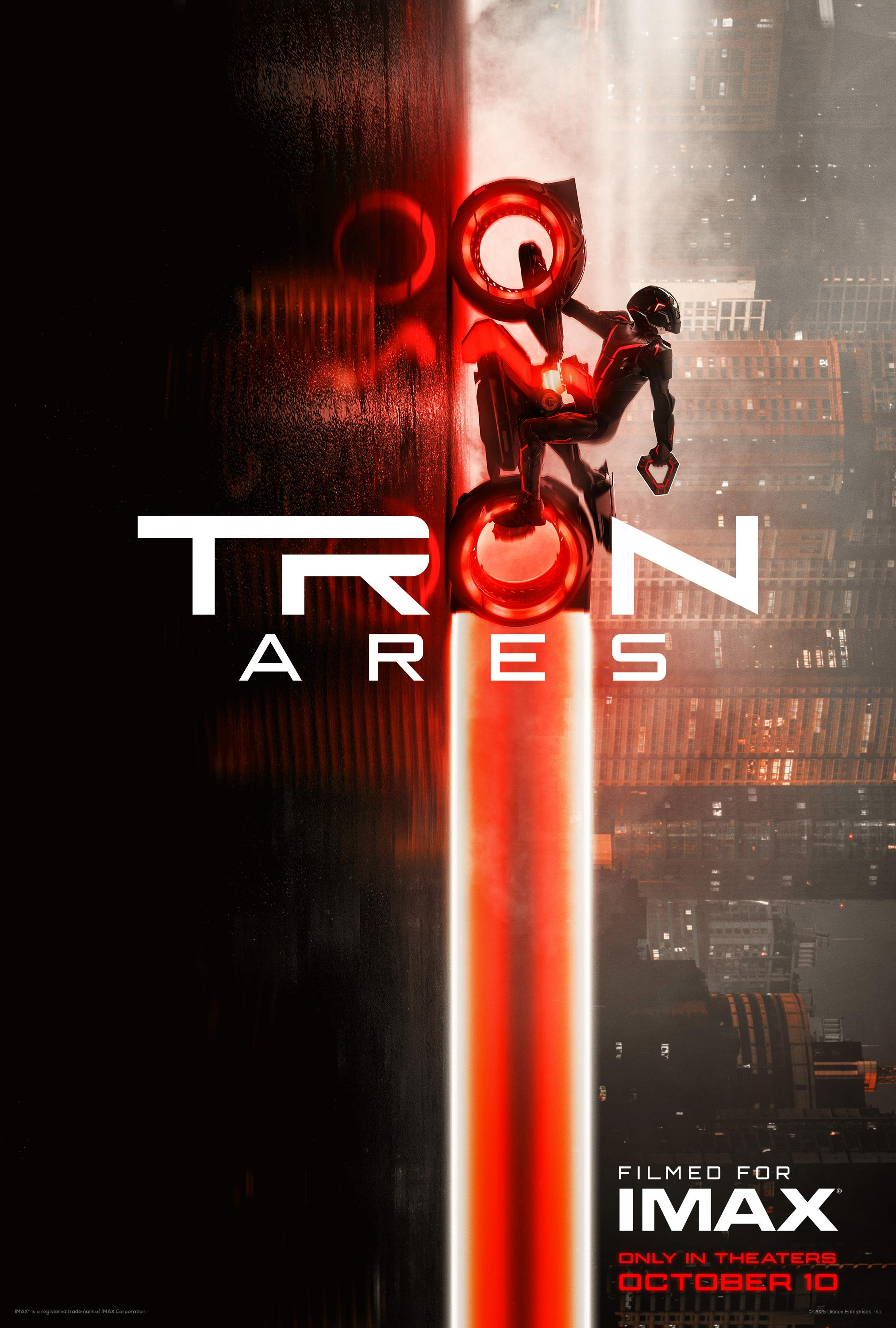
The virtual worlds and objects that come out into the real world in Tron: Ares are eye-popping and a must in 3D. The immersive scenery within the film invite you in with the gorgeous cyberpunk look, and the score by Trent Reznor and Atticus Ross is also a highlight of the experience of watching the film. Just like its predecessor Tron: Legacy, Ares is a perfectly middle-of-the-road film with out-of-this-world visuals yet an underwhelming screenplay. Thankfully, the human protagonist is far more interesting this time around, with Greta Lee giving an engaging performance that’s fun to follow and has some heart. That said, Jared Leto’s performance is hit-or-miss, with the intentional soullessness of the titular character Ares feeling excessive and even cold when he’s supposed to start connecting with the audience and human characters. Evan Peters’ performance does the best with a cliche tech billionaire character, while Jodie Turner-Smith does a great job with a character who’s not as fleshed out as she needed to be.

The film also doesn’t quite explore its themes of altruism vs greed and war with technological advances quite in depth, but the objective the two sides of the coin are both after is engaging, as are a few standout action sequences. If only the film better explored the potential stakes and consequences of the antagonists’ goals. Even if it doesn’t quite manage to form a deep bond with any of its characters, the film is so stunning to look at that the frames leap off the screen. Only a format such as IMAX 3D justifies this watch, but if you can find a screen big enough, it’ll be quite the 2 hours of amazing, if forgettable, eye candy.

Weapons

When seventeen children from the same class all disappear one night, a community is sent reeling and forced to deal with the terrifying consequences.

Weapons is a film that bids farewell to all the tropes we’re used to in even the best of modern horror movies, throwing us first into how a community is affected by such cruel and unexplainable loss. Julia Garner is at the film’s heart as a gentle teacher who suddenly loses all but one of her students — and is quickly blamed by her peers for it. Garner is immediately bondable with the audience due to her desire for answers and peace amidst her unfair situation. But on the other side of the public tensions is what comes off as rage but reveals itself to be fear and desperation in Josh Brolin’s performance as a father hellbent on finding his missing son. His hardness reveals itself as pain and vulnerability and stands out among many others of the actor’s roles.

Though writer-director Zach Cregger sets out to make Weapons feel far more patient than other horror films, he also goes for broke structurally, stylistically, and graphically. The editing, score, and cinematography are chilling, with moments that may end up in modern horror classic territory. Cregger retains some of his previous film Barbarian‘s DNA, such as jumps in time and perspective — some less interesting than others yet necessary for the film’s slow revelation of its mysteries. Within the film’s title lies many of the answers, including the weapon of the human soul itself: the harm that we can inflict or can be inflicted on us. But it’s because the film does hold back so much, and for so much of its runtime, that everything clicks so beautifully. We see and learn just as much as we need to in order to be asking the right questions, and hopelessly guessing what might really be going on here. Once you reach the end of Weapons, you may find yourself equal parts terrified and delighted, but its unraveling will make your heart sink and your legs shake. Weapons is bold and extraordinary even in today’s ever challenging horror landscape. Cregger’s cynical and at times darkly humorous lens fits perfectly into a modern folk tale of sorts that radiates the kind of singular originality felt in M. Night Shyamalan’s golden days of making thrillers. In this epic yet personal horror film, the scares aren’t nearly the whole point, but the whole point is seriously scary — just not in all the ways you’d expect.

The Alto Knights

Two of New York City’s most notorious organized crime bosses vie for control of the city’s streets. Once best friends, petty jealousies and a series of betrayals set them on a deadly collision course.

Robert De Niro playing an infamous mobster is nothing new. But De Niro playing TWO mobsters? Throw in legendary director Barry Levinson of Bugsy, Rain Man, and Good Morning, Vietnam, now that’s something worth writing home about, right? Unfortunately, The Alto Knights is anything but; a film with maybe some potential on set that was completely butchered in the editing room. De Niro’s dual performance is supposed to fascinate the audience but instead distracts. Frank Costello and Vito Genovese are not presented in the film as being two sides of the same coin, as were the mobster twin brothers Kray, played by Tom Hardy in Legend. In this film, the two mobsters are depicted as not just of different families and mannerisms but of different ages, experiences, and motivations. When De Niro finally shares the screen with himself, it’s impossible to buy these disparities as the script depicts them, rather we buy them more like equals under different heaps of makeup, which was not the intention. As Costello, De Niro is giving something between a less soulful version of his turn in The Irishman, a less extravagant version of his turn in The Untouchables, and a less funny version of his turn in Analyze This. He’s interesting as Genovese, but casting another actor to oppose him would’ve worked better to show that one of these gangsters is actually much more frightening than the other.

The film recycles tired tropes of past popular mob films, and as I’ve alluded to here, many of them already star the great De Niro. Though some scenes are at least mediocre in their execution, the editing is horrendous and makes some scenes unwatchable. The film insists on blasting through most scenes like a documentary montage rather than letting scenes breathe and feel like a thrilling drama. The constant narration and barrages of exposition are condescending to its audience of a normally intelligent genre, but insists on feeding us information we could’ve learned through context clues within scenes. The poor dialogue can’t be salvaged by lacking performances from Debra Messing and Cosmo Jarvis, the latter of whose promising transformation never quite gets to shine. Moreover, there never feels like an escalation of tension or events when there feels like we should be building towards something, rather a lack of setup that also leads to a lack of reward. The Alto Knights starts on a bad foot, and never even hints at a chance to redeem itself. Even De Niro and crime film fans need not waste their time, in theaters or at home.

Bridget Jones: Mad About the Boy

Renee Zellweger’s iconic British protagonist has become something of a cinematic treasure across four films now. But her films haven’t made us just laugh along at her missteps, but watch her develop, and even come of age, you could say. This final film has a somewhat more bittersweet tone, though, as Bridget’s lover, Mark Darcy, is no longer in the picture. Four years after his loss, she is finally ready to move on and find love again. The film maturely tackles coming to terms with grief, finding joy again while coexisting with the memory of those who have passed on. But it’s also still irreverent, charming, and romantic. It tackles some of the basics that the first film gave a go at, but Zellweger not only shows Bridget’s goofy side, but her struggles with being a single mother of two, and the absence of her husband.

Joining the mix are Chiwetel Ejiofor and Leo Woodall, who both charm in different ways, but Ejiofor in particular has great chemistry with Zellweger. Though it does retread familiar rom-com territory, or that of comedies about parents raising children, and it’s not the sharpest or smartest of the franchise over Bridget Jones’s Baby, it still offers a good time and a heartwarming conclusion to a lovable, messy delight of a character.

A Real Pain

A Real Pain beautifully balances the heartbreaking and hysterical through the dynamic of Jesse Eisenberg and Kieran Culkin as cousins David and Benji, who travel from New York to Poland together on a tour in memory of their deceased grandmother, a Polish Holocaust survivor. It’s about so many things, whether big or small. From a Jewish perspective, the film powerfully touches on complicated feelings of nationality towards countries in which one’s family lived but suffered horrific atrocities, as well as generational trauma. As someone who has embarked on this tour myself, the film captures not only the visceral nature of walking into places where such evil was committed eight decades ago (which both I and the characters here came to feel, wasn’t even that long ago), but the deep emotional connection towards one’s ancestors, community, and people it invokes.

From a personal perspective, the film is also very much about empathy — the idea of feeling others’ pain, and sadness, to better understand and connect with oneself. Kieran Culkin in particular brings such harsh complexity to his character. Benji is fascinated with human connection and constantly in pursuit of embracing living life with all his senses, but doesn’t always know how to feel, or express himself to others. Even when he pushes others away and embarrasses himself, the audiences can’t help but hold him close to their heart and feel deeply for him in every moment, because of his desire to grieve for his grandmother, and true yet misguided desire for the best. Eisenberg, in one of his most substantial and beautiful performances, wonderfully conveys David’s pull to and from Benji — his responsibility yet resentment towards the way Benji feels, which comes from a distance and envy from him, yet a dear love for him. Their bond is as moving as it is poignant, and even irreverent, and best of all, it’s easy to connect with them both as an audience member, despite how wildly different they are. Eisenberg’s script is devoted to his love for his Jewish heritage and culture, and exploration of the human condition that may even make you reflect on how you live your life. He and Culkin together make for a wonderful pair in a film that’ll take you on an emotional journey filled with weight and resonance.

Kraven the Hunter

Sergei Kravinoff, the son of a crime lord, develops a gift for fighting for and defending wild animals, but soon old and new foes from his life converge as he must embark on the most dangerous fight of his life.

Explaining the movie just then was a difficult task, not in an effort to avoid spoilers of the premise, but because the movie is so shallow it’s hard to really try and sell. It doesn’t quite make much sense, but worst of all, it isn’t fun to sit through. Weak character motivations and a hideous visual style plague this so-called origin story for another Spider-Man villain who Sony tries to manipulate into an antihero, rather unconvincingly. Aaron Taylor-Johnson’s casting as the titular character could’ve been promising in another movie, but he instead looks bored with the material he’s given, and who can blame him? Ariana DeBose and Fred Hechinger are also trying to salvage characters given no weight, but Alessandro Nivola, Christopher Abbott, and Russell Crowe are all awful. Nivola especially is given a lot of screentime but his slimy, unintimidating villain is flat and downright unwatchable.

Kraven, who in the source material is a terrifying brute, is supposed to be a much more sympathetic protagonist here, but we’re never given much reason to like him besides the fact that he’s played by a charismatic, good-looking actor, who isn’t really allowed to exercise too much of that charisma here. The action scenes are ruined by what looks like unfinished CGI, and every character’s look and dialogue is annoying, besides a moments Oscar winner DeBose has that are tolerable at best. The plot points are repetitive, the themes are undercooked, and the overall style is dull and feels more like test footage than a finished film that this character deserves. Not to mention, there’s some painfully obvious dubbed-over lines, which was also a glaring issue in Sony’s Marvel spin-off Madame Web from earlier this year. There’s no real reason here to root for any sort of journey here, as there’s never a promise of any real reward. The film pretends to be gritty, but only ends up being unintentionally humorous. It’s a fittingly empty end to Sony’s Spider-Man Universe of villain spin-offs that like its predecessors in the franchise, you’ll be begging to forget the moment it’s over.