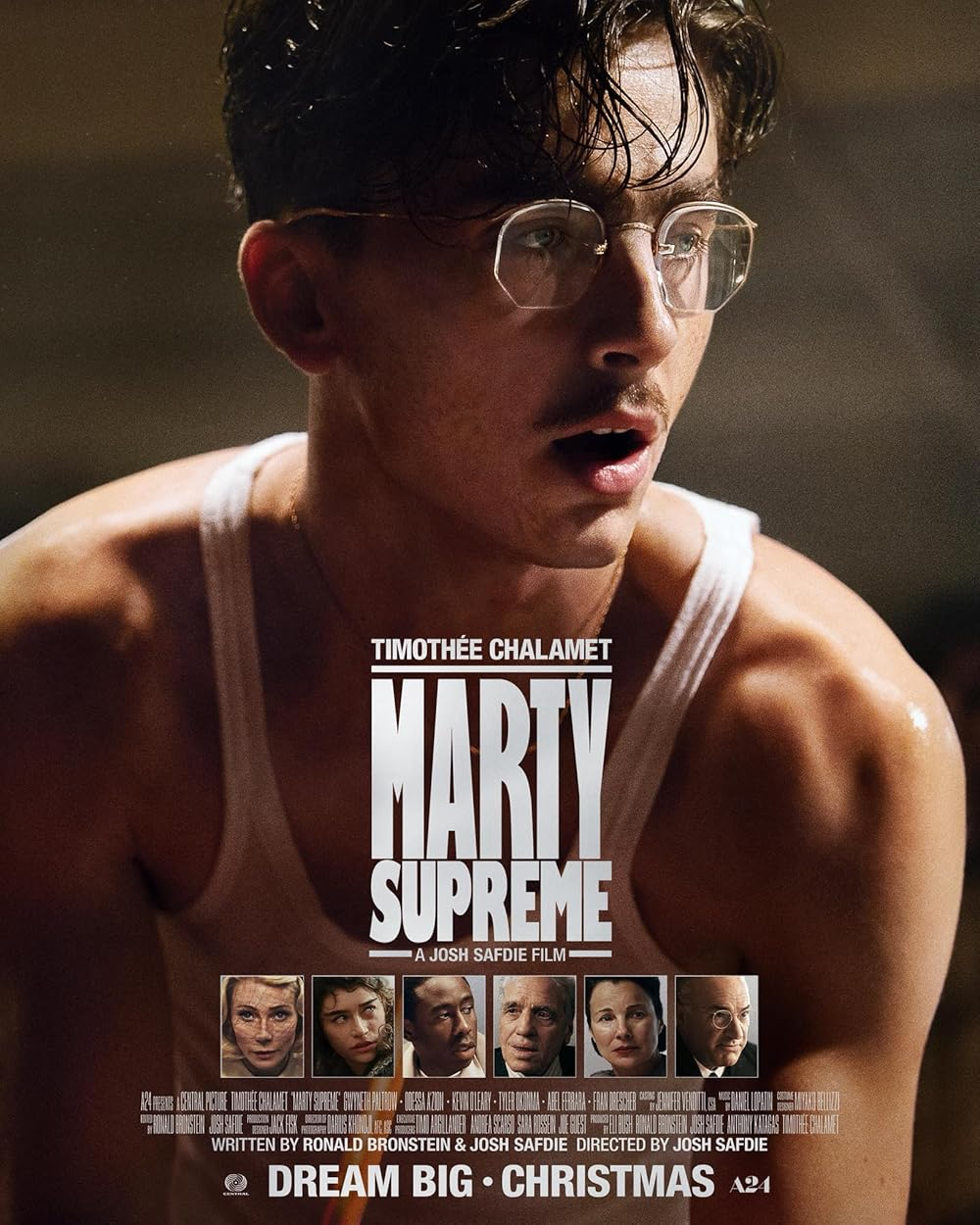
Marty Supreme

The Safdies’ bold filmmaking style has reinvented storytelling since they entered the scene in their expert use of handheld camerawork and overlapping dialogue to build tension, and Josh Safdie’s newest film is not only his grandest, but also one of the year’s must-watch movies that subverts most modern categorizations. If you had trouble rooting for Adam Sandler’s lead in Uncut Gems, Timothee Chalamet’s portrayal of Marty Mauser is almost as slimy, smooth-talking, and utterly self-centered. Not to mention, it’s the best performance of his entire career, devoting so much physicality in every moment to a character who desires to not only be great, but to be celebrated for his greatness. That’s exactly what causes him to make choices that are hot-headed, self-destructive, and often awful to others. Chalamet is loud but oddly charismatic, energetic, and layered. So why, through it all, are we secretly hoping for our unlikable protagonist to get what he wants, even if we know he might just squander it? Marty hustles, lies, insults, and risks it all to reach his ultimate goal of being the best ping pong player in the world, and Safdie’s direction as certain scenarios open rabbit holes of crazy and unwanted situations captures the exhilarating and hysterical chaos of it all.

Odessa A’zion delivers a spectacular breakout performance, giving her character of Rachel a kinetic unpredictability and standing out as a pivotal role in the story that’s impossible to look away from. Gwyneth Paltrow gives much heft to her character, a lost and washed-up but passionate actress looking to be heard in what she feels is a stuck situation in her life, and Kevin O’Leary also shines in a role defined by authority, vanity, and a coldness that looks down on Marty as he approaches him. Tyler, the Creator also stands out as a friend of Marty’s who shares some of the craziest scenes of the film with him. Safdie does an outstanding job of capturing the dirty and rugged look of 1950s New York, with madness increasing as characters yell over each other with the camera up in their faces, or sometimes bad or desperate situations escalate to much, much worse. The script, camerawork, and editing are working together in unison in every moment to create an intense and nail-biting flow that never stops. Not to mention, Daniel Lopatin’s booming score and the brilliantly selected soundtrack enhance every moment in which they’re present.

Chalamet’s performance that vivdly brings the titular character to life is just as fascinating as trying to piece together the greater poetry of the story. The magnitude of Marty’s ambitions are underscored by his entitlement to his gifts and destiny, and his willingness to deceive and toss those close to him aside. This make it fun to predict whether or not he’ll find the success he’s looking for; if he does, at what cost? And if he doesn’t, which of his egregious mistakes will be his downfall? In expected Safdie fashion, it’s overwhelming direction and sound design contribute to a nail-biting watch that resonates as a wickedly structured character study, an absurdly shocking comedy, and one of the one of the most epic dramas of the year.
Dune: Part Two

In the second part of Denis Villeneuve’s adaptation of the classic sci-fi novel, Paul Atreides seeks revenge against the Harkonnens, who slaughtered most of his House Atreides, and liberate the native Fremen of the planet Arrakis while joining them and learning their ways, all while the fate of the Imperium lays in the balance.

The first Dune from 2021 may have been one of the most stunning blockbusters in recent memory, but this extraordinary sequel puts everything in its predecessor — and almost any action movie I’ve ever seen — to shame. Picking up shortly after the first film, the drama is heightened, the world-building is bombastic, and the sound and visual experience is a one-of-a-kind theater trip. Visceral is such an overused term these days that it wouldn’t do Dune: Part Two justice; you feel how wide this universe spreads and the history of the different conflicts and races that inhabit it. And once you’re brought into this fictional world, you’ll never want to leave, as the nearly 3-hour runtime flies by and every plot development is fascinating. Beyond Villeneuve’s imagination, Greig Fraser’s cinematography is the real MVP here. The beauty within the uncertainty of the desert planet is captured in such a scope that it demands in IMAX viewing, and the different planets all contribute a symbolic and gorgeous aesthetic. Timothee Chalamet takes us on the next step of Paul’s journey: his desire to adapt and fight and his fear of allowing power and faith to corrupt him. He proves that he’s always been a movie star that’s here to stay, and Rebecca Ferguson’s Lady Jessica also takes really interesting directions that make you see her role in the story, and of her son’s, in a murkier way. Zendaya also becomes a lot of the heart here as Chani, one of the franchise’s most noble characters, and Josh Brolin is always terrific as Gurney, while Javier Bardem puts his soul into the role of Stilgar, whose faith drives him towards Paul and Jessica. Austin Butler may be the standout, however, as Feyd-Rautha, whose deranged and sadistic presence create a nail-biting character and a powerful young man who has fully embraced his disturbed nature.

Though Dune: Part Two ups the ante with its visuals and performances, its the powerful script and heightened emotional stakes that make this experience what it is. The film explores questions as to how faith and hope can be exploited, and if the urge for power truly corrupts whoever gets a taste of it. Though you may find yourself trying to guess which paths these characters will take, there’s also lots of unexpectedness and the film’s most intense moments took my breath away. You understand so deeply the dynamics of this galaxy and its cultures, and how much lays in the balance. The exhilarating scale and exciting, constantly developing pace only works because of the passion behind each character and story thread: passion to lead, rule, fight, love, honor, avenge, or secure a future. These moral greys form the dark and poetic drama that’s impeccably guided by frame-worthy shots and booming sound. Never have I felt so deeply that I didn’t want a film to end, as once you’re sucked into this marvelous world by Villeneuve, you’ll never want to go home. We’ve rarely seen emotion and grandiose like this in action movies so flawlessly convert to a magnetic cinematic experience. The Empire Strikes Back comparisons are worthy but also a little humbling; this reaches the bar that The Lord of the Rings: The Return of the King set for sci-fi/fantasy epics. It’s a show-stopping galactic saga that unleashes its ambition and magnitude onto you in a way that will entrance and thrill whoever buys a ticket. It’s a spectacle that sets the bar so high for whatever else is to come in blockbuster filmmaking, and like the unreal visuals and scale of Avatar: The Way of Water, needs to be seen on a massive screen, to be transported with other people, and watch a story unfold that you’ll never forget.