Saturday Night

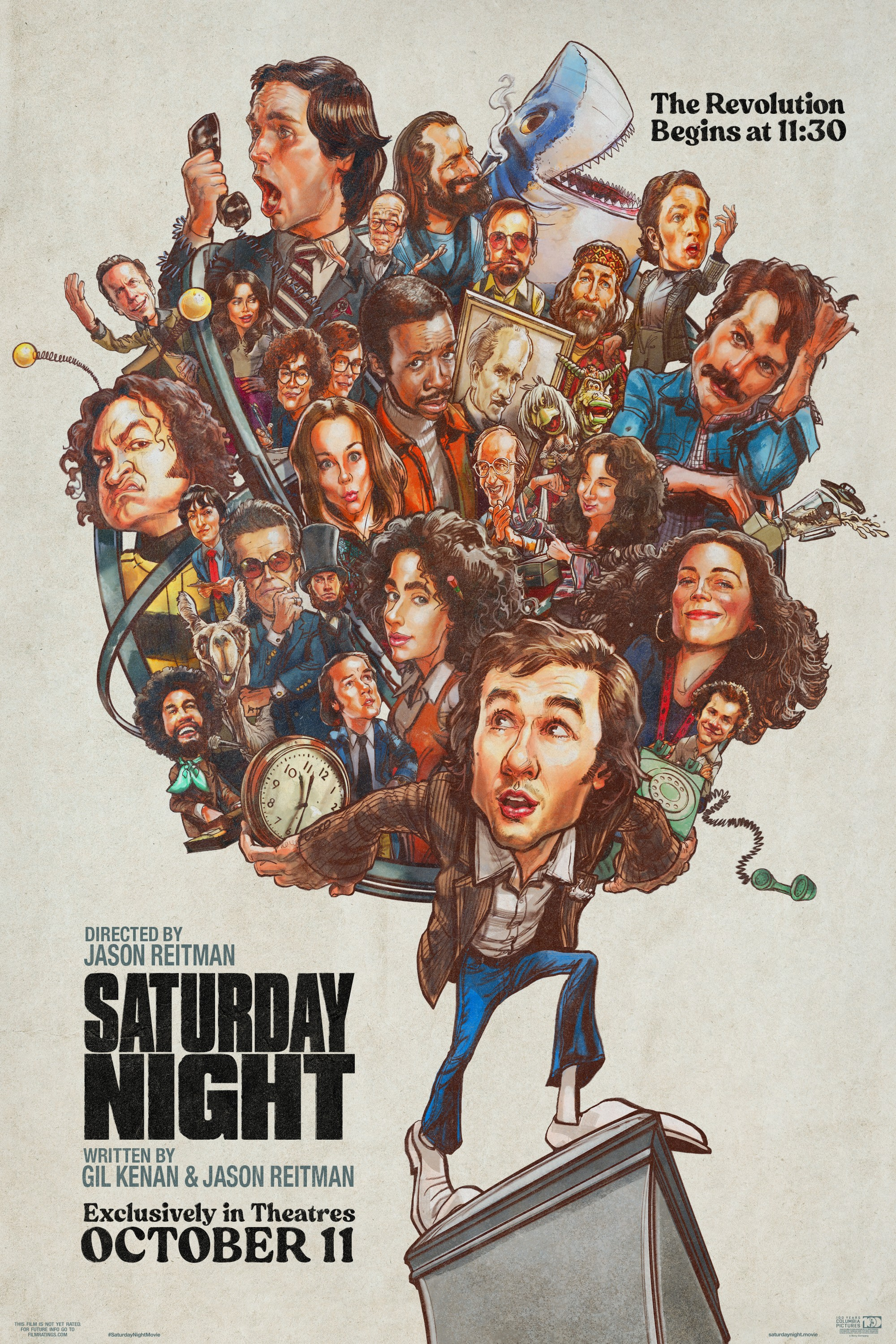
Saturday Night takes us to the fateful night of October 11, 1975 in Manhattan, where Lorne Michaels tried to launch his sketch comedy show for its first-ever episode, which we now know as the iconic and influential Saturday Night Live nearly 50 years later.

A film about SNL should make us laugh, feel revealing, and be packed with celebrity and pop culture history, and that’s exactly what Jason Reitman’s take on the sketch show’s beginning offers plenty of. The lovely 70mm look, long takes throughout the studio, and energetic score from Jon Batiste give the film a strong and dedicated technical edge.

While many films based on true stories have one or two casting choices that feel inspired, Saturday Night has dozens. Gabriel LaBelle, who’s probably a decade younger than Lorne Michaels was when this all went down, plays the creator with a contagious ambition to make magic for audiences on the stage. Rachel Sennott is sometimes the scene-stealer and the heart of it all, while Dylan O’Brien as Dan Aykroyd is one of his most fun performances in years. Cory Michael Smith brilliantly portrays the unstable ego of Chevy Chase, one of the most infamous members of the show’s original cast, while Matt Wood is uncanny in his recreation of the late John Belushi. Nicholas Braun is impeccable and unforgettable as not one but two cultural icons; they’re a pair of performances you have to see to believe. And we haven’t even mentioned Lamorne Morris, Cooper Hoffman, and Matthew Rhys, the latter of whom chews up the scenery as comedian George Carlin. More recognizable names Willem Dafoe and J.K. Simmons are also excellent and hysterical. The best part about this cast is that it reflects how Reitman wants us to feel about the characters and circumstances in the film — a ragtag group of youngsters with the potential to make us laugh, joining forces hoping to change the world.

As we know, the events of this movie, as chaotic as they unfold, did change the world. The most wonderful part about Saturday Night is that it celebrates the convergence of culture for half a decade, which began as NBC’s laughing stock but has since brought together millions with the arts of comedy, music, and performance joining together. The movie itself isn’t as funny as it thinks it is, but when a film celebrates laughter while making you laugh, those ingredients are the perfect groundwork for a purely entertaining wonder, even as you watch everything go wrong (at first). Fans of SNL will have a delightful time with the mythology of 20th-century American comedy, but anyone else will still have a great time with Reitman’s love letter to popular culture, humor, New York City, and the underdog.
Megalopolis

Megalopolis is the ambitious new epic fantasy/sci-fi drama from cinema legend Francis Ford Coppola. In the city of New Rome, Julia Cicero (Nathalie Emmanuel) is torn between the ideas and loyalties of architect Cesar Catalina (Adam Driver), who sets out to reinvent the NYC-esque city entirely into a utopia of his imagining, and her father (Giancarlo Esposito), the mayor who wants to keep things as they are.

Megalopolis sets out to be the most ambitious movie meant for a large screen in ages, with outrageous ideas coming at us straight from Coppola’s mind (and pockets, too). Unfortunately, shooting for the moon doesn’t land Megalopolis among the stars, more so the dirt. It’s a canvas of messy ideas that come together without reward, prestige, or even sense. The dialogue is unintelligible, the story is impossible to follow, and the green screen and effects that try to imagine out-of-this-world visuals in line with Doctor Strange look rather hideous and more in line with Spy Kids or Speed Racer. The film poorly utilizes its stacked cast that includes Driver, Emmanuel, Esposito, Aubrey Plaza, Shia LaBeouf, Jon Voight, Laurence Fishburne, Dustin Hoffman, and more. They’re all given surface-level characters with awful dialogue and absolutely no idea what to do with them. An early scene featuring a number of the principal cast debating on the city’s feature feels more like a drunken celebrity costume party than a scripted and rehearsed scene in a film. The characters are inconsistent (and have unexplained superpowers?), and LaBeouf’s antagonist is laughable and serves no threat whatsoever. Fishburne’s narration is indulgent and unnecessary — the movie begins with Coppola conveying to the audience through Fishburne that he sees parallels between our modern metropolises and Ancient Rome, and then proceeds to spoonfeed that same message to us for 138 minutes with no further nuance.

You may be glad you chose to see Megalopolis on a huge screen… for about two minutes, and then everything goes haywire. The mess of tones and logic is the least of the audience’s worries here; it’s a sensory disaster and a meaningless, incomprehensible drag with hollow ideas and distracting visuals. Things don’t explain themselves or mean things in Megalopolis. They just happen. Yet there’s no mystery underneath to unlock and no sense of intrigue, maturity, or intellect whatsoever from the man who directed The Godfather, Apocalypse Now, and The Conversation. If, like me, you don’t manage to hop on board with this puzzling vision from a filmmaking master devoid of wonder or enjoyment, this is one city you’ll be itching to escape from.

The Wild Robot

ROZZUM unit 7134, or “Roz” for short, is an intelligent robot who finds herself shipwrecked on an island, where she learns to coexist with the animals living there and becomes the adopted parent of an orphaned baby goose, all as the rest of robot-kind awaits her return.

The Wild Robot breathes new life into themes we’ve explored plenty in animated films. The animation is absolutely gorgeous; the storybook-esque coloring that DreamWorks also embraced with Puss in Boots: The Last Wish makes the forest Roz explores look stunning, and makes room for creative liberties with some of the coloring — overly red fires look beautiful in the night sky, and water looks absolutely magnificent. The movie isn’t overly concerned with shoving in action sequences for the sake of youngsters’ attention, nor does it feel pressed to pace itself quicker; the time jumps and lower stakes often benefit the film. Lupita Nyong’o was likely the only person who could’ve voiced Roz with such audacious surprise and innocent gentleness, capturing her eagerness to help, learn, and soon, live the way she wants with and for whom she wants. Pedro Pascal, Kit Connor, Mark Hamill, and Catherine O’Hara round out the great batch of animal voices, though Stephanie Hsu especially kills it as an antagonist.

Though there are moments earlier in The Wild Robot where the animal chase scenes may feel more child-aimed, the movie wisely strips its themes down to the core, about difference and found family, and of course, kindness, to feel fresh and fascinating even compared to many other animated films that have been about the exact same thing. It’s a film that’s sure to touch as much as it will entertain, and the visual and emotional experience of the film together will resonate with all ages. Is it DreamWorks’ best film since the How To Train Your Dragon movies? Perhaps, but it’s also sure to stand the test of time as strongly as some of their greatest classics.

Beetlejuice Beetlejuice

The Deetz family returns after a family tragedy to the old home they left behind in Winter River. But Betelgeuse returns into their lives — just as Lydia Deetz feared — when her daughter Astrid accidentally lets the dead loose.

The long-awaited sequel to one of Tim Burton’s films that’s best stood the test of time — and one of his most purely fun — comes over 35 years after its predecessor. It offers the same classic Halloween feeling audiences enjoyed about the first film, and more of pretty much everything else that movie had as well, for better or worse. The music, comedy, and practical effects all work just as well so many years later, and there’s even another phenomenal musical number. It’s delightful to see Michael Keaton, Winona Ryder, and Catherine O’Hara back in their roles, and just as great at them. The heart of the film comes from O’Hara and Jenna Ortega; O’Hara’s goofy yet conscious grandmother provides so many laughs and her energy as an actress stands out, while Ortega perfectly brings a deadpan charm that’s visibly intrigued but not too shocked at all the insanity she’s yanked into.

The humor often hits the mark, including the titular character’s outlandish remarks and plenty of physical and cynical comedy in typical Burton fashion, but the movie does make a few missteps as the runtime goes along. Its most glaring one is introducing an antagonist played by Monica Bellucci in an incredibly strong first scene for the character, and then hardly utilizing her until much, much later. Though the mother-daughter dynamic between Ryder and Ortega is sweet, the overall objective of the story becomes muddled in the later act. It won’t pack any surprises for fans of the first film, but is entertaining and good-hearted enough to offer some creepily comic fun.