Back to Black chronicles the life and music of Amy Winehouse, through the journey of adolescence to adulthood and the creation of one of the best-selling albums of our time.
It may feel like a step up from recent music biopics like Elvis and I Wanna Dance with Somebody, and may be on par with something like Respect and not quite at the glory of Rocketman. Marisa Abela is great as Winehouse, bringing the young music-loving girl to the screen in the start and the mess of an unstable addict she becomes later in life. But what’s most unbelievable is Abela’s singing which completely captures the one-of-a-kind grandeur of Amy’s voice. There are times when Abela completely disappears and you simply feel the singer alive in front of you. Eddie Marsan gives one of his most memorable performances to date as Amy’s father, while Lesley Manville also brings a lot to the movie as her grandmother. When Jack O’Connell comes in, however, as Amy’s love interest and eventual husband, the film falls into messy melodrama that sinks the runtime and falls into the same traps that many of these biopics suffer from when channeling the artist’s pain and troubles. Winehouse’s journey through love and addiction is filled with cliches, but is empathetic enough for us to forgive her shortcomings. The film also does a great job of incorporating her songs into the film, and best of all, it manages to have its audience actually interact with the subject as a tangible person, rather than just a larger-than-life legend. The more minimalistic approach to the musical biopic gives Back to Black a strong start, but you’ll also have a few too many instances of deja vu, though we’ve certainly seen it done worse. It’s watchable enough for non-fans of the late singer, but for some, it might not stand out among similar films with similar beats that have come out far too recently.
The Ghostbusters have reestablished themselves as the heroes of New York City, but the city soon faces its greatest threat yet when an ancient artifact unlocks a destructive force.
Ghostbusters: Afterlife was a solid tribute to the heart of the original film. This sequel has all the ingredients with none of the direction. The cast still has that charming energy, particularly the Spenglers played by Carrie Coon, Finn Wolfhard, and McKenna Grace (with Paul Rudd stepping into the new stepdad role). Grace is the most interesting part of the film, but her role as the protagonist is watered down by an overabundance of characters. Dan Aykroyd, however, is very enjoyable in his role, as is Ernie Hudson, but the film tries to balance too many of these people, and the original cast ultimately was only there for fan service in a lesser way than the last film. Not to mention, Kumail Nanjiani is usually a standout in any film, but his character here is uninteresting, save for a few laughs. The action has some fun a bit of a retro vibe, with solid SFX editing as well, but the film’s runtime wanders through C-level subplots and the pacing lacks a consistent excitement. When we finally get to the villain, its yet another faceless ancient giant with apocalyptic intent, and the visual effects of the ghosts are also quite lacking. Ultimately, the film settles for a lot of the same, but its the sluggish pace that makes it a lot hollower and not as lively or meaningful as before. This may just be another instance of a beloved franchise going on for one too many films.
An anonymous young man unleashes a campaign of vengeance against the corrupt leaders who murdered his mother and in turn, soon finds himself empowering the poor and victimized of Mumbai.
Monkey Man is proof that no matter how overdone a simple revenge story is, it can always feel fun if the right filmmaker elevates it through energy and style. And Dev Patel’s directorial debut proves that he’s capable of making not just a fun action film, but one with lively world-building and interesting characters. The action is bloody and jaw-dropping, with rewarding long takes and soundtrack choices that elevate the fights. But most importantly, when the action isn’t there for a long time, I always found myself engaged in the story. Similar to John Wick, it also doesn’t romanticize its hero, rather just empowers him to do the wrong things for the right reasons, justifying his ends rather than his means, which gives the film even more of a ruthless edge. The long takes may feel dizzying for a moment, but soon work in the film’s favor to create some exhilarating carnage. The incorporation of Indian culture and mythology, as well as MMA in the film also give the film plenty of life. Patel’s performance is committed and shows once again how much he can command an audience when he’s front and center, and his direction gives the film a vibrant yet patient style. Unlike the majority of the year’s action films so far, it treats its audience like intelligent adults. Monkey Man‘s greatness isn’t just through the expert fight choreography, but also through strong character and mythos development. Other action films this year so far like Road House and Argylle were simply missing that nuance and restraint with its heroes and villains that makes this film one in which we don’t feel talked down on, no “fake-out deaths” or “exposition dumps”, but rather a stylish build to the excitement that lets you breathe, yet still takes action movie fans on a thrilling ride that ends on a satisfying high note.
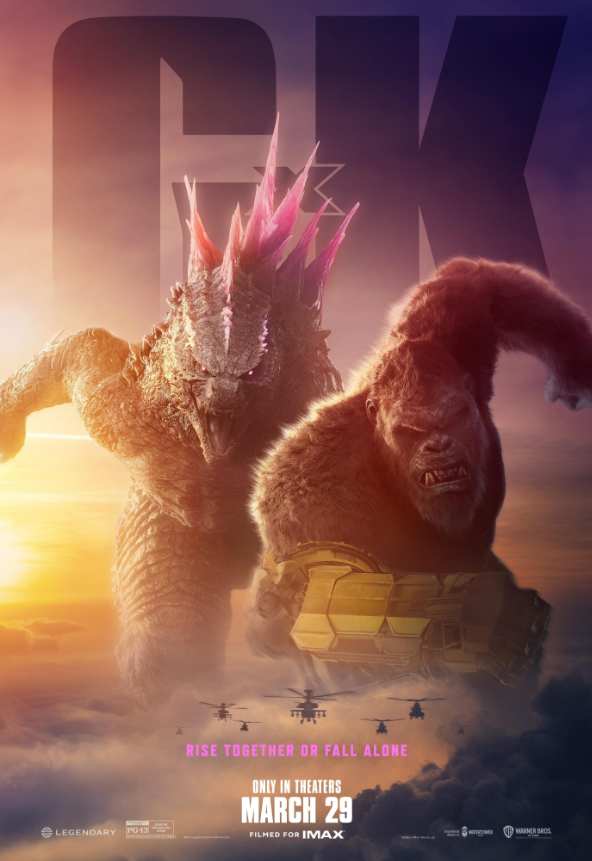
Two ancient titans, Godzilla and Kong, clash in an epic battle as humans unravel their intertwined origins and connection to Skull Island’s mysteries.
We’ve heard of way too many franchises overstaying their welcome lately, but it’s been a while since a film of this scale has failed so spectacularly to answer the question of why it was made. Godzilla vs Kong culminated the MonsterVerse in a battle between two famous characters we’d never seen on-screen before. This is the exact same movie, but without any of what made parts of that movie tolerable. Story, logic, and sense are all but myths in this movie that never quite finds the answer as to what that punch or special offering is that the last film didn’t have. Godzilla and King of the Monsters had massive visual scale, making the human damage and stakes feel wide and consequential, and as a result, the monsters felt huge. Kong: Skull Island had a fun pace and was a visually striking survival action film on an island. But now, the look feels so artificial, the stakes are unclear and boring, and the progression of the story, characters, and locations are exhausting. The visual effects are unconvincing and as a result don’t give you that large, adventurous feel, and the actors feel like they’re wandering through a Warner Bros. studio, struggling to keep this thing together. Rebecca Hall is a great actor to lead a film where the CGI extravaganza comes first, but even her character feels like she has no idea how to make sense of her dialogue. Dan Stevens delivers a fun Crocodile Dundee-esque performance as a Titan veterinarian, and Brian Tyree Henry is the only truly entertaining part of the film as a conspiracy theorist-turned-world-saver after the events of the last film. Not even Godzilla seems able to find himself a place in this film, as his progression throughout the film is probably the lamest thing that can happen to a titular character in a monster movie of this size.
Films like Godzilla x Kong: The New Empire are either made or broken by the visual and cinematic experience, and how they make use of being a grand adventure with enjoyment and spectacle, but what we’re left with is a film with neither of those things. The exposition and plot threads are bland and inconsistent with the franchise, the villains are incredibly underwhelming, and worst of all, it does nothing to differentiate itself from the previous installment. Perhaps bringing back Adam Wingard to direct was the film’s first and greatest mistake, as the stylistic approach of the last film simply wasn’t sufficient for a sequel. What worked when the MonsterVerse began was that these are gigantic events, disaster/monster movies where unbelievable Kaiju rampage the Earth, the stakes and conflicts are to be taken seriously, and the principles of the humans and their relations with the Titans guided the script and the fate of the world. Now, they’re no different than the Transformers movies, where creatures created by computers move across the screen like athletes and are treated like Marvel superheroes with devices and powers, as the structures around them go down like Legos. The worst part about a franchise like this is when it can’t excite; when it’s never been clearer that the best and coolest stuff has already come in past films, and when it’s repeating itself like the only reason it truly has to exist is every blockbuster saga’s greatest curse: studio box office ambitions.
This is a franchise that’s stood the test of time in the world of modern animation, and Jack Black has always been the core of why Po has resonated with audiences for so long — and perhaps the main reason this film manages to entertain at all. Though Kung Fu Panda 4 still has a vibrant and silly energy, it no longer manages to up the ante as each of the past installments did. Though Jack Black is always a huge delight as Po, and possibly one of the best animated franchise leads we’ve ever been graced with, the film often struggles to justify its existence because Po’s journey and growth doesn’t feel as natural and potent as it did in the other films. His struggles to embrace change and pass down the mantle of Dragon Warrior don’t feel fleshed out or as vital to his path. Awkwafina also gives one of her more memorable voice performances and is a great pairing with Black. It’s fun to see Viola Davis as menacing and cunning as she is here, but we don’t spend enough time with the Chameleon to buy her motives and for her to resonate with us. Her characteristics ultimately feel derivative of Lord Shen and Kai from the other movies.
The film embraces the faster pace and editing that worked in the third movie, but the editing decisions sometimes feel even too cartoonish and take you out of the moment. The animation is still lively, but looks a little simplistic compared to the beautifully detailed skies and characters in the last two films. There’s also a side plot that didn’t need as much time as it got, and some inconsistencies with the rules of this world of kung fu that may clash with the rules from the other films. The explanation for the Furious Five’s absence also feels tacked on and too evidently a behind-the-scenes thing. The action and looks are always fun, as is Jack Black being so committed to bringing us all joy and laughs. Is it a fun time in the Valley of Peace? Sure. But it’s clear that the franchise may be out of things to say as it feels we’ve reached the epilogue chapter here.
In the second part of Denis Villeneuve’s adaptation of the classic sci-fi novel, Paul Atreides seeks revenge against the Harkonnens, who slaughtered most of his House Atreides, and liberate the native Fremen of the planet Arrakis while joining them and learning their ways, all while the fate of the Imperium lays in the balance.
The first Dune from 2021 may have been one of the most stunning blockbusters in recent memory, but this extraordinary sequel puts everything in its predecessor — and almost any action movie I’ve ever seen — to shame. Picking up shortly after the first film, the drama is heightened, the world-building is bombastic, and the sound and visual experience is a one-of-a-kind theater trip. Visceral is such an overused term these days that it wouldn’t do Dune: Part Two justice; you feel how wide this universe spreads and the history of the different conflicts and races that inhabit it. And once you’re brought into this fictional world, you’ll never want to leave, as the nearly 3-hour runtime flies by and every plot development is fascinating. Beyond Villeneuve’s imagination, Greig Fraser’s cinematography is the real MVP here. The beauty within the uncertainty of the desert planet is captured in such a scope that it demands in IMAX viewing, and the different planets all contribute a symbolic and gorgeous aesthetic. Timothee Chalamet takes us on the next step of Paul’s journey: his desire to adapt and fight and his fear of allowing power and faith to corrupt him. He proves that he’s always been a movie star that’s here to stay, and Rebecca Ferguson’s Lady Jessica also takes really interesting directions that make you see her role in the story, and of her son’s, in a murkier way. Zendaya also becomes a lot of the heart here as Chani, one of the franchise’s most noble characters, and Josh Brolin is always terrific as Gurney, while Javier Bardem puts his soul into the role of Stilgar, whose faith drives him towards Paul and Jessica. Austin Butler may be the standout, however, as Feyd-Rautha, whose deranged and sadistic presence create a nail-biting character and a powerful young man who has fully embraced his disturbed nature.
Though Dune: Part Two ups the ante with its visuals and performances, its the powerful script and heightened emotional stakes that make this experience what it is. The film explores questions as to how faith and hope can be exploited, and if the urge for power truly corrupts whoever gets a taste of it. Though you may find yourself trying to guess which paths these characters will take, there’s also lots of unexpectedness and the film’s most intense moments took my breath away. You understand so deeply the dynamics of this galaxy and its cultures, and how much lays in the balance. The exhilarating scale and exciting, constantly developing pace only works because of the passion behind each character and story thread: passion to lead, rule, fight, love, honor, avenge, or secure a future. These moral greys form the dark and poetic drama that’s impeccably guided by frame-worthy shots and booming sound. Never have I felt so deeply that I didn’t want a film to end, as once you’re sucked into this marvelous world by Villeneuve, you’ll never want to go home. We’ve rarely seen emotion and grandiose like this in action movies so flawlessly convert to a magnetic cinematic experience. The Empire Strikes Back comparisons are worthy but also a little humbling; this reaches the bar that The Lord of the Rings: The Return of the King set for sci-fi/fantasy epics. It’s a show-stopping galactic saga that unleashes its ambition and magnitude onto you in a way that will entrance and thrill whoever buys a ticket. It’s a spectacle that sets the bar so high for whatever else is to come in blockbuster filmmaking, and like the unreal visuals and scale of Avatar: The Way of Water, needs to be seen on a massive screen, to be transported with other people, and watch a story unfold that you’ll never forget.
In Ethan Coen’s latest road crime comedy, Jamie has just broken up with her girlfriend, while her best friend Marian needs to relax. In search of a fresh start, they embark on an unexpected road trip to Tallahassee. Things quickly go awry when they cross paths with a group of inept criminals.
Leave it to (one of the) Coens to excellently capture yet again this style of crime films that they popularized in the first place — sharp dialogue, exaggerated violence, and crazy mishaps and coincidences that drive the plot forward. Margaret Qualley and Geraldine Viswanathan shine and are wonderful together as two women who want to be young, have fun and score some girls while they’re at it. Viswanathan in particular is terrific as the shier of the duo who’s also the source of some of the film’s funniest moments. Beanie Feldstein is also very funny — as she always is — in a prominent supporting role, not to mention a few A-listers pop their heads in for some great appearances.
Drive-Away Dolls is really carried by its quirky style is purely and unapologetically fun; nothing more, nothing less. But Ethan Coen is such an expert at making films that are fun with this amount of cleverness and delight that it’s no surprise. The two leads’ wise-cracks and chemistry together are so lovely and irresistible that there isn’t a dull moment with them on-screen, though the hypersexualized nature of the film’s plot, especially the second half, may turn some viewers off. The last act does feel very rushed and doesn’t conclude the story between these two women as smoothly as I wish it had; it’s almost like the movie was begging for just another 10 minutes to end things in a more vindicating way. But for Coens fans, this queer buddy comedy isn’t one of their best, but absolutely ridiculous and hilarious with two memorable lead performances and not much else we could wish for from the crazy style and cast.
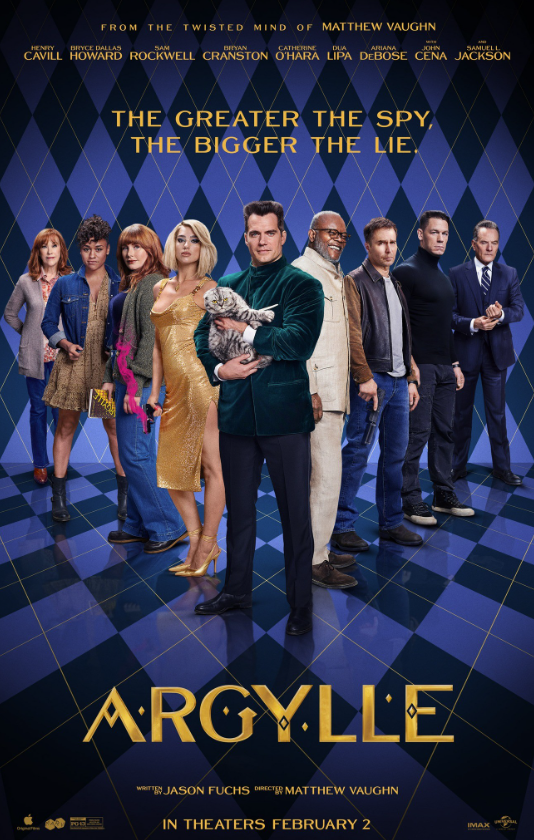
Elly Conway is the reclusive author of the Argylle spy novels . Soon, she realizes the plot of the new book she’s writing starts to mirror real-world events, as a global spy syndicate starts to come after her.
It’s always a blessing when Matthew Vaughn gives us a glimpse into his twisted mind with his witty and bombastic action scenes, and Argylle has a few of those, but it’s everything else that disappoints. Vaughn directs with a love for spy material and cartoonish entertainment mixed with modern, meta flare. The script, however, completely misses the mark and looks the commanding energy that his Kingsman had. Even Sam Rockwell, whose charm and goofiness often comes effortlessly, has to work with dialogue that falls flat and the attempts at humor don’t manage to illicit a response. Though Henry Cavill has some fun and Bryce Dallas Howard tries her best in the leading role, there’s more left to be desired in Ariana DeBose, John Cena, and Samuel L. Jackson’s screentime. Bryan Cranston’s villain may be the weakest link of the cast, as everything he’s given to do is annoyingly generic.
The movie’s downfall is also its ambition, which is often what lifts Vaughn up above the rest. The ludicrous twists are executed in a head-scratching way, and all the film’s rules or explorations of fiction vs reality are thrown to the side for more frustrating decisions that make its lead character less interesting. The pacing also suffers greatly in the film’s second half, the end of which sees us getting a few of those glorious scenes of carnage Vaughn’s known for, which still feel softened compared to what they could’ve been due to the PG-13 rating, but are delightfully exaggerated and have great soundtrack choices. By then, however, the journey to get there is simply exhausting and it may be too little, too late for many viewers.
Argylle is a massive disappointment in which a singular director brings his trademarks to the screen yet again, only this time without the laugh-out-loud glee or the clever script that usually support his vision. Its ambition unfortunately exceeds its grasp, and its inconsistent and convoluted execution make this invitation to take the world a little less seriously with Matthew Vaughn a sadly unrewarding one.
In this musical reimagining of the beloved high school comedy, Cady Heron moves back to the United States from Kenya, where she finds herself a part of the most toxic and destructive high school clique, the Plastics, led by the manipulative and egomaniacal Regina George.
Beloved films being adapted into stage musicals and the musical being in turn adapted into another film is nothing new — we’ve seen it happen with The Producers, Matilda, and most recently, The Color Purple. With the exception of the former, however, the trend still fails to justify the existence of a second film. The energetic songs probably make for a phenomenal stage musical experience in this case, but watching it as a film, it doesn’t have much new to offer if you’ve already seen the 2004 version. Angourie Rice is solid as Cady, and Renee Rapp does an incredible job singing in the role of Regina George, but it doesn’t feel like they do much to escape the shadow of what Lindsay Lohan and Rachel McAdams gave those roles — though that isn’t their fault as actors at all, rather that of the first film’s cultural legacy. Auli’i Cravalho is the film’s most glaring strength and she expands on what the role of Janice has to offer. Every time Cravalho has to sing or deliver a line, she steals the entire film with her charm and talent and she’s the greatest improvement on the original movie. Some songs are more amusing than others, and they’re filmed very well with occasional extended takes, but they aren’t enough to add a whole new layer to the experience, because it still overall feels like watching the exact same movie again. You may feel like the film’s racing through iconic quotes and familiar set pieces that shouldn’t be changed because they worked so well, not to mention almost entirely the same dialogue. That 2004 film already felt really modern and continues to find new audiences that enjoy it today, so despite us having the age of social media to deal with twenty years later, this “even more modern” approach has nothing new to offer, and the themes feel executed in a weaker way here. Tina Fey and Tim Meadows even reprise their roles because so much of what already worked in the previous film comes with an “If it ain’t broke, don’t fix it” disclaimer. If anything, it’ll make you want to seek this musical out on the stage because I’m sure it’s an absolute blast, but the cinematic element doesn’t justify another Mean Girls movie that looks, sounds, and feels so similar, or perhaps it was just too soon for this remake.
Ferrari is legendary director Michael Mann’s latest outing, telling the titular racing driver and entrepreneur’s family life and his entering of his racing team into the 1957 Mille Miglia cup in an attempt to solidify Ferrari as the greatest auto name in Italy — and maybe even the world.
Adam Driver gives a great performance as a figure whose determination for glory and pushing the limits as to what’s possible are front and center — but not necessarily depicted in the most interesting way. His character’s decisions don’t have a lot to say, neither does the story of his relationship with his wife, played by Penelope Cruz; rather it’s the performances that elevate the material. Shailene Woodley is also strong in the film, as is Patrick Dempsey, but again, their characters are more fun to see due to the actors’ work than what they give the film. Like with Ali, Michael Mann seems to be in control of the era he’s depicting through the racing scenes and the production of the scenery. The shots of the cars zooming through the Italian countryside are nice, and everything around Ferrari’s preparation for the race is engaging. However, Ferrari doesn’t have anything as momentous to say as its titular brand and its portrayal of the thrill of the sport of racing by the end of its runtime, which occasionally slows down. The third act is especially noteworthy and there’s a devastating event that hits hard at the end of the film. It’s always a pleasure to see Driver commit himself to a great role, but there’s certainly more resonant racing true stories such as Ford v Ferrari and Rush.