Bullet Train

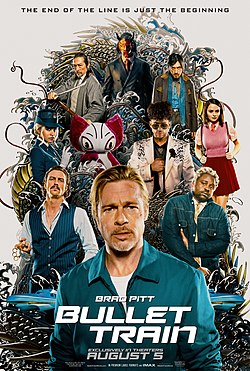
Assassin Ladybug finds himself on a bullet train from Tokyo to Kyoto in order to grab a briefcase of money, but the task reveals itself not so simple as Ladybug discovers he’s not the only assassin on the train looking for the briefcase.

Bullet Train is everything I’ve wanted from an original action movie for a long time — bold, unpredictable, brutal, and irreverent. David Leitch colors the titular train with a lively style and makes the action unhinged and genuinely thrilling. Brad Pitt is no less an action badass than in the days of Fight Club, Troy and Mr. & Mrs. Smith. He gives the character a lot of humor in that he’s an assassin trying to find inner peace and avoid violence — guess how well that works out for him. But it’s hard to call a single character weak or overshadowed by Pitt. Joey King delivers her best ever turn as a deceitful young assassin, and Aaron Taylor-Johnson gives the film some excellent quips. His screen time with Brian Tyree Henry, who’s the film’s highlight, is the most heartfelt aspect of a film in which hitmen are all trying to kill each other. Henry’s talent radiates a special hysterical charm and will make you laugh and smile the most out of all the characters, not to mention he’s one of the most exciting actors these days. Even Bad Bunny, in his acting debut, does a solid job, and Zazie Beetz kills it in a minor role, and in my opinion the most underutilized performer of the film, considering she’s one of the best actresses in the film’s cast. Not to mention a lot of familiar faces that I was surprised were even in the movie, so stay away from the cast list before you see this one.

Bullet Train‘s script feels reminiscent of Guy Ritchie’s most uncompromising films, like Snatch, RocknRolla and The Gentlemen, in which you have to choose your alliances among a cast of criminal characters and anyone could bite the dust. Not to mention the script never takes itself seriously for a second, incorporating flashbacks, a vibrant soundtrack, and unexpected laugh-out-loud humor. The editing is where the film both shines and sometimes falters, as there are a few moments of unnecessarily aggressive cuts during scenes where there’s either action that could’ve used more wide shots, or explanations for events you’ve already seen play out. There’s also an exposition monologue at the end that’s easily the low point of the film and some character placements that don’t flow as smoothly in the third act or have no reason to be there. But in the end, only a filmmaker as bold as Leitch could get away with making something so much fresher than any other $100 million action movie you’ll see on the big screen today that’s not a sequel. Bullet Train has so much going twistiness, vulgarity and blood going for it, yet it’s the cheeky wit, exuberant performances, and relentless style that makes this ride such a welcome one.
The Unbearable Weight of Massive Talent

Nicolas Cage, down on his luck at a creative, financial and personal crossroads, attends a superfan’s birthday party in Spain for $1 million, but must soon become a real life action hero when he finds himself in real danger and conflict.

The Unbearable Weight of Massive Talent is refreshingly meta about the movie industries and its stars — a sort of hybrid between Adaptation and Lethal Weapon. It’s a tribute to the magic of movies and movie stars, and the diversity of Nicolas Cage’s films, including the absurdity of some of his roles and personas, as well as the large fan following he’s retained throughout the years. The movie has some direct references to his various roles, from his Oscar-caliber roles in Leaving Las Vegas and Adaptation to his action blockbuster hits such as Face/Off, The Rock and Con Air, and his more recent indie ventures like Mandy. But they also namedrop Moonstruck, National Treasure, Gone in 60 Seconds, and even The Croods: A New Age, I mean what more could you ask for in a movie about Nic Cage? Within all of this, it’s both a meta commentary to the kinds of scripts and films audiences like — as Cage has been in some of every type — and a laugh-out-loud buddy comedy between Cage and the wonderful Pedro Pascal. Though Cage embraces and pokes fun at himself as, well, himself, Pascal plays Cage’s biggest fan and new best friend who may or may not be a dangerous arms dealer. Pascal’s line delivery, exaggeration and lovability makes him an undeniable delight to watch. So it has something for people looking for an intricate script about scripts, a tribute to an iconic actor, and an action-packed laugh-out-loud comedy. Not to mention there’s some heart involved as the movie tries to parody the idea of a “mature movie about people and relationships” while genuinely getting you interested in the main two friends.

Though it helps to have watched some of Cage’s most iconic movies (on a personal note, my favorites of his are Face/Off, Adaptation and Raising Arizona), it’s also on the stronger end of crowd-pleasing action comedies and has a little something for everyone, definitely living up to the Massive Talent part of its title.

The Lost City

A reclusive romance novelist on a book tour with her cover model gets swept up in a kidnapping attempt that lands them both in a cutthroat jungle adventure.

Sandra Bullock and Channing Tatum make a fun pair in this romantic action-adventure comedy that had me laughing out loud. The leads have great chemistry and they both get to exercise their comedic skills to this wide-appealing genre film. Da’Vine Joy Randolph also steals the show as Bullock’s best friend and Brad Pitt makes an outstandingly thrilling appearance. Though the story is very similar to other recent films like Jungle Cruise and Uncharted, the silly, almost self-aware touch is what makes it a delightful, harmless time. It’s easy to tell where the ride is going, but it’s also very tempting to go along with the ride due to Bullock and Tatum’s chemistry, enough to go to the theater and enjoy with others.

Turning Red

Mei Lee is a 13-year-old girl who is torn between being her mother’s obedient daughter and the chaos of her youth. As if that were not enough, when she gets too excited, she turns into a big red panda.

Turning Red has some surprisingly mature undertones but manages to be witty and charming in its execution just enough to please youngsters, as all Pixar’s films find the balance to do. Director Domee Shi gives the film imaginative visuals and unique use of culture for an animated film. Rosalie Chiang shies in her first ever voice performance as Mei, and Sandra Oh proves herself a fantastic voice actress as her mother Ming, who embodies the mother who expects big things of her daughter but forgets to let her live a life of her own, which may be exactly what her character did in another Disney movie, Raya and the Last Dragon. The movie portrays youth in a lively way that involves the frights of adolescence, and the journeys of growing up with your friends and being obsessed with boy bands with them, for some. This leads to a lot of charm from the youthful side of the film, as well some some wit in the execution and the way the music ties into the film’s mood. Ludwig Goransson of Black Panther, Creed and Tenet fame again proves himself one of the most exciting film composers, and Billie Eilish and Finneas contribute to the lyrics of the fictional boy band 4*Town’s songs. This coming-of-age fantasy comedy doesn’t rank among Pixar’s stronger works but it proves that they’re still at the top of their game with new ways to bring sweet, relatable themes to the screen, in this case about loving your family while staying true to yourself, and embracing your flaws whether that be anxiety or rebelliousness.

Licorice Pizza

The story of Alana Kane and Gary Valentine growing up, running around and going through the treacherous navigation of first love in the San Fernando Valley in 1973.

Licorice Pizza is no less than a Paul Thomas Anderson movie — stylized, larger-than-life, and a beautiful anomaly. Like Boogie Nights and Magnolia, things happen to the characters that often go unexplained but its the way the characters react that defines the story. PTA makes movies that are defined by characters who feel larger-than-life but have a human core, though one may not always understand them on the surface. Alana Haim steals the show in her very first movie role, portraying a young woman trying to find herself only to find that she may not be alone in that. To make things even cooler, her family plays themselves in the film! Cooper Hoffman is also great as an incredibly confident teen actor who looks forward to achieving his destiny someday. The crazy situations that happen may not always add up to much sense but they offer revealing moments about the film’s spirit and character. With that comes a layer of irreverence and craziness with how bold and out there this film gets — like a famous actor trying to his favorite scenes from his movies, or another Hollywood star having a big meltdown — but it’s all PTA’s complex way of conveying his themes and the messy beauty of the human condition. The free-spirited nature is amplified by the vivid direction, including great production value and soundtrack to immerse you into the Valley in the 70s. Like many of PTA’s other films, the movie doesn’t quite fit the mold of one genre — it’s part coming-of-age story, part outrageous comedy, part political drama, part Hollywood-based epic. The movie does slow down in the second half but ends on a strong beat. The movie is a picture of youth, the parts we play to fit into the world, and the bonds that not everyone may understand. It’s a great watch, but it’s best to be familiar with the director’s style and filmography to know what you’re in for.

LicoricePizzaPoster.jpeg

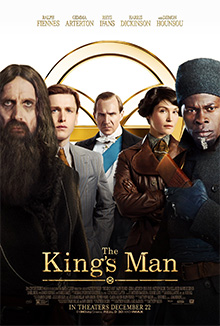
The King’s Man

In the prequel to the Kingsman film series, Orlando Oxford (Ralph Fiennes) forms the Kingsman agency during World War I to stop a huge conspiracy to wipe out millions.

In this large, historically-based prequel, Matthew Vaughn’s unique eye for action and wit remain sharp but he ditches the parodical energy of the last two films for a tonal mess of a WWI action film that takes itself too seriously. Obviously, war is not a joke but the movie already makes fun of the figures behind WWI with its caricatures of Rasputin, Kaiser Wilhelm, King George and Tsar Nicholas (the latter three all being played by the same actor, to make things sillier). So with this Inglorious Basterds-like irreverence the movie plays around with, why not make the entire movie a comedy like the last two movies? The script tries way too hard to teach a somber lesson about violence, but the problem is the movie thrives on the over-the-top carnage seen on screen. The movie is a tonal mess, with the film trying to be both a cartoonish spy comedy and attempting to deconstruct war and lessons around what violence is, as well as having serious, intense scenes on the Western Front that feel like something out of a completely different movie. To make matters worse, the characters all feel flat and the supporting roles, like those of Gemma Arteron and Djimon Honsou, have no agency of their own. Ralph Fiennes is the only actor who gets a fully realized character and he can obviously do no wrong as a performer.

The action and music shine here — as soon as the action begins, the energy kicks in, with thrilling choreography, score (the Kingsman theme that recurs throughout the franchise can never get old), and set pieces. The action and humor play off each other well in these sequences, and Vaughn is an expert at crafting action scenes that grab your attention but are still unapologetically witty and crazy. If I were ever to watch this movie again, though, I would skip all the boring drama and go straight to the awesome action scenes. Instead of embracing the wild and sharp fun the action brings the film, it’s brought done by serious attempts to be a WWI drama, Unfortunately, in the more serious scenes, it feels detached from its audience, and creates a tonally confused movie that can’t decide what it wants to be. The original Kingsman film spoofed James Bond-like spy films while being a terrific example of one. This one missed an opportunity to lean completely into satirizing the politics of war while having an actually fun and wondrous action adventure, but it lacks the unapologetic confidence, energy, adventurousness and irreverence of the last two.

The King's Man.jpg

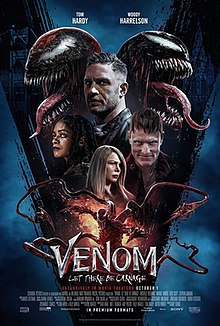
Venom: Let There Be Carnage

Eddie Brock (Tom Hardy) is still learning how to live as a host to alien symbiote Venom, but a visit to an obsessed imprisoned serial killer leads to another symbiote on the loose that the duo must face.

The first Venom movie has a mixed reputation — it’s hated by critics thought it was a box office success and fans enjoyed the relationship between Eddie and Venom. The sequel understands what some fans enjoyed about the first film and leans even more into the silliness of that dynamic. Unfortunately, it carries with it everything that made the first film one of the worst superhero movies in recent years. The dialogue is horrendous — there are a few good jokes here and there but every time every time a plot point needs explaining or the villains open their mouth, you can’t take it seriously at all. And every time the symbiote Venom opens his mouth, his lines are incredibly bland and annoying. For a cast led by four Oscar nominees, nobody does a remotely memorable job, though Hardy looks like he’s enjoying himself more this time. Woody Harrelson as Cletus Kasady could’ve been a darkly hysterical psychopath of a killer, but instead he feels like his character’s twin brother in Now You See Me 2, meaning his performance is truly unbearable. Naomie Harris is also at her worst as Shriek, Kasady’s girlfriend from his teen years who he hasn’t seen in decades but they’re still madly in love. Even the humor often dives from funny into purely cringeworthy territory as the jokes don’t feel more thought out, just Tom Hardy goofing around with 2 different voices.

The action and editing are a mess, with nonstop cuts and dark lighting that prevents you from truly grasping onto the set pieces without laughing at everything that’s going on. The CGI also doesn’t feel so smooth though the design of Carnage is great — the character itself, though, is poorly utilized and we barely get to see him fight Venom or understand what makes him a unique symbiote and fan favorite comic-book villain. There’s no reason viewers would remember him or why he’d strike fear into the audience’s heads like he does with the characters in the film — he’s just a bad symbiote like Riot in the first movie. Considering director Andy Serkis has created some of the most interesting CGI characters of all time, it makes no sense for him to create something as haphazard and painful as this. In terms of conflict, there’s no interesting build of stakes or threat, and in terms of internal conflict for our hero, it’s literally just “Eddie and Venom have to fight less and get along more and Venom needs to eat bad guys but not good guys”.

Visually, script-wise, and tonally, Venom: Let There Be Carnage doesn’t have itself figured out, just like the bro-mance at the center of the film. Though the post-credits scene is worth staying for, the movie as a whole proves why these films can’t latch onto viewers as well as a symbiote like Venom latches onto its host Eddie.

Venom Let There Be Carnage poster.jpg

Free Guy

Guy, a background character in a videogame called Free City, learns the truth about his existence and must race against time to save his world and reclaim his free will.

It seems that with Free Guy, Ryan Reynolds has finally found a movie that lives up to his comedic skills outside of the Deadpool franchise. Reynolds makes the movie infinitely better with his exaggerated reactions, unpredictable and irreverent self-awareness and pop culture analogies, as well as a sense of purity to his character that isn’t seen in his raunchier, more morally ambiguous portrayal of Deadpool. Meanwhile, this movie has a PG-13 rating yet this movie finds its audience and the humor lands most of the time. He has plenty of charisma and humor that carries the story and action but also not overkill where it compromises his character development. Jodie Comer is also wonderful as a female badass who isn’t a traditional “female sidekick and love interest to the male lead”, yet she’s actually the protagonist of the story as much as Reynolds in the best way. Joe Keery also has much time to shine, he’s very famous as Steve in Stranger Things, and just as lovable here. Lil Rel Howery is excellent comedic relief and best friend material everywhere he appears, and Taika Waititi takes a role that in the script would’ve looked incredibly cheesy and hard to stand, and with his delivery, makes the part an irresistible, hilarious part that was perfect for him. I had the same feeling with Reynolds, the role would’ve been much worse with another A-list funny action star.

Reynolds producing and starring gives the movie the perfect opportunity to be meta and let loose on pop culture references and self-aware jokes. Unlike Space Jam: A New Legacy, however, it never descends into immaturity and nonsense, instead embracing its stars talents instead of overly relying on effects. It also takes time to comment on the violent nature of Grand Theft Auto and similar videogames, as well as our obsession with hyperreality and simulated reality like Ready Player One did. The movie’s heartfelt side also asks us to use our humanity for empathy and connecting with other humans more. Believe me, it sounds cheesy but it’s delivered with plenty of heart, as well as themes about free will, the potential of AI, and being more than what people expect of you. The depiction of the world inside the videogame is colorful and lively and feels like a great live-action companion to Wreck-It Ralph, making you think about what such a world would be like in live-action, striking the perfect balance between letting the audience indulge in the silliness but always retaining heart and fun. The movie sometimes hits similar beats to other mainstream other action comedies, and you may be reminded of elements of similar films but it never lets the familiarity get the best of it. Free Guy flourishes when utilizing the loose, free-spirited edge to the humor, story, and characters, including hilarious editing and some unforgettable cameos that had my audience hysterical in the theater and are too brilliant to spoil. While it’s not a must-watch, it’s a great theater experience that makes the best of its potential and talents. It’s especially great to watch Ryan Reynolds and crew have a clearly awesome time starring in and making this entertaining movie that put a smile on my face and never sacrifices the insane visuals for a good story and time that like Deadpool, knows it’s very out there but is always on the audience’s side and never gets too cheesy for its own good.

Free Guy 2021 Poster.jpg

The Suicide Squad

Supervillains Harley Quinn, Bloodsport, Peacemaker and many other of the most notorious villains from the DC Universe are recruited by Amanda Waller to join a mission to liberate the South American island of Corto Maltese from a murderous regime that’s conducting shady experiments. In, exchange the villains get 10 years off their prison sentences if they successfully complete the mission, but if they fail, they’re dead.

DC’s ambitious 2016 endeavor Suicide Squad was a massive failure and disappointment that’s easily at the bottom of the DC Extended Universe ranking when discussing quality. This new sequel, written and directed by James Gunn, the man behind the Guardians of the Galaxy films, is without a doubt at the top of that ranking. The Suicide Squad does its brilliant concept justice this time, throwing away everything that didn’t work about the original and acting as a hilarious, goofy, energetic action-packed wonder that stands beautifully on its own. While the first film aimed to be goofy and comedic, it still had this dark, gritty edge to it which it struggled to balance with a PG-13 rating and fantastical, world-ending conflicts. This movie is colorful and indulges in the goofiness without ever taking itself seriously, yet the characters and story hit home further. The action set pieces are memorable and the R rating helps this movie fully realize its potential with balls-to-the-wall, cartoonish violence that fits with the twisted nature of the characters while still injecting humor and fun through the R rated violence and jokes. The movie also diverges from many superhero movie tropes by focusing less on the huge fantastical concepts and letting you know that nobody is safe.

The characters in this film are even sillier than in the first movie, and some even viler, but the movie makes them incredibly fun and lively to watch, even when there’s carnage to behold. There’s no way you can get enough of Margot Robbie as Harley Quinn — she adds so much to the movie and both this and Birds of Prey have made the style as insane as her, to make her this psychotic yet somehow lovable and exciting protagonist in the most awesome way. However, the other cast members’ work rival hers here. Idris Elba can do no wrong as Bloodsport and he has some great banter with John Cena’s Peacemaker — they’re both very foul people but have some of the best moments of the movie. Joel Kinnaman also has some memorable moments this time as Rick Flag, and Viola Davis plays the menacing Amanda Waller who is trying to make the Suicide Squad do some good but may be more hatable than all the actual criminals in the film — which is a testament to Davis’ terrific casting and presence. A standout has to be Ratcatcher 2, played by Daniela Melchior who gives the movie lots of heart and empathy. Like I said before, the movie continuously embraces the ridiculousness it presents without trying to put a “sane” lens onto it, as shown with wild concepts like characters named Polka-Dot Man and King Shark (a talking shark voiced by Sylvester Stallone). James Gunn’s direction adds a twisted comedy yet so much care for the story and the people in it while not trying to contribute to the bigger DC universe with forced sequel setups which we’ve seen plenty of lately. From the eye-popping action set pieces to the daring style to the standalone nature of the story, it stands out not just as a great comic book movie but as a great movie, period.

The Suicide Squad shows what the DC universe can do when it gives filmmakers full creative freedom and don’t take themselves too seriously. Even with other R-rated superhero comedies like Deadpool around, The Suicide Squad feels really fresh and with the success of Joker and the entertaining Birds of Prey, DC has been figuring out how to make some gems that stand well on their own while differentiating themselves from Marvel and other superhero iterations.

The Suicide Squad official poster.jpeg

Cruella

Cruella dives into the origins of the infamous 101 Dalmatians antagonist. Emma Stone is seriously great as the lead and another reason to praise the actress as well as the seemingly impeccable casting directors at Disney. Her performance is charming, unpredictable, and twisted. Though she is notoriously an insane criminal and dog-killer, she is likable in comparison to the other big Emma of the film. Emma Thompson plays a ruthless, egomaniacal fashion designer whose absolutely repulsive without a single redeeming quality. Her repugnance reminded me of Meryl Streep’s Miranda Priestly in The Devil Wears Prada, another evil, sadistic, fashion designer. Thompson portrays this narcissism and wickedness well, and the movie does a mostly good job, aside from a few lines, keeping her out of cartoonish territory. The relationship between the Emmas onscreen is easily a gripping anchor for the film’s story. Two other standouts are Cruella’s loyal surrogate brothers and sidekicks, played by Joel Fry and Paul Walter Hauser. My favorite was especially Hauser, who is much more comedic (and British) than his other popular turns in films like I, Tonya, Richard Jewell and Da 5 Bloods, and nails every moment he’s on screen. As a fan of his, I was especially glad to see him be in a film with a wide audience like a Disney film.

Cruella‘s script manages to, for most of the runtime, distance itself from the famous story it’s inspired by, despite a few nods and a shoehorned post-credits scene thrown in for the Disney hardcore fans. It feels very much like a Craig Gillespie movie — like his previous film I, Tonya, it’s a fast-paced chronicle of a morally ambiguous woman’s journey into such obscurity. However, it’s the hyper-stylistic approach that’s most detrimental to the film. The soundtrack is a nonstop barrage of rock music with no room for silence or drama, with one popular rock song after the other, and the music choices being frankly on the nose and unoriginal (seriously, why do so many films use “Sympathy for the Devil” by The Rolling Stones?). Had the style kept some of this energy but toned it down to make scenes feel less fluffy and more dramatic for its villain, the movie would’ve resonated more. With such gorgeous production design and costumes that made me awe (and trust me, I don’t always notice beauty in costume design like I did in this film), as well as solid acting and writing, why didn’t Disney trust its audiences to stay engaged from these elements instead of throwing in popular music every second? There’s also a little too much narration for my taste, and you can tell this took inspiration from Scorsese’s hyper-style he trademarked with Goodfellas and The Wolf of Wall Street — a style at least one big movie a year feels the urge to adapt. The movie’s script is best when it follows the psychotic nature of Cruella and her descent into darkness, which Stone wonderfully portrays and is the most intriguing part of the film. It’s also enjoyable to point out the similarities between Cruella and other popular solo movie villains like Joker and Harley Quinn (who headlined the considerably entertaining Birds of Prey), I only wish this movie embraced what worked so much about those two aforementioned films’ approach to their villains. And that’s not saying they should have gotten rid of the energy and fast pace — which does work once Estella becomes Cruella — just give the darker, more unpredictable moments of Stone’s performance room to breathe rather than be edited like a fun heist sequence from an Ocean’s Eleven movie. There’s also a few iffy moments of CGI, including the dogs and a scene involving water, that made me cringe. Cruella is entertaining, fashionable, and has fun with its concept, but feels boxed in by a soundtrack poorly edited into the film that weakens the impact of certain scenes and connections to the original IP that feel thrown in just to check boxes on a studio checklist. Those who are interested will enjoy it, as it’s certainly a good time that’s carried well by its cast, especially the insanity conveyed by Stone, but I feel like there was potential for a stronger film in the editing room.

Cruella 2021 film poster.jpg