Nora and Hae Sung, two deeply connected childhood friends, are wrested apart after Nora’s family emigrates from South Korea. Twenty years later, they are reunited for one fateful week as they confront notions of love and destiny.
Though stories about “what if” romances are not alien for audiences, director Celine Song introduces herself to the mainstream with a magnificent film that’s beautifully told through her gentle eye and script. The style is filled with meditative melancholy, exploring the beauty of fate and what does and doesn’t come out of it, and that happiness and destiny can also mean loss and regret — this is heavily indicated through Greta Lee, who’s lovely performance inhabits lots of emotions but with great restraint in her profoundly kind and poignant expression of the character. Teo Yoo is also excellent as Hae Sung, and John Magaro is delightful as Nora’s husband who deals with this interesting situation for him with patience, understanding, and goodness.
The beautiful wide shots that linger on the characters express the energy they feel within the space they inhabit, and the calming score is simply unforgettable. Within moments of the film, the simplistic yet intimate style pulls you into the love, pain, and reflection these characters experience. It’s one of the most enchanting, touching movies about love and connection I’ve ever seen, deserving a mention in the same breath as Her and Before Sunrise. Yet this one may not just make you reflect on romance, but about those special people in your life who may come in and out but change your life forever. It’s one of those films that digs to the deepest points of your heart and never leaves and may leave you as filled up as heartbroken, and may end up being a defining film for 2023.
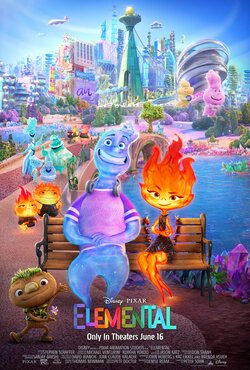
Set in Element City, a world inhabited by anthropomorphic elements of nature, Elemental follows fire element Ember Lumen (Leah Lewis) and water element Wade Ripple (Mamoudou Athie), who meet and fall in love after Wade is summoned by a plumbing accident at a convenience store owned by Ember’s father Bernie.
Elemental gives us Pixar’s most purely romantic film yet — director Peter Sohn claims it to be inspired by films like Guess Who’s Coming to Dinner, Moonstruck and Amelie, and that’s definitely felt, as the main focus of the film is a charming and somewhat star-crossed romance — and with the heavy expectations of a dramatic immigrant family just like Moonstruck. Leah Lewis gives an expert voice performance as Ember, while Mamoudou Athie is simply stellar as Wade, channeling Jack McBrayer’s Fix-It Felix from Wreck-It Ralph as the overly sentimental yet empathetic “water guy”. His voice gives range and heart and you can feel all the fun he must have been having recording his lines.
Though the movie gives some truthful, maybe even relatable, allegories about immigration and living as a minority, it’s as heartfelt as it is on-the-nose and cliché. Ember’s arc greatly resembles that of Mei from Pixar’s Turning Red which came out last year, and that film gave us a deeper look into such similar themes. The movie works best when focusing solely on the romantic connection between the leads, which ends up making for some great filmmaking moments and a sweet connection between the characters and the audience. The design of Element City is also very visually rich. Still, the movie sometimes forces itself back to generic lines and tropes that we’ve seen in many films before, and there’s also a story about the city’s infrastructure and fixing a water leak that felt like it was just checking the box of having a conflict because it’s a kid’s movie, and wasn’t actually necessary to the plot. Elemental is on the lower end of Pixar’s quality, but still has its contagious heart and some strong direction behind an underwhelmingly predictable structure and story arc.
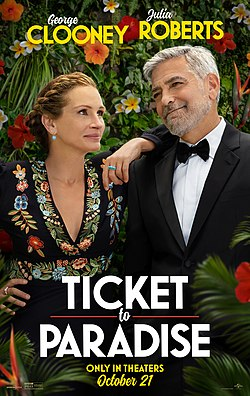
Two divorced parents, David and Georgia Cotton, travel to Bali after learning that their daughter, Lily, is planning to marry a man named Gede, whom she has just met. They decide to work together to sabotage the wedding to prevent Lily from making the same mistake they made twenty-five years ago.
Ticket to Paradise is a welcome reunion for two legendary stars, George Clooney and Julia Roberts, years after they worked on the Ocean’s films, Confessions of a Dangerous Mind, and Money Monster together. They elevate a film that occasionally threatens to fall into generic territory by breathing fun and charm into the film, even when they’re ripping each other to bits with insults. Clooney’s performance is certainly the glue here, as he embraces his comedic chops and his character often pokes fun at himself while being grumpy and over-the-top. Speaking of reunions, fans of Booksmart will love to see Kaitlyn Dever and Billie Lourd sharing the screen again — Dever is great as their daughter Lily, and Billie Lourd is a scene-stealer as her best friend Wren, a character that the plot maybe could’ve done without but when Lourd is so entertaining, the movie suddenly feels infinitely more upbeat with her in it.
The movie can sometimes fall into cheesy territory especially with some obviously scripted lines and an exaggerated ending, as well as some unclear themes about who is more right about what, but it never sinks the film’s heart and sweetness. It’s a film that means to charm and show the nature of flawed parents getting over their own immaturities while loving their daughter, and when the parents are played by two of the most charismatic people in the world, you’ve got yourself a winning film. Though it’s nothing you’ll be urged to watch more than once, or even the best comedy out right now, given how much more memorable and hysterical Bros is, Ticket to Paradise is certainly a harmless and heartfelt good time, especially for today’s rom-com standards, with laughs, vacation-y settings, and charming performances.
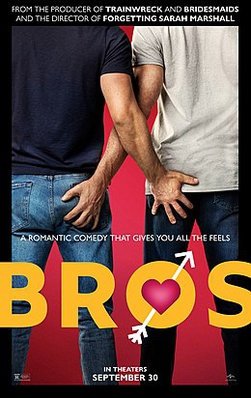
Bobby Lieber (Billy Eichner), a podcast host and museum curator creating the world’s first LGBTQ museum, attempts a relationship with lawyer Aaron — but they must overcome their commitment problems first.
Not only is it celebratory for a major studio to release a gay rom-com, but it’s a breath of fresh air to see a movie about the LGBTQ community that isn’t gloomy or traumatizing but rather entertaining and optimistic. Through through the museum Lieber is creating, the movie is very much about embracing the queer community and undoing the centuries of history that’s been erased. Though Bros rejects the idea that gay and straight relationships are exactly the same by having its lead character claim that “Love is not love!”, as gay male relationships have their own nuances and issues, the romance will be gripping for all audience. But just as important as its representation is the fact that it’s fun, uplifting and hysterical.
Billy Eichner is a fantastic leading man who’s loving yet stubborn nature comes off as warm as it does occasionally frustrating to see him stumble and figure out his way. Eichner, who also co-wrote the movie with director Nicholas Stoller, gives even the side characters their place to shine and make the audience laugh. There’s some incredibly funny moments that will stick with you and come to mind whenever you think of this movie, and lines that are too good to spoil but are worth the laughs in a theater with an audience. Luke Macfarlane is also a breakout star and is endearing as the more “macho” gay man as opposed to Eichner’s “flamboyant”-labeled character, but as the movie mentions, the queer community is not a monolith and the film embraces lesbian, gay. bisexual, and trans characters, including those of color, in its supporting cast. Though the plot occasionally lacks direction, and it may be a few minutes too long, it’s the dialogue and humor that keeps the audience engaged, and the romance that more than gets the audience to root for the leads that grounds the whole film.
As a comedy, Bros will give you stomach-inducing laughs, and as a romance, it’s more than sweet. It’s the positive celebration of diversity that audiences, both queer and straight, will feel uplifted by, and enjoy the sweetness, silliness, and raunchiness the film has to offer.
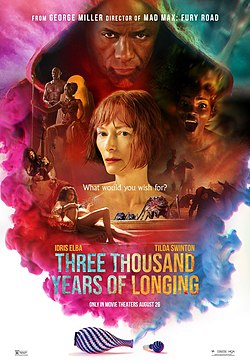
A lonely scholar, on a trip to Istanbul, discovers a Djinn who offers her three wishes in exchange for his freedom.
George Miller’s first film since Mad Max: Fury Road allows him to let loose as expected, but doesn’t feel as rewarding as it could have. Tilda Swinton shines in a more fun, likable role than some of her more “chameleon”-like performances, and Idris Elba is great as a Djinn tasked with most of the film’s dialogue and monologues. The production design is also very noteworthy as is the score by Tom Holkenberg, easily his best music for a film since Fury Road. However, the CGI doesn’t look as grand or convincing as it attempts to be and could’ve used some more work.
Though Swinton and Elba’s conversations about how all the ways wishes could go wrong are interesting, the stories Elba tells about his past don’t feel as powerful or intricate as the film wants you to believe. The third act feels an abrupt turn of events and certainly drags, in a way feeling anticlimactic. Upon digging, Miller has a lot of interesting things to say, whether it be about longing, imagination, or love, but he doesn’t explore them deeply enough to deliver that unexpected blow of catharsis and fulfillment that the ending wants you to experience. Perhaps this is one film that constitutes a rewatch, but only certain parts feel inviting to revisit, while others, I feel I’d simply skip over if I ever saw this film again. It’s certainly bold and like nothing that’s come out this year, and its ambition is worth commending, but for most, this isn’t worth rushing to theaters to watch.
A reclusive romance novelist on a book tour with her cover model gets swept up in a kidnapping attempt that lands them both in a cutthroat jungle adventure.
Sandra Bullock and Channing Tatum make a fun pair in this romantic action-adventure comedy that had me laughing out loud. The leads have great chemistry and they both get to exercise their comedic skills to this wide-appealing genre film. Da’Vine Joy Randolph also steals the show as Bullock’s best friend and Brad Pitt makes an outstandingly thrilling appearance. Though the story is very similar to other recent films like Jungle Cruise and Uncharted, the silly, almost self-aware touch is what makes it a delightful, harmless time. It’s easy to tell where the ride is going, but it’s also very tempting to go along with the ride due to Bullock and Tatum’s chemistry, enough to go to the theater and enjoy with others.
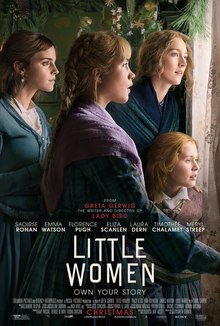
This re-imagining of the classic tale tells the story of the March sisters – four young women each determined to live life on their own terms. This story has been adapted plenty before, but be careful before you can pass on it just for that. Greta Gerwig, who made her transition to the director’s chair with the universally beloved Lady Bird, once again proves her directing skills and breathes energy and light into the screen. The gorgeous production value always stands out, as the costumes and sets are colorful, but the cinematography enhances the beauty to the eye, and this visual appeal combined with Alexandre Desplat’s ambient score makes for an engaging theater experience. However, what truly makes this film resonate is its cast of characters, played by A-list names including some who have worked with Gerwig in the past. Saoirse Ronan, beautifully embodying the soul that is Jo March in every moment on the screen, graps the film and the audiences in her hands with a charming, humane, and poignant performance, rivaling her terrific turn in Gerwig’s previous film, as well as being deserving of awards buzz. The camera beautifully captures every expression of hers and it’s hard not to fall in love with Jo’s ambition, playfulness, and spirit. But she’s not the only performer who steals the screen. It really has been the year of Florence Pugh — this his her third role in 2019 in which she’s really shone as a leading part, and although it’s not as excellent as her gut-punching role in Midsommar, her performance as Amy packs plenty of dimension and ferocity, and every instance with her on screen belongs to her. Amy is sweet and vengeful, tough and vulnerable, and realistically human above all — often she longs to be independent yet sometimes her emotions get in the way of that. Laura Dern also stands out as Marmee, the selfless and loving mother of the girls, in a touching and later heartbreaking performance that’s even more hard-hitting than her much-talked about Marriage Story role. Marmee continuously displays endurance through hardships and role model-like behavior to her daughters on how to behave towards others and themselves. A few actors, like Emma Watson and Timothee Chalamet, just feel like themselves for the majority, but Chalamet has an excellent scene in the latter half of the film in which he really impresses. Meryl Streep also makes the best of her appearance as a judgmental and scene-stealing Aunt March, and Chris Cooper also shows up as a more likable and lighthearted character than his typical role.
Little Women packs a strong punch with its actors and its glamorous prestige, but occasionally loses itself along the journey. This is due to the fact that the movie has many themes going for it, but a few important ones feel too underutilized and weren’t focused on enough. The movie is about female independence (expectations of women vs. their own desires), “owning your story” — literally so in the case of Jo wanting to publish her book yet continuously being asked to make changes to the female character’s journey (making the plot feel very meta in that way), and sisterhood and familial love. Regrettably, these themes didn’t really get the strong focus they deserve, instead only addresses in throwaway lines that are powerfully acted but sometimes out of place in the context of a scene. There’s even a few plot instances that contradict the moving messages the film may have been trying to say — most notably, I found the film in its core to actually be about life and the flow of time, as the movie depicts its protagonists growing up into “little women” (hence the title), and adjusting to change, including travel, passion, and heartbreak. So how ironic that even the center force of the script gets undercut by Gerwig’s choice to tell the story in non-linear fashion, and ultimately the jumps in time feel unnecessary and take away from what could’ve been a beautiful Boyhood-like “lifelike flow” to the runtime. This is why, in the first act of the film, a couple of moments just feel like a compilation of sequences rather than one overarching premise. Thankfully, the second half is especially emotional and memorable in the delivery of its messages and dialogue, but often it feels like the actors and director empowering the script which would’ve felt unpolished on its own.
Little Women would’ve been even more fantastic if not for its nonlinear narrative and a few script choices that feel rushed or untrue to the bigger picture, yet still resonates because of the characters, who so magically embody the hearts of what feel like real people, so sensibly livened by the ensemble cast. The visual appeal’s only there to accompany this already vigorous premise, proving that some stories may really be timeless, even though the runtime drags in the beginning and a few major themes are muddled by a few decisions Gerwig makes. Still though, if this is where Gerwig is after only two directorial works, then I solemnly request that she never stop making films.
The Shape of Water is the latest other-worldly story written and directed by Guillermo del Toro, set against the backdrop of Cold War era America circa 1962, where a mute janitor working at a lab falls in love with an amphibious man being held captive there and devises a plan to help him escape. Guillermo del Toro has recieved acclaim throughout his career for being a visionary director and writer, and his ability to bring fantasy stories like this one with as little CGI as possible is incredible. He’s finally getting Oscar buzz for The Shape of Water, his latest film that, while the concept of a character bonding with a creature of some sort and trying to save it from those attempting to kill it having been depicted in many films such as E.T., How to Train Your Dragon, and Beauty and the Beast, this one is far different in execution — and definitely not a film for kids. There is strong sexual content and violence, but it fits the overall tone and themes the movie is meant to deliver. Sally Hawkins is absolutely fantastic in the leading role of Eliza, and she delivers one of the greatest performance of the year — and her character has absolutely no dialogue! She is able to deliver an emotional performance with only her expressions, and she makes us care for her character deeply without having to speak a word. Another excellent performance is from Michael Shannon, who plays the main antagonist who is filled with rage and hate against the creature and anyone who gets in his way of hurting it. Octavia Spencer, who plays Eliza’s best friend at work, has some great moments of both humor and emotion, and Richard Jenkins and Michael Stuhlbarg are very good too. Not to mention Doug Jones, who plays the creature himself, with lots of costumes and makeup and no CGI for his transformation, which helps his performance feel more realistic and interactive with the other actors in the film.
Guillermo del Toro has stated that this is the movie he is most proud of, and it’s not hard to see why. He such a great eye for these stories and has a creative way of telling them, not just with his style but also with his writing. First of all, his directing of the film is marvelous, with some beautiful ways of capturing certain images and everything looks so artistic throughout the film. The production design and colors also stand out, and del Toro constantly references classic cinema throughout, there’s even a scene where Hawkins imagines herself dancing with the creature in a ’50s-style musical number. The music from Alexandre Desplat is also very nice to hear and it’s one of his best scores in recent years. Not only does the film look majestic, but the writing is very good because although the concept isn’t the most original, the themes and turns the plot takes are unexpected and different. Guillermo del Toro writes and creates this story like a fairy tale, like he does most of his stories, and though it’s not a literal fairy tale, he treats every character importantly and brings this story to life as if it’s a Pan’s Labyrinth-esque fantasy tale. The themes aren’t mostly about being kind to those who are different, about about those who feel lonely and incomplete, and how we try to fulfill ourselves. There is a lot of gore and nudity in the film, which may disturb some, so just a warning to those who don’t like explicit content. The overall plot may feel weird if you think watching a romance between a woman and a creature will disturb you, but the writing feels complex and the story is thrilling and powerful, bringing the story to life on the big screen very effectively. Although some of the scenes without Hawkins on screen felt less intriguing than the scenes with Hawkins as Eliza and Jones as the creature, and the ending, while not bad at all, felt a little bit like a missed opportunity, this joins Pan’s Labyrinth as one of del Toro’s best films, and the awards buzz for this one is quite well deserved, so I recommend you check this one out in theaters before the awards come around.
The Big Sick is the true story of actor and comedian Kumail Nanjiani, playing himself in the main role. He wrote the film with his wife Emily V. Gordon (played by Zoe Kazan in the film), and this tells the story of their relationship and how it was complicated by Emily’s sickness, as well as Kumail’s Pakistani culture.
Neither comedy nor romance are up there on the list of my favorite genres, although I’m not saying I don’t like those genres, because I really do. However, most films in those genres nowadays tend to feel recycled and often the same. However, movies like The Big Sick that try to reinvent the rom-com genre (or one of the genres alone) and stay way from the usual tropes, but still remain a film for the mainstream audience, really intrigue me. The rave reviews have gotten me interested and I sure wasn’t let down considering what this film had to offer. The story is touching and I was interested with the fact that Kumail starred in a film about himself and a story that was personally important to him. It’s not a groundbreaking true story in any way, but it’s not supposed to be. It’s just a smart story about love and relations between cultures. Its modern relevance and terrific humor make it a treat to watch from smart to finish. There was hardly a dull moment, and although a subplot involving Kumail’s stand-up career and his friends could have been developed slightly more and wasn’t as engaging as the rest of the film, I wasn’t really ever pulled out of the film during its 2-hour runtime. Kumail is hilarious and heartwarming and carries the film wonderfully. Of course someone can deliver a great performance as themselves, but he was able to bring something from himself that audiences can connect to and enjoy about his own personality. The way he tells his story is so much fun, and the script from him and his wife is sincere, humorous, and emotionally effective although light-hearted. Zoe Kazan is well-casted as Emily, Kumail’s wife, and she had great chemistry with him as well. An important scene with her character didn’t completely convince me like I hoped in terms of her acting, but most of the time she was able to bring some heart to the screen. There’s also some big names in the film: Ray Romano and Holly Hunter as Emily’s parents. Both of those actors are great, especially Romano, who is hilarious and a fun character to watch and connect with. Hunter is also impressive and the chemistry both the actors have with Kumail on screen is very well done, considering it’s a huge part of the film. By the end of the movie, I was left thinking about the small yet important story that managed to bring a smile on my face, even though the story doesn’t quite wrap up like expected, and this movie proved that you don’t need a huge budget or plot to have a great film that people can connect and have a good time with.
I overall loved the culturally relevant autobiographical true story The Big Sick had to offer, as well as the acting, humor, and terrific writing. This has something in store for all audiences, and one of the more touching films in theaters right now, if you’re looking for a great comedy that has something that will stick with you beyond the laughs.
After a lighthouse keeper and his wife living off the coast of Western Australia rescue a baby from an adrift rowboat, they must decide whether to keep her and raise her as their own or report her to the police. Derek Cianfrance has brought us something truly beautiful with The Light Between Oceans, a poignant, tear-jerking, well-acted piece of film that will impact you emotionally like no other movie this year. Michael Fassbender and Alicia Vikander are astonishing in the film’s lead roles. Fassbender conveys every little emotion his character feels without having to use words. I don’t know if his performance here can beat what he gave us in last year’s Steve Jobs, but this film is undoubtedly another great example of how incapable Fassbender is of delivering anything less than great. Vikander fabulously helps carry the film and delivers what is by far the greatest performance of the year. It was hard to imagine her out of character for a moment because of how impeccably and marvelously she portrayed her role. She brings so much emotional strength that it even becomes disturbing in a few scenes. I haven’t seen too many performances like her’s in recent years. Rachel Weisz is also emotionally exquisite in her strong supporting performance.
The Light Between Oceans doesn’t only bring the best out of its A-list actors. The cinematography is dazzling and the score from Alexandre Desplat is easily the best this year. Every shot in the film is captured so gorgeously and perfectly, and it’s all accompanied very well to Desplat’s marvelous soundtrack. The movie tries very hard to get you emotional and depressed, and thankfully it doesn’t miss. Some scenes in this film managed to break my heart and almost made me shed a few tears. There are parts that are very tough to watch, so I’d only recommend this film for teens and older, but every one of these scenes are boasted by the cast’s strong performances and nearly flawless directing. I’m so impressed by how Cianfrance was able to put all of this to film and capture it so powerfully. All of this is what ultimately makes The Light Between Oceans a modern cinematic achievement.
The Light Between Oceans is gorgeously shot, acted, and directed, and is easily one of the best and most depressing films I’ve seen in theaters this year. It slows down a tad in the final act, but there’s no doubt to say this is the first true Oscar contender of the year. I can’t understand what critics find to be so mediocre about this movie, and I’d highly recommend you go see it if you’re 14 or older.










 filmtoppings.com