Captain America: Brave New World

Sam Wilson has fully accepted and embodied the role of Captain America in a post-Blip world, but comes into conflict with President Thaddeus “Thunderbolt” Ross after an international incident that unveils a deadly conspiracy.

The latest Marvel Studios film, which tries its very best to pay tribute to political conspiracy thrillers such as In the Line of Fire and The Pelican Brief, occasionally entertains but ends up retreading too much familiar ground and feeling too flat. Though it’s great to see Mackie donning the titular suit and in the leading role on the big screen, his character isn’t given real meaningful impact besides what he already went through before and represents for others. Harrison Ford brings a deeper gravitas to Ross than we did in William Hurt’s portrayal of the character, but other characters leave much to be desired, particularly those played by Shira Haas, Giancarlo Esposito, and Tim Blake Nelson. The antagonist has an intriguing backstory but hardly feels plausible in his strategies and dialogue. Though Danny Ramirez gives a fun performance, Carl Lumbly is the only one giving real soul to the film as the fascinating Isaiah Bradley.

The film stumbles in its attempts to show the political consequences of some of the past MCU films, which is interesting but doesn’t deliver anything powerful besides a cool action backdrop. The script as a whole starts off much better as it ends, but even then is mostly rehashing ideas from The Falcon and the Winter Soldier, such as dangerous super soldier villains and the political and national representations of Captain America. Even compared to that miniseries, this film has far less soul, wit, or intrigue, with a half-baked villain plot that doesn’t lead to much. It also feels somewhat implausible compared to the rules that past MCU projects have set, but sadly, the film ultimately feels empty because it’s devoid of real thematic weight. Any attempt at such felt lousy and recycled, particularly the third act, in which the CGI is distracting and the resolution is rather underwhelming. Attempts to set up what’s to come in the MCU feel forced, and though this may feel serviceable enough as a big action film, it’s underwhelming as a Captain America film (considering how stellar the action and themes were in the first three) and ultimately forgettable, which is not what a film with Sam Wilson as its protagonist should be.

Companion

Companion might fall apart if you think too much about plausibility, but that’s not the whole point. It starts out as a “getaway” thriller like any other, but soon things go, well, incredibly south. There isn’t much I can say beyond that because the story and its unfolding take so many unexpected directions that elevate the enjoyment of watching the film. Not to mention, it’s incredibly funny. Sophie Thatcher continues breaking into the thriller genre amazingly, giving her all to what the character needs. Jack Quaid is also fittingly cast as a seemingly “nice guy” with more insecurity under the surface. Rounding out the great supporting cast are Harvey Guillen and Lukas Cage, who nail the comedic timing and pitiful complexities of their characters.

The editing, comedic timing, music choices, and thrills elevate Companion above a few minor writing missteps towards the end. It’s entertaining while smart, with some outrageous dialogue and very well-filmed sequences and production value. It’s not the first modern film to try the satirical horror-thriller approach to issues of masculinity and toxic relationships, even in the last few months, but does it cleverly and with so much fun, including the humor and twisted violence, that it wins you over from start to finish.

Kraven the Hunter

Sergei Kravinoff, the son of a crime lord, develops a gift for fighting for and defending wild animals, but soon old and new foes from his life converge as he must embark on the most dangerous fight of his life.

Explaining the movie just then was a difficult task, not in an effort to avoid spoilers of the premise, but because the movie is so shallow it’s hard to really try and sell. It doesn’t quite make much sense, but worst of all, it isn’t fun to sit through. Weak character motivations and a hideous visual style plague this so-called origin story for another Spider-Man villain who Sony tries to manipulate into an antihero, rather unconvincingly. Aaron Taylor-Johnson’s casting as the titular character could’ve been promising in another movie, but he instead looks bored with the material he’s given, and who can blame him? Ariana DeBose and Fred Hechinger are also trying to salvage characters given no weight, but Alessandro Nivola, Christopher Abbott, and Russell Crowe are all awful. Nivola especially is given a lot of screentime but his slimy, unintimidating villain is flat and downright unwatchable.

Kraven, who in the source material is a terrifying brute, is supposed to be a much more sympathetic protagonist here, but we’re never given much reason to like him besides the fact that he’s played by a charismatic, good-looking actor, who isn’t really allowed to exercise too much of that charisma here. The action scenes are ruined by what looks like unfinished CGI, and every character’s look and dialogue is annoying, besides a moments Oscar winner DeBose has that are tolerable at best. The plot points are repetitive, the themes are undercooked, and the overall style is dull and feels more like test footage than a finished film that this character deserves. Not to mention, there’s some painfully obvious dubbed-over lines, which was also a glaring issue in Sony’s Marvel spin-off Madame Web from earlier this year. There’s no real reason here to root for any sort of journey here, as there’s never a promise of any real reward. The film pretends to be gritty, but only ends up being unintentionally humorous. It’s a fittingly empty end to Sony’s Spider-Man Universe of villain spin-offs that like its predecessors in the franchise, you’ll be begging to forget the moment it’s over.

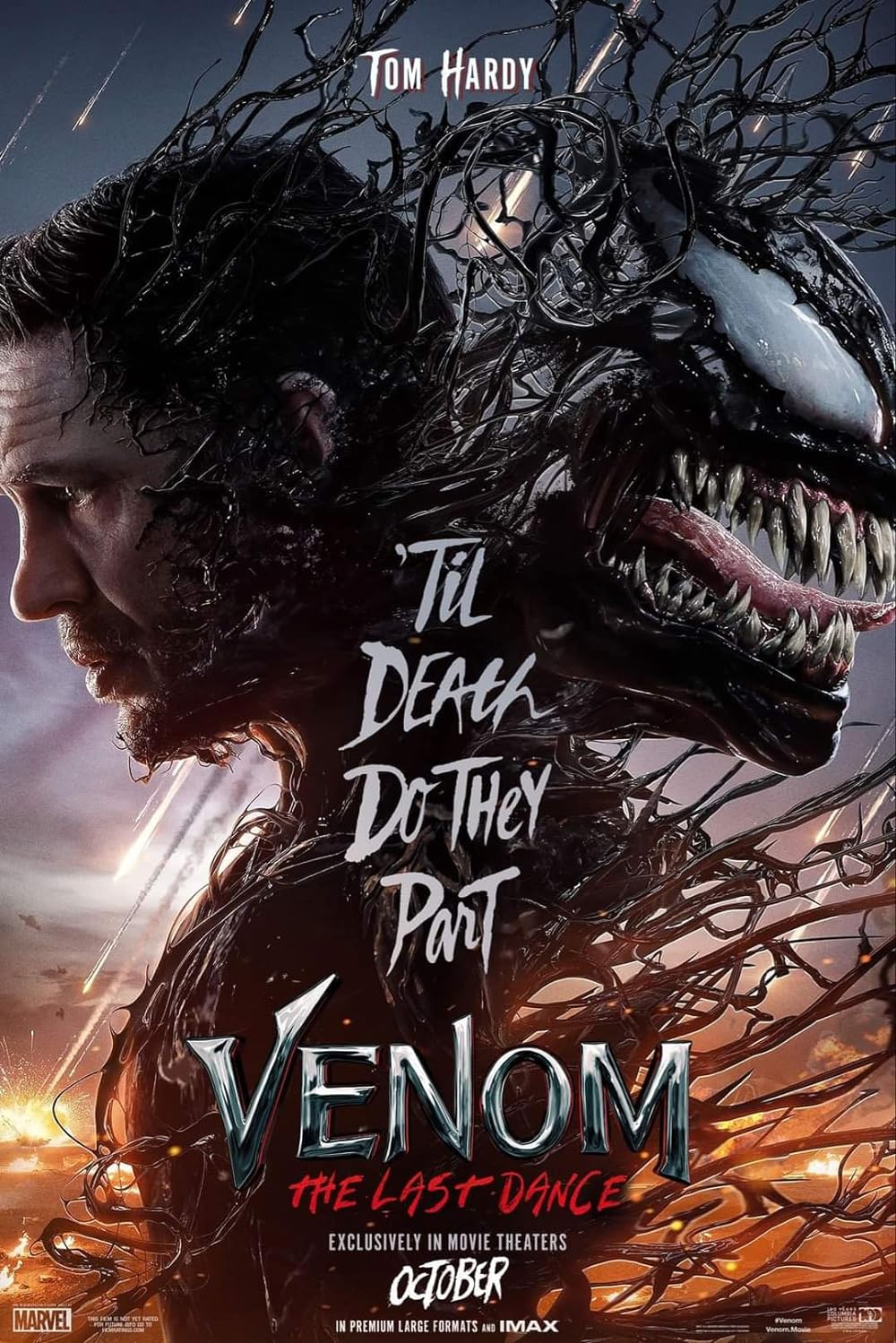
Venom: The Last Dance

Eddie and Venom are now fugitives on the run after the events of the previous film, and soon run into threats that threaten their existence together, and that of the entire world.

The third and final Venom movie offers much stronger laughs due to the bromance between Eddie and Venom. Though there’s still a fair share of cringe, there are some more genuinely funny moments, which for some is all you can ask for from these movies. But it’s hard to pinpoint whether it’s a genuinely better movie than its predecessors, or the bar was set so low by them that enjoying this one is a little easier. Not to mention, coming out after Morbius and Madame Web does this movie many favors considering it’s nowhere near as unwatchable, but how high of a compliment is that really for a movie? Where the film struggles again is making any sense of its story or having any engaging conflict beyond its titular dynamic. For the first bit of the movie, I was enjoying the chemistry between Tom Hardy and the CGI black blob much more than in the past films, but it soon descends into the same dull action scenes and tedious symbiote science exposition these films have subjected us to before.

The action scenes, including the uninspired CGI character designs, feel recycled and unattractive and do nothing different from the past films, as well as a few uninspired soundtrack choices. The rules to the conflicts are inconsistent and contrived, not to mention the disappointing use of great actress Juno Temple, who’s mostly just there to give exposition and stand on the sidelines. It’s also slightly distracting to have cast Chiwetel Ejiofor and Rhys Ifans, who have already had other Marvel roles, and Ejiofor’s character has no depth or originality to him. Every time we come back to the fighting and stakes, it’s hard to care, especially due to a few unrewarding story threads. It’s much more of the same, and leaves no impression despite its efforts to close out the trilogy. It may be the best of these films but that’s hardly a compliment considering how mindless and uninspired they already were.

Megalopolis

Megalopolis is the ambitious new epic fantasy/sci-fi drama from cinema legend Francis Ford Coppola. In the city of New Rome, Julia Cicero (Nathalie Emmanuel) is torn between the ideas and loyalties of architect Cesar Catalina (Adam Driver), who sets out to reinvent the NYC-esque city entirely into a utopia of his imagining, and her father (Giancarlo Esposito), the mayor who wants to keep things as they are.

Megalopolis sets out to be the most ambitious movie meant for a large screen in ages, with outrageous ideas coming at us straight from Coppola’s mind (and pockets, too). Unfortunately, shooting for the moon doesn’t land Megalopolis among the stars, more so the dirt. It’s a canvas of messy ideas that come together without reward, prestige, or even sense. The dialogue is unintelligible, the story is impossible to follow, and the green screen and effects that try to imagine out-of-this-world visuals in line with Doctor Strange look rather hideous and more in line with Spy Kids or Speed Racer. The film poorly utilizes its stacked cast that includes Driver, Emmanuel, Esposito, Aubrey Plaza, Shia LaBeouf, Jon Voight, Laurence Fishburne, Dustin Hoffman, and more. They’re all given surface-level characters with awful dialogue and absolutely no idea what to do with them. An early scene featuring a number of the principal cast debating on the city’s feature feels more like a drunken celebrity costume party than a scripted and rehearsed scene in a film. The characters are inconsistent (and have unexplained superpowers?), and LaBeouf’s antagonist is laughable and serves no threat whatsoever. Fishburne’s narration is indulgent and unnecessary — the movie begins with Coppola conveying to the audience through Fishburne that he sees parallels between our modern metropolises and Ancient Rome, and then proceeds to spoonfeed that same message to us for 138 minutes with no further nuance.

You may be glad you chose to see Megalopolis on a huge screen… for about two minutes, and then everything goes haywire. The mess of tones and logic is the least of the audience’s worries here; it’s a sensory disaster and a meaningless, incomprehensible drag with hollow ideas and distracting visuals. Things don’t explain themselves or mean things in Megalopolis. They just happen. Yet there’s no mystery underneath to unlock and no sense of intrigue, maturity, or intellect whatsoever from the man who directed The Godfather, Apocalypse Now, and The Conversation. If, like me, you don’t manage to hop on board with this puzzling vision from a filmmaking master devoid of wonder or enjoyment, this is one city you’ll be itching to escape from.

The Wild Robot

ROZZUM unit 7134, or “Roz” for short, is an intelligent robot who finds herself shipwrecked on an island, where she learns to coexist with the animals living there and becomes the adopted parent of an orphaned baby goose, all as the rest of robot-kind awaits her return.

The Wild Robot breathes new life into themes we’ve explored plenty in animated films. The animation is absolutely gorgeous; the storybook-esque coloring that DreamWorks also embraced with Puss in Boots: The Last Wish makes the forest Roz explores look stunning, and makes room for creative liberties with some of the coloring — overly red fires look beautiful in the night sky, and water looks absolutely magnificent. The movie isn’t overly concerned with shoving in action sequences for the sake of youngsters’ attention, nor does it feel pressed to pace itself quicker; the time jumps and lower stakes often benefit the film. Lupita Nyong’o was likely the only person who could’ve voiced Roz with such audacious surprise and innocent gentleness, capturing her eagerness to help, learn, and soon, live the way she wants with and for whom she wants. Pedro Pascal, Kit Connor, Mark Hamill, and Catherine O’Hara round out the great batch of animal voices, though Stephanie Hsu especially kills it as an antagonist.

Though there are moments earlier in The Wild Robot where the animal chase scenes may feel more child-aimed, the movie wisely strips its themes down to the core, about difference and found family, and of course, kindness, to feel fresh and fascinating even compared to many other animated films that have been about the exact same thing. It’s a film that’s sure to touch as much as it will entertain, and the visual and emotional experience of the film together will resonate with all ages. Is it DreamWorks’ best film since the How To Train Your Dragon movies? Perhaps, but it’s also sure to stand the test of time as strongly as some of their greatest classics.

Alien: Romulus

While scavenging the deep ends of a derelict space station, a group of young space colonists come face to face with the most terrifying life form in the universe.

Alien: Romulus distances itself from much of the story of the other films, to create a contained haunted house/spaceship thriller. The film manages to give us enough interesting characters to attach us to the action and root for certain ones to make it out, though a few others are simply irritating. Making the premise about a “heist gone wrong” makes it feel unique and gives the film a more fun hook than expected. Cailee Spaeny, who needs no introduction at this point, is not only a terrific lead but perhaps the best person who could’ve played this role, flawlessly balancing the terrified and badass sides to Rain without feeling like Ripley, Shaw, or Daniels 2.0, giving a protective and resourceful edge to her strength. David Jonsson gets a lot to work with as Rain’s surrogate brother Andy, and Isabela Merced absolutely owns her screen time with the terror her character goes through. I mean, who can blame anyone for reacting in such horror after looking at a Xenomorph for the first time?

The effects of the creatures are seamless and innovative, and the gore that unfolds throughout the runtime does not relent or let you feel safe. Though it takes a bit to get going, the thrills get more and more innovative as we explore deeper and deeper through the titular space station. Though it’s often visually stunning, including shots of asteroid belts, planets, and spaceships, the darker lighting makes the shots not quite as gorgeous to look at as Prometheus and Covenant. It embraces enough of the formula that’s made past films work while finding enough in this story to induce curiosity and excitement. It thankfully stands on its own but the action scenes may end up ranking high for fans of the franchise, and ultimately deliver the sophisticated mix of science fiction, action, and horror that have made these films, 45 years later, still feel gripping and cool.

Deadpool & Wolverine

Deadpool enters the larger Marvel Cinematic Universe when he’s called upon by the TVA to save his timeline from erasure — or in other words, a Disney acquisition.

Deadpool continuing into the larger MCU, and with a larger sandbox to reference and joke with, only feels right, with the character reminding us that anything and everything in the world of entertainment need not be taken so seriously. Excitingly, it’s not just the convergence of the Fox Marvel heroes and the MCU, but also Hugh Jackman’s return as Wolverine, whom Deadpool has already poked fun of in his films. The film asks, what if two people who can’t die and have no temper but are polar opposites need to get along (but can’t)? That buddy comedy aspect drives the film, as do the multiverse-level visuals. In addition to Reynolds’ increasingly impressive commitment to one of the most foul-mouthed heroes to ever wear spandex, and Jackman’s rage-filled but emotionally charged take on a Wolverine different from the one we parted ways from in Logan, Emma Corrin shines and never feels lesser than the two A-listers when on screen with them. Corrin gives a delightfully cruel and loose performance as Cassandra Nova, and certainly not right-minded, almost like a Mad Max character given Professor X’s powers. Matthew Macfadyen also gives the film some great fun as a TVA agent whose a little murkier than the ones we met in Loki.

The film’s writing for its lead character doesn’t really hit hard on a deep level, and Wade’s relationship with Vanessa feels like a superficial conflict thrown in for the sake of necessity. Their arc worked way better in Deadpool 2, and here, this variant of Logan is by far the more inviting emotional aspect of the film. Despite Deadpool’s growth as a person taking a backseat, this is a film where the experience is reliant on the action, humor, and surprises, and it delivers on all three fronts. The action scenes are creative, eye-popping, and cheerfully graphic, from an opening that’s one of the most brilliant fight scenes in the trilogy to much, much more that comes after. The jokes come at light speed and have something belly laugh-inducing for everyone, including references to the actors’ filmography. The film also embraces the idea of the multiverse with cameos to behold that’s been kept secret from the marketing for our enjoyment in the theater. It’s probably why Deadpool & Wolverine, despite not having a marginally original story, is such a memorable crowd experience and action blockbuster that does not hold back, continuing to push the limits of how much the blood, raunchiness, and self-awareness can surprise and amuse us. But it’s not just irreverent for the sake of it — the humor and energy of the film brilliantly mesh with the CGI-heavy worldbuilding of the MCU, so come the chemistry that’s promised from the title and meta potential of these franchises colliding, and though that’s the mainstay here, it’s more than enough devoted fans of the superhero genre and the collective theater experience.

A Quiet Place: Day One

Though A Quiet Place worked best due to its minimal cast and remote settings, this prequel works strongly by embracing the chaos of a Manhattan monster invasion, and the desolation left behind, with that large scale terror that made Cloverfield such a cultural stamp. Michael Sarnoski, who directed the excellent Nicolas Cage drama Pig, effortlessly manages to replicate the beautiful tension and almost melodic sound design that John Krasinski distinguished this franchise with in the first two films. Though this film isn’t as heart-racing and emotionally fine-tuned, it’s still got a fantastic protagonist and captivating thrills. Though it’s very well-filmed when focusing tightly on its lead characters, there are a few unnecessary cuts to wide shots that do harm that tension, even if just for a moment. If any actress can command an audience and emote in a way as brilliantly as Emily Blunt — well, that would clearly be Lupita Nyong’o. It’s impossible to look away when she’s on the screen, as her character expresses instability yet empathy that carries the viewer with her from the film’s very first shot to its last. Joseph Quinn also shines, delivering an inconsolable fear to his character that’s also aligned with his courage and generosity.

The film’s real experience comes from use of sound — the amplification and implications of certain sounds compared to others in the mix takes you on a ride of sorts and keeps you on the very edge of your seat. It cleverly paces itself and uses its wider settings, but never sacrifices the mystery that made this franchise great: that all of civilization and hope might just be lost to these deadly creatures beyond what we see. It’s different enough from its predecessors to justify its existence as a spin-off prequel, and conceptually similar enough to continue playing with the idea of sound-hunting monsters and near-silent human leads in exciting and satisfying ways.

Furiosa: A Mad Max Saga

As the world fell, young Furiosa is snatched from the Green Place and falls into the hands of a great Biker Horde led by the Warlord Dementus. Sweeping through the Wasteland, Furiosa must survive many trials as she puts together the means to find her way home.

Action movies have lost the rare beauty of the aesthetic of Fury Road, and its prequel nine years later now. To revisit the Wasteland is a reminder of George Miller’s impeccable vision, true to his Australian roots, and imaginative and demented at every turn. The beauty of this post-apocalyptic warzone where mankind runs wild, destroying each other for resources, is captured with a canvas-like flare that pops out in every second. Perhaps only the Mad Max franchise can so seamlessly ditch its main character without any concern from audiences, yet Anya Taylor-Joy seamlessly adds to the rich lore of the titular character that Charlize Theron already made so legendary. Her silent pain and rage still never overshadows the character’s likability, but Taylor-Joy always feels perfectly placed in this big and mad world. Speaking of mad, Chris Hemsworth’s dive into villainy makes you ask why he hasn’t taken on more psychopaths before (shoutout to Bad Times at the El Royale). His twisted heartlessness and unleashed behavior makes his character is evil as he is delightful, and the actor nails the long batches of dialogue the character has. Tom Burke is also excellent as Praetorian Jack, a character who will certainly stick out for audiences as an anchor of sorts, whether in a haunting or affectionate way.

The one thing Furiosa lacks that made Mad Max: Fury Road the defining action movie is that pitch-perfect pace, and Furiosa‘s slow build across the character’s life’s events is a stark contrast to that lightning speed. Though the buildup may last long, the action is well worth it, and the structure does anything but play it safe afterwards, making this film more heartbreaking and intimate than the last. The sound is also booming and the body count is joyously high, with the best of Miller’s witty editing and inspired scenarios involving vehicles and large battle settings. There’s not a lot of suspense with certain characters knowing where Fury Road picks up, but it also contextualizes Furiosa’s journey to redemption in the aforementioned film, and is a welcome return to the spectacular world-building that we already love Miller and this franchise for.