The Wild Robot

ROZZUM unit 7134, or “Roz” for short, is an intelligent robot who finds herself shipwrecked on an island, where she learns to coexist with the animals living there and becomes the adopted parent of an orphaned baby goose, all as the rest of robot-kind awaits her return.

The Wild Robot breathes new life into themes we’ve explored plenty in animated films. The animation is absolutely gorgeous; the storybook-esque coloring that DreamWorks also embraced with Puss in Boots: The Last Wish makes the forest Roz explores look stunning, and makes room for creative liberties with some of the coloring — overly red fires look beautiful in the night sky, and water looks absolutely magnificent. The movie isn’t overly concerned with shoving in action sequences for the sake of youngsters’ attention, nor does it feel pressed to pace itself quicker; the time jumps and lower stakes often benefit the film. Lupita Nyong’o was likely the only person who could’ve voiced Roz with such audacious surprise and innocent gentleness, capturing her eagerness to help, learn, and soon, live the way she wants with and for whom she wants. Pedro Pascal, Kit Connor, Mark Hamill, and Catherine O’Hara round out the great batch of animal voices, though Stephanie Hsu especially kills it as an antagonist.

Though there are moments earlier in The Wild Robot where the animal chase scenes may feel more child-aimed, the movie wisely strips its themes down to the core, about difference and found family, and of course, kindness, to feel fresh and fascinating even compared to many other animated films that have been about the exact same thing. It’s a film that’s sure to touch as much as it will entertain, and the visual and emotional experience of the film together will resonate with all ages. Is it DreamWorks’ best film since the How To Train Your Dragon movies? Perhaps, but it’s also sure to stand the test of time as strongly as some of their greatest classics.

Beetlejuice Beetlejuice

The Deetz family returns after a family tragedy to the old home they left behind in Winter River. But Betelgeuse returns into their lives — just as Lydia Deetz feared — when her daughter Astrid accidentally lets the dead loose.

The long-awaited sequel to one of Tim Burton’s films that’s best stood the test of time — and one of his most purely fun — comes over 35 years after its predecessor. It offers the same classic Halloween feeling audiences enjoyed about the first film, and more of pretty much everything else that movie had as well, for better or worse. The music, comedy, and practical effects all work just as well so many years later, and there’s even another phenomenal musical number. It’s delightful to see Michael Keaton, Winona Ryder, and Catherine O’Hara back in their roles, and just as great at them. The heart of the film comes from O’Hara and Jenna Ortega; O’Hara’s goofy yet conscious grandmother provides so many laughs and her energy as an actress stands out, while Ortega perfectly brings a deadpan charm that’s visibly intrigued but not too shocked at all the insanity she’s yanked into.

The humor often hits the mark, including the titular character’s outlandish remarks and plenty of physical and cynical comedy in typical Burton fashion, but the movie does make a few missteps as the runtime goes along. Its most glaring one is introducing an antagonist played by Monica Bellucci in an incredibly strong first scene for the character, and then hardly utilizing her until much, much later. Though the mother-daughter dynamic between Ryder and Ortega is sweet, the overall objective of the story becomes muddled in the later act. It won’t pack any surprises for fans of the first film, but is entertaining and good-hearted enough to offer some creepily comic fun.

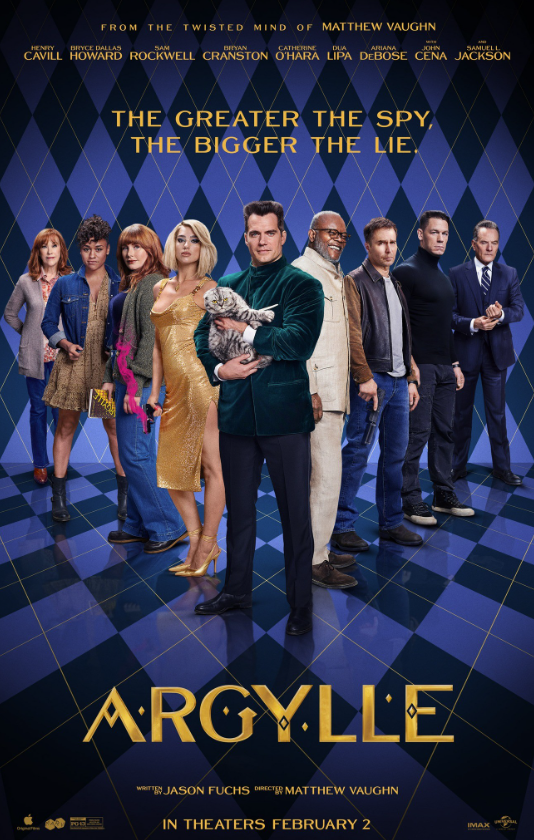
Argylle

Elly Conway is the reclusive author of the Argylle spy novels . Soon, she realizes the plot of the new book she’s writing starts to mirror real-world events, as a global spy syndicate starts to come after her.

It’s always a blessing when Matthew Vaughn gives us a glimpse into his twisted mind with his witty and bombastic action scenes, and Argylle has a few of those, but it’s everything else that disappoints. Vaughn directs with a love for spy material and cartoonish entertainment mixed with modern, meta flare. The script, however, completely misses the mark and looks the commanding energy that his Kingsman had. Even Sam Rockwell, whose charm and goofiness often comes effortlessly, has to work with dialogue that falls flat and the attempts at humor don’t manage to illicit a response. Though Henry Cavill has some fun and Bryce Dallas Howard tries her best in the leading role, there’s more left to be desired in Ariana DeBose, John Cena, and Samuel L. Jackson’s screentime. Bryan Cranston’s villain may be the weakest link of the cast, as everything he’s given to do is annoyingly generic.

The movie’s downfall is also its ambition, which is often what lifts Vaughn up above the rest. The ludicrous twists are executed in a head-scratching way, and all the film’s rules or explorations of fiction vs reality are thrown to the side for more frustrating decisions that make its lead character less interesting. The pacing also suffers greatly in the film’s second half, the end of which sees us getting a few of those glorious scenes of carnage Vaughn’s known for, which still feel softened compared to what they could’ve been due to the PG-13 rating, but are delightfully exaggerated and have great soundtrack choices. By then, however, the journey to get there is simply exhausting and it may be too little, too late for many viewers.

Argylle is a massive disappointment in which a singular director brings his trademarks to the screen yet again, only this time without the laugh-out-loud glee or the clever script that usually support his vision. Its ambition unfortunately exceeds its grasp, and its inconsistent and convoluted execution make this invitation to take the world a little less seriously with Matthew Vaughn a sadly unrewarding one.