I Wanna Dance with Somebody

Naomi Ackie stuns in this biopic about Whitney Houston, and the movie makes a strong case for why she was the greatest singing voice of her generation. It highlights Whitney’s accomplishments, shortcomings, and struggles with glamour, empathy and care, but the editing seems to occasionally bring Ackie’s performance down and while the characters and performances are strong, the script is so cliche it almost feels like it’s checking off boxes as it goes. The music biopic tropes are almost all there, whether it be the way the movie portrays the sudden rise to fame, abusive marriage, addiction, controlling father — it’s the Aretha Franklin biopic Respect but with a different soundtrack. The way the movie goes through these cliches feels almost like the way the parodical Walk Hard: The Dewey Cox story would’ve been written, and the editing often glosses past important story points and doesn’t let the beautiful musical sequences breathe and play out without frequent montage-like editing during the songs. Cinematograper Barry Ackroyd of the Bourne movies, The Hurt Locker, Captain Phillips, and Bombshell isn’t enjoying using a tripod too much and often shifts between handheld and still shots mid-scene which occasionally distracts.

In addition to Ackie’s breathtaking work, changing Houston’s mannerisms as she takes us from her teen years to the end of her life, Stanley Tucci is excellent as her manager Clive Davis, who in a nice change of pace from most biopics, isn’t the greedy asshole who takes advantage of the star, but a kind counselor and a devoted friend to Whitney. Ashton Sanders does a strong job as her husband Bobby Brown, as well as Tamara Tunie and Clarke Peters as her parents. Seeing Whitney’s process in creating her songs is also very satisfying, as well as her struggles with drugs and her music being called “not black enough” by critics of her music. Though it’s easier to follow than this year’s Elvis and has fun sequences for fans of Whitney’s music, with a star-making work from Naomi Ackie, but the script in the latter half could’ve been much stronger, as well as the runtime which drags later on and could’ve trimmed 10-20 minutes.

Puss in Boots: The Last Wish

Puss in Boots discovers that his passion for adventure has taken its toll: he has burnt through eight of his nine lives. With the help of old and new allies — and with some new foes in the way — Puss sets out on an epic journey to find the mythical Last Wish and restore his nine lives.

Eleven years after the first spin-off focusing on Puss in Boots was released, it wasn’t really necessary to continue or dive back into the franchise, but The Last Wish absolutely tops the first movie. Antonio Banderas is having a blast as a role that may at this point be as iconic to his name as Zorro, not to mention the characters bear plenty of similarities. Florence Pugh and John Mulaney also give the film so much with their voice performances, and Olivia Colman and Ray Winstone almost feel like they were born to voice Mama and Papa Bear, not to mention a menacing Wolf voiced by Wagner Moura. Unlike the more realistic animation of the first Puss in Boots, this blend of 3D animation with 2D coloring to create a storybook look feels reminiscent of Spider-Man: Into the Spider-Verse, The Mitchells vs the Machines, and The Bad Guys. Though the frame rate or 2D look of some shots occasionally distracts, the animation ultimately creates for a more colorful and visually impressive experience than the first movie, not to mention the well-paced and engaging action. The movie also pushes Puss to new places as a character — he’s forced to confront his pride, mortality, fears and motives and we feel like we’re watching the animated feline find some genuine growth by the end. But most importantly, its sweet, energetic, and playful intentions definitely translate to the final product, despite some overused jokes or themes that aren’t unfamiliar to animated films. It delivers a reward for families that exceeds expectations, and one of the year’s best animated films alongside films like Guillermo del Toro’s Pinocchio and Turning Red.

Strange World

The legendary Clades are a family of explorers whose differences threaten to topple their latest and most crucial mission.

Strange World is incredibly visually vibrant, which is never an aspect Disney misses in, not to mention director Don Hall’s outstanding track record at Disney in the past with Big Hero 6 and Raya and the Last Dragon. The imaginative color palette in the titular world the Clade family journeys through is engaging and surprising, even when the story material feels a little hollow. Jake Gyllenhaal is perfect as the lead role Searcher Clade, and it feels long overdue for him to join the Disney animation family. His voice has an incredible likability and he delivers the balance between “frustrating (but devoted) dad”, “frustrated/traumatized son” and “reluctant adventurer” really well. Dennis Quaid, Jakoubie Young-White, and Gabrielle Union are all having plenty of fun in the recording booths as well as a dysfunctional family that all want to just get along and enjoy each other’s company, though the grandpa and legendary explorer Jaegar Clade (voiced by Quaid) has other priorities and is overly consumed with his duties to his pride and explorations. Though the style is always visually inviting, the substance behind the conflict doesn’t always click until the end, and the characters’ relationships are way more interesting than the action itself. The style believes it’s being very nostalgic, presenting itself as a tribute to pulp magazines, but it actually looks and feels very modern. Though the film is quite heartfelt due to the characters it develops, the actual themes of familial expectations have been done plenty in recent animated films, most notably in Encanto and Turning Red that are still fresh in all our memories. There are instances where it tries to even become self-aware of the cliches its indulging in, which simply makes it even more awkward. On the positive side, the movie has Disney’s most prominent representation of an LGBTQ main character in one of their animated films, which is a celebratory step forward for family films on the big screen. Gyllenhaal’s voice performance is outstanding, backed by heartfelt supporting characters, and the animation gives the film lots of energy, but not enough to rank it among other adventures from the modern era of the studio like Zootopia or Wreck-It Ralph, though it’s still sweet and a decent one-time watch for families.

Black Panther: Wakanda Forever

As the Wakandans strive to embrace their next chapter in the wake of King T’Challa’s death, Queen Ramonda, Shuri, M’Baku, Okoye and the Dora Milaje must band together with Nakia, T’Challa’s former lover and a War Dog spy, and CIA agent Everett Ross to forge a new path for their beloved kingdom.

Black Panther: Wakanda Forever had to decide how to face two immense challenges — following up a cultural phenomenon and one of the most popular and resonant movies in recent years, and doing it without its magnificent lead, Chadwick Boseman. The effortless charisma and commanding dignity Boseman brought with him are absolutely missed in this sequel, yet writer-director Ryan Coogler decided to use his loss to give the film a complex gravity and message about grief, legacy and moving forward. Not only does Coogler use the sequel to expand the scale from the first film into a glove-trotting political fantastical battle, but also as a means to explore new stylistic grounds, feeling more director-focused than any Marvel movie in a while.

The visuals and action manage to even outdo the excellent and versatile fights from the first film, and the pace is much more graceful than the tighter pacing of other MCU films from this year. The music by Ludwig Goransson has a language of its own, always surprising, entertaining, and hitting you hard. Goransson uses African, Latin, and electronic bases in order to create a score that builds off the one from the first. The cinematography is more intimate than in the last film, with the camera sometimes closer to the characters or letting the visuals feel more seamless rather than showy. The movie addresses our feelings of sadness about losing Boseman and T’Challa through the characters, but doesn’t linger in it or feel stuck in the past. Speaking of the characters, Letitia Wright is great as Shuri, who is forced to mature quickly after what she’s had to cope with here, but it feels like this entire world of Wakandans, even the lovable side character of M’Baku, is growing and getting wiser with time. Angela Bassett delivers a ferocious performance as Ramonda, and honestly some of the best acting this entire Marvel franchise has seen. Dominique Thorne also shines as a cheerful, lovable presence she conveys through Riri Williams. Lupita Nyong’o also provides warmth and elegance as Nakia, though Martin Freeman’s return isn’t exactly necessary and his role in the plot could’ve been combined with Nyong’o’s character. Now, how does one follow up a villain as resonant and scene-stealing as Michael B. Jordan’s brilliant Killmonger? With Namor, Tenoch Huerta delivers a kindness we haven’t seen in many villains before, while clearly being violent and vengeful in his methods while showing warmth and empathy towards his people. He makes Namor a memorable character whose backstory’s execution isn’t the most hard-hitting but whose developments are always interesting.

This movie is the most sophisticated work Marvel’s done in a while, distancing itself from reminders of the bigger universe and allowing Coogler and crew’s creativity run free and deliver spectacle that feels consequential and really sinks in. It’s refreshing to feel like a Marvel movie isn’t constantly working to check off boxes to set up a bigger universe and pander to the widest action movie fanbase possible — after all, the first Black Panther was all about making stories about POCs no longer niche. While the messages may not be as revelatory as in its predecessor, it’s a film that rivals the first in ambition and weight. Perhaps it resonates so well because we all feel like a world with Wakanda is an infinitely better one, and a world without its late hero is one that’s infinitely worse. Black Panther: Wakanda Forever demands your eyes on the big screen and an open heart, with the performances and style creating an action adventure with gripping and soulful humanity.

Black Adam

After using his powers for vengeance, the mortal slave Teth-Adam was imprisoned by the gods and trapped for centuries, becoming Black Adam. Nearly 5,000 years later, Black Adam is freed and finds his unique form of justice challenged by the Justice Society of America (JSA).

If you’re familiar with the kind of blockbusters Dwayne Johnson is often a part of, this is no different — an action movie that tries to be as crowd pleasing as possible with as little brain energy as possible. And it’s very middle-of-the-road for his filmography — it’s not as fun as the Jumanji or Fast & Furious films but not as embarrassingly bad as Skyscraper or Baywatch, so right there in the middle with forgettable spectacle like San Andreas, Red Notice and Jungle Cruise. Johnson delivers a solid performance as Black Adam, whose humor this time around comes more from Adam’s “fish out of water” aspect. However, his character’s actual development in order to justify him turning into a more rageful anti-hero is pretty uninteresting and it says a lot that all four members of the Justice Society have no backstory or arc but are far more interesting than him. Aldis Hodge shows off his badassery as Hawkman, going toe-to-toe with Johnson and even managing to steal the show from him, along with Pierce Brosnan, who is also great as Doctor Fate, whose powers and presence are intriguing. Noah Centineo and Quintessa Swindell are also entertaining as the other two members of the JSA. Unfortunately, the movie is brought down by a bloated conflict, weak CGI and a script you’ve seen a thousand times before. The rapid editing of action scenes takes away lots of the grandiose, even when Black Adam fighting the JSA starts off fun. By the third act, it descends completely into a forced “good guy vs bad guy” CGI-fest of action that feels pulled straight out of Justice League. Though the style manages to occasionally have fun, it’s got too many elements working against it, whether it be the editing, Marwan Kenzari’s awful character, the lack of thematic clarity, or a willingness to take itself less seriously than it should.

Black Adam serves loud noise and huge action scenes — exactly what The Rock is known for — but unfortunately nothing more. The solid supporting cast and occasionally entertaining action and scale isn’t enough to save this movie from descending into generic chaos.

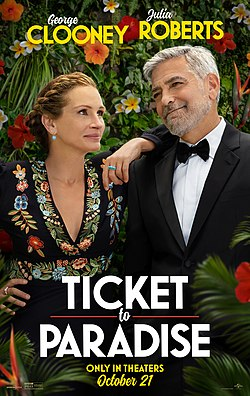
Ticket to Paradise

Two divorced parents, David and Georgia Cotton, travel to Bali after learning that their daughter, Lily, is planning to marry a man named Gede, whom she has just met. They decide to work together to sabotage the wedding to prevent Lily from making the same mistake they made twenty-five years ago.

Ticket to Paradise is a welcome reunion for two legendary stars, George Clooney and Julia Roberts, years after they worked on the Ocean’s films, Confessions of a Dangerous Mind, and Money Monster together. They elevate a film that occasionally threatens to fall into generic territory by breathing fun and charm into the film, even when they’re ripping each other to bits with insults. Clooney’s performance is certainly the glue here, as he embraces his comedic chops and his character often pokes fun at himself while being grumpy and over-the-top. Speaking of reunions, fans of Booksmart will love to see Kaitlyn Dever and Billie Lourd sharing the screen again — Dever is great as their daughter Lily, and Billie Lourd is a scene-stealer as her best friend Wren, a character that the plot maybe could’ve done without but when Lourd is so entertaining, the movie suddenly feels infinitely more upbeat with her in it.

The movie can sometimes fall into cheesy territory especially with some obviously scripted lines and an exaggerated ending, as well as some unclear themes about who is more right about what, but it never sinks the film’s heart and sweetness. It’s a film that means to charm and show the nature of flawed parents getting over their own immaturities while loving their daughter, and when the parents are played by two of the most charismatic people in the world, you’ve got yourself a winning film. Though it’s nothing you’ll be urged to watch more than once, or even the best comedy out right now, given how much more memorable and hysterical Bros is, Ticket to Paradise is certainly a harmless and heartfelt good time, especially for today’s rom-com standards, with laughs, vacation-y settings, and charming performances.

The Woman King

The Woman King historical epic inspired by the true events that happened in The Kingdom of Dahomey, one of the most powerful states of Africa in the 18th and 19th centuries. Viola Davis makes every performance of hers seem effortless, and her role as General Nanisca of the Agoije, the Dahomey’s all-female group of warriors who defend the Kingdom, is no exception. Davis portrays the titular character as a fighter with a tough exterior who eventually peels back layers to reveal pain she must defend herself from through physical and emotional strength. Thuso Mbedu and Lashana Lynch are both outstanding, Mbedu as a new recruit who must grow into a courageous fighter, and Lynch as a commander who gives it her all into the role physically and makes you care so much about her character.

The action is staged very well and is surprisingly strong for a PG-13 rating, but it’s never distractingly holding back from showing violence either, though nothing is disturbing here. The grandeur of the costumes and sets makes the atmosphere work so well, and the film benefits from a spectacular score from Terence Blanchard, who should at least get nominated for an Oscar. Though the film does occasionally slow down between the powerful moments, the last act especially is the most exciting, investing and empowering and elevates the entire movie. It’s a great popcorn action film but also a showcase of amazing production and performances that’s built for the big screen.

A Quiet Place Part II

Following the events of the predecessor, the Abbott family now face the terrors of the outside world. With both A Quiet Place and its sequel that’s now playing in theaters everywhere, John Krasinski has proven himself to be not only an awesome actor but a master filmmaker. It worries me whenever a studio greenlights a sequel to a great film that stands alone perfectly, but A Quiet Place Part II is one of the rare occasions where the sequel lives up the original, and not only that, but along with that 2018 film, is one of the best horror/thrillers of recent years. A lot of it is thanks to Krasinski’s direction and the style which made the concept and storytelling of the first film so memorable. The opening sequence is nail-biting and even though the violence is kept at a PG-13 level, the film knows where and how to scare most effectively with showing and not showing certain things. For example, we see scenes from characters’ perspectives so the aliens and action aren’t always in the frame but sometimes in the background. The cinematography and editing are great as well, but it’s the sound editing that makes the movie. It’s the small noises that make you terrified for the characters as they try to survive among creatures who can track them based on any small noise from a distance, and the sound creates its own tension without a single jump scare. The loud sound effects of the monsters contrast this excellently and make this a terrific theater experience.

Emily Blunt may be at her best in this series as a mother trying to protect her kids, including a newborn, from otherworldly threats that are a family’s worst nightmare. Cillian Murphy is also excellent as a new addition to the cast, a cynical, hopeless survivor who is changed by his time with the Abbott family. Millicent Simmonds, the deaf actress who plays the deaf daughter in the film, may be the film’s heroine as she takes on challenges courageously and delivers a stellar performance, with not only some of the most positive deaf representation I’ve ever seen in film but all around a brilliant actor and lead role. Noah Jupe, who plays the son/brother, is again excellent, and he’s proven himself with these films as well as his magnificent roles in 2019’s Ford v Ferrari and Honey Boy. And even with just a cameo, Krasinski himself makes his presence felt throughout the film, passing the courage and good-ness of his character from the last film into his children and the world of the movie. Beyond the brilliant scares, which are only strengthened by techniques such as cross-cutting that Krasinski marvelously uses to make scenes more powerful and symbolic, the film retains the heart that made its predecessor so emotional — in every frame and line, this is a movie about a monster apocalypse, but also about parenthood, family, human survival, and hope. And one can’t help but think that with a family taking back their world by venturing back into the unknown and fighting back against the apocalypse, it’s a perfect film to represent our return to theaters. I, for one, had not been to the theaters since Tenet last August, when some screens briefly reopened, and this is an impeccable choice to return to the big screen with for the thrills, sound, and amazing effects and story that will more than satisfy those who know what they’re in for, and for the shared experience we’ve been longing to have back and can finally experience for a new blockbuster once again.

A Quiet Place Part II.jpg

Yesterday

Jack Malik is a struggling singer-songwriter in a tiny English seaside town whose dreams of fame are rapidly fading, until a freak bus accident during a mysterious global blackout, after which Jack wakes up to discover that nobody except him can remember The Beatles. Soon Jack makes a life-altering decision that sends him to fame as he starts taking credit for the band’s forgotten songs.

Yesterday is a movie with a fantastically original premise, compared to the same recycled formulas in a lot of genres. Though it does sometimes get stuck in mediocre rom-com tropes, like a cheesy romance in the second act that doesn’t know where it’s going until the very end, this movie takes advantage of its genius idea and makes for a fun, humorous, and interesting two hours. Himesh Patel is not only fun and charming but also sings really well and was well-cast — he hasn’t been in much before but may soon make a name for himself after his starring role here — and also entertaining are Lily James as his best friend, and Ed Sheeran as himself — the singer who helps Jack skyrocket to stardom. However, one character I found to be annoying was his manager played by Kate McKinnon, whose comedic turns I usually enjoy on Saturday Night Live, but here her character was simply irritating and unlikable. It’s no surprise the music is so enjoyable — they chose the best band to make this movie about, and as a huge Beatles fan myself, it’s great to hear them all through the film, and luckily they cast a great actor who can sing as well. There’s also plenty of humorous moments I didn’t expect and the jokes almost always land. Like I said, the second half does lose a little bit of steam but once you see where it all ends up, you get to take in some of the themes the movie is going for. There’s also another sweet theme about how the most iconic of pop culture is what touches people’s hearts and should be kept alive. As one character says, “A world without the Beatles is a world infinitely worse.” So I have to applaud director Danny Boyle and writer Richard Curits for creating one of the most original films of the year that sometimes doesn’t avoid genre tropes but the fresh plotline makes for some truly great moments, and there’s also plenty of excellent musical moments as well. When everything that’s out has to do with killer toys, superheroes, and animated animals, why not try something new for a change and support this one-of-a-kind film I bet you won’t regret seeing in theaters.

Yesterday film.jpg

A Wrinkle in Time

ratings2

Meg Murry is a young girl whose astrophysicist father disappeared four years ago. One day she learns from three magical travelers that she can find her father if she embarks on a journey of self-discovery across the universe, accompanied by her brother and her classmate.

A Wrinkle in Time had some big names in its cast, a popular source material, and lots of ambition which was evident from the intriguing trailers — so why did Disney go ahead and make a safe children’s movie with the same plot they always use instead of something that families can love too? Ava Duvernay is not a bad filmmaker, she did a fantastic job directing Selma so I had faith that I could really enjoy this film. However, the overuse of visuals, waste of great cast members, and 100% familiarity and predictability of the plot offer nothing new that will resonate. Storm Reid is great as the young Meg who is curious, rebellious, and learns to embrace who she is. However, the rest of the actors, while great, aren’t used to the movie’s advantage. With names like Oprah Winfrey, Reese Witherspoon, and Mindy Kaling, we’d surely get some great leading faces, but not only are they not present for a good amount of the film, but the actors are just being the typical persona of how they usually portray their characters. Oprah is of course just there to inspire people, Witherspoon is funny but really just there to charm, and Kaling is extremely annoying as a character whose only dialogue is famous quotes from historical figures or celebrities. The cast’s (and the film’s) greatest strengths are Chris Pine and Gugu Mbatha-Raw, who have been promising in nearly everything they’ve done. We’ve come to know Pine as Captain Kirk and more recently, Wonder Woman’s love interest, and Mbatha-Raw is a rising talent most notably in her role in Black Mirror. Here they play the most remarkable parts of the film; an ambitious scientist who loves nothing more than his family, and the wife and mother whose life is left with a void after her husband’s disappearance. They are both terrific to watch on-screen, yet so underused, and this part of the story could have been used more dominantly but in the middle of the film it’s ditched for the classic formula we see in nearly every film. Other familiar faces include Zach Galifiankis and Michael Pena, but they too are forgotten and we spend more time with the generic love interest played by Levi Miller and the irritating younger brother by the name of Charles Wallace.

A Wrinkle in Time had a lot going for it, and though lots of it feels like a missed opportunity, there are some things it gets right. We’re ultimately left with a theme about being your best and embracing your faults, because in the end, we can all do great things. Kids will love this message and be empowered by this theme, but to everyone who’s seen a movie before, it’s all the same. An ordinary kid who feels isolated from everyone else is pulled into a magical journey and learns to be a hero and a better version of themselves, and falls in love and the way. Sound familiar, right? It feels like this could’ve been something unique but instead used the same recycled formula for a new generation. Even Star Wars has a significantly similar plot to this one. The CGI and green-screen don’t feel real and intimate enough either, and at the end, it doesn’t seem like much of the story had a point either, just a bunch of names and concepts thrown at you that don’t have some sort of resonance and thrills to offer. Some may argue this movie celebrates female empowerment and diversity, but is that enough to make a good movie? That part should be the icing on the cake that can be added to something great.

Your kids may be enamored and entertained by the messages this film has to offer, but if you’re over 10 years old, A Wrinkle in Time will leave you thinking about nothing but the potential that was missed here. This should’ve been something families will talk to their kids about and recommend to friends, but in the end, we’re left with a familiar story accompanied with forgettable execution. Ava Duvernay and Disney should’ve learned, like their protagonist, to embrace their faults and improve upon what’s done before, and trust me, I’ve seen lots of great Disney movies, but this one just doesn’t add up to something I’d recommend to anyone going to the movies with friends or a date. On the bright side, there’s still Black Panther and Annihilation out there for whoever hasn’t seen those yet.

AWrinkleInTimeTeaser.jpg