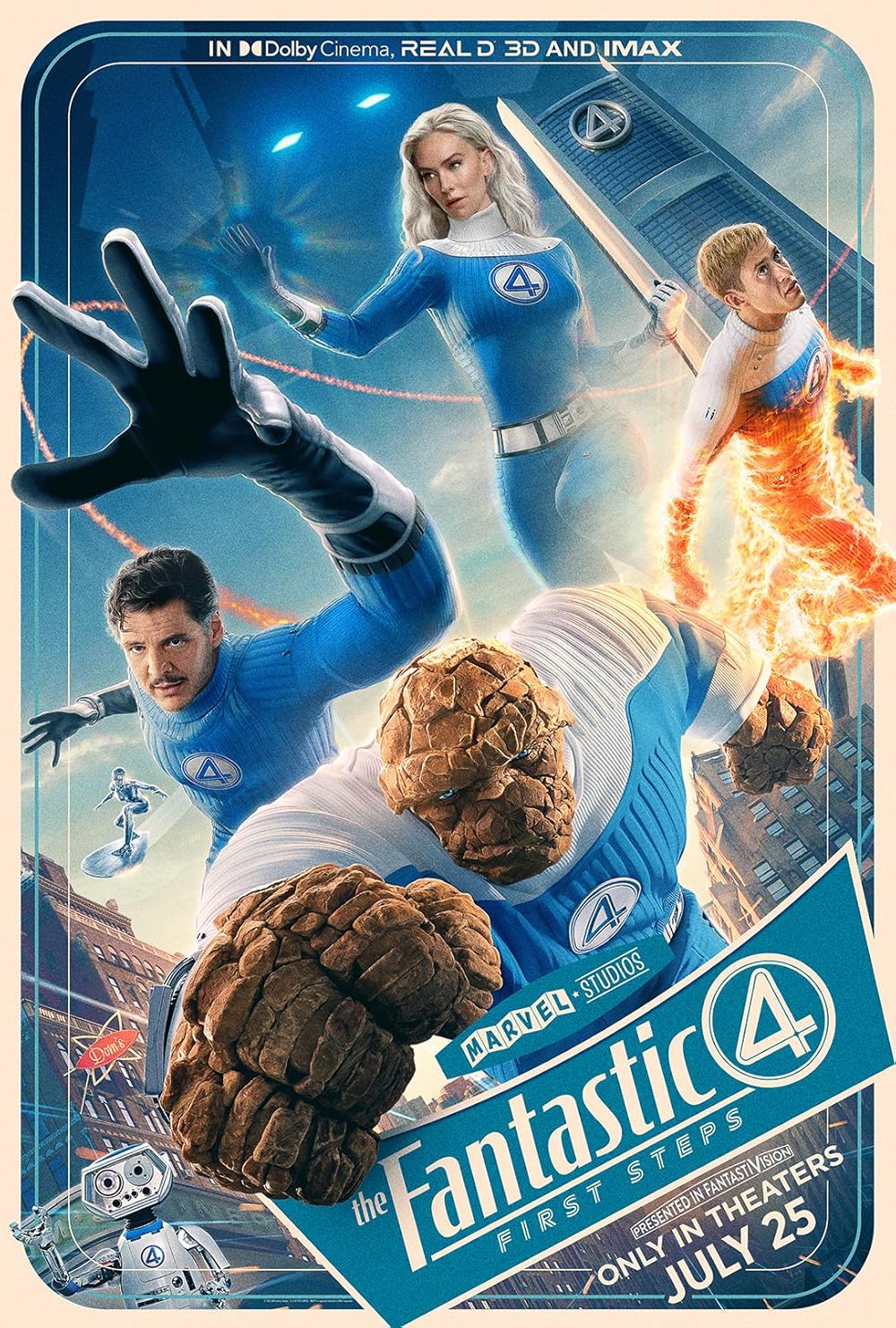
It seems like the third time’s the charm for Marvel’s first family — after three different iterations on screen, the Fantastic Four finally get a film that’s not only watchable, but irresistible. Since this film is set in a parallel universe to the 36 films preceding it in the Marvel Cinematic Universe, it gets to build a new world from scratch. The eye-popping visuals will leave you in awe, including extraordinary costume and production design. The retrofuturistic approach to this new world recaptures that feeling of wonder of humanity embarking into space for the first time, while imagining a reality where all of humanity rallied together behind reason, morality, and science. This idealism and dream-like wonder bring a beautiful look and excitement that’s distinct from Marvel’s other outings that are set in a world with undertones much more like ours. Pedro Pascal gives his star-like charisma to Reed Richards, but the film wisely gives Vanessa Kirby’s Sue Storm much of the film’s emotional weight. Kirby is given a journey unique to Marvel and the screen, and she and Joseph Quinn fit their roles like a glove. Ebon Moss-Bachrach is a highlight as the deeply heartfelt and lovable Ben Grimm, and the family’s dynamic together is sweetly reminiscent of a team like The Incredibles.
The action-packed pace wastes no time, even when it sometimes skips time with detailed character arcs, their relations with one another, their world, and their roles in it drive the film very well, even when the conflict may be priority. The only shame is that talented supporting players Sarah Niles and Natasha Lyonne weren’t given a little more screen time. The effects and action always entertain, and even the world-devouring giant Galactus is given a serviceable motivation to give his presence weight, including Ralph Ineson’s powerful voice. Meanwhile, his herald Shalla-Bal, the Silver Surfer, is given an interesting portrayal by Julia Garner. The Fantastic Four: First Steps doesn’t set out to surprise, but it certainly wows and stands out among the MCU, finally giving the characters a great outing and vivacious portrayals with a gorgeous aesthetic that takes a life of its own and gives the film a stunning feeling of enjoyment throughout.
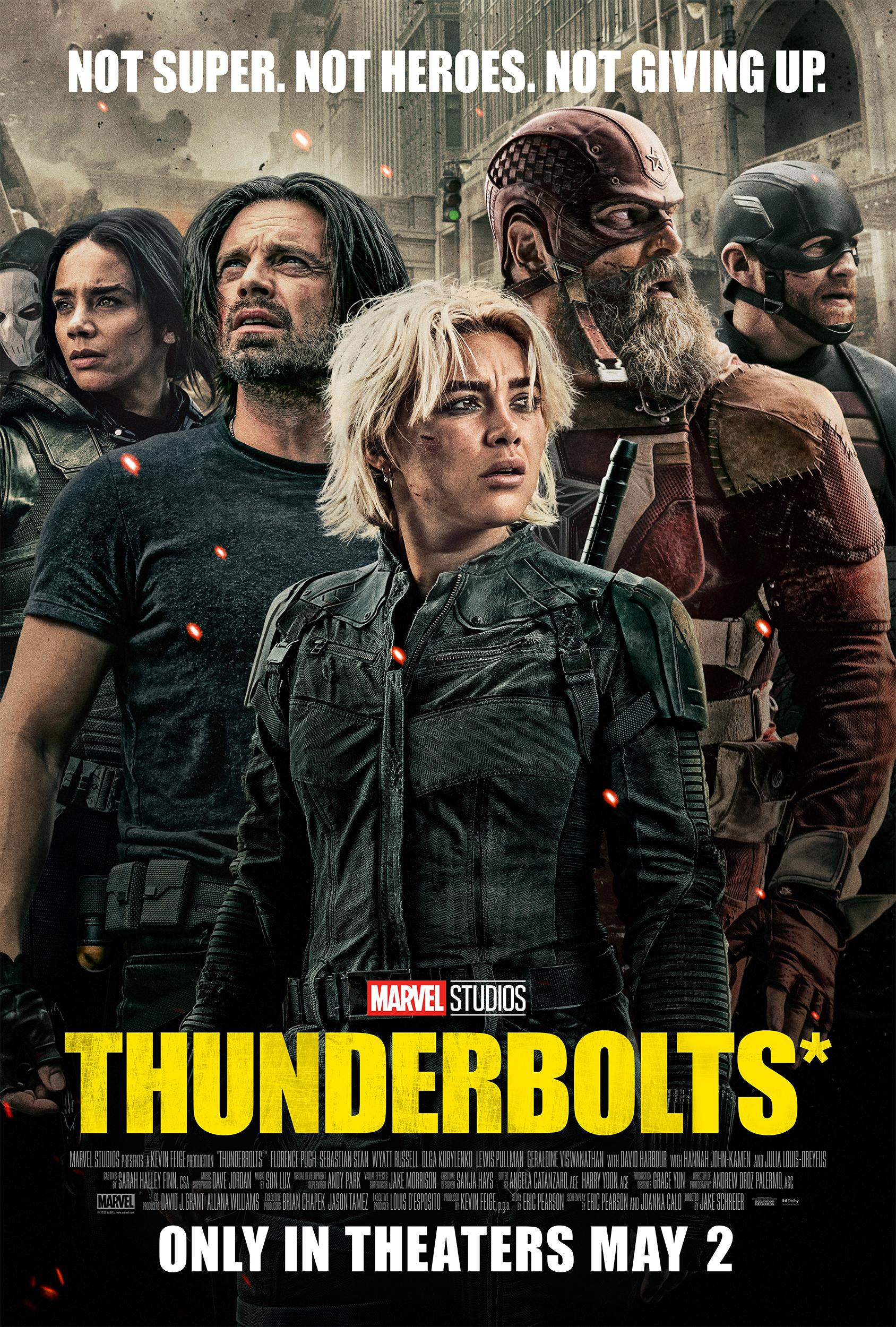
After being lured into a deadly trap by CIA director Valentina Allegra de Fontaine, a group of antiheroes form an unlikely team to bring de Fontaine and her destructive plan down.
Thunderbolts* is oozing with energy and a deep care for its characters, with a darker edge of corruption and death to its subjects. Contrary to this February’s Captain America: Brave New World, Thunderbolts* thrives by allowing its cast’s charisma to roam freely, led by the incredible Florence Pugh. This time around, Yelena is the film’s lead, and Pugh taps into the character’s core of depression and emptiness, including her tumultuous relationship with her father, former Soviet super soldier Red Guardian, played by the vivacious and hysterical David Harbour, longing for glory again. Wyatt Russell and Hannah John-Kamen are also utilized very well, while Sebastian Stan returns as Bucky, who leads many of the others through a similar emotional arc he’s learned his way through. Geraldine Viswanathan is also a standout as Mel, assistant to de Fontaine — played in such a juicy performance by Julia Louis-Dreyfus as a menacing figure who will stop at nothing to gain absolute power and avoid all consequences for it. Though Lewis Pullman’s performance doesn’t have the same loose charm we may have felt from him in Top Gun: Maverick and Lessons in Chemistry, he also well portrays Bob’s awkwardness and the darkness enveloping his character.
The best part about the film is how the characters interact as a team — their action and combat scenes are awesome, the way their differences interact through banter and humor is greatly entertaining, and the way they utilize their strengths to solve problems (albeit reluctantly) makes them unique. Some characters’ arcs could’ve used more closure, and the final act and climactic battle could’ve hit harder, and it’s not as stylistically irreverent as Guardians of the Galaxy or The Suicide Squad, but like those films, it’s about people who want anything but to be heroes learning to find redemption by embracing one another’s differences and company, and stepping up and do the right thing. It may not be one of the MCU’s most visionary installments, but also may prove to be one of their more rewatchable in the future, as its cast of misfits and contagious energy stand out. If these characters weren’t your favorite in the MCU or anything close, that may just change for good after Thunderbolts* — an extravagant action/comedy that may be short on some wildness or development in certain aspects, but is certainly big on the excitement and reward.
Years after defeating Thanos alongside the Avengers, the Guardians embark on an uncertain adventure to save one of their own from a monumental threat, meeting old and new friends and foes along the way.
It’s been almost a decade since James Gunn’s first Guardians changed the game for superhero movies — and so many copycats or inspirations have come to the mainstream since, or attempted to. But the camaraderie of the titular team has not gotten old, even if it’s their sixth overall appearance in the MCU, and likely their last. The goofy quirks of Gunn’s humor, poking fun at the mistfit-like attitudes of the characters, or his way of giving the outcasts a traumatic backstory and a chance to grow, breathe life and soul into nearly every frame of Vol. 3. It’s not necessarily the best of the three, but it is the most visually dynamic, with engaging settings and interesting close-ups or moving shots during the actions. Chris Pratt and Dave Bautista continue to deliver in the roles that have come to define their career and help shape their A-lister status, but it’s Karen Gillan and especially Pom Klementieff who get to really grow and steal the screen from them. Rocket is also given a heavy storyline that is as tear-jerking as it is revelatory for his character. Though Chukwudi Iwuji’s villain is very over-the-top, he’s also entertaining and works for the film’s purpose. However, the inclusion of Gamora’s alternate version from an Endgame timeline feels like the storyline that didn’t add too much to the film, and her original incarnation’s death in Infinity War still feels best left untouched as it hangs weirdly over her appearance here. Here, her character is more to serve Peter Quill’s arc or simply an excuse to have the awesome Zoë Saldaña around. However, Will Poulter’s presence is Adam Warlock suffer here despite the movie’s already long (yet breezy and earned) 150-minute runtime — though he’s built up as a threat to interact with the Guardians and make his own decisions, he’s left as a very basic side character who cracks a few jokes. The character deserved an awful lot better than he got, especially due to the great work Poulter does do with what he’s given, it’s just a shame his and Ayesha’s story set up from the post-credits scene of Vol. 2 gets the bare minimum payoff. In addition, a notable standout is Oscar nominee Maria Bakalova as the voice of Cosmo the Spacedog, a very entertaining critter who gets her deserved limelight.
The soundtrack in the last two films was dominant and diverse, practically its own character within the film and a driving force for Quill’s arc. The soundtrack in this movie definitely hits less hard and may have a few too similar songs, but it’s made up for with a few amazing needle drops that set the tone and immerse you in the moment. Most of all, the character’s dynamics are all so beautiful and the building of the action is the backbone of the film, rooted in the bond of this team that has strengthened and matured over a few films. Even if the first film is a beast that’s only rivaled by a few other Marvel movies for the title of the studio’s best film, Guardians of the Galaxy Vol. 3 has undeniable charm and is also one of the most emotional MCU films across all the phases. It’s one of their better post-Endgame works and a great big-screen watch for the visuals, heart, and cast of characters.
As the Wakandans strive to embrace their next chapter in the wake of King T’Challa’s death, Queen Ramonda, Shuri, M’Baku, Okoye and the Dora Milaje must band together with Nakia, T’Challa’s former lover and a War Dog spy, and CIA agent Everett Ross to forge a new path for their beloved kingdom.
Black Panther: Wakanda Forever had to decide how to face two immense challenges — following up a cultural phenomenon and one of the most popular and resonant movies in recent years, and doing it without its magnificent lead, Chadwick Boseman. The effortless charisma and commanding dignity Boseman brought with him are absolutely missed in this sequel, yet writer-director Ryan Coogler decided to use his loss to give the film a complex gravity and message about grief, legacy and moving forward. Not only does Coogler use the sequel to expand the scale from the first film into a glove-trotting political fantastical battle, but also as a means to explore new stylistic grounds, feeling more director-focused than any Marvel movie in a while.
The visuals and action manage to even outdo the excellent and versatile fights from the first film, and the pace is much more graceful than the tighter pacing of other MCU films from this year. The music by Ludwig Goransson has a language of its own, always surprising, entertaining, and hitting you hard. Goransson uses African, Latin, and electronic bases in order to create a score that builds off the one from the first. The cinematography is more intimate than in the last film, with the camera sometimes closer to the characters or letting the visuals feel more seamless rather than showy. The movie addresses our feelings of sadness about losing Boseman and T’Challa through the characters, but doesn’t linger in it or feel stuck in the past. Speaking of the characters, Letitia Wright is great as Shuri, who is forced to mature quickly after what she’s had to cope with here, but it feels like this entire world of Wakandans, even the lovable side character of M’Baku, is growing and getting wiser with time. Angela Bassett delivers a ferocious performance as Ramonda, and honestly some of the best acting this entire Marvel franchise has seen. Dominique Thorne also shines as a cheerful, lovable presence she conveys through Riri Williams. Lupita Nyong’o also provides warmth and elegance as Nakia, though Martin Freeman’s return isn’t exactly necessary and his role in the plot could’ve been combined with Nyong’o’s character. Now, how does one follow up a villain as resonant and scene-stealing as Michael B. Jordan’s brilliant Killmonger? With Namor, Tenoch Huerta delivers a kindness we haven’t seen in many villains before, while clearly being violent and vengeful in his methods while showing warmth and empathy towards his people. He makes Namor a memorable character whose backstory’s execution isn’t the most hard-hitting but whose developments are always interesting.
This movie is the most sophisticated work Marvel’s done in a while, distancing itself from reminders of the bigger universe and allowing Coogler and crew’s creativity run free and deliver spectacle that feels consequential and really sinks in. It’s refreshing to feel like a Marvel movie isn’t constantly working to check off boxes to set up a bigger universe and pander to the widest action movie fanbase possible — after all, the first Black Panther was all about making stories about POCs no longer niche. While the messages may not be as revelatory as in its predecessor, it’s a film that rivals the first in ambition and weight. Perhaps it resonates so well because we all feel like a world with Wakanda is an infinitely better one, and a world without its late hero is one that’s infinitely worse. Black Panther: Wakanda Forever demands your eyes on the big screen and an open heart, with the performances and style creating an action adventure with gripping and soulful humanity.
After the events of Avengers: Endgame, Peter Parker goes on a school trip to Europe with his friends, only to be recruited by Nick Fury to take on the Spider-Man mantle once again and team up with interdimensional hero Mysterio to fight new threats known as the Elementals.
Spider-Man: Far From Home marks the beginning of a new chapter for the Marvel Cinematic Universe, and had a lot of expectations to fill consider it not only has to follow the grand phenomenon that was Endgame but also follow up on the story of Spider-Man: Homecoming and make a story that still feels new and exciting. Well not only does Spider-Man: Far From Home live up to the expectations for a good Homecoming sequel but it also introduces new concepts and unexpected turns even after 23 Marvel films, proving that they haven’t yet lost their steam. Tom Holland still carries the film wonderfully and continues to convince me that he’s the best Spider-Man yet. Peter is now trying to hold onto his youth and is afraid to accept new and bigger responsibilites after losing an important figure in his life. Peter must learn to mature and step up throughout the film which makes for a strong arc in the film. Also great is his chemistry with Zendaya, who is also really great in her role as MJ, who we didn’t see enough of in Homecoming but is a leading part here. Watching their connection blossom throughout the film is really sweet and was done well by the writers and actors. Also really fun parts of the film are Jacob Batalon as Peter’s hysterical best friend Ned, and Jon Favreau as Tony Stark’s assistant Happy who is still played with plenty of charm, and he and Peter once again have great scenes together.
What director Jon Watts is once again able to do with this sequel is maintain that “high school movie” tone with Peter facing issues like bullies, crushes, etc., but Watts also makes sure to bring us a high-stakes superhero movie with threats and responsibilites that Peter must face as Spider-Man. He keeps the tone light and adds plenty of humor as we’re used to seeing from Marvel, and keeps the signature Marvel hero, villain, and conflict tropes. However, one thing I was underwhelemed by was the visual look of the film. Marvel has always impressed me with the production design, cienamtography, and visuals in their films, espeically lately with the gorgeous Captain Marvel and Avengers movies, but here the movie feels very boringly shot and there is no color scheme or visual style that will keep your eyes in awe like the past Marvel movies this year have. The battles often feel well-realized but the green screen also sometimes doesn’t blend in and the design for the Elementals villains as well as the final battle are also less impressive visually. Also, the fact that Sony oversees these Spider-Man MCU films while Disney controls all the others leads to some questionable or unexplained references to the bigger universe, which are sometimes welcome but sometimes a bit much or raise unneeded questions rather than serve as world-building. While Homecoming had fun small appearances from Iron Man and Captain America, here some of the connections to the rest of the MCU feel like Sony trying to constantly remind the world that their property is part of Disney’s Marvel universe as well. Other than the obvious impact Infinity War and Endgame have on the main character, some of this world-building raises more questions than it needs to and possibly tampers with the consistency Disney has been keeping so smoothly through its MCU films. I feel like there were also some underdeveloped plot points throughout the film, and they could have extended the runtime by only 5 minutes to help establish these more, like we don’t see much of how the world is readjusting after Thanos’ actions shook the universe, and we also hear peoople repeadetly mention a large character from Endgame but I think we needed a bit more about how Peter is affected by that character’s loss. Also, the timing of the release was way too soon (only 2 months) after Endgame, which was the big conclusion to many years of MCU films — so why not wait a bit longer and let us take in the first big chapter instead of diving right into the next one? Hopefully this won’t undermine the effect of Endgame as a finale as time goes by, because both these films are still great on their own. What Spider-Man: Far From Home does best, however, is remind us why we love this incarnation of the character and why he resonates with audiences, as well as provide new challenges and growth for the character as well deliver on the tone of a film that has to feel large-scaled on small-sclaed at the same time.
Spider-Man: Far From Home is a satisfying sequel that ups the scale and stakes for Spidey with more locations and more cdhallenging foes than before, even though it’s visually dull compared to the other big Marvel movies this year, and the pacing could’ve been slightly improved. However, the performances, storyline, and humor all deliver as expected and there’s an awesome mid-credits scene that changes the game for the future of Spider-Man.
Intergalactic adventurer Peter Quill finds himself the object of an unrelenting bounty hunt after stealing a mysterious orb coveted by Ronan, a powerful villain with ambitions that threaten the entire universe. To evade Ronan, Quill is forced into an uneasy truce with a quartet of disparate misfits – Rocket, a gun-toting raccoon, Groot, a tree-like humanoid, the deadly and enigmatic Gamora and the revenge-driven Drax the Destroyer. But when Quill discovers the true power of the orb and the menace it poses to the cosmos, he and his team must find a way to stop Ronan’s madness and save the galaxy.
The Marvel Cinematic Universe is improving as it goes. And this movie is definitely it’s best yet. I have to admit, it’s even better than The Avengers! It’s smart, funny, entertaining, and full of heart. The pace is good (it’s never too slow), the characters are all very funny, and best of all, the action scenes are extremely fun to sit through. It really has a Star Wars feel to it, with all the spaceship battles, the fact that the Guardians keep traveling from planet to planet, and I sort of felt that Ronan was sort of like Darth Vader, with a helmet, a low voice, and an ugly face.
One thing that didn’t turn out like I thought it would be but didn’t really bother me was that Thanos (a god-like figure who works with Ronan and is Gamora’s adoptive father) had a smaller role than I expected (just a one minute cameo), but that’s OK. Maybe he’ll have a bigger role in the Avengers 2!
My two favorite characters to see onscreen were Rocket and Groot, the hilarious duo who know how to kick ass. Lots of the other characters were also very charming and funny, especially Quill (the space outlaw who calls himself “Star-Lord”).
In conclusion, Guardians of the Galaxy is brilliant, smart, wonderfully silly, and is as entertaining, awesome, and fun, as any other Marvel movie. I would recommend it for any Marvel movie fans!







 filmtoppings.com