Rachel Morrison impresses in her touching and exciting directorial debut. The film focuses on Claressa Shields, the only American boxer to win a gold medal at the Olympics — let alone at age 16!
Morrison’s energetic style and the vibrant soundtrack give a Creed-like energy to The Fire Inside, a film that portrays the city of Flint as the ultimate underdog and gives the audience characters we can really interact with and understand, even if we don’t always agree with them, such as Claressa’s parents. Ryan Destiny shines in her first major role, giving Claressa Shields a titular fire and rageful drive to win that makes her fascinating and lovable.
What makes the film worth the price of admission is watching Brian Tyree Henry work his magic in an awards-worthy powerhouse of a performance. As Claressa’s coach Jason, Henry not only extends an enduring tough love that anchors the film, but makes the audience fall in love with the character and wish for him to be our coach and grounding force. Henry’s one-of-a-kind humanity and charm makes Jason lovable and riveting, and we as an audience deeply care for him and understand his decisions even when Claressa might not.
As for the film as a whole, there are many familiar beats to other sports and boxing films that it touches on, but it never loses its heart and engagement and even subverts the typical uplifting sports film structure to show that its true soul was in this coach-student relationship that feels like so much more to us. It’s not going to rank among the greatest boxing pictures, but surely is worth a watch for a feel-good story.
It’s so easy for erotic thrillers to fall too far into camp, or take themselves too seriously, which has caused many, such as Unfaithful or Basic Instinct, to fall into either melodrama or laughability. Babygirl not only succeeds because of its layered themes, but also because of its irony. It feels like a film that has to be made today. Only Halina Reijn behind the camera could’ve made Babygirl feel as audacious as it is without the moral discomfort taking over. The direction, cinematography, editing, and score pack surprises and evolve with the film as the story descends into murkiness and the situation gets increasingly out of hand.
Nicole Kidman gives her most daring performance in years, a character that on the page seems like many others she’s played, but is ultimately anything but. The script explores Romy’s inability to recognize her freedom to choose after an awful decision, as she throws herself into a situation she suddenly can’t escape. The film dives into power and gender dynamics, workplace standards, and the murky idea of submission. Is power the ability to lie? To be reckless? To screw up, or even give that power up? Are those powers and luxuries different for women, even today?
While Kidman is incredible, Harris Dickinson is equally magnetic. He’s equal parts silly and brutish, and the tough masculinity bursts out of his awkward softness, indicating a desire to pin down and control. Their dynamic is fascinating, but the movie brilliantly leans into camp humor during some of the more cringey scenes, without it overshadowing the mature undertones. Antonio Banderas also has plenty of strong moments, playing Kidman’s husband, a complex, empathetic character in his own right. Sophie Wilde shines as well, and her scenes are brilliantly played and key to the film’s themes.
The film’s thrills come in this fusion of feelings we have towards these characters, and how easily it all escalates. Reijn is clearly having fun with it all, whether the shots of corporate Manhattan, the mirror she holds to these characters, or the remarkable soundtrack choices. The runtime is enticing and you never quite know what you’re about to get. There’s nuance to unpack and never provides easy answers to its questions about its workplace and familial settings, but it all feels so effortless that you never feel like the movie’s working too hard to make you think, laugh, or have fun.
Rafiki tells Simba and Nala’s daughter Kiara the story of her grandfather Mufasa, the once king of Pride Rock, and his upbringing with his brother Scar.
Mufasa boasts a beautiful cinematic experience that’s best experienced in 3D. The visuals are transporting with their photorealism and colorful sceneries of the wild world, and get to develop new settings without behind held back by recreating scenes from another movie the way 2019’s The Lion King was. That alone warrants the theatrical experience here, and not much else. Though Mufasa isn’t remaking another beloved movie anymore, it’s still restrained by the same lack of characterization that made the photorealistic animals feel emotionally distant in its predecessor. The animals can’t quite emote like they can in other animated films, and this creates a tonal dissonance between what the original 1994 film set for the franchise and the photoreal road the filmmakers are going down now. Aaron Pierre’s gravitas gives Mufasa just the right profundity, but Kelvin Harrison Jr., who’s a wonderful actor, feels rather miscast as Scar, a character who feels inconsistent both performance and character-wise. The problem with the rest of the characters is that save for Mads Mikkelsen’s villain, who’s basically Scar from the original minus the intrigue, everyone is a younger version of a Lion King character, and are stuck doing impersonations of the actors that came before them. There feels like there is nothing to discover emotionally, and the backstory behind the characters doesn’t really enrich what came before rather than just filling in some logistical gaps, all of which form a very cliche story. Not to mention, Billy Eichner and Seth Rogen as Timon and Pumbaa’s gags have been done to death and annoy more than they charm.
Though this one isn’t following the same story of another film beat for beat the way The Lion King was, that movie at least had the advantage of inheriting phenomenal songs from the original film. Lin-Manuel Miranda’s music here is incredibly lacking, with every song feeling derivative of a song from its predecessor, or even more recent Disney films. The worst part is, despite some of the action being visually stunning, the musical sequences are weakened because of a lack of connection to the animal characters who are less animated when they’re made to look real. If this made the 2019 film feel cold to you, this one won’t feel any more energetic. The film opens with a powerful tribute to James Earl Jones, the original voice of Mufasa — the fact that that’s the most (and maybe only) emotionally touching part of the film is very telling. Despite stunning visuals, including some beautiful sequences of the animals in the snow, Mufasa doesn’t offer much originality from a thematic, character, or musical point of view, and everything underneath the breathtaking aesthetic is easy to forget after watching.
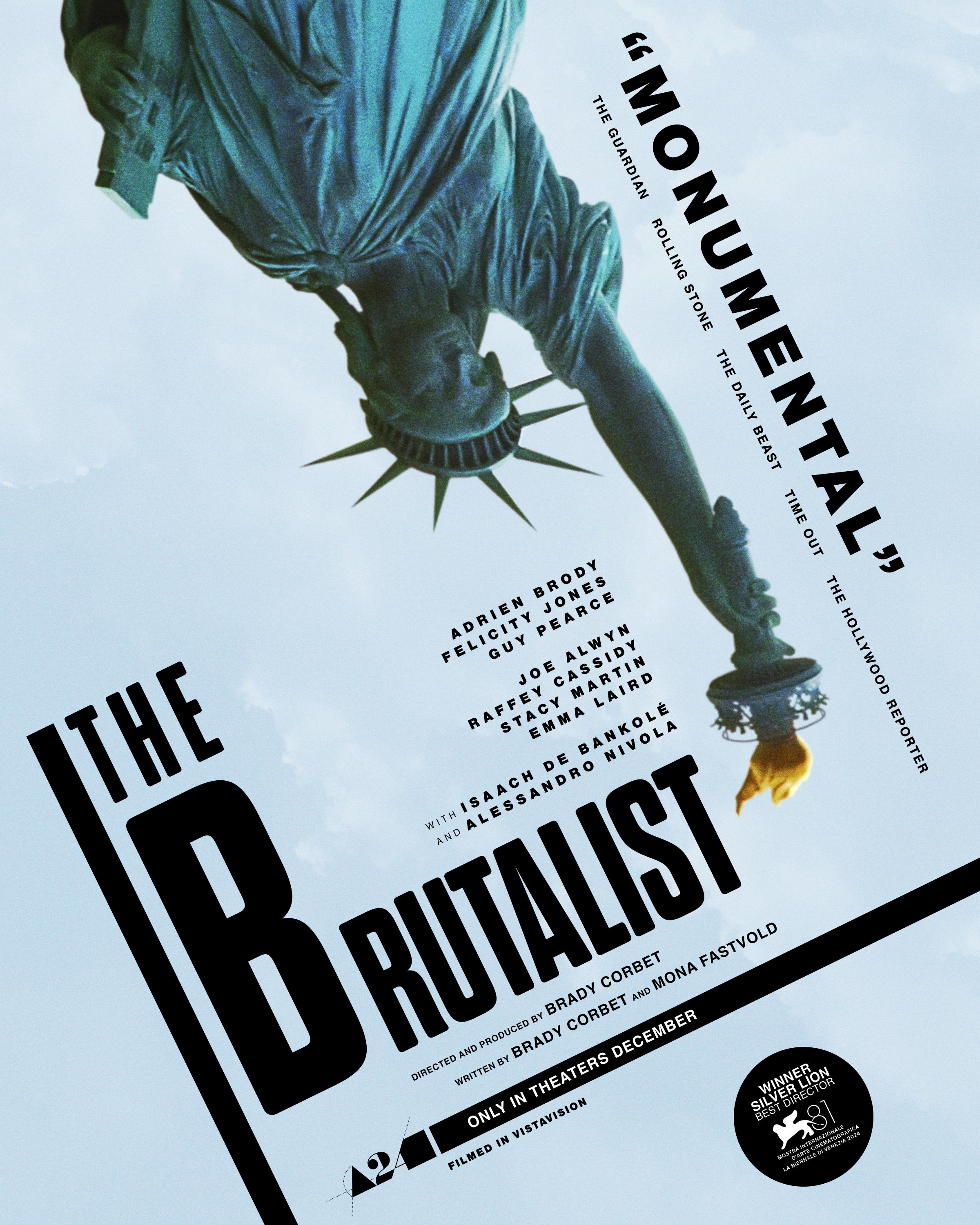
There’s no shortage of incredible films covering the dark chapter of humanity that is the Holocaust, not to mention one starring The Brutalist’s Adrien Brody. That said, no film has asked in this fashion what comes after a film like The Pianist, or even The Zone of Interest — life after the war ended for survivors of one of humanity’s great atrocities, including mass immigration to America, was no “fairy tale” happy ending. Instead, The Brutalist portrays mere life for a Holocaust survivor as what it really must have been: an endless waking nightmare. An early shot sets the tone perfectly: our main character Lazlo Toth, is on a boat arriving in New York, only the camera frames the Statue of Liberty sideways and shakily — a look into Lazlo’s hidden perspective of the world ahead of him.
Brody’s performance is integral to our journey with the film. The unlocking of Lazlo’s ambitions is gripping for the audiences, but even more so is his struggles with his surroundings and his outlook on his sense of self, which has been fractured after the war, as for every survivor. Brody’s chronicling of a fictional man’s journey, who is brought to life with such pain and understanding that some viewers may be surprised this isn’t a biopic, is a tremendous performance and some of the decade’s most remarkable acting. When Lazlo is cold, angry, or hard to read, we still understand and care about him because he’s incredibly delicate and empathetic. Felicity Jones is heartbreaking and vulnerable as Lazlo’s wife, whose tenderness anchors him, while she goes against odds to stand up for him when even he can’t. Guy Pearce is riveting and unforgettable as a larger-than-life man who starts an almost angel in Lazlo’s life, sweeping him from the poverty of immigrant life and giving him a canvas for glory and success. What’s key to the intrigue is that Pearce’s character isn’t so easy to read. He’s elegant, but also temperamental and has a sick idea of power and control.
The film captures a chapter in history in its grandeur, powerfully covering Jewish assimilation in America, and how willing America is to truly let others. There’s a sense of hopelessness to the struggles they endure, as the promises of immigration prove more difficult than meets the eye, but not just that. There’s a feeling of horror underneath, even when there isn’t a moment of violence, and you’re simply witnessing the towering cinematography and hearing the booming score. Brady Corbet brilliantly hides discomfort and terror that’s itching to break out of this historical drama about architecture, and it seeps deep into its audience while never quite making it to the surface in a literal sense. Still, the gorgeous shots, magnificent production design, and undertones of every scene grip us throughout the long time it depicts.
The ending is delivered in a way that’s tonally unexpected and polarizing compared to the rest of the film and hits you like an emotional sledgehammer. It makes the entire experience more heart-shattering and important and is impossible to forget. The Brutalist is a devastating and sweeping epic like we’ve rarely gotten in recent decades, with a look and feel that stuns as much as it quietly terrifies, capturing an entire era with a long but mostly earned runtime. Like the big epic films like Lawrence of Arabia and Schindler’s List, The Brutalist is massive and transformative and is one of those films that’ll stay with you forever.
Sergei Kravinoff, the son of a crime lord, develops a gift for fighting for and defending wild animals, but soon old and new foes from his life converge as he must embark on the most dangerous fight of his life.
Explaining the movie just then was a difficult task, not in an effort to avoid spoilers of the premise, but because the movie is so shallow it’s hard to really try and sell. It doesn’t quite make much sense, but worst of all, it isn’t fun to sit through. Weak character motivations and a hideous visual style plague this so-called origin story for another Spider-Man villain who Sony tries to manipulate into an antihero, rather unconvincingly. Aaron Taylor-Johnson’s casting as the titular character could’ve been promising in another movie, but he instead looks bored with the material he’s given, and who can blame him? Ariana DeBose and Fred Hechinger are also trying to salvage characters given no weight, but Alessandro Nivola, Christopher Abbott, and Russell Crowe are all awful. Nivola especially is given a lot of screentime but his slimy, unintimidating villain is flat and downright unwatchable.
Kraven, who in the source material is a terrifying brute, is supposed to be a much more sympathetic protagonist here, but we’re never given much reason to like him besides the fact that he’s played by a charismatic, good-looking actor, who isn’t really allowed to exercise too much of that charisma here. The action scenes are ruined by what looks like unfinished CGI, and every character’s look and dialogue is annoying, besides a moments Oscar winner DeBose has that are tolerable at best. The plot points are repetitive, the themes are undercooked, and the overall style is dull and feels more like test footage than a finished film that this character deserves. Not to mention, there’s some painfully obvious dubbed-over lines, which was also a glaring issue in Sony’s Marvel spin-off Madame Web from earlier this year. There’s no real reason here to root for any sort of journey here, as there’s never a promise of any real reward. The film pretends to be gritty, but only ends up being unintentionally humorous. It’s a fittingly empty end to Sony’s Spider-Man Universe of villain spin-offs that like its predecessors in the franchise, you’ll be begging to forget the moment it’s over.
Nickel Boys tells of the powerful friendship between two young black men navigating the harrowing trials of a notoriously abusive reform school together in Florida. From that description alone, this may not sound like such a radical work of cinema quite yet, until you learn the key piece that defines it all: the movie is filmed completely from the first-person point-of-view of the teen friends and protagonists Elwood and Turner. Through this effect, you feel like you’re living a lifetime with them, traveling back to the 1960s, particularly into some of the deepest, darkest holes dug by America’s foundations that ruthlessly and systemically discriminated against people of color. It’s an invisible feat to get your audience to immediately care about a character whose face you barely see, but through Elwood’s perspective, we’re pulled and immersed into a heart-stopping time capsule. This experience may feel jarring at first, and the editing does occasionally break the gimmick’s own rules, the approach enhances the film’s thematic weight. From the cast, Aunjanue Ellis-Taylor is in particular brilliant in a small but unforgettable performance as Elwood’s grandmother.
RaMell Ross brings us into the sensory experiences of the characters with convincing production value, showing us subtly a world that ignores and persecutes teenagers of color, with a system built to see black men as guilty before charged and unworthy of the same chances. It’s also a film about how trauma can root itself into the soul and reshape a person’s being and outlook. The final act in particular is unforgettable and will stick with you for a long, long time after the credits roll. Nickel Boys is important, daring, and affecting in a deeply haunting way, and is a must-watch essential film of the year.
Moana and her people have now rightfully reclaimed their place in history as wayfinders who sail the ocean in search of exploration. One day, Moana receives a call from her ancestors to embark with an unexpected crew across dangerous waters, and reteam with her old friend, demigod Maui, for their most challenging and important quest yet.
The first Moana remains an unforgettable and impactful film among Disney’s recent animated films. This sequel retains everything that made that first film look so gorgeous, and builds on the dynamic colors of the ocean and its mystical findings. The transformative magic of watching the first film, though, is missing in this sequel that can’t quite justify its existence. Moana doesn’t feel like a film that has sequel potential built into it, as opposed to even other Disney sequels like Frozen II and Inside Out 2. Watching the sequel unfortunately didn’t convince me otherwise. Though its still charming and has some fun to be experienced, it’s basically retreading the same beats from the first film.
Auli’i Cravalho proves again why she’s earned the spotlight in her wonderful voice performance as the titular character, but Moana lacks any actual internal conflict this time around — there’s even an opening song all about how she’s finally become who she’s supposed to me, and the movie never ends up convincing us that she does need to change and grow, just to remember who she’s already become. Speaking of the songs, there are only two that manage to stand out at all, “Beyond” and “Can I Get a Chee Hoo?”, but even those are stuck in the shadow of the overly similar — and far more original — “How Far I’ll Go” and “You’re Welcome” from the first film. There are a few laughs and solid new characters, including Moana’s trio of new voyagers and companions, and an unexpected antagonist. However, the key piece that’s missing from Moana 2 is any sort of feeling that something is at stake here — what happens to Moana’s people, the ocean, or even her own internal journey if they fail this mission? What does Moana have to learn here, now that she’s embraced who she needs to be and discovered her destiny? The answers to these questions are unfortunately insufficient and affect the excitement levels older audiences may feel watching it.
Moana 2 is colorful and has its share of sweet moments (it certainly has way more soul than Strange World and Wish), but most of what works about it is drawn from the first film, including its beautiful depiction of the ocean, tributes to Polynesian culture, and lovely characters. Rehashing the incredible themes, numbers, and world-building doesn’t work, though, without the same spark of originality and wonder that made us never forget Moana. Whether you’re going in expecting a serviceable adventure aimed towards younger audiences or just unsure why this movie needed a sequel, Moana 2 is unlikely to change your mind.








 filmtoppings.com