Beetlejuice Beetlejuice

The Deetz family returns after a family tragedy to the old home they left behind in Winter River. But Betelgeuse returns into their lives — just as Lydia Deetz feared — when her daughter Astrid accidentally lets the dead loose.

The long-awaited sequel to one of Tim Burton’s films that’s best stood the test of time — and one of his most purely fun — comes over 35 years after its predecessor. It offers the same classic Halloween feeling audiences enjoyed about the first film, and more of pretty much everything else that movie had as well, for better or worse. The music, comedy, and practical effects all work just as well so many years later, and there’s even another phenomenal musical number. It’s delightful to see Michael Keaton, Winona Ryder, and Catherine O’Hara back in their roles, and just as great at them. The heart of the film comes from O’Hara and Jenna Ortega; O’Hara’s goofy yet conscious grandmother provides so many laughs and her energy as an actress stands out, while Ortega perfectly brings a deadpan charm that’s visibly intrigued but not too shocked at all the insanity she’s yanked into.

The humor often hits the mark, including the titular character’s outlandish remarks and plenty of physical and cynical comedy in typical Burton fashion, but the movie does make a few missteps as the runtime goes along. Its most glaring one is introducing an antagonist played by Monica Bellucci in an incredibly strong first scene for the character, and then hardly utilizing her until much, much later. Though the mother-daughter dynamic between Ryder and Ortega is sweet, the overall objective of the story becomes muddled in the later act. It won’t pack any surprises for fans of the first film, but is entertaining and good-hearted enough to offer some creepily comic fun.

Deadpool & Wolverine

Deadpool enters the larger Marvel Cinematic Universe when he’s called upon by the TVA to save his timeline from erasure — or in other words, a Disney acquisition.

Deadpool continuing into the larger MCU, and with a larger sandbox to reference and joke with, only feels right, with the character reminding us that anything and everything in the world of entertainment need not be taken so seriously. Excitingly, it’s not just the convergence of the Fox Marvel heroes and the MCU, but also Hugh Jackman’s return as Wolverine, whom Deadpool has already poked fun of in his films. The film asks, what if two people who can’t die and have no temper but are polar opposites need to get along (but can’t)? That buddy comedy aspect drives the film, as do the multiverse-level visuals. In addition to Reynolds’ increasingly impressive commitment to one of the most foul-mouthed heroes to ever wear spandex, and Jackman’s rage-filled but emotionally charged take on a Wolverine different from the one we parted ways from in Logan, Emma Corrin shines and never feels lesser than the two A-listers when on screen with them. Corrin gives a delightfully cruel and loose performance as Cassandra Nova, and certainly not right-minded, almost like a Mad Max character given Professor X’s powers. Matthew Macfadyen also gives the film some great fun as a TVA agent whose a little murkier than the ones we met in Loki.

The film’s writing for its lead character doesn’t really hit hard on a deep level, and Wade’s relationship with Vanessa feels like a superficial conflict thrown in for the sake of necessity. Their arc worked way better in Deadpool 2, and here, this variant of Logan is by far the more inviting emotional aspect of the film. Despite Deadpool’s growth as a person taking a backseat, this is a film where the experience is reliant on the action, humor, and surprises, and it delivers on all three fronts. The action scenes are creative, eye-popping, and cheerfully graphic, from an opening that’s one of the most brilliant fight scenes in the trilogy to much, much more that comes after. The jokes come at light speed and have something belly laugh-inducing for everyone, including references to the actors’ filmography. The film also embraces the idea of the multiverse with cameos to behold that’s been kept secret from the marketing for our enjoyment in the theater. It’s probably why Deadpool & Wolverine, despite not having a marginally original story, is such a memorable crowd experience and action blockbuster that does not hold back, continuing to push the limits of how much the blood, raunchiness, and self-awareness can surprise and amuse us. But it’s not just irreverent for the sake of it — the humor and energy of the film brilliantly mesh with the CGI-heavy worldbuilding of the MCU, so come the chemistry that’s promised from the title and meta potential of these franchises colliding, and though that’s the mainstay here, it’s more than enough devoted fans of the superhero genre and the collective theater experience.

Fly Me to the Moon

Marketing specialist Kelly Jones and launch director Cole Davis cross paths at the Kennedy Space Center and sell America the race to put a man on the moon. But things get truly complicated when NASA orders Jones to come up with a contingency plan to mankind’s greatest achievement.

Scarlett Johansson and Channing Tatum shine in this romantic star vehicle set in the backdrop of the space race, but the film flourishes most when focused on its playful interactions with history and period mood. Tatum is particularly strong as a character whose authority is thrown into messy situations, and Jim Rash is a hilarious standout as a director friend of Johansson’s character. Ray Romano also gives potentially his most delightful performance since The Big Sick as a NASA scientist who gets some of the film’s most touching dialogue. The $100 million budget also pays off as you feel the grand scale of NASA’s sites and activity, as well as the gravity (no pun intended) of this place and its happenings for the world and human possibility. Some scenes may fall into the shadow of First Man due to some of the same events being covered, but it’s not really fair to compare any film to that one technically. The film work’s best when embracing this ambition alongside it’s bright, comedic tone, and this energy creates an engaging watch, even when the film is low on substance — or the substance to the lead characters just isn’t that memorable. Still, Johansson and Tatum’s performances are enough to entice the audience and though the editing is a bit aggressive at times, and the film doesn’t leave you with as much food for that as it does toying around with history, it brings its 60s time period — and the wonder that came with NASA at the time — to life with enough flare to induce smiles, laughs, and a nice trip to the movies for all.

Inside Out 2

Riley has just turned 13 and has finished middle school, and Joy, Sadness, Fear, Anger, and Disgust are continuing to guide her through the ups and downs of growing up — if only things didn’t get so complicated when Anxiety arrives with a new wave of emotions to take over.

Inside Out 2 certainly doesn’t reinvent what it inherited from its predecessor, but it certainly expands on it — and when your predecessor is one of the most brilliant animated movies in Pixar’s history, who are we to complain? The beautiful animation builds the corners of the world (or should I say, Riley’s brain) with an endless captivation. The visual look and feel of the first film was a huge part of what made it so magical and immediately timeless, and this movie captures that with a new breath of life. The world-building is also filled with clever puns and fun corners that we may often relate to. Amy Poehler again commands the ship as captain of this film’s cast of emotions, and newcomer Maya Hawke is terrific as Anxiety, who shakes things up for Riley and the emotions in a frustratingly messy way. Who would’ve thought? Ayo Edebiri also shines as Envy, as does Adèle Exarchopoulos as Boredom.

Seeing the emotions come into conflict and/or work together to act and react in the best ways for Riley is entertaining, but the film never loses the first movie’s relentless humor as well. There’s a clear agelessness that comes with the story and themes of the film. In the nine years since Inside Out was released, I feel no less that Inside Out 2 is aimed for me than when I watched the first one on the big screen. The universality of anxiety and unconditional self-love can be deeply felt by any audience member of any demographic, and start meaningful conversations between anyone. With that, we’re reminded of the purpose of some of Pixar’s greatest hits. Though watching Inside Out in 2015 was a magical experience that maybe no film will ever replicate, this sequel hits all the right notes in the best way we could wish for. It’s a funny, cheeky, gorgeous, and profound emotional release and Pixar’s best film since Soul.

The Fall Guy

Colt Seavers, a down-and-out stuntman, must find the missing star of a new blockbuster film he’s doubling on, while (hopefully) winning the director (and his ex-girlfriend)’s affection back.

David Leitch continues to be a leading voice in action movies with his creative and passionate voice for action and comedy that often turns out star-studded and visually appealing. Much of the film’s charm comes from Ryan Gosling’s brilliant turn as Colt. Like his Oscar-nominated Ken in Barbie, Colt is a sad shell of a “cool guy” who’s too evidently madly in love. Gosling’s comedic timing is at the lightning speed of his Ken, or Holland March from The Nice Guys, and his big personality infuses Colt with a foolishly endearing heart. Emily Blunt also gives one of her most entertaining performances of late as the romantic lead, and Winston Duke is also loads of fun as Colt’s best friend and the film-within-a-film’s stunt coordinator, while Aaron Taylor-Johnson, Hannah Waddingham, and Stephanie Hsu also round out the stellar cast. Waddingham in particular is very extravagant but delightful as Gail, the producer of the film Colt’s working on.

The most clever and thrilling part of The Fall Guy is that Leitch makes the movie stunt-filming scenes as high-stakes and exciting as the actual action scenes of the film. The great scale, dedication, and sound effects make shooting an action movie stunt feel like the incredible, hard-achieved feat that it really is. Additionally, the lightspeed humor feels effortless thanks to the writing, editing, and the cast’s delivery. The lively soundtrack does have a few generic and overused selections, but it’s not enough to sink this smooth romantic action comedy where all the different genre pieces play off each other pitch-perfectly. The director’s career as a stunt coordinator is made evident by the love and tribute to the stunts community here, in this blockbuster that’s hilariously pleasing and greatly worth the big screen price of admission.

The Ministry of Ungentlemanly Warfare

Guy Ritchie’s latest action film is loosely based on true, mostly encrypted stories, in which the British military recruits a small group of highly skilled soldiers to strike against German forces behind enemy lines during World War II.

Guy Ritchie seems to be racking out more movies than some of his fans will be able to keep track of, but among a slew with varying qualities, this one may end up being looked back at as one of his most entertaining films ever. Ritchie imbues the screen with an Inglorious Basterds-like irreverence to its Nazi-killing action. The WWII battles are swiftly edited and have action sequences that’ll make you cheer with glee at the bad guy body count and the different ways they get killed by the titular heroes. Henry Cavill leads the pack with a similar irreverence he gave Ritchie’s The Man From U.N.C.L.E., but with an even rougher edge to his badassery. The ensemble of Eiza Gonzalez, Alan Ritchson, Henry Golding, and Cary Elwes all give the film a liveliness that makes up for a lack of uniqueness to them, as well as a menacing Til Schweiger who maintains a strong presence. Unlike last year’s Operation Fortune, the film’s witty humor matches the extra wicked energy the director is known for, but it may lack character depth for some viewers. Most of the characters have little substance besides “recently incarcerated” or “they’re crazy”, but their outlandish personalities make up for that in the case of this film. The soundtrack choices aren’t always on-point, but the Western-inspired music usually adds to the film’s sharp direction. The film also doesn’t manage to always balance the different moving plots seamlessly, as Ritchie sometimes can’t help but indulge too much in his trademark banters which can sidetrack, but ultimately culminates in some strong tension in the third act. The Ministry of Ungentlemanly Warfare perhaps achieves what Matthew Vaughn’s The King’s Man failed to do — turn covert misfit spies into World War heroes and make the journey feel exciting and earned on the way. Ritchie is no stranger to the approach he set out to achieve here, but he manages to balance out his quirks with an excellent style, an interesting mission and cast of characters, and a rewarding catharsis when the action and comedy hit their peaks, as you might not want the fighting to stop out of sheer Ritchie delight.

Ghostbusters: Frozen Empire

The Ghostbusters have reestablished themselves as the heroes of New York City, but the city soon faces its greatest threat yet when an ancient artifact unlocks a destructive force.

Ghostbusters: Afterlife was a solid tribute to the heart of the original film. This sequel has all the ingredients with none of the direction. The cast still has that charming energy, particularly the Spenglers played by Carrie Coon, Finn Wolfhard, and McKenna Grace (with Paul Rudd stepping into the new stepdad role). Grace is the most interesting part of the film, but her role as the protagonist is watered down by an overabundance of characters. Dan Aykroyd, however, is very enjoyable in his role, as is Ernie Hudson, but the film tries to balance too many of these people, and the original cast ultimately was only there for fan service in a lesser way than the last film. Not to mention, Kumail Nanjiani is usually a standout in any film, but his character here is uninteresting, save for a few laughs. The action has some fun a bit of a retro vibe, with solid SFX editing as well, but the film’s runtime wanders through C-level subplots and the pacing lacks a consistent excitement. When we finally get to the villain, its yet another faceless ancient giant with apocalyptic intent, and the visual effects of the ghosts are also quite lacking. Ultimately, the film settles for a lot of the same, but its the sluggish pace that makes it a lot hollower and not as lively or meaningful as before. This may just be another instance of a beloved franchise going on for one too many films.

Kung Fu Panda 4

This is a franchise that’s stood the test of time in the world of modern animation, and Jack Black has always been the core of why Po has resonated with audiences for so long — and perhaps the main reason this film manages to entertain at all. Though Kung Fu Panda 4 still has a vibrant and silly energy, it no longer manages to up the ante as each of the past installments did. Though Jack Black is always a huge delight as Po, and possibly one of the best animated franchise leads we’ve ever been graced with, the film often struggles to justify its existence because Po’s journey and growth doesn’t feel as natural and potent as it did in the other films. His struggles to embrace change and pass down the mantle of Dragon Warrior don’t feel fleshed out or as vital to his path. Awkwafina also gives one of her more memorable voice performances and is a great pairing with Black. It’s fun to see Viola Davis as menacing and cunning as she is here, but we don’t spend enough time with the Chameleon to buy her motives and for her to resonate with us. Her characteristics ultimately feel derivative of Lord Shen and Kai from the other movies.

The film embraces the faster pace and editing that worked in the third movie, but the editing decisions sometimes feel even too cartoonish and take you out of the moment. The animation is still lively, but looks a little simplistic compared to the beautifully detailed skies and characters in the last two films. There’s also a side plot that didn’t need as much time as it got, and some inconsistencies with the rules of this world of kung fu that may clash with the rules from the other films. The explanation for the Furious Five’s absence also feels tacked on and too evidently a behind-the-scenes thing. The action and looks are always fun, as is Jack Black being so committed to bringing us all joy and laughs. Is it a fun time in the Valley of Peace? Sure. But it’s clear that the franchise may be out of things to say as it feels we’ve reached the epilogue chapter here.

Drive-Away Dolls

In Ethan Coen’s latest road crime comedy, Jamie has just broken up with her girlfriend, while her best friend Marian needs to relax. In search of a fresh start, they embark on an unexpected road trip to Tallahassee. Things quickly go awry when they cross paths with a group of inept criminals.

Leave it to (one of the) Coens to excellently capture yet again this style of crime films that they popularized in the first place — sharp dialogue, exaggerated violence, and crazy mishaps and coincidences that drive the plot forward. Margaret Qualley and Geraldine Viswanathan shine and are wonderful together as two women who want to be young, have fun and score some girls while they’re at it. Viswanathan in particular is terrific as the shier of the duo who’s also the source of some of the film’s funniest moments. Beanie Feldstein is also very funny — as she always is — in a prominent supporting role, not to mention a few A-listers pop their heads in for some great appearances.

Drive-Away Dolls is really carried by its quirky style is purely and unapologetically fun; nothing more, nothing less. But Ethan Coen is such an expert at making films that are fun with this amount of cleverness and delight that it’s no surprise. The two leads’ wise-cracks and chemistry together are so lovely and irresistible that there isn’t a dull moment with them on-screen, though the hypersexualized nature of the film’s plot, especially the second half, may turn some viewers off. The last act does feel very rushed and doesn’t conclude the story between these two women as smoothly as I wish it had; it’s almost like the movie was begging for just another 10 minutes to end things in a more vindicating way. But for Coens fans, this queer buddy comedy isn’t one of their best, but absolutely ridiculous and hilarious with two memorable lead performances and not much else we could wish for from the crazy style and cast.

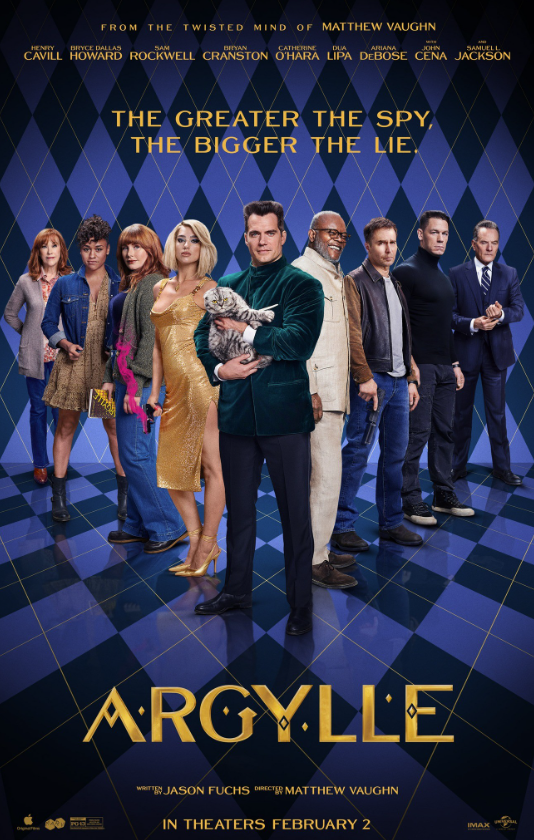
Argylle

Elly Conway is the reclusive author of the Argylle spy novels . Soon, she realizes the plot of the new book she’s writing starts to mirror real-world events, as a global spy syndicate starts to come after her.

It’s always a blessing when Matthew Vaughn gives us a glimpse into his twisted mind with his witty and bombastic action scenes, and Argylle has a few of those, but it’s everything else that disappoints. Vaughn directs with a love for spy material and cartoonish entertainment mixed with modern, meta flare. The script, however, completely misses the mark and looks the commanding energy that his Kingsman had. Even Sam Rockwell, whose charm and goofiness often comes effortlessly, has to work with dialogue that falls flat and the attempts at humor don’t manage to illicit a response. Though Henry Cavill has some fun and Bryce Dallas Howard tries her best in the leading role, there’s more left to be desired in Ariana DeBose, John Cena, and Samuel L. Jackson’s screentime. Bryan Cranston’s villain may be the weakest link of the cast, as everything he’s given to do is annoyingly generic.

The movie’s downfall is also its ambition, which is often what lifts Vaughn up above the rest. The ludicrous twists are executed in a head-scratching way, and all the film’s rules or explorations of fiction vs reality are thrown to the side for more frustrating decisions that make its lead character less interesting. The pacing also suffers greatly in the film’s second half, the end of which sees us getting a few of those glorious scenes of carnage Vaughn’s known for, which still feel softened compared to what they could’ve been due to the PG-13 rating, but are delightfully exaggerated and have great soundtrack choices. By then, however, the journey to get there is simply exhausting and it may be too little, too late for many viewers.

Argylle is a massive disappointment in which a singular director brings his trademarks to the screen yet again, only this time without the laugh-out-loud glee or the clever script that usually support his vision. Its ambition unfortunately exceeds its grasp, and its inconsistent and convoluted execution make this invitation to take the world a little less seriously with Matthew Vaughn a sadly unrewarding one.