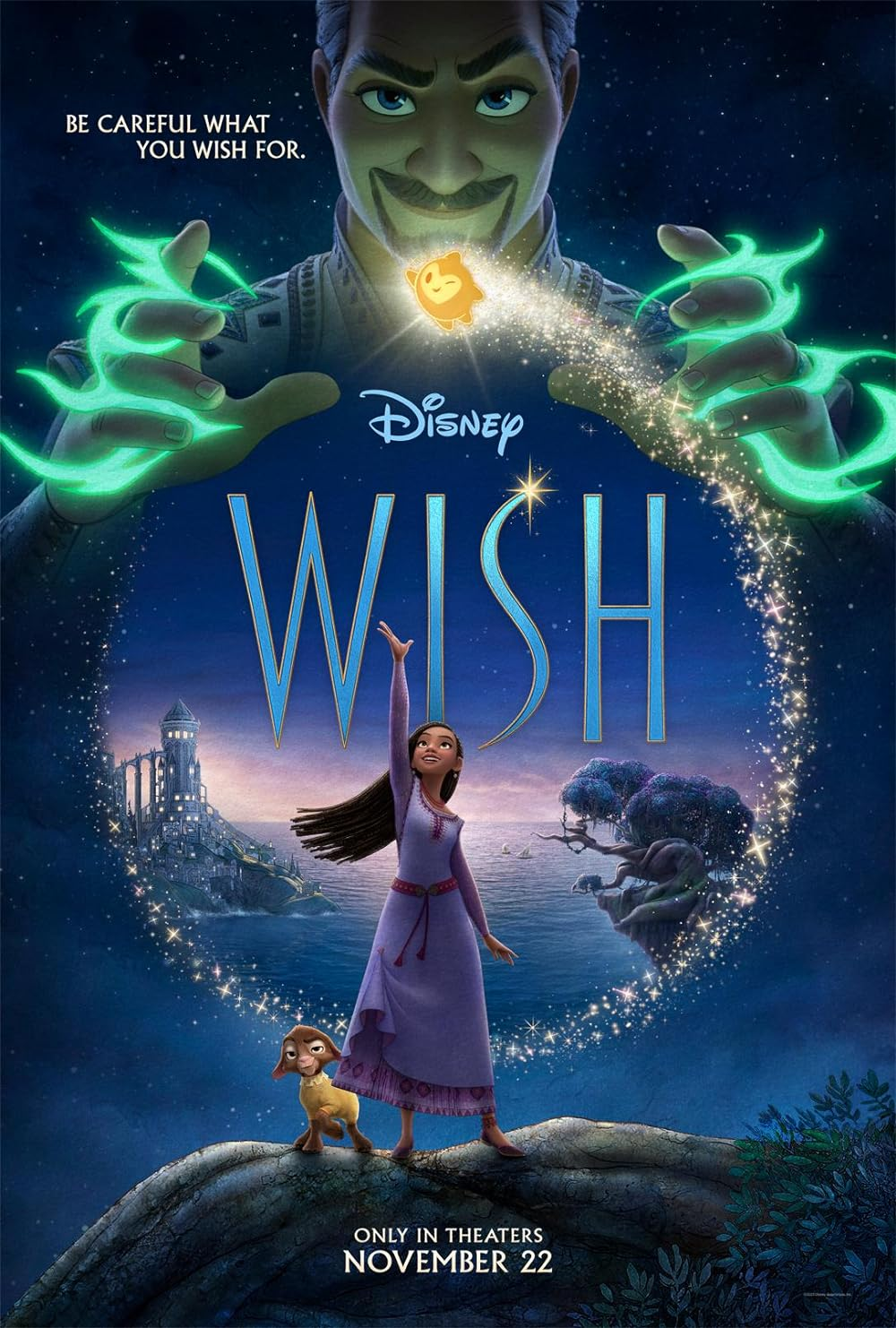
In the Kingdom of Rosas, King Magnifico safeguards the people’s wishes with the promise to grant them one day. But when young Asha wishes upon a star for her community to have better, what she didn’t expect was for the star to answer back.
Disney experiments with the 2D coloring of 3D characters that films like the Spider-Verse have popularized, which can’t seem to make up for the film’s derivative story. Though the animation is vivid in colorful in the scenes that are night-set or creatively lit, most of the scenes set during the day feel like they lack lighting or any sort of flare besides the gimmick. Ariana DeBose’s performance is full of joy and her singing is spectacular, though that shouldn’t come as a surprise. The character of Asha has nothing to really distinguish herself from other Disney heroines like Rapunzel and Mirabel, and the concept of her wishes and motives feel rather underdeveloped. Chris Pine does great as well, but his villain’s descent from charismatic leader to power-hungry wizard feels unearned. None of the supporting characters are quite memorable, and a few of the songs do stand out, including “This Wish”, “At All Costs”, and “This is the Thanks I Get”. But both the middle and end portions, particularly the talking animals and forgettable action, greatly suffer from this lack of an interesting ensemble and heart that made the characters in Frozen, Moana or Encanto resonate. It’s certainly enough to keep the children entertained and singing along, but is also too generic to earn a place among the ranks of other films from the studio that have solidified themselves in Disney’s legacy.
Stereotypical Barbie (Margot Robbie) leaves the Barbie-run utopia of Barbie Land alongside Ken (Ryan Gosling) in search of self-discovery after realizing she might not be as perfect as she thought.
Director Greta Gerwig of Lady Bird and Little Women fame takes what could’ve been a tiringly formulaic fish-out-of-water toy-based film and makes it a clever and cheeky good time. For all its ridiculousness, there is an undeniable heart here and the cast seems to be having such a great time. Gosling in particular gets to show off his master skills as a comedic and physical performer and America Ferrera is an important character who’s inarguably the heart of the film. Aside from Robbie, Simu Liu, Kate McKinnon, Issa Rae, Kingsley Ben-Adir Alexandra Shipp, Emma Mackey and Will Ferrell are also as delightful as some of the performances are campy, though that’s definitely the point of the movie thematically. The bright colors and fun costume designs, as well as the spot-on soundtrack add to this film’s level of meta irreverence that’s only matched by The LEGO Movie, a movie that may draw comparisons, including the fact that Will Ferrell plays a character related to business in both.
While this may be the most self-aware movie of all time and it leans into that quite well, it also packs some delightful surprises in its humor and themes that definitely weren’t written particularly with kids in mind. It’s so in touch with its audience, who may be especially tweens and teens, but may also be a great watch for mothers. The movie explores the idea of Barbie as having been a representation of womanhood and shows with honesty the complexity of the human condition and women as flawed individuals who are expected to always be at their best but that isn’t quite life, and that’s the beauty of it. It also unpacks some of the ridiculousness of social constructs such as gender stereotypes and the patriarchy in a way that occasionally hits you on the head but adds nuance to this film about Barbie dolls. Best of all, the jokes are great and so passionately delivered by the actors that like I said, the fun they must have had on set feels contagious to the audiences watching.
Barbie may be obvious in its thematic delivery but also absurdly charming and witty, with an excellent message for young girls and an all-star cast that’s the best live-action movie about dolls we could’ve imagined.
Ariel, a young mermaid longing to experience the human world, makes a deal with a sea witch to trade her beautiful voice for human legs so she can discover the world above water and impress a prince.
Disney’s live-action remakes have fallen on a spectrum from awe-inspiring to mediocre to horrendous. The Little Mermaid‘s execution reminds me most of the Aladdin remake, in that it’s trying so hard to emulate the style and feel of the animation instead of embracing the fact that it’s in live-action, which makes the look and feel turn out artificial. The visuals in the underwater scenes fail to establish a balance between fantastical and photorealistic, and look too much like they were a shot on a soundstage, with the actors and the effects not blending in too well. Not to mention the beautiful and immersive underwater worlds we’ve recently seen in Aquaman, Avatar: The Way of Water, and Black Panther: Wakanda Forever, and The Little Mermaid‘s depiction can’t distinguish itself or awe in a new way. Halle Bailey is possibly the best Ariel we could’ve gotten — though at first it feels like she’s trying too hard to emulate a 1989 animated character, she eventually gets the chance to make the performance her own as the film goes by, and gives Ariel that naive curiosity and goodness she needed. And her wonderful, angelic singing voice does songs like “Part of Your World” justice. Daveed Diggs is a highlight as the voice of Sebastian, giving us a laugh-out-loud entertaining time as the iconic sidekick and a personality that feels like Diggs is having the time of his life. But Melissa McCarthy as Ursula is an absolute blast here — she feels like what Ursula was always meant to be had they ever made this story into live-action, but McCarthy also makes Ursula borderline likable when she’s not doing evil things due to simply how much fun she’s having being flamboyant, cackling and over-the-top. Though some were concerned about her casting as Ursula, I think she completely nailed it and elevated the whole movie.
The Little Mermaid‘s strengths often lie in the aforementioned cast members, but Bailey and Jonah Hauer-King also have a lot of chemistry, and the movie’s heart gets to flow a lot more naturally when they’re hanging out in the surface world, including the iconic “Kiss the Girl” scene. But besides that, Prince Eric’s character arc, including his relationship with his mother, really only feels “cute” and that’s it. Perhaps that’s all you should ask for in a Disney remake, for it to be sweet and likable enough for kids, and the movie delivers on that part, as the underwater scenes and the themes of compassion will be enough for younger audiences to feel that intrigue. But it also reuses a lot of the tropes we see in these Disney live-action remakes, not to mention the movie is concerned with anything but Ariel’s role as a sister, as Triton’s other daughters are a mere afterthought in the script, and Triton himself is perhaps more understandable than the writers wanted. For a director like Rob Marshall, who’s a cinematic musical veteran including with Chicago and Mary Poppins Returns, the shots during the musical scenes feel often redundant. There’s an atrocious new song led by the usually great Awkwafina that feels too much like the songwriters took a decades-long break before writing this song instead of fitting in well with the rest of the music, and a song delivered entirely through narration in Ariel’s head that could have also been directed in a more creative way. Like I said, the film feels too much directed in the language of animation that it simply feels like an animated movie in live-action rather than a live-action adaptation of an animated film.
Though there’s a lot that can be enjoyed, The Little Mermaid fails to justify its existence in the live-action medium, as there’s too much here that feels like the style of animation, even in something like Moana, would have complimented better, and those visuals feel too devoid of that effortless personality in live-action, but it still has its charm and is still one of the more watchable live-action remakes of Disney classics.
Years after defeating Thanos alongside the Avengers, the Guardians embark on an uncertain adventure to save one of their own from a monumental threat, meeting old and new friends and foes along the way.
It’s been almost a decade since James Gunn’s first Guardians changed the game for superhero movies — and so many copycats or inspirations have come to the mainstream since, or attempted to. But the camaraderie of the titular team has not gotten old, even if it’s their sixth overall appearance in the MCU, and likely their last. The goofy quirks of Gunn’s humor, poking fun at the mistfit-like attitudes of the characters, or his way of giving the outcasts a traumatic backstory and a chance to grow, breathe life and soul into nearly every frame of Vol. 3. It’s not necessarily the best of the three, but it is the most visually dynamic, with engaging settings and interesting close-ups or moving shots during the actions. Chris Pratt and Dave Bautista continue to deliver in the roles that have come to define their career and help shape their A-lister status, but it’s Karen Gillan and especially Pom Klementieff who get to really grow and steal the screen from them. Rocket is also given a heavy storyline that is as tear-jerking as it is revelatory for his character. Though Chukwudi Iwuji’s villain is very over-the-top, he’s also entertaining and works for the film’s purpose. However, the inclusion of Gamora’s alternate version from an Endgame timeline feels like the storyline that didn’t add too much to the film, and her original incarnation’s death in Infinity War still feels best left untouched as it hangs weirdly over her appearance here. Here, her character is more to serve Peter Quill’s arc or simply an excuse to have the awesome Zoë Saldaña around. However, Will Poulter’s presence is Adam Warlock suffer here despite the movie’s already long (yet breezy and earned) 150-minute runtime — though he’s built up as a threat to interact with the Guardians and make his own decisions, he’s left as a very basic side character who cracks a few jokes. The character deserved an awful lot better than he got, especially due to the great work Poulter does do with what he’s given, it’s just a shame his and Ayesha’s story set up from the post-credits scene of Vol. 2 gets the bare minimum payoff. In addition, a notable standout is Oscar nominee Maria Bakalova as the voice of Cosmo the Spacedog, a very entertaining critter who gets her deserved limelight.
The soundtrack in the last two films was dominant and diverse, practically its own character within the film and a driving force for Quill’s arc. The soundtrack in this movie definitely hits less hard and may have a few too similar songs, but it’s made up for with a few amazing needle drops that set the tone and immerse you in the moment. Most of all, the character’s dynamics are all so beautiful and the building of the action is the backbone of the film, rooted in the bond of this team that has strengthened and matured over a few films. Even if the first film is a beast that’s only rivaled by a few other Marvel movies for the title of the studio’s best film, Guardians of the Galaxy Vol. 3 has undeniable charm and is also one of the most emotional MCU films across all the phases. It’s one of their better post-Endgame works and a great big-screen watch for the visuals, heart, and cast of characters.
The Super Mario Bros. Movie assembles an all-star voice cast in the game-based movie in which Mario, Luigi and Princess Peach must band together to stop Bowser’s attack on the mushroom kingdom. The animation is colorful and lively, doing the vivid and imaginative world of Mario justice. Though the movie starts out with a sweet underdog charm due to its protagonist brothers, it soon trades any personality that makes the franchise stand out for the same flat characters and dynamics Illumination Entertainment has been writing for over a decade. The characters’ journeys aren’t all that intriguing besides some of the voice performances, and the plot, dialogue and even song choices have been borrowed from countless other movies. There are a few funny moments and the action is suitable for families to watch, but the movie never aims to have a heart that could impress teens or adults. Chris Pratt does an okay job as the titular character, though his turn is nowhere near as unique as what he brought to Emmett in The Lego Movie. Jack Black, Charlie Day and Seth Rogen perfectly fit their characters, so does Anya Taylor-Joy though Princess Peach’s characteristics are reduced to “brave female butt-kicker” and any character relationships or themes are brushed past, even the adventure feels incredibly rushed. Mario and Luigi’s brotherhood is the one thing that’s charming, though they aren’t together for that long.
The movie draws from and pays tribute to many corners of the Mario game franchise, but a lot of the game play references feel incredibly on the nose, when the point of a video game adaptation is to draw from the look and feel of the source material rather than strictly translate its gameplay. Though it does reward fans to see all parts of Mario’s history including Super Smash Bros and Luigi’s Mansion, it’s unfortunately not enough to warrant the price of admission. The film’s main strength is in the voice cast and colorful animation, as well as a few good jokes, but it’s really only worth going to to keep audiences 10 and under attentive, as most of the film’s story beats feel like an AI took Illumination’s past movies and wrote them into the Mario universe. Unfortunately, you’re better off rewatching similar movies like The Lego Movie or Wreck-It Ralph.
A charming thief and a band of unlikely adventurers embark on an epic quest to retrieve a lost relic, but things go dangerously awry when they run afoul of the wrong people.
With the medieval action/fantasy epic genre being worn out to death in recent years, and a franchise with a less than notable track record, Dungeons & Dragons: Honor Among Thieves is the year’s most pleasant surprise so far. Sure, the conflict and world-building tread the line of “just enough” and the exposition isn’t that engaging, but Jonathan Goldstein and John Francis Daley imbue the film with a well-meaning, heartfelt energy that provides unexpected laughs and charm. Unlike a lot of bland fantasy action films from recent years like King Arthur: Legend of the Sword, Warcraft or the countless Hercules reboots, the characters in this movie feel like they have actual souls and empathetic reasons for the audience to root for them, not just in the quest but in their personal journeys. Chris Pine reminds the audience why his charisma works so naturally for a leading man, even though his character is occasionally greedy and a misfit. Michelle Rodriguez also delivers a more hardcore but lovable character than Letty from the Fast and Furious saga, and Justice Smith also delivers a sorcerer learning to gain his confidence well. Rege-Jean Page and Sophia Lillis both play standouts as very well-realized characters that may one day deserve a cool spinoff. Hugh Grant is also a silly yet fun villain, though his character’s presence and writing do the bare minimum for an antagonist to face off against the main team, and with an actor less capable than Grant, the role would’ve needed much more to sustain the audience’s attention.
Though some of the visual effects and green-screen are obvious, the movie isn’t trying to remind too much of the Lord of the Rings films, but rather create a jolly and comedic journey that perfectly fits the imagination, playfulness and vast possibilities of the Dungeons & Dragons brand. The action and excitement are enough to make up for conflict and rules that seem cliche, not to mention editing, direction and humor that make this not a must-watch, but better than it had any right to be, and will make the audience have a smile on their face and want to spend even more time with these characters than they ever thought they would.
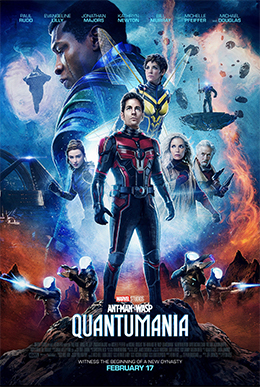
Scott and Cassie Lang, Hope and Janet van Dyne, and Hank Pym are all accidentally transported to the Quantum Realm and embark on an adventure that goes beyond the limits of what they thought was possible.
Though this threequel expands on the scale of the last two Ant-Man movies to the massive possibilities of the Quantum Realm, the film lacks the charm and wit that a movie with Paul Rudd as a shrinking superhero should have. The green screen and visual effects are hit or miss in terms of blending in with the actors, and the sets feel derivative of Star Wars and Guardians of the Galaxy, almost as if the production asked James Gunn to borrow a Guardians set for a day but without following through with the weird and quirkiness of what we’re seeing. Instead, the adventure just feels like it’s going through the motions until we meet Kang, who’s played strongly by Jonathan Majors. The stakes when it comes to his character are engaging but still too vague to give his character the depth beneath Majors’ stellar presence. Whenever the actors do get the chance to quip off each other or interact with bonkers new characters they meet, it makes for funny moments, especially due to Rudd’s undeniable talent and Kathryn Newton’s performance as Cassie, but any meaningful character development is nonexistent besides the characters revealing secrets or reiterating their love to each other. The movie’s themes about heroism and “looking out for the little guy” are sweet but only take it so far because of the unoriginal execution. The action itself has some fun moments and laughs, but ends up a standard adventure that isn’t inspired or clever enough to do its titular hero justice or advance his arc besides showing him the MCU’s new big bad.
Ant-Man and the Wasp: Quantumania is a watchable movie without enough quirks to make the tone satisfying or enough complexity to make the conflict fascinating. Even for the Ant-Man trilogy, it’s simply fine and only needs to be watched to collect important puzzle pieces for the future of the MCU.
Set more than a decade after the events of the first film, learn the story of the Sully family (Jake, Neytiri, and their kids), the trouble that follows them, the lengths they go to keep each other safe, the battles they fight to stay alive, and the tragedies they endure.
James Cameron created a monumental landmark in visual entertainment and epic storytelling with Avatar. A sequel so many years later with so much promise to top the first would send too impossible to be real, but The Way of Water manages to deliver that same ambition felt in every shot of the first film and then some. Years were spent to create new technology to film motion-capture scenes underwater, and I’m glad Cameron spent all the time he needed to get it right because the term “out of this world” has never fit more for anything else. The plot beats in the first hour are familiar, but everything from there onwards is breathtaking, grand, and mesmerizing to the eye. The underwater scenes are some of the most visceral visual cinema I’ve ever seen, with the detail and realism allows you to completely suspend disbelief as you feel you’re actually on Pandora. Sam Worthington and Zoe Saldana are great in their roles again, and the script this time beautifully captures the depth of a parent’s love for their child. Sigourney Weaver returns not as the same character but in a different and inventive way. Jake and Neytiri’s children are as complex and poetic characters as their parents who carry across the story’s themes such as empathy, uniqueness, and selflessness.
Cameron manages to somehow expand on the scale of Pandora and this fictional universe that millions of audiences were already in love with, while finding the intimate moments beneath all the colorful CGI that often stick out and resonate. The cast ensemble may not be Lord of the Rings-level of memorable yet, but the world-building and storytelling certainly is. Not to mention, the love Cameron creates between the audience and the oceans of Pandora may hopefully bring attention to the way corporations and human actions deplete our oceans here at home, and the way of water the title refers to is the beauty of nature that our ancestors knew so purely that can give life and consume those who don’t respect it. The overall narrative has familiar beats but the emotion is heartfelt and thrilling, and the atmosphere and aesthetics are a once-in-a-lifetime experience that has to be seen on the biggest screen you can seek out and in 3D — I’d recommend IMAX 3D, which is how I saw it. Avatar: The Way of Water may have the lesser story of the two Avatar films, but it has a sensational awe and grandeur to its fusion of images, score, and weight that invites you to not only enjoy, but experience, behold, and never want to leave the forests and oceans of Pandora.
The legendary Clades are a family of explorers whose differences threaten to topple their latest and most crucial mission.
Strange World is incredibly visually vibrant, which is never an aspect Disney misses in, not to mention director Don Hall’s outstanding track record at Disney in the past with Big Hero 6 and Raya and the Last Dragon. The imaginative color palette in the titular world the Clade family journeys through is engaging and surprising, even when the story material feels a little hollow. Jake Gyllenhaal is perfect as the lead role Searcher Clade, and it feels long overdue for him to join the Disney animation family. His voice has an incredible likability and he delivers the balance between “frustrating (but devoted) dad”, “frustrated/traumatized son” and “reluctant adventurer” really well. Dennis Quaid, Jakoubie Young-White, and Gabrielle Union are all having plenty of fun in the recording booths as well as a dysfunctional family that all want to just get along and enjoy each other’s company, though the grandpa and legendary explorer Jaegar Clade (voiced by Quaid) has other priorities and is overly consumed with his duties to his pride and explorations. Though the style is always visually inviting, the substance behind the conflict doesn’t always click until the end, and the characters’ relationships are way more interesting than the action itself. The style believes it’s being very nostalgic, presenting itself as a tribute to pulp magazines, but it actually looks and feels very modern. Though the film is quite heartfelt due to the characters it develops, the actual themes of familial expectations have been done plenty in recent animated films, most notably in Encanto and Turning Red that are still fresh in all our memories. There are instances where it tries to even become self-aware of the cliches its indulging in, which simply makes it even more awkward. On the positive side, the movie has Disney’s most prominent representation of an LGBTQ main character in one of their animated films, which is a celebratory step forward for family films on the big screen. Gyllenhaal’s voice performance is outstanding, backed by heartfelt supporting characters, and the animation gives the film lots of energy, but not enough to rank it among other adventures from the modern era of the studio like Zootopia or Wreck-It Ralph, though it’s still sweet and a decent one-time watch for families.
After using his powers for vengeance, the mortal slave Teth-Adam was imprisoned by the gods and trapped for centuries, becoming Black Adam. Nearly 5,000 years later, Black Adam is freed and finds his unique form of justice challenged by the Justice Society of America (JSA).
If you’re familiar with the kind of blockbusters Dwayne Johnson is often a part of, this is no different — an action movie that tries to be as crowd pleasing as possible with as little brain energy as possible. And it’s very middle-of-the-road for his filmography — it’s not as fun as the Jumanji or Fast & Furious films but not as embarrassingly bad as Skyscraper or Baywatch, so right there in the middle with forgettable spectacle like San Andreas, Red Notice and Jungle Cruise. Johnson delivers a solid performance as Black Adam, whose humor this time around comes more from Adam’s “fish out of water” aspect. However, his character’s actual development in order to justify him turning into a more rageful anti-hero is pretty uninteresting and it says a lot that all four members of the Justice Society have no backstory or arc but are far more interesting than him. Aldis Hodge shows off his badassery as Hawkman, going toe-to-toe with Johnson and even managing to steal the show from him, along with Pierce Brosnan, who is also great as Doctor Fate, whose powers and presence are intriguing. Noah Centineo and Quintessa Swindell are also entertaining as the other two members of the JSA. Unfortunately, the movie is brought down by a bloated conflict, weak CGI and a script you’ve seen a thousand times before. The rapid editing of action scenes takes away lots of the grandiose, even when Black Adam fighting the JSA starts off fun. By the third act, it descends completely into a forced “good guy vs bad guy” CGI-fest of action that feels pulled straight out of Justice League. Though the style manages to occasionally have fun, it’s got too many elements working against it, whether it be the editing, Marwan Kenzari’s awful character, the lack of thematic clarity, or a willingness to take itself less seriously than it should.
Black Adam serves loud noise and huge action scenes — exactly what The Rock is known for — but unfortunately nothing more. The solid supporting cast and occasionally entertaining action and scale isn’t enough to save this movie from descending into generic chaos.













 filmtoppings.com