Black Panther: Wakanda Forever

As the Wakandans strive to embrace their next chapter in the wake of King T’Challa’s death, Queen Ramonda, Shuri, M’Baku, Okoye and the Dora Milaje must band together with Nakia, T’Challa’s former lover and a War Dog spy, and CIA agent Everett Ross to forge a new path for their beloved kingdom.

Black Panther: Wakanda Forever had to decide how to face two immense challenges — following up a cultural phenomenon and one of the most popular and resonant movies in recent years, and doing it without its magnificent lead, Chadwick Boseman. The effortless charisma and commanding dignity Boseman brought with him are absolutely missed in this sequel, yet writer-director Ryan Coogler decided to use his loss to give the film a complex gravity and message about grief, legacy and moving forward. Not only does Coogler use the sequel to expand the scale from the first film into a glove-trotting political fantastical battle, but also as a means to explore new stylistic grounds, feeling more director-focused than any Marvel movie in a while.

The visuals and action manage to even outdo the excellent and versatile fights from the first film, and the pace is much more graceful than the tighter pacing of other MCU films from this year. The music by Ludwig Goransson has a language of its own, always surprising, entertaining, and hitting you hard. Goransson uses African, Latin, and electronic bases in order to create a score that builds off the one from the first. The cinematography is more intimate than in the last film, with the camera sometimes closer to the characters or letting the visuals feel more seamless rather than showy. The movie addresses our feelings of sadness about losing Boseman and T’Challa through the characters, but doesn’t linger in it or feel stuck in the past. Speaking of the characters, Letitia Wright is great as Shuri, who is forced to mature quickly after what she’s had to cope with here, but it feels like this entire world of Wakandans, even the lovable side character of M’Baku, is growing and getting wiser with time. Angela Bassett delivers a ferocious performance as Ramonda, and honestly some of the best acting this entire Marvel franchise has seen. Dominique Thorne also shines as a cheerful, lovable presence she conveys through Riri Williams. Lupita Nyong’o also provides warmth and elegance as Nakia, though Martin Freeman’s return isn’t exactly necessary and his role in the plot could’ve been combined with Nyong’o’s character. Now, how does one follow up a villain as resonant and scene-stealing as Michael B. Jordan’s brilliant Killmonger? With Namor, Tenoch Huerta delivers a kindness we haven’t seen in many villains before, while clearly being violent and vengeful in his methods while showing warmth and empathy towards his people. He makes Namor a memorable character whose backstory’s execution isn’t the most hard-hitting but whose developments are always interesting.

This movie is the most sophisticated work Marvel’s done in a while, distancing itself from reminders of the bigger universe and allowing Coogler and crew’s creativity run free and deliver spectacle that feels consequential and really sinks in. It’s refreshing to feel like a Marvel movie isn’t constantly working to check off boxes to set up a bigger universe and pander to the widest action movie fanbase possible — after all, the first Black Panther was all about making stories about POCs no longer niche. While the messages may not be as revelatory as in its predecessor, it’s a film that rivals the first in ambition and weight. Perhaps it resonates so well because we all feel like a world with Wakanda is an infinitely better one, and a world without its late hero is one that’s infinitely worse. Black Panther: Wakanda Forever demands your eyes on the big screen and an open heart, with the performances and style creating an action adventure with gripping and soulful humanity.

The Fabelmans

Growing up in post-World War II era Arizona, a young man named Sammy Fabelman discovers a shattering family secret and explores how the power of films can help him see the truth.

Inspired by his own childhood and infatuation with cinema and filmmaking, The Fabelmans feels like everything Steven Spielberg’s career has been leading up to until now. But not only is it personal and revealing, it’s a masterpiece in its own right that earns its spot amongst other Spielberg classics. Michelle Williams somehow tops her remarkable work in Blue Valentine and Manchester by the Sea in one of the most powerful performances in Spielberg’s recent films. Williams makes the role and everything it demands hers. Along with his co-writer Tony Kushner, who also worked with the director on Munich, Lincoln and West Side Story, Spielberg paints an empathetic look at his mother through Williams’ character, Mitzi Fabelman, but also doesn’t shy away from her flaws and shortcomings, though never quite judging her. As the family’s patriarch Burt, Paul Dano delivers his most restrained but possibly most impactful performance yet, as the logos to Mitzi’s pathos, who does everything, even if it’s spending lots of time with his work or being firm with his kids, out of love and pride for his family. Seth Rogen is also excellent as Sammy’s surrogate uncle, portraying the most endearing and complex role of his career — not to mention Judd Hirsch in a hilarious few minutes of screentime. But Gabrille LaBelle as Sammy himself is a breakout to behold. He rips into your heart as a young man who embodies the aspiration and underdog not just in Spielberg but in all of us, as he works through familial conflicts, (sometimes anti-Semitic) bullying, and adolescence through empathy and, as sappy yet poetic as it sounds, film.

Along with his frequent collaborator behind the camera, cinematographer Janusz Kaminski, Spielberg makes basic settings such as a camping site or a high school hallway feel like a fairy tale. The production value along with the colors of the scenery make the simplest 1950s and 60s settings look grand, and makes film and cameras look like a weapon that spews greatness and wonder wherever it goes, because to the legendary filmmaker, that’s exactly what it is, and he makes you feel it in every frame. Even if you’re a cinema buff, it’s the most human coming-of-age story about family in a long time that juxtaposes innocence with the mistakes people, especially parental figures, can make — but the importance their humanity has on their children — and the uncertainty yet optimism of the world that is to come for Sammy Fabelman. Spielberg also manages to tell entire stories about certain characters’ backgrounds without ever directly addressing them, simply through their reactions and decisions. It’s incredible that about 50 years and 40 movies into his career, he still manages to surprise us and make us in awe, but don’t worry, there’s a lot of laugh-out-loud humor as well, so much effectively for a movie that isn’t ever quite a comedy. Knowing where the director’s story ends makes this journey with him, which is 2-and-a-half hours but earns every minute of it, even more gratifying. This movie especially resonated with me for its striking depiction of how movies and filmmaking can make you feel less lonely, as Spielberg’s films have for around half a century now. It’ll entertain, inspire and touch all ages, feeling like the culmination of his creative career yet unlike almost anything he’s ever made before. By the end you’d want to thank him for the opportunity to peer into his world.

Black Adam

After using his powers for vengeance, the mortal slave Teth-Adam was imprisoned by the gods and trapped for centuries, becoming Black Adam. Nearly 5,000 years later, Black Adam is freed and finds his unique form of justice challenged by the Justice Society of America (JSA).

If you’re familiar with the kind of blockbusters Dwayne Johnson is often a part of, this is no different — an action movie that tries to be as crowd pleasing as possible with as little brain energy as possible. And it’s very middle-of-the-road for his filmography — it’s not as fun as the Jumanji or Fast & Furious films but not as embarrassingly bad as Skyscraper or Baywatch, so right there in the middle with forgettable spectacle like San Andreas, Red Notice and Jungle Cruise. Johnson delivers a solid performance as Black Adam, whose humor this time around comes more from Adam’s “fish out of water” aspect. However, his character’s actual development in order to justify him turning into a more rageful anti-hero is pretty uninteresting and it says a lot that all four members of the Justice Society have no backstory or arc but are far more interesting than him. Aldis Hodge shows off his badassery as Hawkman, going toe-to-toe with Johnson and even managing to steal the show from him, along with Pierce Brosnan, who is also great as Doctor Fate, whose powers and presence are intriguing. Noah Centineo and Quintessa Swindell are also entertaining as the other two members of the JSA. Unfortunately, the movie is brought down by a bloated conflict, weak CGI and a script you’ve seen a thousand times before. The rapid editing of action scenes takes away lots of the grandiose, even when Black Adam fighting the JSA starts off fun. By the third act, it descends completely into a forced “good guy vs bad guy” CGI-fest of action that feels pulled straight out of Justice League. Though the style manages to occasionally have fun, it’s got too many elements working against it, whether it be the editing, Marwan Kenzari’s awful character, the lack of thematic clarity, or a willingness to take itself less seriously than it should.

Black Adam serves loud noise and huge action scenes — exactly what The Rock is known for — but unfortunately nothing more. The solid supporting cast and occasionally entertaining action and scale isn’t enough to save this movie from descending into generic chaos.

Ticket to Paradise

Two divorced parents, David and Georgia Cotton, travel to Bali after learning that their daughter, Lily, is planning to marry a man named Gede, whom she has just met. They decide to work together to sabotage the wedding to prevent Lily from making the same mistake they made twenty-five years ago.

Ticket to Paradise is a welcome reunion for two legendary stars, George Clooney and Julia Roberts, years after they worked on the Ocean’s films, Confessions of a Dangerous Mind, and Money Monster together. They elevate a film that occasionally threatens to fall into generic territory by breathing fun and charm into the film, even when they’re ripping each other to bits with insults. Clooney’s performance is certainly the glue here, as he embraces his comedic chops and his character often pokes fun at himself while being grumpy and over-the-top. Speaking of reunions, fans of Booksmart will love to see Kaitlyn Dever and Billie Lourd sharing the screen again — Dever is great as their daughter Lily, and Billie Lourd is a scene-stealer as her best friend Wren, a character that the plot maybe could’ve done without but when Lourd is so entertaining, the movie suddenly feels infinitely more upbeat with her in it.

The movie can sometimes fall into cheesy territory especially with some obviously scripted lines and an exaggerated ending, as well as some unclear themes about who is more right about what, but it never sinks the film’s heart and sweetness. It’s a film that means to charm and show the nature of flawed parents getting over their own immaturities while loving their daughter, and when the parents are played by two of the most charismatic people in the world, you’ve got yourself a winning film. Though it’s nothing you’ll be urged to watch more than once, or even the best comedy out right now, given how much more memorable and hysterical Bros is, Ticket to Paradise is certainly a harmless and heartfelt good time, especially for today’s rom-com standards, with laughs, vacation-y settings, and charming performances.

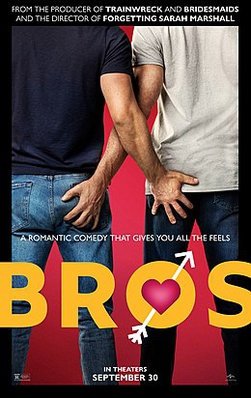
Bros

Bobby Lieber (Billy Eichner), a podcast host and museum curator creating the world’s first LGBTQ museum, attempts a relationship with lawyer Aaron — but they must overcome their commitment problems first.

Not only is it celebratory for a major studio to release a gay rom-com, but it’s a breath of fresh air to see a movie about the LGBTQ community that isn’t gloomy or traumatizing but rather entertaining and optimistic. Through through the museum Lieber is creating, the movie is very much about embracing the queer community and undoing the centuries of history that’s been erased. Though Bros rejects the idea that gay and straight relationships are exactly the same by having its lead character claim that “Love is not love!”, as gay male relationships have their own nuances and issues, the romance will be gripping for all audience. But just as important as its representation is the fact that it’s fun, uplifting and hysterical.

Billy Eichner is a fantastic leading man who’s loving yet stubborn nature comes off as warm as it does occasionally frustrating to see him stumble and figure out his way. Eichner, who also co-wrote the movie with director Nicholas Stoller, gives even the side characters their place to shine and make the audience laugh. There’s some incredibly funny moments that will stick with you and come to mind whenever you think of this movie, and lines that are too good to spoil but are worth the laughs in a theater with an audience. Luke Macfarlane is also a breakout star and is endearing as the more “macho” gay man as opposed to Eichner’s “flamboyant”-labeled character, but as the movie mentions, the queer community is not a monolith and the film embraces lesbian, gay. bisexual, and trans characters, including those of color, in its supporting cast. Though the plot occasionally lacks direction, and it may be a few minutes too long, it’s the dialogue and humor that keeps the audience engaged, and the romance that more than gets the audience to root for the leads that grounds the whole film.

As a comedy, Bros will give you stomach-inducing laughs, and as a romance, it’s more than sweet. It’s the positive celebration of diversity that audiences, both queer and straight, will feel uplifted by, and enjoy the sweetness, silliness, and raunchiness the film has to offer.

The Woman King

The Woman King historical epic inspired by the true events that happened in The Kingdom of Dahomey, one of the most powerful states of Africa in the 18th and 19th centuries. Viola Davis makes every performance of hers seem effortless, and her role as General Nanisca of the Agoije, the Dahomey’s all-female group of warriors who defend the Kingdom, is no exception. Davis portrays the titular character as a fighter with a tough exterior who eventually peels back layers to reveal pain she must defend herself from through physical and emotional strength. Thuso Mbedu and Lashana Lynch are both outstanding, Mbedu as a new recruit who must grow into a courageous fighter, and Lynch as a commander who gives it her all into the role physically and makes you care so much about her character.

The action is staged very well and is surprisingly strong for a PG-13 rating, but it’s never distractingly holding back from showing violence either, though nothing is disturbing here. The grandeur of the costumes and sets makes the atmosphere work so well, and the film benefits from a spectacular score from Terence Blanchard, who should at least get nominated for an Oscar. Though the film does occasionally slow down between the powerful moments, the last act especially is the most exciting, investing and empowering and elevates the entire movie. It’s a great popcorn action film but also a showcase of amazing production and performances that’s built for the big screen.

Three Thousand Years of Longing

A lonely scholar, on a trip to Istanbul, discovers a Djinn who offers her three wishes in exchange for his freedom.

George Miller’s first film since Mad Max: Fury Road allows him to let loose as expected, but doesn’t feel as rewarding as it could have. Tilda Swinton shines in a more fun, likable role than some of her more “chameleon”-like performances, and Idris Elba is great as a Djinn tasked with most of the film’s dialogue and monologues. The production design is also very noteworthy as is the score by Tom Holkenberg, easily his best music for a film since Fury Road. However, the CGI doesn’t look as grand or convincing as it attempts to be and could’ve used some more work.

Though Swinton and Elba’s conversations about how all the ways wishes could go wrong are interesting, the stories Elba tells about his past don’t feel as powerful or intricate as the film wants you to believe. The third act feels an abrupt turn of events and certainly drags, in a way feeling anticlimactic. Upon digging, Miller has a lot of interesting things to say, whether it be about longing, imagination, or love, but he doesn’t explore them deeply enough to deliver that unexpected blow of catharsis and fulfillment that the ending wants you to experience. Perhaps this is one film that constitutes a rewatch, but only certain parts feel inviting to revisit, while others, I feel I’d simply skip over if I ever saw this film again. It’s certainly bold and like nothing that’s come out this year, and its ambition is worth commending, but for most, this isn’t worth rushing to theaters to watch.

Nope

OJ and Emerald Haywood are siblings who own a ranch in a lonely gulch of inland California, where they train and handle horses for movie and TV productions. Soon, they bear witness to an uncanny and chilling discovery. 

To call Jordan Peele a unique filmmaker of our time would be an understatement — he’s blended genres and used them to incorporate thoughtful social commentary into the most mainstream popcorn entertainment, all while giving audiences films that can satisfy, challenge, and entertain. Nope is no different. It’s a science fiction-horror-thriller-comedy with a modern infusion of likable characters and borderline surrealist world-building, and Peele’s filmmaking is at the level of the most respected auteurs like Stanley Kubrick. It’s got moments of shock, laughter, brutality, and terrifying humanity that adds so much astonishment to a film that starts with what could’ve been an overused premise in anyone’s else hands. Daniel Kaluuya has evolved into a modern film star of his generation — though he’s starred in Black Panther and won an Oscar for Judas and the Black Messiah, it was Peele’s debut Get Out that guaranteed his stardom. He’s a master at being funny but showing a character confront with real and inner “demons” in a silent way but always being a fun character too. Keke Palmer has a contagious, bubbly energy and I’m sure the entire cast and crew had plenty of laughs due to her fantastic delivery of her lines that often sneaks up on you in hysterical ways. But she’s also a genuine hero, not to mention Steven Yeun and Brandon Perea who are scene stealers.

Peele’s style always challenges genre, structure, and how the audience expects to react to things. His stylistic energy in Nope invokes eyes staring in awe, jaws dropping, and mouths smiling all at once. Due to this, Nope transcends accessibility for fans of horror, and is a top-notch film for all fans of big-screen spectacle, because it never settles for just being a horror movie. In it’s own way, Nope is a piece of art, that’s not meant to give you easy answers or leave you comfortable. Like Peele’s last movie Us, there’s so much to debunk as the thematic elements often drive the filmmaking in his movies. This one addresses many things, but among it, humanity’s flocking to images chaos and danger, and our obsession with getting as close to death and trauma as we can while wanting to arrogantly cheat the effects they may have on us, should our endeavors to harness danger go wrong. The movie is also a tribute to filmmakers and crew members in positions we don’t often acknowledge, and the achievements of black contributions to cinema that aren’t always celebrated. In a way, Peele uses this movie to celebrate the invention of cinema but also warn about our roles as audience members and monetizers of content that’s both real and adapted from truth. With it, he creates the most daring and awe-inspiring summer blockbuster possible that I’m sure will inspire many to create and challenge the world of films the way he has.

Bullet Train

Assassin Ladybug finds himself on a bullet train from Tokyo to Kyoto in order to grab a briefcase of money, but the task reveals itself not so simple as Ladybug discovers he’s not the only assassin on the train looking for the briefcase.

Bullet Train is everything I’ve wanted from an original action movie for a long time — bold, unpredictable, brutal, and irreverent. David Leitch colors the titular train with a lively style and makes the action unhinged and genuinely thrilling. Brad Pitt is no less an action badass than in the days of Fight Club, Troy and Mr. & Mrs. Smith. He gives the character a lot of humor in that he’s an assassin trying to find inner peace and avoid violence — guess how well that works out for him. But it’s hard to call a single character weak or overshadowed by Pitt. Joey King delivers her best ever turn as a deceitful young assassin, and Aaron Taylor-Johnson gives the film some excellent quips. His screen time with Brian Tyree Henry, who’s the film’s highlight, is the most heartfelt aspect of a film in which hitmen are all trying to kill each other. Henry’s talent radiates a special hysterical charm and will make you laugh and smile the most out of all the characters, not to mention he’s one of the most exciting actors these days. Even Bad Bunny, in his acting debut, does a solid job, and Zazie Beetz kills it in a minor role, and in my opinion the most underutilized performer of the film, considering she’s one of the best actresses in the film’s cast. Not to mention a lot of familiar faces that I was surprised were even in the movie, so stay away from the cast list before you see this one.

Bullet Train‘s script feels reminiscent of Guy Ritchie’s most uncompromising films, like Snatch, RocknRolla and The Gentlemen, in which you have to choose your alliances among a cast of criminal characters and anyone could bite the dust. Not to mention the script never takes itself seriously for a second, incorporating flashbacks, a vibrant soundtrack, and unexpected laugh-out-loud humor. The editing is where the film both shines and sometimes falters, as there are a few moments of unnecessarily aggressive cuts during scenes where there’s either action that could’ve used more wide shots, or explanations for events you’ve already seen play out. There’s also an exposition monologue at the end that’s easily the low point of the film and some character placements that don’t flow as smoothly in the third act or have no reason to be there. But in the end, only a filmmaker as bold as Leitch could get away with making something so much fresher than any other $100 million action movie you’ll see on the big screen today that’s not a sequel. Bullet Train has so much going twistiness, vulgarity and blood going for it, yet it’s the cheeky wit, exuberant performances, and relentless style that makes this ride such a welcome one.

Thor: Love and Thunder

Thor enlists the help of Valkyrie, Korg and ex-girlfriend Jane Foster to fight Gorr the God Butcher, who intends to make the gods extinct.

Taika Waititi brings his signature laugh out loud humor and energetic storytelling style to Love and Thunder, as well as playing the lovable rock giant Korg who’s become Thor’s sidekick of sorts. Chris Hemsworth is as always having lots of fun, and Natalie Portman returns as his old flame Jane, who accompanies him along with Valkyrie (Tessa Thompson kills it as always though her character doesn’t get as personal as Thor and Jane do) on the film’s journey. Russell Crowe is also quite funny as Zeus, and expect some great celebrity cameos as well. The standout though is definitely Christian Bale as the villain. He gets to go all out with his performance as Gorr the God Butcher, and his motivations make sense as well as his weapons and planets seeming cool, though I would’ve added a little more screentime with the character because in a way he’s still underutilized compared to the heroes. But also worth mentioning is the memorable soundtrack that gives the film a lot of life — and Guns N Roses hits.

Though Waititi’s style now feels synonymous with Thor’s solo journey, it also feels like the saving grace of the movie that Taika’s at the director’s chair. Since Thor’s already gone through most of his meaningful development from his first movie unto Endgame, there isn’t much left to develop with him and the movie is best enjoyed as a Waititi adventure comedy as a result. It’s also not as smooth or funny as Ragnarok, and the director’s weakest film yet. The script feels rushed and slowed down in the wrong places and certain nuances feel underdeveloped — a few more minutes of runtime wouldn’t have hurt. The final battle is also visually uninteresting though conceptually fun, the location and lighting of the action feels anything but exciting. Thor and Jane’s romantic chemistry is sweet but also nowhere near as natural of a pairing as Tom Holland and Zendaya in Spider-Man or Robert Downey Jr. and Gwyneth Paltrow in the Iron Man movies. It also feels like Thor’s journey concluded more naturally with Endgame, and as an epilogue to his story it serves the character fine, but I think Marvel should close his arc here because it feels like all of Thor’s most memorable moments and growths are in the past.

Thor: Love and Thunder is a solid 2 hours of fun visuals and laughs, though it feels like the character’s story is being stretched a little past its breaking point, go for the enjoyment and cast, especially Christian Bale’s villanous performance.