Sinners

Twin brothers Smoke and Stack return to their hometown to open a blues club for a fresh start, only to discover that an even greater evil is waiting to welcome them back.

Ryan Coogler, one of the most impactful filmmakers to come out of the last decade, creates his most original, commanding, and dazzling film, a kind many have been waiting to see for a long time. Coogler gets free reign to blend genres with unique storytelling on a larger scale than we’ve seen before. The characters leap off the page and screen with their wonderful portrayals from Michael B. Jordan, Hailee Steinfeld, Wunmi Mosaku, and Delroy Lindo, as well as a more menacing turn from Jack O’Connell. As both Smoke and Stack, Jordan plays characters who aren’t free of moral question marks but still worth rooting for, and have excellent romances with Mosaku and Steinfeld, while Lindo has brilliant moments of reflection, strength, and humor.

The film portrays America in the 1930s as a place of difficulty and strive, with a system built to oppress black Americans, but in the main characters’ blues club, a dazzling, one-of-a-kind portrayal of black culture and music in a safe space of untouched, booming joy. The music is a language of its own in the film, not just another magnificent score by Ludwig Goransson, but the way music inspires and drives the characters across generations of their history. Music in the film is its own plane of sacred storytelling and unity, and it’s brought to life with roaring energy that the audience can enjoy yet by moved by. The cinematography by Autumn Durald Arkapaw, who also collaborated with Coogler on Black Panther: Wakanda Forever, also takes the film to another level, with distance between objects, characters, and backgrounds — or mere darkness — creating a weight in its shock. The film develops its characters in a world that’s breathing and moving around them in unexpected and exciting ways, even before the blues kicks in, and far before the horror action elevates the film to yet another level of mastery. The bloody violence is unpredictable and riveting to look at, and balances the line between horrific and irresistibly fun.

Though an ending scene stretches out and explains the themes too excessively, Sinners brings together genres and a remarkable cast full of life and heart that spreads to the audience. The visionary cinematography, music, and costume design compliment a story that’s filled with as much adoration for the immersive settings it creates as it is deeply hinting at themes of the system’s attempts to appropriate and erase black culture and history, and much more beneath the surface. Not only does it work for action, horror, or thriller fans, but it’s a beautiful piece of storytelling that only comes every few years. Not quite like any blockbuster we’ve seen, Sinners is a journey of pride, terror, and legend that needs to be experience on the big screen, solidifying Ryan Coogler as one of our great modern filmmakers who deserves all the more creative freedom and spotlight that’s coming his way.

A Minecraft Movie

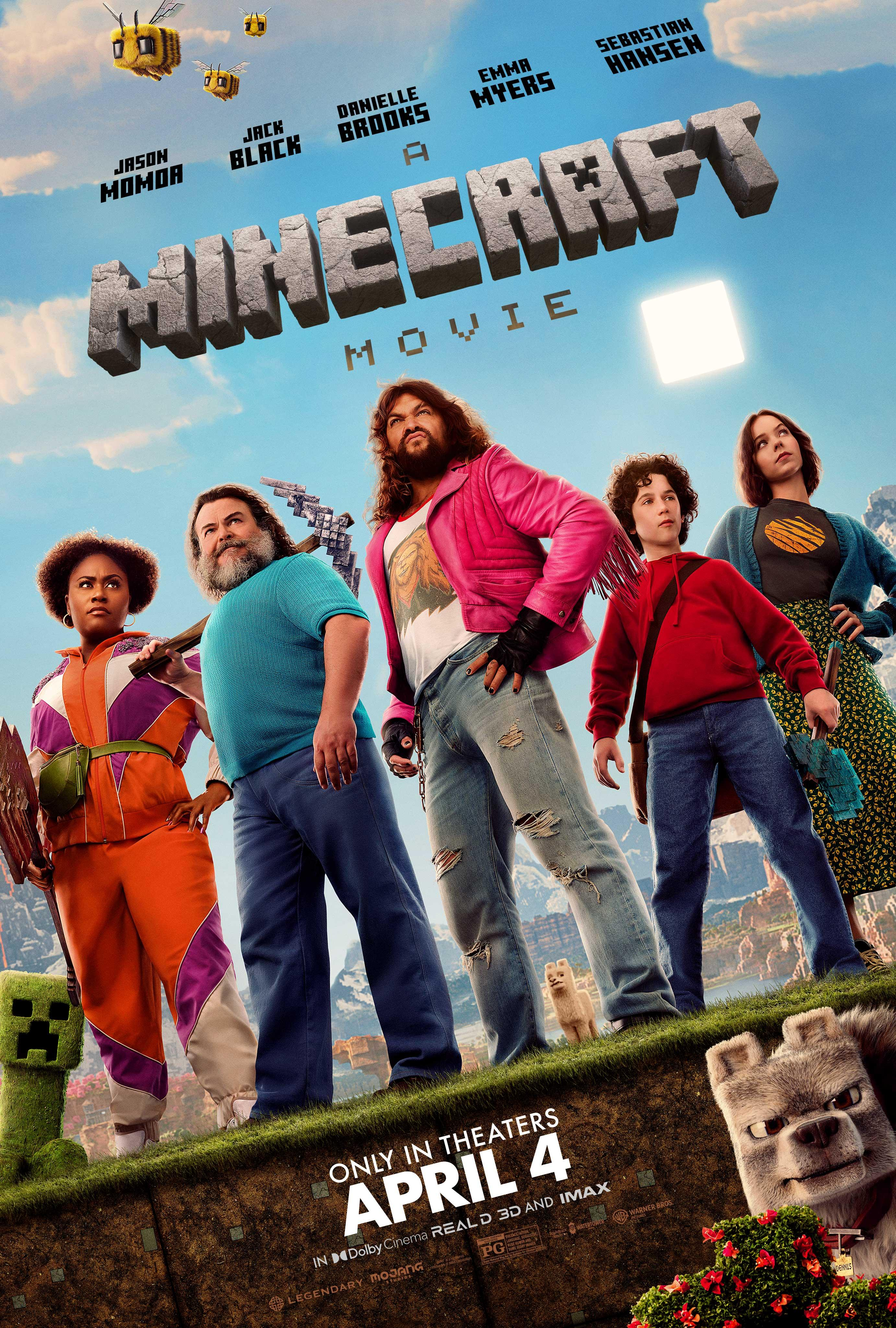
A Minecraft Movie may prove a treat for younger audiences and fans of the beloved game. It’s got charm, thanks to its main stars, particularly Jack Black. He gleefully gives his playful and extravagant energy to Steve, even throwing in his musical comedy talents. Jason Momoa entertains but his dialogue threatens to miss almost as much as it’ll make you laugh. Danielle Brooks is splendid as a very unexpected companion on this journey, and gives the runtime lots of heart. Emma Myers does a solid job playing an unlikely heroic character, whose storyline with her brother avoids some cliches while falling head first into others.

Though this is a Minecraft movie first, director Jared Hess’ love for misfits and outcasts is written all over the film. What brings the film down is the aesthetic, that fails to get you to suspend your disbelief strongly enough to overlook the unconvincing green screen and weirdly uncanny CGI of some of the Minecraft characters/species. The live-action parts carry the film well if you ignore some of the backdrops, but sometimes you’ll wish that the scenes inside the Overworld were completely animated. It also doesn’t help that the idea of an unlikely team of social outsiders from the real world trying to navigate a fantastical world they’ve been suddenly pulled into is nothing new. Even the Jumanji films, also starring Black, had much more to offer the formula.

Still, the film has just enough charm to delight children and families, embracing the essence of the game with a positive message about creativity. And Black proves that he’ll continue to entertain generations of viewers with his ability to let loose. It’s a film that embraces exactly what it is, even if when you think about the film or look too long at the visual details, the building blocks starts to fall apart.

Snow White (2025)

Some remakes get a chance to breathe new life into their stories and worlds, while others, like Disney’s new Snow White, feel like a film from 90 years ago was frozen in carbonate for decades and then unnecessarily turned into a different medium. In this case, Snow White feels like 30% that, while the other 70% feels like sprinkles of modern flare that feels out of place. Oscar winners Benj Pasek and Justin Paul add songs that feel to derivative and cliche, hitting all the same “Welcome to our lovely kingdom”, “I want a better life”, “Look how evil I am”, and “Maybe we’re attracted to each other” beats that are in nearly every other musical. In some instances, the songs even sound too much like the duo’s Dear Evan Hansen soundtrack.

Rachel Zegler tries her best to entertain in a sweet but one-dimensional role elevated by her charisma and strong singing voice. However, all the other elements around her distract, including the unconvincing and at times hideous CGI of the animals, surroundings, and let’s not even talk about those dwarves, who seem almost nightmarish. But a painfully glaring weak link is the miscasting of Gal Gadot as the Evil Queen. Her line delivery feels unnatural, and the character just gets more irritating as the film goes along.

Most sadly, Snow White is inconsistent and deeply hollow as a film. It has almost no charm that feels organic, and can’t decide between elements that feel nostalgic or new, like the very modern-sounding soundtrack. Nothing of importance is ever quite explained or given meaning to, things just happen because the point that we’ve gotten in the story needs that thing to happen. For younger children, being unconditionally kind is an important message, but even Disney has delivered this theme in a way that’s so much more tangible and heartfelt; take even their live-action 2015 Cinderella remake for example. This remake doesn’t expand on or reinvigorate its source material, simply morphs it into weird images that look colorful but never have any real sense of life.

The Alto Knights

Two of New York City’s most notorious organized crime bosses vie for control of the city’s streets. Once best friends, petty jealousies and a series of betrayals set them on a deadly collision course.

Robert De Niro playing an infamous mobster is nothing new. But De Niro playing TWO mobsters? Throw in legendary director Barry Levinson of Bugsy, Rain Man, and Good Morning, Vietnam, now that’s something worth writing home about, right? Unfortunately, The Alto Knights is anything but; a film with maybe some potential on set that was completely butchered in the editing room. De Niro’s dual performance is supposed to fascinate the audience but instead distracts. Frank Costello and Vito Genovese are not presented in the film as being two sides of the same coin, as were the mobster twin brothers Kray, played by Tom Hardy in Legend. In this film, the two mobsters are depicted as not just of different families and mannerisms but of different ages, experiences, and motivations. When De Niro finally shares the screen with himself, it’s impossible to buy these disparities as the script depicts them, rather we buy them more like equals under different heaps of makeup, which was not the intention. As Costello, De Niro is giving something between a less soulful version of his turn in The Irishman, a less extravagant version of his turn in The Untouchables, and a less funny version of his turn in Analyze This. He’s interesting as Genovese, but casting another actor to oppose him would’ve worked better to show that one of these gangsters is actually much more frightening than the other.

The film recycles tired tropes of past popular mob films, and as I’ve alluded to here, many of them already star the great De Niro. Though some scenes are at least mediocre in their execution, the editing is horrendous and makes some scenes unwatchable. The film insists on blasting through most scenes like a documentary montage rather than letting scenes breathe and feel like a thrilling drama. The constant narration and barrages of exposition are condescending to its audience of a normally intelligent genre, but insists on feeding us information we could’ve learned through context clues within scenes. The poor dialogue can’t be salvaged by lacking performances from Debra Messing and Cosmo Jarvis, the latter of whose promising transformation never quite gets to shine. Moreover, there never feels like an escalation of tension or events when there feels like we should be building towards something, rather a lack of setup that also leads to a lack of reward. The Alto Knights starts on a bad foot, and never even hints at a chance to redeem itself. Even De Niro and crime film fans need not waste their time, in theaters or at home.

Mickey 17

Mickey is an Expendable on a expedition to the space colony Niflheim — meaning a new copy of him is printed out every time he dies, which is more often than others. Soon, trouble ensues as Mickey finds himself in a dangerous situation and a fight to survive.

Bong Joon-ho’s likely largest production in sheer scale isn’t subtle in its themes, whether of human nature, fascism, or the arrogant abuse of technology, but it’s still clever, vibrant, and so full of heart, more than enough so to serve as an absolute blast of a film. The look and feel of the sci-fi settings feels original and Pattinson’s delivery of the titular character is likable. Mickey 17 is an insecure man/clone who’s somewhat at peace with the bleakness of his situation, but is fun to follow along and has the sudden urge to stay alive and fight for what’s right. He also has great chemistry with himself as Mickey 18, who’s only a few hours older than 17 but almost the polar opposite — hardened and occasionally ruthless. Naomi Ackie gives the film its soul; she’s so lively and wonderful as Nasha, who elevates Mickey as much as she’s on her own meaningful journey. Steven Yeun also shines as a sleazy and unrealiable but multi-dimensional frenemy of Mickey’s. The parallels between Mark Ruffalo’s character and certain powerful men in our reality aren’t hard to decipher, but he and Toni Collette entertain, even when their performances occasionally threaten to fall into caricature.

Mickey 17‘s magic is finding the humor and gentleness within the darkness. Mickey always sees his situation with a sense of irony, but Bong also finds care and soul within side characters who usually would feel disposable in other films. He never loses sight of the absurdity at hand but keeps elevating the stakes and with it, his signature expert eye. The film packs charm, exceptional world-building, irreverence, and characters we love, not despite but especially for their messiest parts.

A Real Pain

A Real Pain beautifully balances the heartbreaking and hysterical through the dynamic of Jesse Eisenberg and Kieran Culkin as cousins David and Benji, who travel from New York to Poland together on a tour in memory of their deceased grandmother, a Polish Holocaust survivor. It’s about so many things, whether big or small. From a Jewish perspective, the film powerfully touches on complicated feelings of nationality towards countries in which one’s family lived but suffered horrific atrocities, as well as generational trauma. As someone who has embarked on this tour myself, the film captures not only the visceral nature of walking into places where such evil was committed eight decades ago (which both I and the characters here came to feel, wasn’t even that long ago), but the deep emotional connection towards one’s ancestors, community, and people it invokes.

From a personal perspective, the film is also very much about empathy — the idea of feeling others’ pain, and sadness, to better understand and connect with oneself. Kieran Culkin in particular brings such harsh complexity to his character. Benji is fascinated with human connection and constantly in pursuit of embracing living life with all his senses, but doesn’t always know how to feel, or express himself to others. Even when he pushes others away and embarrasses himself, the audiences can’t help but hold him close to their heart and feel deeply for him in every moment, because of his desire to grieve for his grandmother, and true yet misguided desire for the best. Eisenberg, in one of his most substantial and beautiful performances, wonderfully conveys David’s pull to and from Benji — his responsibility yet resentment towards the way Benji feels, which comes from a distance and envy from him, yet a dear love for him. Their bond is as moving as it is poignant, and even irreverent, and best of all, it’s easy to connect with them both as an audience member, despite how wildly different they are. Eisenberg’s script is devoted to his love for his Jewish heritage and culture, and exploration of the human condition that may even make you reflect on how you live your life. He and Culkin together make for a wonderful pair in a film that’ll take you on an emotional journey filled with weight and resonance.

The Brutalist

There’s no shortage of incredible films covering the dark chapter of humanity that is the Holocaust, not to mention one starring The Brutalist’s Adrien Brody. That said, no film has asked in this fashion what comes after a film like The Pianist, or even The Zone of Interest — life after the war ended for survivors of one of humanity’s great atrocities, including mass immigration to America, was no “fairy tale” happy ending. Instead, The Brutalist portrays mere life for a Holocaust survivor as what it really must have been: an endless waking nightmare. An early shot sets the tone perfectly: our main character Lazlo Toth, is on a boat arriving in New York, only the camera frames the Statue of Liberty sideways and shakily — a look into Lazlo’s hidden perspective of the world ahead of him.

Brody’s performance is integral to our journey with the film. The unlocking of Lazlo’s ambitions is gripping for the audiences, but even more so is his struggles with his surroundings and his outlook on his sense of self, which has been fractured after the war, as for every survivor. Brody’s chronicling of a fictional man’s journey, who is brought to life with such pain and understanding that some viewers may be surprised this isn’t a biopic, is a tremendous performance and some of the decade’s most remarkable acting. When Lazlo is cold, angry, or hard to read, we still understand and care about him because he’s incredibly delicate and empathetic. Felicity Jones is heartbreaking and vulnerable as Lazlo’s wife, whose tenderness anchors him, while she goes against odds to stand up for him when even he can’t. Guy Pearce is riveting and unforgettable as a larger-than-life man who starts an almost angel in Lazlo’s life, sweeping him from the poverty of immigrant life and giving him a canvas for glory and success. What’s key to the intrigue is that Pearce’s character isn’t so easy to read. He’s elegant, but also temperamental and has a sick idea of power and control.

The film captures a chapter in history in its grandeur, powerfully covering Jewish assimilation in America, and how willing America is to truly let others. There’s a sense of hopelessness to the struggles they endure, as the promises of immigration prove more difficult than meets the eye, but not just that. There’s a feeling of horror underneath, even when there isn’t a moment of violence, and you’re simply witnessing the towering cinematography and hearing the booming score. Brady Corbet brilliantly hides discomfort and terror that’s itching to break out of this historical drama about architecture, and it seeps deep into its audience while never quite making it to the surface in a literal sense. Still, the gorgeous shots, magnificent production design, and undertones of every scene grip us throughout the long time it depicts.


The ending is delivered in a way that’s tonally unexpected and polarizing compared to the rest of the film and hits you like an emotional sledgehammer. It makes the entire experience more heart-shattering and important and is impossible to forget. The Brutalist is a devastating and sweeping epic like we’ve rarely gotten in recent decades, with a look and feel that stuns as much as it quietly terrifies, capturing an entire era with a long but mostly earned runtime. Like the big epic films like Lawrence of Arabia and Schindler’s List, The Brutalist is massive and transformative and is one of those films that’ll stay with you forever.

Heretic

When two Mormon missionaries arrive at Mr. Reed’s house attempting to convert them, they find themselves stuck there in a game of wits, fighting for their lives.

When two Mormon missionaries arrive at Mr. Reed’s house attempting to convert them, they find themselves stuck there, fighting for their lives.

Heretic doesn’t play out with the typical levels of jump scares and macabre we’re used to from horror films these days — rather it’s a battle of wits in which the characters contemplate belief, religion, and faith… oh, and an adult man is terrorizing two young women as they’re held captive in his house, which becomes a maze of puzzles related to his disdain for their faith. Hugh Grant is rather terrifying as Mr. Reed here, but he’s clearly having such a delightful time in the character’s skin. He’s as threatening as you can imagine a mysterious man in his 60s alone in a large house but also has plenty of outlandish and hilarious dialogue. Some viewers simply looking for an intellectual dark comedy could most definitely find satisfaction in watching Heretic. You also genuinely care about our two protagonists. Sophie Thatcher and Chloe East both bring cleverness to the film, a willingness to challenge their captor, and not break down and quit. Thatcher brings a rebellious sense of mystery to Sister Barnes, while Chloe East is heartfelt and capable as Sister Paxton.

Though Heretic takes some time for the uniqueness and thrills to set in, it stands out from other recent horror films thanks to its restraint on its scares, as well as its smart screenplay and chilling villain. The three performances are integral and lift up the film’s shocking fun, and may even make you think about some big ideas all while you’re enjoying this dark ride.

Sing Sing

Sing Sing takes place in the titular New York prison and focuses on inmates involved in the Rehabilitation Through the Arts (RTA) program, as they work through their traumas to find redemption through acting.

Colman Domingo beautifully leads this film as one of the only actors not starring as themselves, opening us to a completely different side of him from his turn in Rustin, but equally moving and majestic. His charisma and soul commands the screen like not many actors can, balancing authority in his efforts to strengthen camaraderie throughout the RTA’s production at Sing Sing, and a longing to leave his imprisonment and prove his innocence from a crime he’s doing time for that he didn’t commit. He makes us deeply care for Divine G’s struggle but his “performance within a performance” scenes are also impossible to look away from. Paul Raci is also lovely as the RTA director encouraging the inmates to open up and unlock their deepest feelings through the process of acting and imagination. Besides those two Oscar nominees, almost everyone else is a veteran of the RTA program playing themselves, unlocking a naturalistic sincerity in not just the characters but the experience (similar to watching Frances McDormand interact with real-life nomads in Nomadland).

As these inmates find the hidden parts of themselves and get in touch with their most vulnerable sides, the experience of watching Sing Sing becomes just that for the audience. We’re left reflecting on our own livelihoods we’ve taken for granted, and the times we may have felt trapped and longed to escape from realities of our own. Acting is not just redemption for these characters we grow to feel deeply for — it reinvigorates their love for being alive, and reminds them of something to fight for, including their brothers on the stage with them. The film frames this rehabilitative process as a reclamation of the self, even behind bars where people are often treated as, well, less than people. It’s a rare experience that breaks down barriers and makes us feel close to characters that would often frighten us from the outside in any other film. Beyond those discussions about empathy it may stir within us, the film is kind-hearted and funny even amidst the most difficult of settings. In this mix of Oscar-nominated actors alongside a number of men playing themselves, the real often blends with the scripted, both for the characters and the art, that invites audiences for a complex but loving and extraordinary drama of raw and beautiful storytelling.

Twisters

Kate Cooper, a retired tornado-chaser and meteorologist, is persuaded by her former colleague Javi to return to work with a new team and new technologies to stop deadly new tornadoes from wreaking havoc on central Oklahoma.

Twisters is a film that takes a vastly similar premise to the original, and a genre that’s been tired and torn since that first film’s release — a few good-looking movie stars trying to survive a deadly natural disaster — but winds up being better and more engaging than that first film in just about every way. The stars’ endless charm is the film’s secret weapon. Often in a modern effects-centric disaster film, one might find themselves either bored to death by the human scenes or yelling at their dumb decisions. The characters here aren’t just compelling, they’re also so much darn fun to watch. Daisy Edgar-Jones (of Normal People, Fresh, and Where the Crawdads Sing fame) is one of the reasons the film is so interesting to watch, and Kate’s intelligence, empathy, and passion for making a difference through science make for an emotional lead. If Hit Man hadn’t already proved that Glen Powell was a superstar here to stay, he’s again awesome here as a scientifically smart, behaviorally dumb Internet-famous tornado chaser whose group and approaches clash with Kate’s. His character genuinely feels layered, in addition to the funny cowboy side we first meet, and his chemistry with Edgar-Jones is irresistible. Not many actors have the charm Anthony Ramos has given every film he graces, and his presence in the film isn’t taken for granted. A few great actors like Brandon Perea and Sasha Lane could’ve been given a little more to do, though.

In addition to genuinely wanting to watch these characters interact and survive, the tornado action and destruction are a blast. The effects look like a great blend of that Amblin Spielbergian practical look and some large CGI set pieces. They all come together seamlessly with the booming sound effects to create an edge-of-your-seat experience. But director Lee Isaac Chung’s style is never only about big effects and havoc. The characters, science, and even the editing are always key to the story and pace here — not to mention, the soundtrack adds a terrific lot to the film. This new take on a familiar story meshes the old and the new with plenty of genuine thrills that I haven’t felt in many franchise films this year. But none of it matters without its stars’ infectious charisma, which, together with the tornado action, will put a big smile on your face and prove one of the year’s strongest blockbuster sequels that undoubtedly tops the first.