Furiosa: A Mad Max Saga

As the world fell, young Furiosa is snatched from the Green Place and falls into the hands of a great Biker Horde led by the Warlord Dementus. Sweeping through the Wasteland, Furiosa must survive many trials as she puts together the means to find her way home.

Action movies have lost the rare beauty of the aesthetic of Fury Road, and its prequel nine years later now. To revisit the Wasteland is a reminder of George Miller’s impeccable vision, true to his Australian roots, and imaginative and demented at every turn. The beauty of this post-apocalyptic warzone where mankind runs wild, destroying each other for resources, is captured with a canvas-like flare that pops out in every second. Perhaps only the Mad Max franchise can so seamlessly ditch its main character without any concern from audiences, yet Anya Taylor-Joy seamlessly adds to the rich lore of the titular character that Charlize Theron already made so legendary. Her silent pain and rage still never overshadows the character’s likability, but Taylor-Joy always feels perfectly placed in this big and mad world. Speaking of mad, Chris Hemsworth’s dive into villainy makes you ask why he hasn’t taken on more psychopaths before (shoutout to Bad Times at the El Royale). His twisted heartlessness and unleashed behavior makes his character is evil as he is delightful, and the actor nails the long batches of dialogue the character has. Tom Burke is also excellent as Praetorian Jack, a character who will certainly stick out for audiences as an anchor of sorts, whether in a haunting or affectionate way.

The one thing Furiosa lacks that made Mad Max: Fury Road the defining action movie is that pitch-perfect pace, and Furiosa‘s slow build across the character’s life’s events is a stark contrast to that lightning speed. Though the buildup may last long, the action is well worth it, and the structure does anything but play it safe afterwards, making this film more heartbreaking and intimate than the last. The sound is also booming and the body count is joyously high, with the best of Miller’s witty editing and inspired scenarios involving vehicles and large battle settings. There’s not a lot of suspense with certain characters knowing where Fury Road picks up, but it also contextualizes Furiosa’s journey to redemption in the aforementioned film, and is a welcome return to the spectacular world-building that we already love Miller and this franchise for.

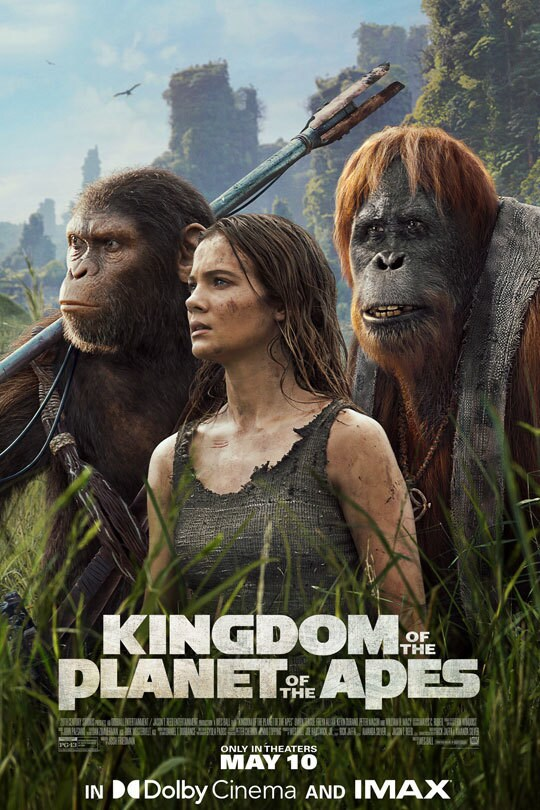
Kingdom of the Planet of the Apes

Set several generations in the future following Caesar’s reign, apes are the dominant species living harmoniously and humans have been regressed to a feral state. One young ape undertakes a harrowing journey that will cause him to question all that he has known about the past and to make choices that will define a future for apes and humans alike.

More Apes after the conclusion of the incredible Caesar trilogy with War for the Planet of the Apes sounded too cash-grabby and too soon. What was wise on the filmmakers’ behalf was to treat this installment not as a direct sequel or reboot, but a slight reset of sorts as we pick up 300 years later, focusing on the legacy of the apocalypse and Caesar’s leadership. Apes are no longer living in fear of humans, rather Earth has become their planet, which creates an intriguing new setting that still doesn’t quite undo the finality of the last film. Ever present is the amazing dedication to the visuals and world-building. The motion-capture technology used to transform the actors into chimps, and the performances themselves, are impressive and make you forget for the entire 2 hour and 25 minute runtime that you’re watching performers rather than real apes in this world. Though Andy Serkis as Caesar was an iconic leading character that’s impossible to top, Owen Teague gives a sympathetic performance as Noa who strongly takes us on this adventure in this new era for the planet. Peter Macon also stand out as the wise Raka, and Freya Allan is especially expressive in her deep performance as human character Mae, though the script missteps in where to take her path later on. Kevin Durand gives such a committed presence to the villainous and tyrannical Proximus, a more charismatic version of the manipulative and sadistic Koba from Dawn. Proximus’ dialogue and physicality dominates whatever else is in the screen and truly terrifies, and his objective is quite menacing as well. However, his motivations, compared to Koba (who many ranked as one of the 2010s’ best villains), leave less room for moral grey area and rather feel like “pure evil”; there’s no layer or nuance to the terror Proximus wants to inflict or how he got there, though I can’t complain as to how well Durand brings the character to life.

Kingdom is most interesting when focusing on the apes’ new ways and how Caesar’s legacy impacts the sects of apes in different ways. But gone is the intrigue of the human-ape conflict and its undertones for human nature, though the film doesn’t understand this and often dwells too much in conflicts that War had ended with such finality, instead of embracing its other themes as its strengths. There’s also a character played by a recognizable Oscar nominee who’s entire being there felt unnecessary and simply complicates the logic of the world building further. The film isn’t short on great action and visuals in this imaginative, lively, post-apocalyptic world. It’s just that when you have two practically perfect films in the franchise preceding it, as Matt Reeves helmed them, it’s harder for this film to escape that shadow especially when the last one ended so definitively and didn’t beg for any sort of ambiguity or continuation. Kingdom of the Planet of the Apes is an engaging ride that should probably be seen on a large screen, even when it stumbles in justifying its existence and polishing its character motivations. Not to mention, it may have just been to soon for this inevitable continuation to a perfect ending, and the film’s final minutes raise more unnecessary questions that undo what we just saw than exciting invitations for more.

Challengers

Tashi, a former tennis prodigy turned coach, turned her husband Art into a champion. But to overcome a losing streak, he needs to face his ex-best friend, Patrick, who’s also Tashi’s ex-boyfriend.

One thing that’s thrilling about Challengers is that it never gives you easy answers. Is it about devotion? Manipulation? Triumph? Doom? All of them? One thing’s for sure: it’s a film about passion. Raw physical and emotional passion between humans for one another, and for the kick they get doing the one thing they can’t live without — in this case, playing tennis. And for all the right reasons, Luca Guadagnino is at his most maximalist stylistically to convey this raw passion these characters feel and bring us into the world, from exciting editing and some experimental cinematography to the synth, almost Run Lola Run-esque score from Trent Reznor and Atticus Ross. It’s the polar opposite to his more naturalistic, minimalist approach to the intimacy of Call Me By Your Name, and an upping of the ante of the wilder style of Bones and All. Zendaya gives one of her heaviest performance, portraying Tashi perfectly over a long span of time, through fascination, ambition, longing, control, and deceit. Josh O’Connor and Mike Faist are also great, particularly Faist, whose charm entrances the screen. The West Side Story star announces himself as a powerhouse whose apparent harmlessness you can’t help but feel for. Their friendship established in the opening minutes of the film sets the stage for everything to come, and makes you care for how the rest may unfold or fall apart.

Challengers is the rare film that transports you into its world in a case where there are only 3 characters who really bear any significance. There’s a scene between the three main characters that happens early on chronologically that enchants you and sucks you into the close, complicated intimacy they inhabit in this space, and the film never lets you go once this scene happens until the credits roll. It’s an experience that’s dynamic, unpredictable, and darkly human, with three riveting leading performances at its center, and sets the bar the rest of what’s to come in Guadagnino’s directorial career.

The Fall Guy

Colt Seavers, a down-and-out stuntman, must find the missing star of a new blockbuster film he’s doubling on, while (hopefully) winning the director (and his ex-girlfriend)’s affection back.

David Leitch continues to be a leading voice in action movies with his creative and passionate voice for action and comedy that often turns out star-studded and visually appealing. Much of the film’s charm comes from Ryan Gosling’s brilliant turn as Colt. Like his Oscar-nominated Ken in Barbie, Colt is a sad shell of a “cool guy” who’s too evidently madly in love. Gosling’s comedic timing is at the lightning speed of his Ken, or Holland March from The Nice Guys, and his big personality infuses Colt with a foolishly endearing heart. Emily Blunt also gives one of her most entertaining performances of late as the romantic lead, and Winston Duke is also loads of fun as Colt’s best friend and the film-within-a-film’s stunt coordinator, while Aaron Taylor-Johnson, Hannah Waddingham, and Stephanie Hsu also round out the stellar cast. Waddingham in particular is very extravagant but delightful as Gail, the producer of the film Colt’s working on.

The most clever and thrilling part of The Fall Guy is that Leitch makes the movie stunt-filming scenes as high-stakes and exciting as the actual action scenes of the film. The great scale, dedication, and sound effects make shooting an action movie stunt feel like the incredible, hard-achieved feat that it really is. Additionally, the lightspeed humor feels effortless thanks to the writing, editing, and the cast’s delivery. The lively soundtrack does have a few generic and overused selections, but it’s not enough to sink this smooth romantic action comedy where all the different genre pieces play off each other pitch-perfectly. The director’s career as a stunt coordinator is made evident by the love and tribute to the stunts community here, in this blockbuster that’s hilariously pleasing and greatly worth the big screen price of admission.

Civil War

A journey across a dystopian future America, following a team of military-embedded journalists as they race against time to reach DC before rebel factions descend upon the White House.

Alex Garland is often not one to shy away from dark images as they unfold, but there’s something particular about the violence in Civil War, as if you’re peeking at something you’re not supposed to, only it’s happening in your own yard. Garland seems to have something to say with the “action” here that’s proven itself in reality too much not to struck a chord when it’s depicted way — Americans being just a few disagreements (and arms) away from completely tearing each other apart. What began this second civil war in America is none of our concern, rather the ease at which we’ve turned on the very fabric of democracy. Bloodthirsty militias and anarchists seem too familiar a sight, though we’re following this dystopian war through a group of journalists. Kirsten Dunst gives a powerful performance, as she reveals the most about her character in the quietest of moments. Wagner Moura also gives the film a lot with his charismatic, knowledgeable, and authoritative presence among the protagonists. Cailee Spaeny is notably wonderful as the ambitious younger photographer on the journey who’s horrified responses to what unfolds in front of her are probably how we’d react to, let’s face it. Stephen McKinley Henderson is a fantastic presence as well who adds a lot with his wisdom and charm to each of Garland’s projects that he’s in.

Though Civil War is minimal on exposition as to the larger politics of this war — rather we get an idea of the state of the nation through smaller moments and remarks — the action is incredibly harrowing and graphic. The sounds of gunfire and combat roar through the speakers, and blood is a “loud” reality and consequence. It all plays out without the “cool” sort of filter many Hollywood action movies have, rather it’s an unfolding of sheer chaos and carnage through intentionally amassed manpower, in the way that Children of Men and Sicario throw you into uncontained, senseless warfare. Best of all, the climactic battle at the center of the third act is exhilarating and ends in the most Alex Garland rug-pulling way possible for a film with this subject matter. Fans of Garland’s daring and mature work be interested in the punch he packs here, but for anyone who’s simply looking for an action film — this one’s singular and profound but does not hold back, and when it’s untamed, it’s at its most engrossing.

The Ministry of Ungentlemanly Warfare

Guy Ritchie’s latest action film is loosely based on true, mostly encrypted stories, in which the British military recruits a small group of highly skilled soldiers to strike against German forces behind enemy lines during World War II.

Guy Ritchie seems to be racking out more movies than some of his fans will be able to keep track of, but among a slew with varying qualities, this one may end up being looked back at as one of his most entertaining films ever. Ritchie imbues the screen with an Inglorious Basterds-like irreverence to its Nazi-killing action. The WWII battles are swiftly edited and have action sequences that’ll make you cheer with glee at the bad guy body count and the different ways they get killed by the titular heroes. Henry Cavill leads the pack with a similar irreverence he gave Ritchie’s The Man From U.N.C.L.E., but with an even rougher edge to his badassery. The ensemble of Eiza Gonzalez, Alan Ritchson, Henry Golding, and Cary Elwes all give the film a liveliness that makes up for a lack of uniqueness to them, as well as a menacing Til Schweiger who maintains a strong presence. Unlike last year’s Operation Fortune, the film’s witty humor matches the extra wicked energy the director is known for, but it may lack character depth for some viewers. Most of the characters have little substance besides “recently incarcerated” or “they’re crazy”, but their outlandish personalities make up for that in the case of this film. The soundtrack choices aren’t always on-point, but the Western-inspired music usually adds to the film’s sharp direction. The film also doesn’t manage to always balance the different moving plots seamlessly, as Ritchie sometimes can’t help but indulge too much in his trademark banters which can sidetrack, but ultimately culminates in some strong tension in the third act. The Ministry of Ungentlemanly Warfare perhaps achieves what Matthew Vaughn’s The King’s Man failed to do — turn covert misfit spies into World War heroes and make the journey feel exciting and earned on the way. Ritchie is no stranger to the approach he set out to achieve here, but he manages to balance out his quirks with an excellent style, an interesting mission and cast of characters, and a rewarding catharsis when the action and comedy hit their peaks, as you might not want the fighting to stop out of sheer Ritchie delight.

Back to Black

Back to Black chronicles the life and music of Amy Winehouse, through the journey of adolescence to adulthood and the creation of one of the best-selling albums of our time.

It may feel like a step up from recent music biopics like Elvis and I Wanna Dance with Somebody, and may be on par with something like Respect and not quite at the glory of Rocketman. Marisa Abela is great as Winehouse, bringing the young music-loving girl to the screen in the start and the mess of an unstable addict she becomes later in life. But what’s most unbelievable is Abela’s singing which completely captures the one-of-a-kind grandeur of Amy’s voice. There are times when Abela completely disappears and you simply feel the singer alive in front of you. Eddie Marsan gives one of his most memorable performances to date as Amy’s father, while Lesley Manville also brings a lot to the movie as her grandmother. When Jack O’Connell comes in, however, as Amy’s love interest and eventual husband, the film falls into messy melodrama that sinks the runtime and falls into the same traps that many of these biopics suffer from when channeling the artist’s pain and troubles. Winehouse’s journey through love and addiction is filled with cliches, but is empathetic enough for us to forgive her shortcomings. The film also does a great job of incorporating her songs into the film, and best of all, it manages to have its audience actually interact with the subject as a tangible person, rather than just a larger-than-life legend. The more minimalistic approach to the musical biopic gives Back to Black a strong start, but you’ll also have a few too many instances of deja vu, though we’ve certainly seen it done worse. It’s watchable enough for non-fans of the late singer, but for some, it might not stand out among similar films with similar beats that have come out far too recently.

Ghostbusters: Frozen Empire

The Ghostbusters have reestablished themselves as the heroes of New York City, but the city soon faces its greatest threat yet when an ancient artifact unlocks a destructive force.

Ghostbusters: Afterlife was a solid tribute to the heart of the original film. This sequel has all the ingredients with none of the direction. The cast still has that charming energy, particularly the Spenglers played by Carrie Coon, Finn Wolfhard, and McKenna Grace (with Paul Rudd stepping into the new stepdad role). Grace is the most interesting part of the film, but her role as the protagonist is watered down by an overabundance of characters. Dan Aykroyd, however, is very enjoyable in his role, as is Ernie Hudson, but the film tries to balance too many of these people, and the original cast ultimately was only there for fan service in a lesser way than the last film. Not to mention, Kumail Nanjiani is usually a standout in any film, but his character here is uninteresting, save for a few laughs. The action has some fun a bit of a retro vibe, with solid SFX editing as well, but the film’s runtime wanders through C-level subplots and the pacing lacks a consistent excitement. When we finally get to the villain, its yet another faceless ancient giant with apocalyptic intent, and the visual effects of the ghosts are also quite lacking. Ultimately, the film settles for a lot of the same, but its the sluggish pace that makes it a lot hollower and not as lively or meaningful as before. This may just be another instance of a beloved franchise going on for one too many films.

Monkey Man

An anonymous young man unleashes a campaign of vengeance against the corrupt leaders who murdered his mother and in turn, soon finds himself empowering the poor and victimized of Mumbai.

Monkey Man is proof that no matter how overdone a simple revenge story is, it can always feel fun if the right filmmaker elevates it through energy and style. And Dev Patel’s directorial debut proves that he’s capable of making not just a fun action film, but one with lively world-building and interesting characters. The action is bloody and jaw-dropping, with rewarding long takes and soundtrack choices that elevate the fights. But most importantly, when the action isn’t there for a long time, I always found myself engaged in the story. Similar to John Wick, it also doesn’t romanticize its hero, rather just empowers him to do the wrong things for the right reasons, justifying his ends rather than his means, which gives the film even more of a ruthless edge. The long takes may feel dizzying for a moment, but soon work in the film’s favor to create some exhilarating carnage. The incorporation of Indian culture and mythology, as well as MMA in the film also give the film plenty of life. Patel’s performance is committed and shows once again how much he can command an audience when he’s front and center, and his direction gives the film a vibrant yet patient style. Unlike the majority of the year’s action films so far, it treats its audience like intelligent adults. Monkey Man‘s greatness isn’t just through the expert fight choreography, but also through strong character and mythos development. Other action films this year so far like Road House and Argylle were simply missing that nuance and restraint with its heroes and villains that makes this film one in which we don’t feel talked down on, no “fake-out deaths” or “exposition dumps”, but rather a stylish build to the excitement that lets you breathe, yet still takes action movie fans on a thrilling ride that ends on a satisfying high note.

Godzilla x Kong: The New Empire

Two ancient titans, Godzilla and Kong, clash in an epic battle as humans unravel their intertwined origins and connection to Skull Island’s mysteries.

We’ve heard of way too many franchises overstaying their welcome lately, but it’s been a while since a film of this scale has failed so spectacularly to answer the question of why it was made. Godzilla vs Kong culminated the MonsterVerse in a battle between two famous characters we’d never seen on-screen before. This is the exact same movie, but without any of what made parts of that movie tolerable. Story, logic, and sense are all but myths in this movie that never quite finds the answer as to what that punch or special offering is that the last film didn’t have. Godzilla and King of the Monsters had massive visual scale, making the human damage and stakes feel wide and consequential, and as a result, the monsters felt huge. Kong: Skull Island had a fun pace and was a visually striking survival action film on an island. But now, the look feels so artificial, the stakes are unclear and boring, and the progression of the story, characters, and locations are exhausting. The visual effects are unconvincing and as a result don’t give you that large, adventurous feel, and the actors feel like they’re wandering through a Warner Bros. studio, struggling to keep this thing together. Rebecca Hall is a great actor to lead a film where the CGI extravaganza comes first, but even her character feels like she has no idea how to make sense of her dialogue. Dan Stevens delivers a fun Crocodile Dundee-esque performance as a Titan veterinarian, and Brian Tyree Henry is the only truly entertaining part of the film as a conspiracy theorist-turned-world-saver after the events of the last film. Not even Godzilla seems able to find himself a place in this film, as his progression throughout the film is probably the lamest thing that can happen to a titular character in a monster movie of this size.

Films like Godzilla x Kong: The New Empire are either made or broken by the visual and cinematic experience, and how they make use of being a grand adventure with enjoyment and spectacle, but what we’re left with is a film with neither of those things. The exposition and plot threads are bland and inconsistent with the franchise, the villains are incredibly underwhelming, and worst of all, it does nothing to differentiate itself from the previous installment. Perhaps bringing back Adam Wingard to direct was the film’s first and greatest mistake, as the stylistic approach of the last film simply wasn’t sufficient for a sequel. What worked when the MonsterVerse began was that these are gigantic events, disaster/monster movies where unbelievable Kaiju rampage the Earth, the stakes and conflicts are to be taken seriously, and the principles of the humans and their relations with the Titans guided the script and the fate of the world. Now, they’re no different than the Transformers movies, where creatures created by computers move across the screen like athletes and are treated like Marvel superheroes with devices and powers, as the structures around them go down like Legos. The worst part about a franchise like this is when it can’t excite; when it’s never been clearer that the best and coolest stuff has already come in past films, and when it’s repeating itself like the only reason it truly has to exist is every blockbuster saga’s greatest curse: studio box office ambitions.