Moana 2

Moana and her people have now rightfully reclaimed their place in history as wayfinders who sail the ocean in search of exploration. One day, Moana receives a call from her ancestors to embark with an unexpected crew across dangerous waters, and reteam with her old friend, demigod Maui, for their most challenging and important quest yet.

The first Moana remains an unforgettable and impactful film among Disney’s recent animated films. This sequel retains everything that made that first film look so gorgeous, and builds on the dynamic colors of the ocean and its mystical findings. The transformative magic of watching the first film, though, is missing in this sequel that can’t quite justify its existence. Moana doesn’t feel like a film that has sequel potential built into it, as opposed to even other Disney sequels like Frozen II and Inside Out 2. Watching the sequel unfortunately didn’t convince me otherwise. Though its still charming and has some fun to be experienced, it’s basically retreading the same beats from the first film.

Auli’i Cravalho proves again why she’s earned the spotlight in her wonderful voice performance as the titular character, but Moana lacks any actual internal conflict this time around — there’s even an opening song all about how she’s finally become who she’s supposed to me, and the movie never ends up convincing us that she does need to change and grow, just to remember who she’s already become. Speaking of the songs, there are only two that manage to stand out at all, “Beyond” and “Can I Get a Chee Hoo?”, but even those are stuck in the shadow of the overly similar — and far more original — “How Far I’ll Go” and “You’re Welcome” from the first film. There are a few laughs and solid new characters, including Moana’s trio of new voyagers and companions, and an unexpected antagonist. However, the key piece that’s missing from Moana 2 is any sort of feeling that something is at stake here — what happens to Moana’s people, the ocean, or even her own internal journey if they fail this mission? What does Moana have to learn here, now that she’s embraced who she needs to be and discovered her destiny? The answers to these questions are unfortunately insufficient and affect the excitement levels older audiences may feel watching it.

Moana 2 is colorful and has its share of sweet moments (it certainly has way more soul than Strange World and Wish), but most of what works about it is drawn from the first film, including its beautiful depiction of the ocean, tributes to Polynesian culture, and lovely characters. Rehashing the incredible themes, numbers, and world-building doesn’t work, though, without the same spark of originality and wonder that made us never forget Moana. Whether you’re going in expecting a serviceable adventure aimed towards younger audiences or just unsure why this movie needed a sequel, Moana 2 is unlikely to change your mind.

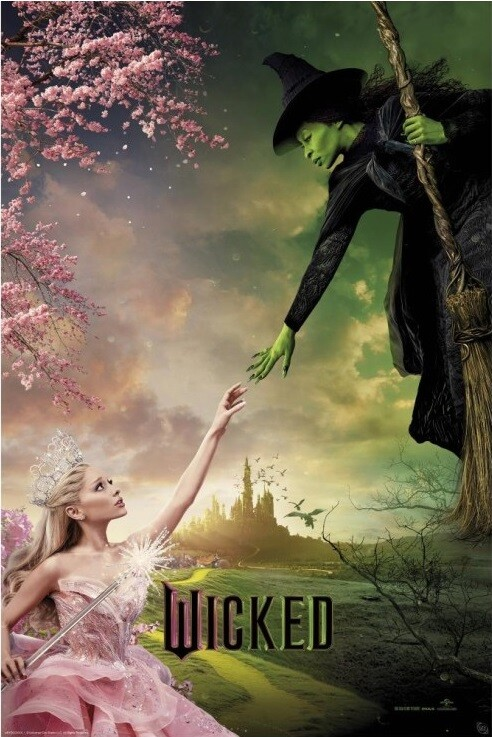
Wicked

Wicked tells the story of Oz in a new light, as we meet Elphaba and Glinda in their early years of sorcery, who eventually become the Wicked Witch and the Good Witch, respectively.

Few stage-to-musical adaptations in recent memory capture the excitement of being there with the actors on a production filled with song and dance like this one. Despite its title, Wicked is one big burst of joy, led by the spectacular Cynthia Erivo, who makes the material, and the mere art of musical theater itself, feel like they were made for her. Erivo’s enchanting voice is moving and never quite lets go of the audience, rather you’ll be begging for more of her songs. Ariana Grande plays into type well as Galdina, who starts of as quite the narcissist, but the characterizations of both her and Elphaba soon become more complicated in a way that feels genuine and touching. Michelle Yeoh is also wonderful, and Jonathan Bailey and Jeff Goldblum are delightful. But it’s not one element that makes the movie works: it’s the beautiful costumes and sets, put together with the music and story, brought to life by these talents. The songs might have not worked without the incredible musical numbers and dance sequences, but Jon M. Chu steps up to the responsibility of bringing out the best of this bombastic fantasy tale. It also deeply humanizes an infamous movie villain in a way that feels natural and oddly grounded, with themes that may connect with audiences.

As this is only the first part of the two-film adaptation of the musical, the pace dives deep into unexpected subplots, and though this approach threatens to deem the split unnecessary, it ends up fleshing out its world in a rewarding way, making the runtime worth it, and leaving audiences with much anticipation for the next film. Wicked is a cinematic experience with exciting musical numbers, an incredible leading performance from Erivo, and mesmerizing execution that’s a must for both fans and non-fans. It’s hard to believe there’s so much more to come, though where you’re left here in Elphaba and Glinda’s journey is still an astounding and gratifying moment.

Gladiator II

Decades after the events of Gladiator, the Roman Empire has fallen into the tyrannical hands of Emperors Geta and Caracalla. Hanno, a young man taken to Rome as a slave, learns of his connection to the Empire and trains to be a Gladiator to fight against the corrupt emperors.

This long-awaited sequel doesn’t have the same visual beauty and flare as its predecessor, but is still a solid action film that embraces the best aspects of the first film’s story. It’s quite an uphill battle to create a hero as strong as Maximus Meridius now that he and Russell Crowe are out of the picture… unless, of course, you cast Paul Mescal. Mescal brings a tenderness to his performance that shows through even when he ought to show strength and ferocity in the arena. Pedro Pascal is also fantastic and completely chews up the scenery, as do Joseph Quinn and Fred Hechinger as the spoiled and maniacal emperors. Denzel Washington gives so much life to the film, seemingly just by being his soulful, fun self. He brings a lot of humanity as he and Mescal enter a mentor-student dynamic. The film doesn’t work as well without Washington’s presence, whose character takes unexpected turns throughout the film.

Gladiator II‘s script works when focusing on its protagonist’s journey, as well as his fight against tyrrany. The power dynamics and engaging action scenes carry the story forward, though visually, it feels held back from what could’ve been compared to the first film. Ridley Scott’s style here doesn’t feel as patient and refined as in his recent The Last Duel, and the CGI could’ve used a lot more improvement. However, the action choreography is as bloody and grand as fans of the original could hope for, and the ending is beautifully done as a realization of promises we didn’t even realize the first film had. It’s a noble continuation that honors the first film, and its cast led by Mescal and Washington, while never quite reaching that original movie’s breathtaking heights, but still better than some of Scott’s other recent outings, and worth a watch in theaters.

The Apprentice

The Apprentice envisions the rise of billionaire tycoon and megalomaniac Donald Trump as a teacher-student relationship between Trump and his cutthroat attorney Roy Cohn, the acolyte of many evildoers in American history such as Nixon and McCarthy. It takes a serious approach with only a dash of irreverence in its script and style, showing the true scope of the values America represents and the ones it claims to but fails. Sebastian Stan isn’t doing a comedic impersonation of the man like many we’ve seen on Saturday Night Live, rather he transcends that and embodies Trump’s skin, becoming more and more like the Trump we’re used to seeing and hearing as the runtime progresses. Donald in the film is chronicled in his journey from a spoiled brat living off his dad’s achievements, to the narcissistic bully obsessed with greed and demonizing others. Much of what he seems to learn is attributed to his mentor, attorney Roy Cohn. Jeremy Strong is incredible in the role, giving a massive performance as a man who dominates every room yet evidently has a small sense of self. Cohn is played by Strong with immense physicality and a fragile fearfulness to his appearance. Even when the film’s pacing occasionally slows down or falters, the film is entirely worth it for those two principal performances.

Director Ali Abassi is fascinated with the American ambitions and values that surfaced in the 1980s, including Cohn’s “kill or be killed” mentality that many big American wealth giants lived by, or splitting the world into “winners and losers”. The use of various vintage cameras to immerse the audience in its 80s period can come off as indulgent and even distracting when too rushed, but the production value looks uncanny to how the Trumps at that time and their “achievements” really looked. Most importantly, it shows the normalization of bigotry and corruption in the American system, and how it’s rigged to enable the wealthy to get richer, and continuously toss the needs of the people aside. Trump comes of age in the film, but perhaps for the worst. His wishes are all granted, but at what cost? The spread of his ambitions to conquer the world and rub it in everyone else’s faces seem never-ending, but we see his infamous persona here originating from a desire to always be strong and win no matter the cost. The Apprentice isn’t just an origin story of modern evil, but a tale of the delusional men who roam at the top of society, capturing the essence of how a force of destruction and its hunger for power was activated and enabled by forces not so unlike him.

Joker: Folie à Deux

After inciting violence, murder, and chaos in Gotham City, Arthur Fleck is institutionalized at Arkham, where he faces trial for his crimes — and perhaps the love of his life.

It might still be that there’s no reality in which a sequel to Joker makes sense. Joker felt so fresh compared to other IP-driven blockbusters when it was released, but also provided a sense of shock when it ended. Folie à Deux is a confused sequel that left me feeling nothing. Perhaps a radical decision like making this follow-up a jukebox musical is exactly what it needed to justify its existence, but a movie this ambitious is also too cowardly to take large enough swings or hit hard as a musical. The two main ingredients that work here are Joaquin Phoenix’s performance, which is still incredibly committed and breathtaking at times, and the gorgeous cinematography by Lawrence Sher, which embraces different colors and a grand sort of look to its prison scenes. However, it’s a bad sign when you wish such a legend like Phoenix was spending his time and talents elsewhere rather than helping Warner Bros. milk this character, which won him an Oscar the first time around.

One of the things that inherently doesn’t work about the concept of a Joker sequel is that we don’t have that gateway of sympathy into Arthur’s world when we meet him; he’s been dejected and abused by the world around him, but by the time this movie starts, he’s already done his awful deeds, and it’s hard to feel anything for him in this one’s opening act. Without that fascinating entrance into this world of sorrow and sadism, it’s hard to really feel anything watching the movie. Lady Gaga’s casting is inspired, but the film itself doesn’t do her and the character justice. Why make the singer of a generation whisper lots of her singing or not give her something more substantial than to pine over Arthur? In a psychological thriller about two insane criminals that turns into a musical, the numbers couldn’t afford to be this safe and scared. They feel like they’re holding back and are too concerned with convincing us they are set in the characters’ heads rather than leaning into surrealism and ambiguity. The music scenes don’t feel like a trip, or like they’re unlocking something about the characters and the film that can’t be backtracked on, they’re just breaks with song, and that’s what makes this risk feel so frustrating and timid. Not to mention, we don’t feel like we learn anything new about Arthur that wasn’t already established in the first film, nor anything original about the justice system, the mass hysteria around violence, or society’s outlook on poverty and the mentally ill.

Joker: Folie à Deux is a film that, unlike the masterful and already iconic first movie, has no identity of its own, because it’s too scared to commit to its giant leaps. As a courtroom drama, it’s derivative. As a romance, it’s painfully undercooked. As a social commentary, it’s tiring. And as a musical, it’s just too dim. By the end, nothing really transports, terrifies, or resonates, and worst of all, it fails to answer the most important question of why another chapter to this story.

Megalopolis

Megalopolis is the ambitious new epic fantasy/sci-fi drama from cinema legend Francis Ford Coppola. In the city of New Rome, Julia Cicero (Nathalie Emmanuel) is torn between the ideas and loyalties of architect Cesar Catalina (Adam Driver), who sets out to reinvent the NYC-esque city entirely into a utopia of his imagining, and her father (Giancarlo Esposito), the mayor who wants to keep things as they are.

Megalopolis sets out to be the most ambitious movie meant for a large screen in ages, with outrageous ideas coming at us straight from Coppola’s mind (and pockets, too). Unfortunately, shooting for the moon doesn’t land Megalopolis among the stars, more so the dirt. It’s a canvas of messy ideas that come together without reward, prestige, or even sense. The dialogue is unintelligible, the story is impossible to follow, and the green screen and effects that try to imagine out-of-this-world visuals in line with Doctor Strange look rather hideous and more in line with Spy Kids or Speed Racer. The film poorly utilizes its stacked cast that includes Driver, Emmanuel, Esposito, Aubrey Plaza, Shia LaBeouf, Jon Voight, Laurence Fishburne, Dustin Hoffman, and more. They’re all given surface-level characters with awful dialogue and absolutely no idea what to do with them. An early scene featuring a number of the principal cast debating on the city’s feature feels more like a drunken celebrity costume party than a scripted and rehearsed scene in a film. The characters are inconsistent (and have unexplained superpowers?), and LaBeouf’s antagonist is laughable and serves no threat whatsoever. Fishburne’s narration is indulgent and unnecessary — the movie begins with Coppola conveying to the audience through Fishburne that he sees parallels between our modern metropolises and Ancient Rome, and then proceeds to spoonfeed that same message to us for 138 minutes with no further nuance.

You may be glad you chose to see Megalopolis on a huge screen… for about two minutes, and then everything goes haywire. The mess of tones and logic is the least of the audience’s worries here; it’s a sensory disaster and a meaningless, incomprehensible drag with hollow ideas and distracting visuals. Things don’t explain themselves or mean things in Megalopolis. They just happen. Yet there’s no mystery underneath to unlock and no sense of intrigue, maturity, or intellect whatsoever from the man who directed The Godfather, Apocalypse Now, and The Conversation. If, like me, you don’t manage to hop on board with this puzzling vision from a filmmaking master devoid of wonder or enjoyment, this is one city you’ll be itching to escape from.

Sing Sing

Sing Sing takes place in the titular New York prison and focuses on inmates involved in the Rehabilitation Through the Arts (RTA) program, as they work through their traumas to find redemption through acting.

Colman Domingo beautifully leads this film as one of the only actors not starring as themselves, opening us to a completely different side of him from his turn in Rustin, but equally moving and majestic. His charisma and soul commands the screen like not many actors can, balancing authority in his efforts to strengthen camaraderie throughout the RTA’s production at Sing Sing, and a longing to leave his imprisonment and prove his innocence from a crime he’s doing time for that he didn’t commit. He makes us deeply care for Divine G’s struggle but his “performance within a performance” scenes are also impossible to look away from. Paul Raci is also lovely as the RTA director encouraging the inmates to open up and unlock their deepest feelings through the process of acting and imagination. Besides those two Oscar nominees, almost everyone else is a veteran of the RTA program playing themselves, unlocking a naturalistic sincerity in not just the characters but the experience (similar to watching Frances McDormand interact with real-life nomads in Nomadland).

As these inmates find the hidden parts of themselves and get in touch with their most vulnerable sides, the experience of watching Sing Sing becomes just that for the audience. We’re left reflecting on our own livelihoods we’ve taken for granted, and the times we may have felt trapped and longed to escape from realities of our own. Acting is not just redemption for these characters we grow to feel deeply for — it reinvigorates their love for being alive, and reminds them of something to fight for, including their brothers on the stage with them. The film frames this rehabilitative process as a reclamation of the self, even behind bars where people are often treated as, well, less than people. It’s a rare experience that breaks down barriers and makes us feel close to characters that would often frighten us from the outside in any other film. Beyond those discussions about empathy it may stir within us, the film is kind-hearted and funny even amidst the most difficult of settings. In this mix of Oscar-nominated actors alongside a number of men playing themselves, the real often blends with the scripted, both for the characters and the art, that invites audiences for a complex but loving and extraordinary drama of raw and beautiful storytelling.

Deadpool & Wolverine

Deadpool enters the larger Marvel Cinematic Universe when he’s called upon by the TVA to save his timeline from erasure — or in other words, a Disney acquisition.

Deadpool continuing into the larger MCU, and with a larger sandbox to reference and joke with, only feels right, with the character reminding us that anything and everything in the world of entertainment need not be taken so seriously. Excitingly, it’s not just the convergence of the Fox Marvel heroes and the MCU, but also Hugh Jackman’s return as Wolverine, whom Deadpool has already poked fun of in his films. The film asks, what if two people who can’t die and have no temper but are polar opposites need to get along (but can’t)? That buddy comedy aspect drives the film, as do the multiverse-level visuals. In addition to Reynolds’ increasingly impressive commitment to one of the most foul-mouthed heroes to ever wear spandex, and Jackman’s rage-filled but emotionally charged take on a Wolverine different from the one we parted ways from in Logan, Emma Corrin shines and never feels lesser than the two A-listers when on screen with them. Corrin gives a delightfully cruel and loose performance as Cassandra Nova, and certainly not right-minded, almost like a Mad Max character given Professor X’s powers. Matthew Macfadyen also gives the film some great fun as a TVA agent whose a little murkier than the ones we met in Loki.

The film’s writing for its lead character doesn’t really hit hard on a deep level, and Wade’s relationship with Vanessa feels like a superficial conflict thrown in for the sake of necessity. Their arc worked way better in Deadpool 2, and here, this variant of Logan is by far the more inviting emotional aspect of the film. Despite Deadpool’s growth as a person taking a backseat, this is a film where the experience is reliant on the action, humor, and surprises, and it delivers on all three fronts. The action scenes are creative, eye-popping, and cheerfully graphic, from an opening that’s one of the most brilliant fight scenes in the trilogy to much, much more that comes after. The jokes come at light speed and have something belly laugh-inducing for everyone, including references to the actors’ filmography. The film also embraces the idea of the multiverse with cameos to behold that’s been kept secret from the marketing for our enjoyment in the theater. It’s probably why Deadpool & Wolverine, despite not having a marginally original story, is such a memorable crowd experience and action blockbuster that does not hold back, continuing to push the limits of how much the blood, raunchiness, and self-awareness can surprise and amuse us. But it’s not just irreverent for the sake of it — the humor and energy of the film brilliantly mesh with the CGI-heavy worldbuilding of the MCU, so come the chemistry that’s promised from the title and meta potential of these franchises colliding, and though that’s the mainstay here, it’s more than enough devoted fans of the superhero genre and the collective theater experience.

Twisters

Kate Cooper, a retired tornado-chaser and meteorologist, is persuaded by her former colleague Javi to return to work with a new team and new technologies to stop deadly new tornadoes from wreaking havoc on central Oklahoma.

Twisters is a film that takes a vastly similar premise to the original, and a genre that’s been tired and torn since that first film’s release — a few good-looking movie stars trying to survive a deadly natural disaster — but winds up being better and more engaging than that first film in just about every way. The stars’ endless charm is the film’s secret weapon. Often in a modern effects-centric disaster film, one might find themselves either bored to death by the human scenes or yelling at their dumb decisions. The characters here aren’t just compelling, they’re also so much darn fun to watch. Daisy Edgar-Jones (of Normal People, Fresh, and Where the Crawdads Sing fame) is one of the reasons the film is so interesting to watch, and Kate’s intelligence, empathy, and passion for making a difference through science make for an emotional lead. If Hit Man hadn’t already proved that Glen Powell was a superstar here to stay, he’s again awesome here as a scientifically smart, behaviorally dumb Internet-famous tornado chaser whose group and approaches clash with Kate’s. His character genuinely feels layered, in addition to the funny cowboy side we first meet, and his chemistry with Edgar-Jones is irresistible. Not many actors have the charm Anthony Ramos has given every film he graces, and his presence in the film isn’t taken for granted. A few great actors like Brandon Perea and Sasha Lane could’ve been given a little more to do, though.

In addition to genuinely wanting to watch these characters interact and survive, the tornado action and destruction are a blast. The effects look like a great blend of that Amblin Spielbergian practical look and some large CGI set pieces. They all come together seamlessly with the booming sound effects to create an edge-of-your-seat experience. But director Lee Isaac Chung’s style is never only about big effects and havoc. The characters, science, and even the editing are always key to the story and pace here — not to mention, the soundtrack adds a terrific lot to the film. This new take on a familiar story meshes the old and the new with plenty of genuine thrills that I haven’t felt in many franchise films this year. But none of it matters without its stars’ infectious charisma, which, together with the tornado action, will put a big smile on your face and prove one of the year’s strongest blockbuster sequels that undoubtedly tops the first.

Fly Me to the Moon

Marketing specialist Kelly Jones and launch director Cole Davis cross paths at the Kennedy Space Center and sell America the race to put a man on the moon. But things get truly complicated when NASA orders Jones to come up with a contingency plan to mankind’s greatest achievement.

Scarlett Johansson and Channing Tatum shine in this romantic star vehicle set in the backdrop of the space race, but the film flourishes most when focused on its playful interactions with history and period mood. Tatum is particularly strong as a character whose authority is thrown into messy situations, and Jim Rash is a hilarious standout as a director friend of Johansson’s character. Ray Romano also gives potentially his most delightful performance since The Big Sick as a NASA scientist who gets some of the film’s most touching dialogue. The $100 million budget also pays off as you feel the grand scale of NASA’s sites and activity, as well as the gravity (no pun intended) of this place and its happenings for the world and human possibility. Some scenes may fall into the shadow of First Man due to some of the same events being covered, but it’s not really fair to compare any film to that one technically. The film work’s best when embracing this ambition alongside it’s bright, comedic tone, and this energy creates an engaging watch, even when the film is low on substance — or the substance to the lead characters just isn’t that memorable. Still, Johansson and Tatum’s performances are enough to entice the audience and though the editing is a bit aggressive at times, and the film doesn’t leave you with as much food for that as it does toying around with history, it brings its 60s time period — and the wonder that came with NASA at the time — to life with enough flare to induce smiles, laughs, and a nice trip to the movies for all.