Mickey 17

Mickey is an Expendable on a expedition to the space colony Niflheim — meaning a new copy of him is printed out every time he dies, which is more often than others. Soon, trouble ensues as Mickey finds himself in a dangerous situation and a fight to survive.

Bong Joon-ho’s likely largest production in sheer scale isn’t subtle in its themes, whether of human nature, fascism, or the arrogant abuse of technology, but it’s still clever, vibrant, and so full of heart, more than enough so to serve as an absolute blast of a film. The look and feel of the sci-fi settings feels original and Pattinson’s delivery of the titular character is likable. Mickey 17 is an insecure man/clone who’s somewhat at peace with the bleakness of his situation, but is fun to follow along and has the sudden urge to stay alive and fight for what’s right. He also has great chemistry with himself as Mickey 18, who’s only a few hours older than 17 but almost the polar opposite — hardened and occasionally ruthless. Naomi Ackie gives the film its soul; she’s so lively and wonderful as Nasha, who elevates Mickey as much as she’s on her own meaningful journey. Steven Yeun also shines as a sleazy and unrealiable but multi-dimensional frenemy of Mickey’s. The parallels between Mark Ruffalo’s character and certain powerful men in our reality aren’t hard to decipher, but he and Toni Collette entertain, even when their performances occasionally threaten to fall into caricature.

Mickey 17‘s magic is finding the humor and gentleness within the darkness. Mickey always sees his situation with a sense of irony, but Bong also finds care and soul within side characters who usually would feel disposable in other films. He never loses sight of the absurdity at hand but keeps elevating the stakes and with it, his signature expert eye. The film packs charm, exceptional world-building, irreverence, and characters we love, not despite but especially for their messiest parts.

Bridget Jones: Mad About the Boy

Renee Zellweger’s iconic British protagonist has become something of a cinematic treasure across four films now. But her films haven’t made us just laugh along at her missteps, but watch her develop, and even come of age, you could say. This final film has a somewhat more bittersweet tone, though, as Bridget’s lover, Mark Darcy, is no longer in the picture. Four years after his loss, she is finally ready to move on and find love again. The film maturely tackles coming to terms with grief, finding joy again while coexisting with the memory of those who have passed on. But it’s also still irreverent, charming, and romantic. It tackles some of the basics that the first film gave a go at, but Zellweger not only shows Bridget’s goofy side, but her struggles with being a single mother of two, and the absence of her husband.

Joining the mix are Chiwetel Ejiofor and Leo Woodall, who both charm in different ways, but Ejiofor in particular has great chemistry with Zellweger. Though it does retread familiar rom-com territory, or that of comedies about parents raising children, and it’s not the sharpest or smartest of the franchise over Bridget Jones’s Baby, it still offers a good time and a heartwarming conclusion to a lovable, messy delight of a character.

Captain America: Brave New World

Sam Wilson has fully accepted and embodied the role of Captain America in a post-Blip world, but comes into conflict with President Thaddeus “Thunderbolt” Ross after an international incident that unveils a deadly conspiracy.

The latest Marvel Studios film, which tries its very best to pay tribute to political conspiracy thrillers such as In the Line of Fire and The Pelican Brief, occasionally entertains but ends up retreading too much familiar ground and feeling too flat. Though it’s great to see Mackie donning the titular suit and in the leading role on the big screen, his character isn’t given real meaningful impact besides what he already went through before and represents for others. Harrison Ford brings a deeper gravitas to Ross than we did in William Hurt’s portrayal of the character, but other characters leave much to be desired, particularly those played by Shira Haas, Giancarlo Esposito, and Tim Blake Nelson. The antagonist has an intriguing backstory but hardly feels plausible in his strategies and dialogue. Though Danny Ramirez gives a fun performance, Carl Lumbly is the only one giving real soul to the film as the fascinating Isaiah Bradley.

The film stumbles in its attempts to show the political consequences of some of the past MCU films, which is interesting but doesn’t deliver anything powerful besides a cool action backdrop. The script as a whole starts off much better as it ends, but even then is mostly rehashing ideas from The Falcon and the Winter Soldier, such as dangerous super soldier villains and the political and national representations of Captain America. Even compared to that miniseries, this film has far less soul, wit, or intrigue, with a half-baked villain plot that doesn’t lead to much. It also feels somewhat implausible compared to the rules that past MCU projects have set, but sadly, the film ultimately feels empty because it’s devoid of real thematic weight. Any attempt at such felt lousy and recycled, particularly the third act, in which the CGI is distracting and the resolution is rather underwhelming. Attempts to set up what’s to come in the MCU feel forced, and though this may feel serviceable enough as a big action film, it’s underwhelming as a Captain America film (considering how stellar the action and themes were in the first three) and ultimately forgettable, which is not what a film with Sam Wilson as its protagonist should be.

I’m Still Here

I’m Still Here takes place during the tightening grip of a military dictatorship in Brazil, 1971, focusing on a real family that suffered a horrific injustice at the hands of their corrupt government. However, Eunice Paiva emerged stronger than ever from the most unimaginable of tragedies and suffering — as a woman and a mother. Fernanda Torres gives a subtle ferocity to Paiva and the film: a ferocity to both her love and her agony. The film does too good of a job making you connect with the beautiful family of Eunice, Rubens and their children, before their reality is shaken forever. When the film takes this dark turn, you feel the anguish and horror with Eunice, and the impact of this part in the film never quite leaves you, even as the film continues throughout time in her life. Throughout this time afterwards, Eunice’s love preservers throughout grief, and she makes unthinkable choices, that make you think about their unexpected nature.

The film is a reflection of fascism throughout history and its deep-seated ripples on an individual, a family, and a society. The aesthetic evolves throughout the different tones of the film, and though it goes on for five minutes too long at the end, it hits hard with its devastating themes and moving story. It’s a deeply powerful and heart-wrenching film about loss, grief, and the barbarity of fascism made unforgettable by Torres’ leading performance and the difficult yet remarkable subject material.

A Real Pain

A Real Pain beautifully balances the heartbreaking and hysterical through the dynamic of Jesse Eisenberg and Kieran Culkin as cousins David and Benji, who travel from New York to Poland together on a tour in memory of their deceased grandmother, a Polish Holocaust survivor. It’s about so many things, whether big or small. From a Jewish perspective, the film powerfully touches on complicated feelings of nationality towards countries in which one’s family lived but suffered horrific atrocities, as well as generational trauma. As someone who has embarked on this tour myself, the film captures not only the visceral nature of walking into places where such evil was committed eight decades ago (which both I and the characters here came to feel, wasn’t even that long ago), but the deep emotional connection towards one’s ancestors, community, and people it invokes.

From a personal perspective, the film is also very much about empathy — the idea of feeling others’ pain, and sadness, to better understand and connect with oneself. Kieran Culkin in particular brings such harsh complexity to his character. Benji is fascinated with human connection and constantly in pursuit of embracing living life with all his senses, but doesn’t always know how to feel, or express himself to others. Even when he pushes others away and embarrasses himself, the audiences can’t help but hold him close to their heart and feel deeply for him in every moment, because of his desire to grieve for his grandmother, and true yet misguided desire for the best. Eisenberg, in one of his most substantial and beautiful performances, wonderfully conveys David’s pull to and from Benji — his responsibility yet resentment towards the way Benji feels, which comes from a distance and envy from him, yet a dear love for him. Their bond is as moving as it is poignant, and even irreverent, and best of all, it’s easy to connect with them both as an audience member, despite how wildly different they are. Eisenberg’s script is devoted to his love for his Jewish heritage and culture, and exploration of the human condition that may even make you reflect on how you live your life. He and Culkin together make for a wonderful pair in a film that’ll take you on an emotional journey filled with weight and resonance.

Mufasa: The Lion King

Rafiki tells Simba and Nala’s daughter Kiara the story of her grandfather Mufasa, the once king of Pride Rock, and his upbringing with his brother Scar.

Mufasa boasts a beautiful cinematic experience that’s best experienced in 3D. The visuals are transporting with their photorealism and colorful sceneries of the wild world, and get to develop new settings without behind held back by recreating scenes from another movie the way 2019’s The Lion King was. That alone warrants the theatrical experience here, and not much else. Though Mufasa isn’t remaking another beloved movie anymore, it’s still restrained by the same lack of characterization that made the photorealistic animals feel emotionally distant in its predecessor. The animals can’t quite emote like they can in other animated films, and this creates a tonal dissonance between what the original 1994 film set for the franchise and the photoreal road the filmmakers are going down now. Aaron Pierre’s gravitas gives Mufasa just the right profundity, but Kelvin Harrison Jr., who’s a wonderful actor, feels rather miscast as Scar, a character who feels inconsistent both performance and character-wise. The problem with the rest of the characters is that save for Mads Mikkelsen’s villain, who’s basically Scar from the original minus the intrigue, everyone is a younger version of a Lion King character, and are stuck doing impersonations of the actors that came before them. There feels like there is nothing to discover emotionally, and the backstory behind the characters doesn’t really enrich what came before rather than just filling in some logistical gaps, all of which form a very cliche story. Not to mention, Billy Eichner and Seth Rogen as Timon and Pumbaa’s gags have been done to death and annoy more than they charm.

Though this one isn’t following the same story of another film beat for beat the way The Lion King was, that movie at least had the advantage of inheriting phenomenal songs from the original film. Lin-Manuel Miranda’s music here is incredibly lacking, with every song feeling derivative of a song from its predecessor, or even more recent Disney films. The worst part is, despite some of the action being visually stunning, the musical sequences are weakened because of a lack of connection to the animal characters who are less animated when they’re made to look real. If this made the 2019 film feel cold to you, this one won’t feel any more energetic. The film opens with a powerful tribute to James Earl Jones, the original voice of Mufasa — the fact that that’s the most (and maybe only) emotionally touching part of the film is very telling. Despite stunning visuals, including some beautiful sequences of the animals in the snow, Mufasa doesn’t offer much originality from a thematic, character, or musical point of view, and everything underneath the breathtaking aesthetic is easy to forget after watching.

The Brutalist

There’s no shortage of incredible films covering the dark chapter of humanity that is the Holocaust, not to mention one starring The Brutalist’s Adrien Brody. That said, no film has asked in this fashion what comes after a film like The Pianist, or even The Zone of Interest — life after the war ended for survivors of one of humanity’s great atrocities, including mass immigration to America, was no “fairy tale” happy ending. Instead, The Brutalist portrays mere life for a Holocaust survivor as what it really must have been: an endless waking nightmare. An early shot sets the tone perfectly: our main character Lazlo Toth, is on a boat arriving in New York, only the camera frames the Statue of Liberty sideways and shakily — a look into Lazlo’s hidden perspective of the world ahead of him.

Brody’s performance is integral to our journey with the film. The unlocking of Lazlo’s ambitions is gripping for the audiences, but even more so is his struggles with his surroundings and his outlook on his sense of self, which has been fractured after the war, as for every survivor. Brody’s chronicling of a fictional man’s journey, who is brought to life with such pain and understanding that some viewers may be surprised this isn’t a biopic, is a tremendous performance and some of the decade’s most remarkable acting. When Lazlo is cold, angry, or hard to read, we still understand and care about him because he’s incredibly delicate and empathetic. Felicity Jones is heartbreaking and vulnerable as Lazlo’s wife, whose tenderness anchors him, while she goes against odds to stand up for him when even he can’t. Guy Pearce is riveting and unforgettable as a larger-than-life man who starts an almost angel in Lazlo’s life, sweeping him from the poverty of immigrant life and giving him a canvas for glory and success. What’s key to the intrigue is that Pearce’s character isn’t so easy to read. He’s elegant, but also temperamental and has a sick idea of power and control.

The film captures a chapter in history in its grandeur, powerfully covering Jewish assimilation in America, and how willing America is to truly let others. There’s a sense of hopelessness to the struggles they endure, as the promises of immigration prove more difficult than meets the eye, but not just that. There’s a feeling of horror underneath, even when there isn’t a moment of violence, and you’re simply witnessing the towering cinematography and hearing the booming score. Brady Corbet brilliantly hides discomfort and terror that’s itching to break out of this historical drama about architecture, and it seeps deep into its audience while never quite making it to the surface in a literal sense. Still, the gorgeous shots, magnificent production design, and undertones of every scene grip us throughout the long time it depicts.


The ending is delivered in a way that’s tonally unexpected and polarizing compared to the rest of the film and hits you like an emotional sledgehammer. It makes the entire experience more heart-shattering and important and is impossible to forget. The Brutalist is a devastating and sweeping epic like we’ve rarely gotten in recent decades, with a look and feel that stuns as much as it quietly terrifies, capturing an entire era with a long but mostly earned runtime. Like the big epic films like Lawrence of Arabia and Schindler’s List, The Brutalist is massive and transformative and is one of those films that’ll stay with you forever.

Kraven the Hunter

Sergei Kravinoff, the son of a crime lord, develops a gift for fighting for and defending wild animals, but soon old and new foes from his life converge as he must embark on the most dangerous fight of his life.

Explaining the movie just then was a difficult task, not in an effort to avoid spoilers of the premise, but because the movie is so shallow it’s hard to really try and sell. It doesn’t quite make much sense, but worst of all, it isn’t fun to sit through. Weak character motivations and a hideous visual style plague this so-called origin story for another Spider-Man villain who Sony tries to manipulate into an antihero, rather unconvincingly. Aaron Taylor-Johnson’s casting as the titular character could’ve been promising in another movie, but he instead looks bored with the material he’s given, and who can blame him? Ariana DeBose and Fred Hechinger are also trying to salvage characters given no weight, but Alessandro Nivola, Christopher Abbott, and Russell Crowe are all awful. Nivola especially is given a lot of screentime but his slimy, unintimidating villain is flat and downright unwatchable.

Kraven, who in the source material is a terrifying brute, is supposed to be a much more sympathetic protagonist here, but we’re never given much reason to like him besides the fact that he’s played by a charismatic, good-looking actor, who isn’t really allowed to exercise too much of that charisma here. The action scenes are ruined by what looks like unfinished CGI, and every character’s look and dialogue is annoying, besides a moments Oscar winner DeBose has that are tolerable at best. The plot points are repetitive, the themes are undercooked, and the overall style is dull and feels more like test footage than a finished film that this character deserves. Not to mention, there’s some painfully obvious dubbed-over lines, which was also a glaring issue in Sony’s Marvel spin-off Madame Web from earlier this year. There’s no real reason here to root for any sort of journey here, as there’s never a promise of any real reward. The film pretends to be gritty, but only ends up being unintentionally humorous. It’s a fittingly empty end to Sony’s Spider-Man Universe of villain spin-offs that like its predecessors in the franchise, you’ll be begging to forget the moment it’s over.

Moana 2

Moana and her people have now rightfully reclaimed their place in history as wayfinders who sail the ocean in search of exploration. One day, Moana receives a call from her ancestors to embark with an unexpected crew across dangerous waters, and reteam with her old friend, demigod Maui, for their most challenging and important quest yet.

The first Moana remains an unforgettable and impactful film among Disney’s recent animated films. This sequel retains everything that made that first film look so gorgeous, and builds on the dynamic colors of the ocean and its mystical findings. The transformative magic of watching the first film, though, is missing in this sequel that can’t quite justify its existence. Moana doesn’t feel like a film that has sequel potential built into it, as opposed to even other Disney sequels like Frozen II and Inside Out 2. Watching the sequel unfortunately didn’t convince me otherwise. Though its still charming and has some fun to be experienced, it’s basically retreading the same beats from the first film.

Auli’i Cravalho proves again why she’s earned the spotlight in her wonderful voice performance as the titular character, but Moana lacks any actual internal conflict this time around — there’s even an opening song all about how she’s finally become who she’s supposed to me, and the movie never ends up convincing us that she does need to change and grow, just to remember who she’s already become. Speaking of the songs, there are only two that manage to stand out at all, “Beyond” and “Can I Get a Chee Hoo?”, but even those are stuck in the shadow of the overly similar — and far more original — “How Far I’ll Go” and “You’re Welcome” from the first film. There are a few laughs and solid new characters, including Moana’s trio of new voyagers and companions, and an unexpected antagonist. However, the key piece that’s missing from Moana 2 is any sort of feeling that something is at stake here — what happens to Moana’s people, the ocean, or even her own internal journey if they fail this mission? What does Moana have to learn here, now that she’s embraced who she needs to be and discovered her destiny? The answers to these questions are unfortunately insufficient and affect the excitement levels older audiences may feel watching it.

Moana 2 is colorful and has its share of sweet moments (it certainly has way more soul than Strange World and Wish), but most of what works about it is drawn from the first film, including its beautiful depiction of the ocean, tributes to Polynesian culture, and lovely characters. Rehashing the incredible themes, numbers, and world-building doesn’t work, though, without the same spark of originality and wonder that made us never forget Moana. Whether you’re going in expecting a serviceable adventure aimed towards younger audiences or just unsure why this movie needed a sequel, Moana 2 is unlikely to change your mind.

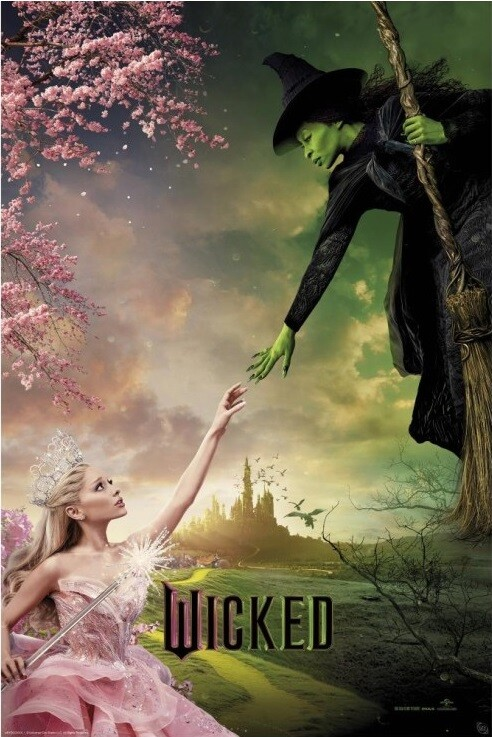
Wicked

Wicked tells the story of Oz in a new light, as we meet Elphaba and Glinda in their early years of sorcery, who eventually become the Wicked Witch and the Good Witch, respectively.

Few stage-to-musical adaptations in recent memory capture the excitement of being there with the actors on a production filled with song and dance like this one. Despite its title, Wicked is one big burst of joy, led by the spectacular Cynthia Erivo, who makes the material, and the mere art of musical theater itself, feel like they were made for her. Erivo’s enchanting voice is moving and never quite lets go of the audience, rather you’ll be begging for more of her songs. Ariana Grande plays into type well as Galdina, who starts of as quite the narcissist, but the characterizations of both her and Elphaba soon become more complicated in a way that feels genuine and touching. Michelle Yeoh is also wonderful, and Jonathan Bailey and Jeff Goldblum are delightful. But it’s not one element that makes the movie works: it’s the beautiful costumes and sets, put together with the music and story, brought to life by these talents. The songs might have not worked without the incredible musical numbers and dance sequences, but Jon M. Chu steps up to the responsibility of bringing out the best of this bombastic fantasy tale. It also deeply humanizes an infamous movie villain in a way that feels natural and oddly grounded, with themes that may connect with audiences.

As this is only the first part of the two-film adaptation of the musical, the pace dives deep into unexpected subplots, and though this approach threatens to deem the split unnecessary, it ends up fleshing out its world in a rewarding way, making the runtime worth it, and leaving audiences with much anticipation for the next film. Wicked is a cinematic experience with exciting musical numbers, an incredible leading performance from Erivo, and mesmerizing execution that’s a must for both fans and non-fans. It’s hard to believe there’s so much more to come, though where you’re left here in Elphaba and Glinda’s journey is still an astounding and gratifying moment.