Some remakes get a chance to breathe new life into their stories and worlds, while others, like Disney’s new Snow White, feel like a film from 90 years ago was frozen in carbonate for decades and then unnecessarily turned into a different medium. In this case, Snow White feels like 30% that, while the other 70% feels like sprinkles of modern flare that feels out of place. Oscar winners Benj Pasek and Justin Paul add songs that feel to derivative and cliche, hitting all the same “Welcome to our lovely kingdom”, “I want a better life”, “Look how evil I am”, and “Maybe we’re attracted to each other” beats that are in nearly every other musical. In some instances, the songs even sound too much like the duo’s Dear Evan Hansen soundtrack.
Rachel Zegler tries her best to entertain in a sweet but one-dimensional role elevated by her charisma and strong singing voice. However, all the other elements around her distract, including the unconvincing and at times hideous CGI of the animals, surroundings, and let’s not even talk about those dwarves, who seem almost nightmarish. But a painfully glaring weak link is the miscasting of Gal Gadot as the Evil Queen. Her line delivery feels unnatural, and the character just gets more irritating as the film goes along.
Most sadly, Snow White is inconsistent and deeply hollow as a film. It has almost no charm that feels organic, and can’t decide between elements that feel nostalgic or new, like the very modern-sounding soundtrack. Nothing of importance is ever quite explained or given meaning to, things just happen because the point that we’ve gotten in the story needs that thing to happen. For younger children, being unconditionally kind is an important message, but even Disney has delivered this theme in a way that’s so much more tangible and heartfelt; take even their live-action 2015 Cinderella remake for example. This remake doesn’t expand on or reinvigorate its source material, simply morphs it into weird images that look colorful but never have any real sense of life.
Rafiki tells Simba and Nala’s daughter Kiara the story of her grandfather Mufasa, the once king of Pride Rock, and his upbringing with his brother Scar.
Mufasa boasts a beautiful cinematic experience that’s best experienced in 3D. The visuals are transporting with their photorealism and colorful sceneries of the wild world, and get to develop new settings without behind held back by recreating scenes from another movie the way 2019’s The Lion King was. That alone warrants the theatrical experience here, and not much else. Though Mufasa isn’t remaking another beloved movie anymore, it’s still restrained by the same lack of characterization that made the photorealistic animals feel emotionally distant in its predecessor. The animals can’t quite emote like they can in other animated films, and this creates a tonal dissonance between what the original 1994 film set for the franchise and the photoreal road the filmmakers are going down now. Aaron Pierre’s gravitas gives Mufasa just the right profundity, but Kelvin Harrison Jr., who’s a wonderful actor, feels rather miscast as Scar, a character who feels inconsistent both performance and character-wise. The problem with the rest of the characters is that save for Mads Mikkelsen’s villain, who’s basically Scar from the original minus the intrigue, everyone is a younger version of a Lion King character, and are stuck doing impersonations of the actors that came before them. There feels like there is nothing to discover emotionally, and the backstory behind the characters doesn’t really enrich what came before rather than just filling in some logistical gaps, all of which form a very cliche story. Not to mention, Billy Eichner and Seth Rogen as Timon and Pumbaa’s gags have been done to death and annoy more than they charm.
Though this one isn’t following the same story of another film beat for beat the way The Lion King was, that movie at least had the advantage of inheriting phenomenal songs from the original film. Lin-Manuel Miranda’s music here is incredibly lacking, with every song feeling derivative of a song from its predecessor, or even more recent Disney films. The worst part is, despite some of the action being visually stunning, the musical sequences are weakened because of a lack of connection to the animal characters who are less animated when they’re made to look real. If this made the 2019 film feel cold to you, this one won’t feel any more energetic. The film opens with a powerful tribute to James Earl Jones, the original voice of Mufasa — the fact that that’s the most (and maybe only) emotionally touching part of the film is very telling. Despite stunning visuals, including some beautiful sequences of the animals in the snow, Mufasa doesn’t offer much originality from a thematic, character, or musical point of view, and everything underneath the breathtaking aesthetic is easy to forget after watching.
Moana and her people have now rightfully reclaimed their place in history as wayfinders who sail the ocean in search of exploration. One day, Moana receives a call from her ancestors to embark with an unexpected crew across dangerous waters, and reteam with her old friend, demigod Maui, for their most challenging and important quest yet.
The first Moana remains an unforgettable and impactful film among Disney’s recent animated films. This sequel retains everything that made that first film look so gorgeous, and builds on the dynamic colors of the ocean and its mystical findings. The transformative magic of watching the first film, though, is missing in this sequel that can’t quite justify its existence. Moana doesn’t feel like a film that has sequel potential built into it, as opposed to even other Disney sequels like Frozen II and Inside Out 2. Watching the sequel unfortunately didn’t convince me otherwise. Though its still charming and has some fun to be experienced, it’s basically retreading the same beats from the first film.
Auli’i Cravalho proves again why she’s earned the spotlight in her wonderful voice performance as the titular character, but Moana lacks any actual internal conflict this time around — there’s even an opening song all about how she’s finally become who she’s supposed to me, and the movie never ends up convincing us that she does need to change and grow, just to remember who she’s already become. Speaking of the songs, there are only two that manage to stand out at all, “Beyond” and “Can I Get a Chee Hoo?”, but even those are stuck in the shadow of the overly similar — and far more original — “How Far I’ll Go” and “You’re Welcome” from the first film. There are a few laughs and solid new characters, including Moana’s trio of new voyagers and companions, and an unexpected antagonist. However, the key piece that’s missing from Moana 2 is any sort of feeling that something is at stake here — what happens to Moana’s people, the ocean, or even her own internal journey if they fail this mission? What does Moana have to learn here, now that she’s embraced who she needs to be and discovered her destiny? The answers to these questions are unfortunately insufficient and affect the excitement levels older audiences may feel watching it.
Moana 2 is colorful and has its share of sweet moments (it certainly has way more soul than Strange World and Wish), but most of what works about it is drawn from the first film, including its beautiful depiction of the ocean, tributes to Polynesian culture, and lovely characters. Rehashing the incredible themes, numbers, and world-building doesn’t work, though, without the same spark of originality and wonder that made us never forget Moana. Whether you’re going in expecting a serviceable adventure aimed towards younger audiences or just unsure why this movie needed a sequel, Moana 2 is unlikely to change your mind.
Riley has just turned 13 and has finished middle school, and Joy, Sadness, Fear, Anger, and Disgust are continuing to guide her through the ups and downs of growing up — if only things didn’t get so complicated when Anxiety arrives with a new wave of emotions to take over.
Inside Out 2 certainly doesn’t reinvent what it inherited from its predecessor, but it certainly expands on it — and when your predecessor is one of the most brilliant animated movies in Pixar’s history, who are we to complain? The beautiful animation builds the corners of the world (or should I say, Riley’s brain) with an endless captivation. The visual look and feel of the first film was a huge part of what made it so magical and immediately timeless, and this movie captures that with a new breath of life. The world-building is also filled with clever puns and fun corners that we may often relate to. Amy Poehler again commands the ship as captain of this film’s cast of emotions, and newcomer Maya Hawke is terrific as Anxiety, who shakes things up for Riley and the emotions in a frustratingly messy way. Who would’ve thought? Ayo Edebiri also shines as Envy, as does Adèle Exarchopoulos as Boredom.
Seeing the emotions come into conflict and/or work together to act and react in the best ways for Riley is entertaining, but the film never loses the first movie’s relentless humor as well. There’s a clear agelessness that comes with the story and themes of the film. In the nine years since Inside Out was released, I feel no less that Inside Out 2 is aimed for me than when I watched the first one on the big screen. The universality of anxiety and unconditional self-love can be deeply felt by any audience member of any demographic, and start meaningful conversations between anyone. With that, we’re reminded of the purpose of some of Pixar’s greatest hits. Though watching Inside Out in 2015 was a magical experience that maybe no film will ever replicate, this sequel hits all the right notes in the best way we could wish for. It’s a funny, cheeky, gorgeous, and profound emotional release and Pixar’s best film since Soul.
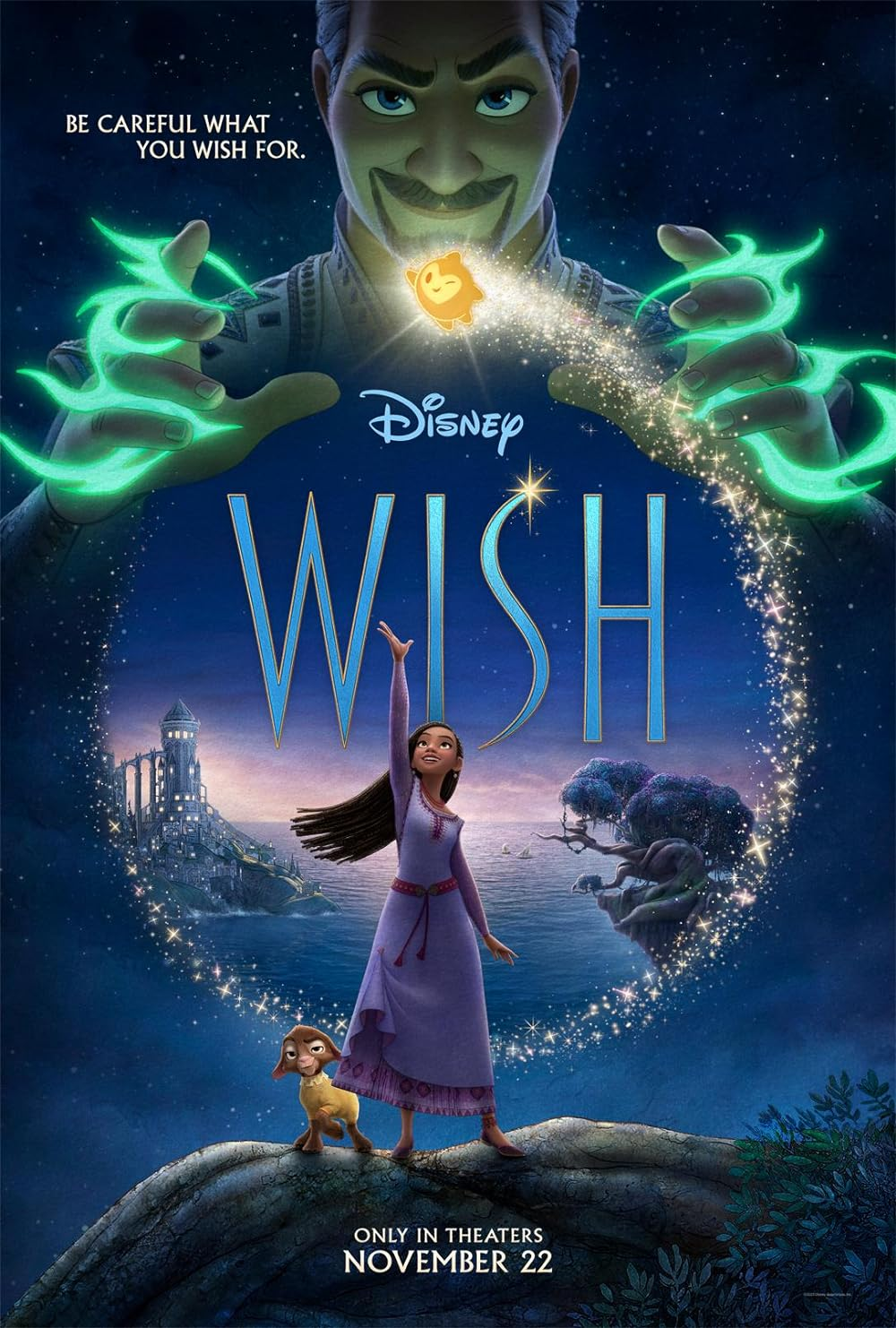
In the Kingdom of Rosas, King Magnifico safeguards the people’s wishes with the promise to grant them one day. But when young Asha wishes upon a star for her community to have better, what she didn’t expect was for the star to answer back.
Disney experiments with the 2D coloring of 3D characters that films like the Spider-Verse have popularized, which can’t seem to make up for the film’s derivative story. Though the animation is vivid in colorful in the scenes that are night-set or creatively lit, most of the scenes set during the day feel like they lack lighting or any sort of flare besides the gimmick. Ariana DeBose’s performance is full of joy and her singing is spectacular, though that shouldn’t come as a surprise. The character of Asha has nothing to really distinguish herself from other Disney heroines like Rapunzel and Mirabel, and the concept of her wishes and motives feel rather underdeveloped. Chris Pine does great as well, but his villain’s descent from charismatic leader to power-hungry wizard feels unearned. None of the supporting characters are quite memorable, and a few of the songs do stand out, including “This Wish”, “At All Costs”, and “This is the Thanks I Get”. But both the middle and end portions, particularly the talking animals and forgettable action, greatly suffer from this lack of an interesting ensemble and heart that made the characters in Frozen, Moana or Encanto resonate. It’s certainly enough to keep the children entertained and singing along, but is also too generic to earn a place among the ranks of other films from the studio that have solidified themselves in Disney’s legacy.
Set more than a decade after the events of the first film, learn the story of the Sully family (Jake, Neytiri, and their kids), the trouble that follows them, the lengths they go to keep each other safe, the battles they fight to stay alive, and the tragedies they endure.
James Cameron created a monumental landmark in visual entertainment and epic storytelling with Avatar. A sequel so many years later with so much promise to top the first would send too impossible to be real, but The Way of Water manages to deliver that same ambition felt in every shot of the first film and then some. Years were spent to create new technology to film motion-capture scenes underwater, and I’m glad Cameron spent all the time he needed to get it right because the term “out of this world” has never fit more for anything else. The plot beats in the first hour are familiar, but everything from there onwards is breathtaking, grand, and mesmerizing to the eye. The underwater scenes are some of the most visceral visual cinema I’ve ever seen, with the detail and realism allows you to completely suspend disbelief as you feel you’re actually on Pandora. Sam Worthington and Zoe Saldana are great in their roles again, and the script this time beautifully captures the depth of a parent’s love for their child. Sigourney Weaver returns not as the same character but in a different and inventive way. Jake and Neytiri’s children are as complex and poetic characters as their parents who carry across the story’s themes such as empathy, uniqueness, and selflessness.
Cameron manages to somehow expand on the scale of Pandora and this fictional universe that millions of audiences were already in love with, while finding the intimate moments beneath all the colorful CGI that often stick out and resonate. The cast ensemble may not be Lord of the Rings-level of memorable yet, but the world-building and storytelling certainly is. Not to mention, the love Cameron creates between the audience and the oceans of Pandora may hopefully bring attention to the way corporations and human actions deplete our oceans here at home, and the way of water the title refers to is the beauty of nature that our ancestors knew so purely that can give life and consume those who don’t respect it. The overall narrative has familiar beats but the emotion is heartfelt and thrilling, and the atmosphere and aesthetics are a once-in-a-lifetime experience that has to be seen on the biggest screen you can seek out and in 3D — I’d recommend IMAX 3D, which is how I saw it. Avatar: The Way of Water may have the lesser story of the two Avatar films, but it has a sensational awe and grandeur to its fusion of images, score, and weight that invites you to not only enjoy, but experience, behold, and never want to leave the forests and oceans of Pandora.
The legendary Clades are a family of explorers whose differences threaten to topple their latest and most crucial mission.
Strange World is incredibly visually vibrant, which is never an aspect Disney misses in, not to mention director Don Hall’s outstanding track record at Disney in the past with Big Hero 6 and Raya and the Last Dragon. The imaginative color palette in the titular world the Clade family journeys through is engaging and surprising, even when the story material feels a little hollow. Jake Gyllenhaal is perfect as the lead role Searcher Clade, and it feels long overdue for him to join the Disney animation family. His voice has an incredible likability and he delivers the balance between “frustrating (but devoted) dad”, “frustrated/traumatized son” and “reluctant adventurer” really well. Dennis Quaid, Jakoubie Young-White, and Gabrielle Union are all having plenty of fun in the recording booths as well as a dysfunctional family that all want to just get along and enjoy each other’s company, though the grandpa and legendary explorer Jaegar Clade (voiced by Quaid) has other priorities and is overly consumed with his duties to his pride and explorations. Though the style is always visually inviting, the substance behind the conflict doesn’t always click until the end, and the characters’ relationships are way more interesting than the action itself. The style believes it’s being very nostalgic, presenting itself as a tribute to pulp magazines, but it actually looks and feels very modern. Though the film is quite heartfelt due to the characters it develops, the actual themes of familial expectations have been done plenty in recent animated films, most notably in Encanto and Turning Red that are still fresh in all our memories. There are instances where it tries to even become self-aware of the cliches its indulging in, which simply makes it even more awkward. On the positive side, the movie has Disney’s most prominent representation of an LGBTQ main character in one of their animated films, which is a celebratory step forward for family films on the big screen. Gyllenhaal’s voice performance is outstanding, backed by heartfelt supporting characters, and the animation gives the film lots of energy, but not enough to rank it among other adventures from the modern era of the studio like Zootopia or Wreck-It Ralph, though it’s still sweet and a decent one-time watch for families.
The final chapter of the legendary story that’s spanned generations, The Rise of Skywalker follows the Resistance taking a final stand against the First Order, as Rey, the last of the lightsaber-wielding Jedi, prepares to face off against the Supreme Leader Kylo Ren.
Star Wars: The Rise of Skywalker takes the challenge of concluding a culturally treasured story that’s spanned four decades head-on, yet sacrifices something important in the process. Part of Star Wars is taking you away from reality and over to a galaxy far, far away, and this film succeeds at making the eye-popping visuals stand out in every shot, especially if you watch it in 3D, as you should for every Star Wars movie considering the grand scale they have to offer. John Williams, one of the real MVPs of the franchise, has composed every film in this saga and once again stuns with his beautiful musical scores. The cast still has plenty of energy and heart, especially the trio of protagonists — Daisy Ridley’s Rey shows plenty of emotion and energy and it’s hard not to love her character as she embarks on the final chapter of her adventure, and John Boyega’s Finn, as well as Oscar Isaac’s Poe, are very lovable as the daring fighters who are eager to lead and defeat the First Order for the greater good of the galaxy. It’s difficult not to enjoy whenever the lovable Chewbacca, C3P0, or BB-8 are on-screen either. The late Carrie Fisher also appears as General Leia, and although her appearance is very small, it’s a welcome and bittersweet one. Also returning from the original trilogy are Mark Hamill and Billy Dee Williams as galactic legends Luke and Lando — if only they had a bit more to do on screen, though. Unfortunately, nobody really gets a meaningful arc this time except Rey, but even her arc gets muddled and confusing by a decision that harms the emotional weight of the previous two installments. Not even Adam Driver, who plays the main antagonist in Episodes VII and VIII, gets much to do. In the last film, Kylo Ren became the Supreme Leader of the First Order, but instead of utilizing that brilliant and original idea of having a young, conflicted boy become the head of the evil, tyrannical organization, he ends up answering to Palpatine for most of the film, and I’m not sure if Palpatine’s role in the film was even warranted. Finn’s a deserter of the First Order who’s become a sign of heroism and bravery for the Resistance, but that isn’t explored as an important character trait anymore — hell, he’s no longer a multi-dimensional character anymore, barely anyone is in this movie. Naomi Ackie is introduced as a new character named Jannah. Her character seems fantastic, yet they do absolutely nothing with her character other than make her stand next to Finn for the film’s entire second half, so unfortunately we’ll never know anything about her or if she was really as great of a character as she could’ve been.
The runtime is stuffed with so many ideas that either don’t make sense or are rushed past in the blink of an eye; it felt so rushed that it was almost like Disney mandated them to not make it a minute longer. The editing in The Force Awakens was so excellent it even received an Oscar nomination, but here the cuts are so fast and occasionally feel unnatural. In the other films, the action scenes feel nuanced but the ones here are so quick that it’s going to be hard to look at them as “scenes” for their filmmaking and purpose. In a movie with so much fighting, I ironically can’t remember a specific moment where the action is notably impressive, although it’s thankfully loud and colorful enough to be engaging, yet not resonant. In the predecessor The Last Jedi, I was shaking in suspense for a lot of the film, but unfortunately in The Rise of Skywalker, there isn’t really a moment where I had that same feeling. Maybe it’s because although there’s so much plot, the script never gives us a moment to breathe or just develop the characters emotionally. Without any emotional arcs being set up, we can’t be concerned about what’ll happen to them later in the film. There’s also a few iffy lines of dialogue that either felt like placeholders or sub-par ways to convey ideas that could’ve come off as stronger. The movie also has plenty of moments that allude to the previous films, such as A New Hope and The Empire Strikes Back, and these moments will work well because how much of an impact this saga has had throughout the audience’s lifetimes. Some moments will make you applaud and smile, and my theater experience with this film only reminds me how beautiful these Star Wars films bring people together, even after 42 years. However, by the end The Rise of Skywalker doesn’t feel like the natural continuation of the trilogy’s story, but rather like it’s trying to be the antithesis of The Last Jedi. Many of the powerful decisions Rian Johnson made in VIII feel undermined by what J.J. Abrams chooses to do in some scenes, and instead of going with the flow of the story, it feels like he disregarded the tone and value of the previous film, and even his own film The Force Awakens (I’m not even sure what the tone of this movie is, if I’m being honest). Abrams is a filmmaker I regard with lots of talent towards bringing a sense of wonder and imagination towards the screen, and it’s unfortunate because there so many moments of greatness throughout that are harmed by the light-speed runtime (which although, at 142 minutes, is longer than most other SW films, still feels incredibly rushed and overcrowded), and the director’s working against the story that he and Johnson established so well before. Although the actual ending of the film and the Skywalker Saga is nicely done, the final chapter of the journey there should’ve hit home as well. Regrettably though, it’s the least risky and exhilarating film of the bunch (although it’s arguably better than the prequels, which to me don’t capture the true meaning of Star Wars that well).
Star Wars: The Rise of Skywalker is the conclusion to one of the most beloved stories in the history of not only film, but also the art of fiction itself. Unfortunately, as an enormous fan myself, I found myself disappointed. the overabundance of ideas Abrams tries to fit into a crammed runtime (if you ask me, they should’ve taken a page out of Marvel’s book and made the movie 3 hours in order to give this saga the fitting send-off it deserved), and the choice to emphasize too much fan service over a sufficient amount of character/emotional payoff end up harming the story that was so beautifully constructed in the past outings of this trilogy. This feels like a great film that was cut in half and then made some frustrating last-minute decisions that don’t even impact the later events of the film, and the main characters’ arcs would’ve been much stronger without these decisions. While there were definitely some plot points I enjoyed and the vibrant visuals and world-building, as well as the film’s role in concluding the franchise, will excite most audiences and incite instances of applause, the lack of boldness and spirit makes this the least gripping and rewarding film in the sequel trilogy, despite the satisfying nostalgia that makes for an awesome theater experience when you’re watching it with other Star Wars-loving audience members.
Disney has been dominating the decade with Marvel, Star Wars, animation (both Pixar and their titular studio), but their series that has divided people the most is their live-action remakes of animated classics. So people were most excited but also nervous when it came to the photoreal-but-actually-still-animated remake of their defining animated feature from the 20th century, The Lion King. First off, on a visual standpoint, this movie is an achievement. It follows the same reign of The Jungle Book in recreating iconic characters and setting to look as real as possible, and it really delivers. All the animals and sets look like an actual picture, even though not a single frame was actually there. It’s amazing to see how far visuals have gone these days, and Disney has been headliner these last few years in consistently breaking the boundaries of what can be done with a computer, whether it’s the amazing action in Avengers and Star Wars films or breathtaking animation in films like Toy Story and Incredibles — but the feats of the CGI completely pay off here in making the illusion unnoticable and making it feel like a more immersive journey. The film is perfectly casted with Donald Glover shining and making something of his own out of Simba’s role here, and it helps that he’s experienced in both acting and singing. Also huge standouts are Timon and Pumbaa, who are scene-stealing and Seth Rogen’s voice espeically fit for Pumbaa. Also worth pointing out is John Oliver who is hysterical as Zazu. However, for some characters, like Scar for example, it’s sometimes hard not to make comparisons to superior versions, like Jeremy Irons who was perfect in the 1994 version. Perhaps neither he nor James Earl Jones needed recasting (the latter of which was thankfully able to return as Mufasa). Speaking of roles from the original, Rafiki’s role was unfortuantely reduced this time around so he feels like less of a mentor to Simba and barely even has dialogue.
The musical numbers are still very fun, espeically the classic “Hakuna Matata”, and the “Lion Sleeps Tonight” gag is extended and made even funnier. The shame is that they shortened the Scar’s menacing anthem “Be Prepared” to be much slower but as a result feels more like a whispered spoken word poem than a song. The Lion King is stuck in a loophole in terms of delivering for fans because people want a remake to somehow reinvent the story but at the same time poeple get angry as soon as something major is changed. Unfortuantely, some of the changes made in this remake are for the worse, and other than that, a lot of sequences in the film or a shot-for-shot copy-paste of what we’ve already seen. A lot of the dialogue is the same as well, and I just wish they had added some more story to what we already know because the fact that we recognize every scene and line so well will eventually make things boring. On the bright side, it manages to retain some of the soul that reminds us why we love the original so much (themes like confronting your past or lines from Mufasa about the truth of being a wise king). The problem is that once these characters are animated to look photorealistic, they can no longer exaggerate emotions like the original iterations do — Scar is no longer a charismatic Shakespearean character, and every character just looks like an animal talking. This movie has incredible visual technology that deserves plenty of praise for Jon Favreau, maybe next time he could have used it to make original content rather than remaking known stories, or just added a little more that we haven’t seen before to do something new with the story.
The Lion King is a visual marvel and filled with nostaliga, but it’s greatest strength and weakness is that it’s almost exactly the same as the original. If the original Lion King was so perfect, why change anything? But why do we want to see the same movie over again? That’s the problem that this new remake finds itself in which is why despite being nice to look at, the script is beat for beat the same, which is why the only way this movie can really be appreciated is in 3D and on the biggest movie screen you can find. Does it offer much new? Not really, or even at all to be honest. But in terms of recommendation for the theaters I have to say go for the visuals and for the story which still stays strong, but the emotional expressions that came through the original versions of the characters (which didn’t need to feel photoreal and therefore could be exaggerated for animals) is exactly what will make the original Lion King forever superior.
Meg Murry is a young girl whose astrophysicist father disappeared four years ago. One day she learns from three magical travelers that she can find her father if she embarks on a journey of self-discovery across the universe, accompanied by her brother and her classmate.
A Wrinkle in Time had some big names in its cast, a popular source material, and lots of ambition which was evident from the intriguing trailers — so why did Disney go ahead and make a safe children’s movie with the same plot they always use instead of something that families can love too? Ava Duvernay is not a bad filmmaker, she did a fantastic job directing Selma so I had faith that I could really enjoy this film. However, the overuse of visuals, waste of great cast members, and 100% familiarity and predictability of the plot offer nothing new that will resonate. Storm Reid is great as the young Meg who is curious, rebellious, and learns to embrace who she is. However, the rest of the actors, while great, aren’t used to the movie’s advantage. With names like Oprah Winfrey, Reese Witherspoon, and Mindy Kaling, we’d surely get some great leading faces, but not only are they not present for a good amount of the film, but the actors are just being the typical persona of how they usually portray their characters. Oprah is of course just there to inspire people, Witherspoon is funny but really just there to charm, and Kaling is extremely annoying as a character whose only dialogue is famous quotes from historical figures or celebrities. The cast’s (and the film’s) greatest strengths are Chris Pine and Gugu Mbatha-Raw, who have been promising in nearly everything they’ve done. We’ve come to know Pine as Captain Kirk and more recently, Wonder Woman’s love interest, and Mbatha-Raw is a rising talent most notably in her role in Black Mirror. Here they play the most remarkable parts of the film; an ambitious scientist who loves nothing more than his family, and the wife and mother whose life is left with a void after her husband’s disappearance. They are both terrific to watch on-screen, yet so underused, and this part of the story could have been used more dominantly but in the middle of the film it’s ditched for the classic formula we see in nearly every film. Other familiar faces include Zach Galifiankis and Michael Pena, but they too are forgotten and we spend more time with the generic love interest played by Levi Miller and the irritating younger brother by the name of Charles Wallace.
A Wrinkle in Time had a lot going for it, and though lots of it feels like a missed opportunity, there are some things it gets right. We’re ultimately left with a theme about being your best and embracing your faults, because in the end, we can all do great things. Kids will love this message and be empowered by this theme, but to everyone who’s seen a movie before, it’s all the same. An ordinary kid who feels isolated from everyone else is pulled into a magical journey and learns to be a hero and a better version of themselves, and falls in love and the way. Sound familiar, right? It feels like this could’ve been something unique but instead used the same recycled formula for a new generation. Even Star Wars has a significantly similar plot to this one. The CGI and green-screen don’t feel real and intimate enough either, and at the end, it doesn’t seem like much of the story had a point either, just a bunch of names and concepts thrown at you that don’t have some sort of resonance and thrills to offer. Some may argue this movie celebrates female empowerment and diversity, but is that enough to make a good movie? That part should be the icing on the cake that can be added to something great.
Your kids may be enamored and entertained by the messages this film has to offer, but if you’re over 10 years old, A Wrinkle in Time will leave you thinking about nothing but the potential that was missed here. This should’ve been something families will talk to their kids about and recommend to friends, but in the end, we’re left with a familiar story accompanied with forgettable execution. Ava Duvernay and Disney should’ve learned, like their protagonist, to embrace their faults and improve upon what’s done before, and trust me, I’ve seen lots of great Disney movies, but this one just doesn’t add up to something I’d recommend to anyone going to the movies with friends or a date. On the bright side, there’s still Black Panther and Annihilation out there for whoever hasn’t seen those yet.







 filmtoppings.com